

Personal injury firms that still rely on manual contact lists and spreadsheets for medical referrals are effectively capping their own growth. It’s a common frustration in the industry. You likely spend more time chasing down missing medical records or correcting inconsistent documentation than you do on actual litigation. When your attorney physician referral system is built on outdated, manual processes, it creates a massive administrative bottleneck that slows down settlements and limits your firm’s ability to scale.
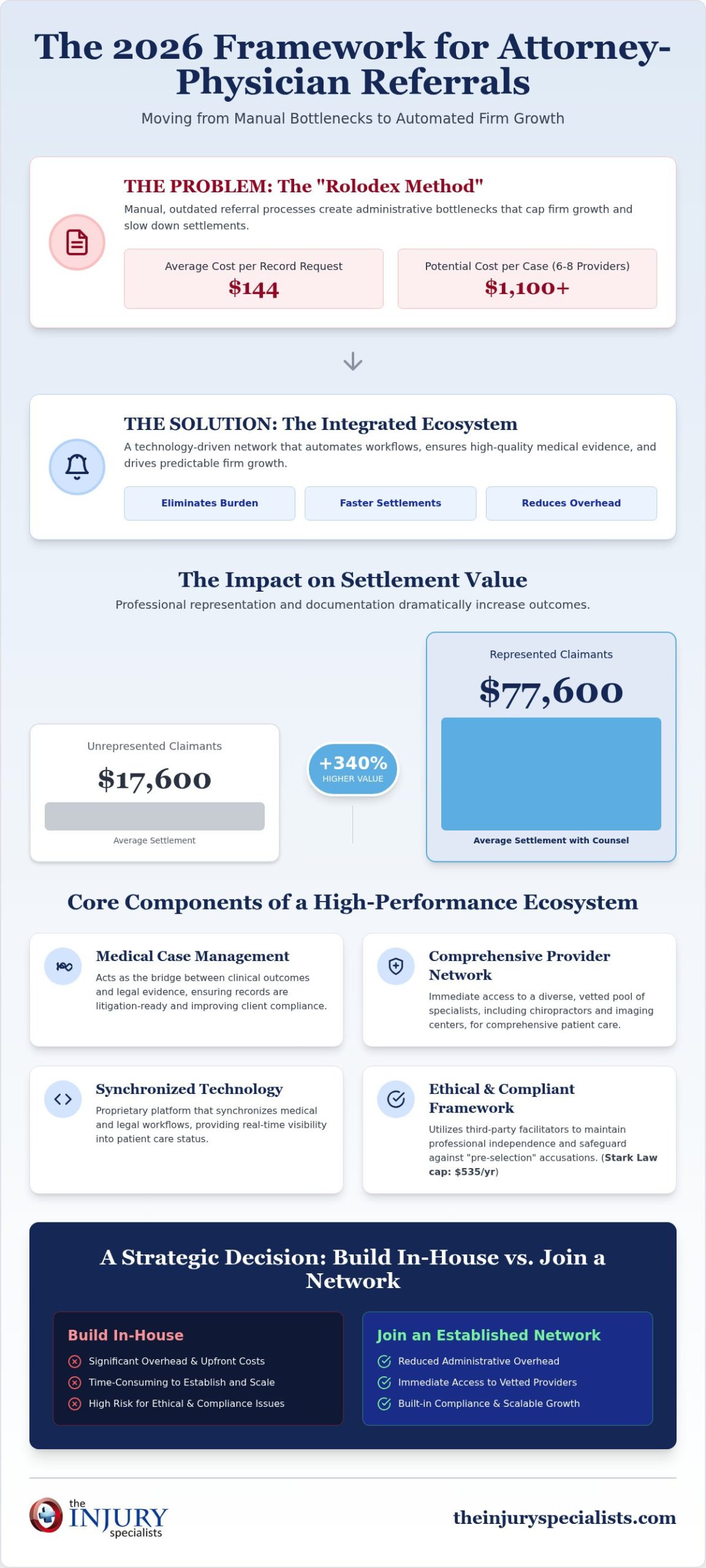
You know that represented claimants receive average settlements of $77,600, which is over 300% more than those without counsel, but this value is only realized when the medical evidence is professional and precise. You need a system that ensures compliance and high-quality care without the fear of ethical “pre-selection” accusations. This article outlines the 2026 framework for moving beyond static directories and into an integrated, technology-driven ecosystem. We’ll show you how to automate your referral workflow, reduce the heavy cost of manual record retrieval, and leverage professional partnerships to drive predictable firm growth.
Key Takeaways
- Transition from manual “Rolodex” methods to automated ecosystems to eliminate the administrative burden of tracking patient compliance and care status.
- Optimize your attorney physician referral system by integrating medical case management that provides high-quality medical evidence for faster settlements.
- Safeguard your practice against ethical “pre-selection” accusations by utilizing third-party facilitators to maintain professional independence.
- Reduce firm overhead by joining a national network that offers immediate access to a diverse range of providers, including chiropractors and imaging centers.
- Implement proprietary technology that synchronizes medical and legal workflows to ensure your firm is ready for the 2026 regulatory landscape.
The Evolution of Attorney Physician Referral Systems
The legal landscape of 2026 has rendered the casual handshake referral obsolete. Success in modern personal injury litigation requires a shift from informal networking to a high-performance attorney physician referral system. This evolution is driven by the need for absolute transparency and clinical autonomy. In the current regulatory environment, an attorney physician referral system is a structured framework for medical-legal coordination that ensures patients receive immediate care while law firms secure the documentation necessary for trial or settlement.
A professional system protects what we call the triad of care. This triad consists of the accident victim, the medical provider, and the legal representative. When these three entities operate within an integrated ecosystem, the results are predictable and scalable. Without it, firms often find themselves bogged down by administrative friction that erodes the value of even the strongest cases.
The Limitations of Traditional Referral Methods
The “Rolodex method” fails because it cannot handle the volume or the complexity of modern claims. Relying on manual tracking and phone-tag logistics leads to fragmented care where medical and legal silos do not communicate. This lack of coordination is expensive. Research shows that law firms managing medical record requests in-house spend an average of $144 per request. For a typical case involving six to eight providers, this administrative burden can cost a firm up to $1,100 in labor and fees before a single demand letter is sent.
Manual referrals also increase the risk of inconsistent documentation. If a provider’s notes don’t align with the legal theory of the case, the settlement value plummets. Professional systems eliminate this risk by establishing clear, firm-distinct processes for how data is collected and shared from day one.
The Rise of the Professional Referral Network
Modern networks prioritize objective medical case management over casual hand-offs. As of January 1, 2026, the Stark Law non-monetary compensation cap is set at $535 per year. This strict limit highlights the dangers of Physician self-referral and informal financial entanglements. Using a third-party facilitator ensures that referrals are based on medical necessity and provider expertise rather than unethical “pre-selection” arrangements.
National networks provide a level of consistency that local, manual lists cannot match. They offer standardized documentation that helps attorneys achieve higher settlement outcomes. Data indicates that represented claimants receive average settlements of $77,600, which is 340% more than those without counsel. By joining an established network, firms gain access to a vetted pool of specialists, including chiropractors and imaging centers, ensuring that every patient receives comprehensive treatment that is fully documented and ready for the demands of 2026 litigation.
Core Components of a High-Performance Referral Ecosystem
Building a robust attorney physician referral system requires more than a list of phone numbers. It demands a sophisticated architecture that synchronizes medical treatment with legal strategy. This ecosystem functions as a central hub, ensuring that every referral results in high-quality care and admissible evidence. By moving away from fragmented forms and adopting ethical medical-legal partnerships, firms can create a reliable pipeline for case growth while maintaining strict professional independence. It’s about creating a machine that works without constant manual intervention.
The Role of Medical Case Management
Case management acts as the nervous system of any successful referral network. It serves as the critical bridge between clinical outcomes and legal evidence. When you utilize professional medical case management for attorneys, you ensure that medical records are litigation-ready from day one. This process significantly improves client compliance by providing patients with a clear roadmap for their recovery. It also eliminates the administrative chaos of chasing down status updates or missing documentation. A well-managed system provides real-time visibility into the patient’s care status. This allows your staff to focus on high-level case strategy rather than clerical follow-ups.
Comprehensive Provider Specialization
A high-performance system must offer immediate access to a diverse range of specialists. This includes primary care, chiropractors, specialized imaging centers, and physical therapists. Coordinating these services through a single attorney physician referral system ensures a holistic recovery for the client. Diagnostic imaging is particularly vital. Having MRI and CT scans integrated into the referral loop provides the objective evidence needed to prove damages. When the right specialist is matched to the specific injury immediately, the trajectory of the case improves. You can explore our national network to see how integrated provider access simplifies this process.
The ecosystem should also incorporate pre-settlement funding. This component is essential for ensuring uninterrupted medical care for clients who don’t have health insurance. Standardized communication protocols between your firm and medical offices further solidify the relationship. These protocols define how data is exchanged, how appointments are tracked, and how billing is handled. By establishing these clear rules of engagement, you remove the bottlenecks that typically stall personal injury cases. This systematic approach transforms your referral process from a series of manual tasks into a scalable engine for firm expansion. Firms looking to deepen this infrastructure can benefit from understanding how a structured attorney medical provider network bridges the gap between clinical care and litigation-ready documentation.
Navigating Ethics and Compliance in Medical-Legal Referrals
Compliance is the foundation of a sustainable attorney physician referral system. In 2026, the scrutiny on medical-legal relationships has reached an all-time high. New regulations, such as California’s SB 351, have strengthened prohibitions against the corporate practice of medicine to ensure clinical autonomy remains intact. For law firms, this means every referral must be defensible under ethical standards that prioritize patient health over litigation outcomes. A professional network acts as a buffer. It provides the third-party facilitation necessary to avoid the perception of “kickbacks” or unethical fee-sharing arrangements.
Maintaining Objective Medical Opinions
A physician must always remain an independent evaluator. They are not agents of your law firm. When a medical provider’s independence is compromised, the resulting documentation loses its weight in court. Critics often argue that direct attorney-physician agreements lead to inflated bills and unnecessary procedures. A structured attorney physician referral system prevents this “Wolf in Disguise” scenario by utilizing objective, evidence-based protocols. By using a network that vets providers for clinical integrity, you ensure that the medical evidence supporting your case is beyond reproach.
Transparency is your best defense. Disclosure best practices for 2026 suggest that attorneys should be clear about their referral sources. This is particularly important when considering the Stark Law non-monetary compensation cap, which remains at $535 for the 2026 calendar year. Even accidental violations of these strict liability statutes can lead to massive penalties. Using an established network ensures all professional interactions stay well within these legal boundaries. This protects both the firm and the provider from regulatory risk.
HIPAA and Data Security Standards
Managing sensitive medical data across a distributed network requires more than just secure email. Modern referral platforms must adhere to SOC 2 or equivalent security standards to prevent data breaches. With law firms spending an average of $144 per medical record request, the sheer volume of data moving between offices is staggering. Protecting this information is a legal and ethical mandate. You must implement rigorous standards for attorney client medical care coordination to ensure privacy is never compromised. This includes mandatory disclosures if AI tools are used in patient interactions, as required by laws like California’s AB 489. Secure, integrated technology provides the audit trails and encryption necessary to maintain HIPAA compliance while scaling your firm’s operations.
Building vs. Joining a Referral Network: A Strategic Comparison
Law firms reaching a certain volume face a critical decision. You must choose whether to build an internal attorney physician referral system or join an established national network. This choice is essentially between becoming a software and logistics company or remaining a high-performance law firm. While building in-house offers total control, the diversion of resources often stalls the very growth you’re trying to achieve. It’s a strategic trade-off that requires careful analysis of long-term firm goals.
The In-House Build: Costs and Complexities
Building a proprietary tool involves significant hidden costs. Beyond the initial development phase, you face ongoing maintenance and the necessity for rigorous security updates to meet 2026 data standards. Vetting providers across multiple states or even different counties is a resource-intensive nightmare. Most firms find they need at least one full-time employee simply to manage the logistics of provider relationships, credentialing, and documentation tracking. This administrative overhead often outweighs the perceived benefits of a custom build. If your system isn’t SOC 2 compliant, you also face significant liability risks when handling sensitive medical data.
The Network Advantage: Scale and Speed
Joining a national network provides immediate scalability that an in-house build cannot match. You gain instant access to a vetted database of specialists who specifically accept personal injury liens. This eliminates the months spent recruiting and vetting individual providers. Established networks also possess the marketing power to attract high-tier medical partners that a single firm might struggle to reach. The technology is plug-and-play. It aligns with your existing workflows, allowing your staff to focus on litigation rather than technical troubleshooting or manual follow-ups.
A professional network is designed to grow personal injury law firm referrals automatically. It creates a reciprocal environment where medical providers can easily refer patients to your firm through a secure, integrated platform. This synergy drives predictable growth without the need for a massive internal tech budget. When you leverage an existing attorney physician referral system, you benefit from a platform that has already been optimized for the 2026 legal landscape. Before making this decision, reviewing the comprehensive guide to law firm medical referral programs in 2026 can help you evaluate the structural requirements and technology considerations involved. If you’re ready to stop managing spreadsheets and start scaling your practice, it’s time to join our national referral network and leverage a system built for professional synergy.
Scaling Your Firm with The Injury Specialists Integrated Network
The Injury Specialists operates as the premier attorney physician referral system for firms that prioritize efficiency and professional synergy. We provide the largest personal injury referral network in the United States, giving your firm immediate access to a vetted pool of medical professionals. This system goes beyond simple introductions. It integrates medical case management based on your firm’s distinct processes, ensuring that every patient’s journey is documented according to your specific litigation needs. This level of synchronization is essential for maximizing case value in the competitive 2026 legal market. By utilizing our managed care model, you remove the administrative friction that typically slows down the path to settlement.
Technology That Streamlines Case Workflow
Our proprietary case management technology platform is the engine that drives firm productivity. It allows for real-time tracking of patient care and documentation status, providing your staff with a clear view of every case’s medical progress. This integrated technology eliminates the “black hole” of medical referrals by ensuring that data flows seamlessly between providers and your legal team. You don’t have to worry about missing records or unconfirmed appointments. The platform handles the logistics, allowing you to focus on high-level strategy and settlement negotiations. It provides a level of transparency that manual systems simply cannot replicate, ensuring that every piece of medical evidence is litigation-ready.
Strategic Growth and Marketing Support
The network provides a significant marketing advantage by acting as a high-level facilitator between professional sectors. We help you find new referral partners and build a dominant presence in the personal injury sector through our “Power-Connector” infrastructure. This includes access to a wide array of specialists, from chiropractic offices to advanced imaging centers, all of whom are experienced in lien-based care. Our integrated pre-settlement funding options ensure that your clients can maintain their treatment schedules without financial interruption. This holistic approach builds stronger cases and more reliable professional partnerships. Our national scope allows you to scale your firm into new jurisdictions with confidence, knowing that the quality of care and documentation remains consistent across our entire attorney physician referral system.
Join the largest personal injury referral network today.
Future-Proof Your Practice with a Scalable Referral Engine
The 2026 legal landscape demands a departure from outdated, manual networking. Success now relies on a sophisticated attorney physician referral system that prioritizes data security, clinical independence, and administrative speed. You’ve seen how moving beyond the “Rolodex method” reduces overhead and ensures every medical record is litigation-ready. By integrating medical case management and diverse provider access, your firm can focus on high-value litigation while technology handles the logistical complexities of patient care tracking.
It’s time to stop managing spreadsheets and start scaling your practice. Firms that have built a structured law firm medical referral program consistently outperform those relying on informal provider lists when it comes to documentation quality and settlement outcomes. You can streamline your medical-legal referrals with The Injury Specialists to gain immediate access to the largest personal injury referral network in the United States. Our platform provides integrated medical case management and national coverage for physicians and imaging centers. Join a system designed for professional synergy and predictable growth. Your firm is ready for a more efficient future; let’s build it together.
Frequently Asked Questions
How does an attorney physician referral system improve settlement values?
An attorney physician referral system improves settlement values by ensuring all medical treatment is documented with litigation in mind. Professional systems provide the objective, high-quality medical evidence that insurance adjusters require to justify higher payouts. Data shows that represented claimants receive average settlements of $77,600, which is over 300% more than those without counsel. This value is driven by the precise coordination between clinical care and legal documentation.
Is it ethical for an attorney to refer a client to a specific doctor?
Yes, referring a client to a specific doctor is ethical as long as the attorney maintains professional independence and the referral serves the client’s best medical interests. Using a third-party attorney physician referral system adds a critical layer of transparency. This structure helps avoid the perception of unethical financial entanglements or “pre-selection” arrangements. It ensures that referrals are based on medical necessity and provider expertise rather than informal handshake deals.
What is the difference between a referral service and a medical case management network?
A referral service typically provides a static list of names or a simple directory. In contrast, a medical case management network offers a comprehensive infrastructure for tracking patient care from start to finish. These networks synchronize medical and legal workflows, ensuring that every treatment step is documented and litigation-ready. This managed care approach eliminates the administrative “black hole” often found in manual referral processes.
Can a referral system help with medical lien management?
A professional system simplifies lien management by connecting firms with providers who specifically treat on a lien or Letter of Protection (LOP) basis. This allows clients to receive necessary care with no upfront costs. The system tracks these liens throughout the case, ensuring that all medical providers are paid correctly from the final settlement. This coordination reduces the administrative burden on your firm’s accounting and paralegal staff.
Do referral systems work for imaging and chiropractic services?
Yes, integrated networks provide immediate access to specialized imaging centers and chiropractic care. These providers are essential for documenting soft tissue injuries and providing diagnostic evidence like MRIs and CT scans. Having these specialists integrated into the referral loop ensures a holistic recovery for the client. It also ensures that objective diagnostic data is collected early in the case to prove the severity of damages.
How much does it cost to implement a professional referral system?
The cost depends on whether you join an established national network or attempt to build a proprietary platform in-house. Joining a network is generally more cost-effective as it eliminates the massive development and maintenance expenses of custom software. Firms often find that the “full-time employee” requirement for manual network management is more expensive than the membership fees associated with a professional, technology-driven system.
Can a national referral network handle state-specific legal requirements?
National networks are designed to handle state-specific regulations by vetting providers and processes against local statutes. This includes staying compliant with evolving laws such as California’s SB 351 regarding the corporate practice of medicine. By using a network with national scope, your firm can scale into new jurisdictions with confidence. The system ensures that your referral practices remain defensible and compliant regardless of the specific state requirements.
What technology is required to manage attorney-physician referrals?
Effective management requires a proprietary case management technology platform that supports real-time tracking and secure data exchange. This technology must be HIPAA compliant and ideally SOC 2 certified to protect sensitive medical data. The platform should offer audit trails and automated documentation retrieval to eliminate manual follow-ups. High-performance systems use these tools to synchronize medical and legal offices, ensuring that your staff can focus on litigation strategy.
