

The strength of a personal injury case is rarely determined in the courtroom. It’s built during the first ninety days of medical treatment through meticulous oversight. Many firms treat medical tracking as a back-office administrative task, yet mastering attorney client medical care coordination is a strategic legal asset that directly dictates case value. When communication with providers is fragmented, gaps in treatment emerge that insurance adjusters use to devalue your client’s claims. Relying on manual follow-ups often leads to delayed records and incomplete evidence at the most critical moments of the litigation process.
We understand the administrative burden that in-house medical tracking places on your legal team. This article provides a strategic framework for streamlining client treatment and improving documentation through professional care coordination. You’ll learn how to implement a system for tracking recovery that reduces staff time spent on medical follow-ups while building the comprehensive evidence required for higher settlement values. We will examine how integrated technology and specialized referral networks transform medical management from a logistical hurdle into a competitive advantage.
Key Takeaways
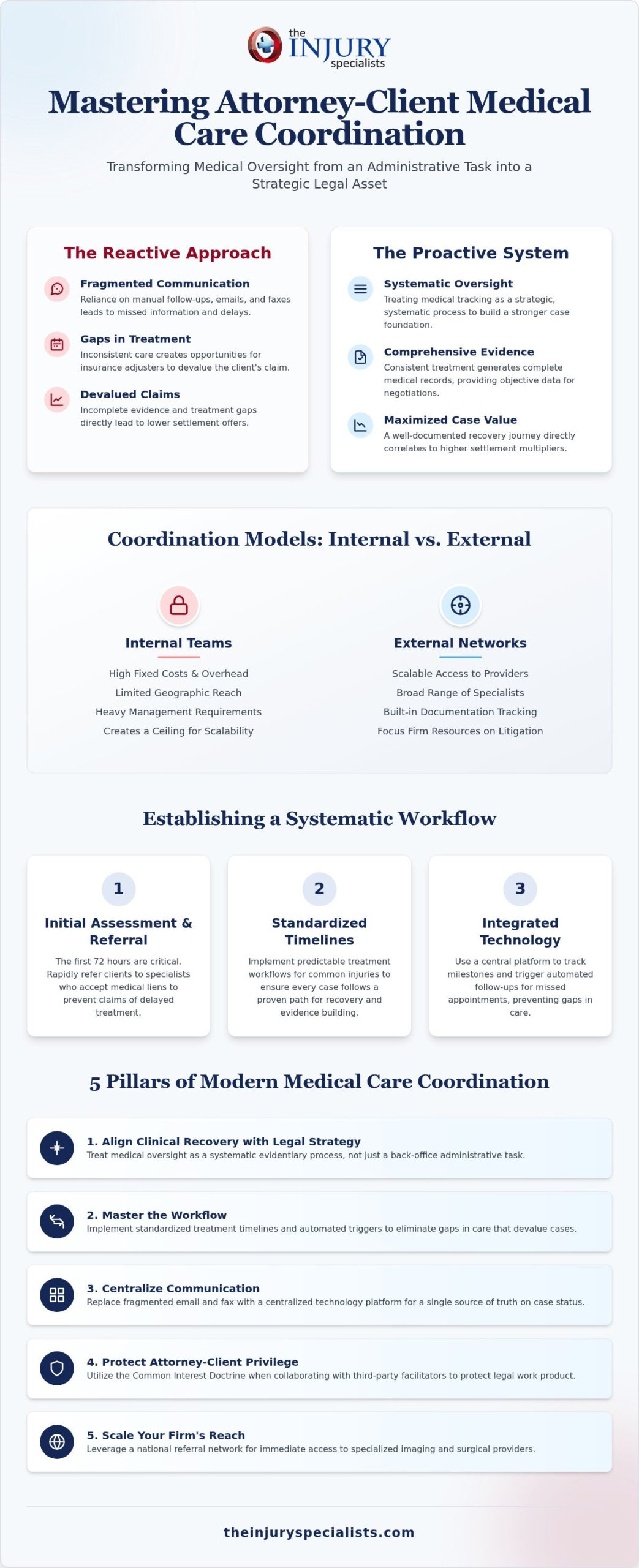
- Align clinical recovery with legal strategy by treating medical oversight as a systematic evidentiary process rather than a back-office administrative task.
- Master attorney client medical care coordination by implementing standardized treatment timelines and automated triggers to eliminate gaps in care that devalue cases.
- Replace fragmented email and fax communication with a centralized technology platform to maintain a single source of truth for real-time case status.
- Protect attorney-client privilege and legal work product by utilizing the Common Interest doctrine when collaborating with third-party facilitators.
- Scale your firm’s reach by leveraging a national referral network for immediate access to specialized imaging and surgical providers across multiple jurisdictions.
What is Attorney-Client Medical Care Coordination?
Attorney-client medical care coordination is the systematic oversight of a client’s medical journey to align clinical recovery with legal evidentiary requirements. It represents the functional intersection of healthcare delivery and personal injury litigation strategy. For high-volume firms, this process is the missing link in maximizing case value. While standard legal intake focuses on the incident, coordination focuses on the recovery. It ensures that every medical touchpoint serves as a building block for the eventual demand package.
Care coordination is distinct from medical case management in a clinical sense. It is a business-to-business logistical framework designed to eliminate administrative friction. By integrating medical tracking into the legal workflow, firms transition from being reactive observers to proactive case managers. This level of attorney client medical care coordination transforms medical data into a strategic asset, ensuring that the legal team isn’t blindsided by missing records or unexplained treatment gaps during settlement negotiations.
The Legal Impact of Proactive Care Oversight
Insurance adjusters rely on “gaps in care” to devalue claims. If a client misses three weeks of physical therapy, the defense argues the injury wasn’t severe or has already resolved. Proactive oversight identifies these lapses before they become permanent stains on the case file. Comprehensive medical records, generated through consistent treatment, provide the objective data needed for higher settlement multipliers. Proactive care coordination reduces the volume of “lost” clients by maintaining a continuous link between the law firm, the medical provider, and the patient’s recovery milestones.
Internal vs. External Coordination Models
Firms often face a choice between hiring internal staff or utilizing external networks. Hiring legal nurses or in-house coordinators carries significant administrative costs and creates a ceiling for scalability. In contrast, an external referral network with integrated technology provides immediate access to a broad range of providers without the overhead of additional payroll. This model allows firms to focus on litigation while the network handles the logistical heavy lifting.
- Internal Models: High fixed costs, limited geographic reach, and heavy management requirements.
- External Networks: Scalable access to specialized imaging, chiropractic care, and physical therapy with built-in documentation tracking.
A technology-driven platform acts as a central hub for all stakeholders. It allows firms to scale their case volume without a linear increase in staff hours. By leveraging a national network, attorneys can ensure their clients receive specialized care regardless of location, while maintaining a single point of contact for all medical-legal updates.
Establishing a Systematic Workflow for Client Treatment
Efficiency in personal injury litigation is built on predictable workflows. Effective attorney client medical care coordination requires more than just a list of doctors; it demands a structured framework that mirrors the litigation timeline. High-growth firms don’t wait for clients to report their progress. Instead, they implement standardized treatment timelines for common injuries, such as soft tissue trauma or disc herniations. This approach ensures that every case follows a proven path toward both clinical recovery and legal resolution.
Integrating these medical milestones into your firm’s case management software creates a transparent feedback loop. When a client misses an appointment, the system should trigger an immediate follow-up. This proactive stance prevents small lapses from becoming significant “gaps in care” defenses. By centralizing this data, your legal team maintains a real-time pulse on every case without the need for constant, manual status calls to provider offices.
Step 1: Initial Medical Assessment and Referral
The first 72 hours post-incident are critical. Rapid referral to specialists, including orthopedists, chiropractors, or neurologists, is necessary to prevent defense claims of delayed treatment. Using a specialized network to find doctors who accept medical liens ensures your clients receive immediate care without upfront out-of-pocket costs. Connecting with a physician referral network allows your firm to automate these initial steps while ensuring every provider understands the specific documentation requirements of a legal claim.
Step 2: Monitoring Treatment Compliance
Consistency is the foundation of case value. Automated check-ins confirm client attendance and allow your team to address barriers to care, such as transportation issues or financial instability, before they stall the case. In many instances, pre-settlement funding serves as a vital tool to ensure uninterrupted treatment. When a client can afford their daily expenses, they’re far more likely to remain compliant with their long-term rehabilitation schedule, resulting in a stronger evidentiary record.
Step 3: Real-Time Documentation Retrieval
Waiting until the end of a case to request records is a recipe for delayed demands. A superior workflow involves ongoing, real-time collection of clinical notes and diagnostic reports. This ensures that MRI or CT results are immediately matched to the corresponding clinical findings. It’s essential to verify that ICD-10 codes precisely reflect the accident’s mechanism of injury to ensure the medical records withstand defense scrutiny during the demand phase. This continuous retrieval process keeps your files “demand-ready” at all times, significantly reducing the time between the end of treatment and the settlement offer. Firms looking to deepen their understanding of how clinical documentation drives recovery outcomes should explore medical case management for attorneys and its role in maximizing PI settlement value.
Leveraging Technology to Centralize Medical-Legal Communication
Manual communication methods are a bottleneck for high-volume firms. Relying on fax and email for medical-legal updates is inefficient and prone to error. These fragmented channels prevent a clear view of the client’s recovery status and often lead to misplaced documents. A centralized technology platform solves this by creating a single source of truth. It allows every stakeholder to access real-time data, ensuring that attorney client medical care coordination remains seamless throughout the life of the case.
Transparent provider portals drastically reduce the need for administrative status calls. Instead of paralegals spending hours on the phone, they can view treatment updates and record availability instantly. This transparency builds trust between the firm and the provider while protecting sensitive Protected Health Information (PHI) through encrypted, secure channels. By moving away from legacy communication, firms can focus their energy on litigation rather than logistical follow-ups.
Features of a World-Class Case Management Platform
A sophisticated platform doesn’t just store data; it manages the workflow. It provides the infrastructure needed to align law firm processes with medical documentation requirements. Key features include:
- Automated record tracking: Receive instant status notifications when new records are uploaded or when a client misses a clinical milestone.
- Direct integration: Platforms that sync with provider scheduling and billing systems eliminate manual data entry and reduce human error.
- HIPAA-compliant storage: Centralizing documents in a secure environment ensures full regulatory compliance while allowing for immediate retrieval during the demand phase.
Marketing and Networking Through Technology
Technology acts as a bridge, allowing firms to expand their referral partner base beyond local handshake agreements. By utilizing a national network, firms can connect with specialized providers in various jurisdictions through a single interface. This connectivity is essential for firms handling cases across state lines or in multiple regions.
Data-driven insights also allow firms to track provider reliability and the speed of record delivery. This level of oversight ensures that you’re only working with partners who meet your firm’s standards for efficiency. For a deeper look at these systems, read our guide on Physician Referral Services for Personal Injury: The Professional’s Guide to Integrated Networks. Using technology to manage these relationships creates a scalable model for growth that manual processes simply cannot match.
Navigating Compliance and Protecting the Attorney-Client Privilege
Compliance is the bedrock of a successful litigation strategy. When managing attorney client medical care coordination, firms must balance the need for clinical transparency with the absolute necessity of protecting attorney-client privilege. The ‘Common Interest’ doctrine is a vital legal tool in this process. It allows legal teams and medical facilitators to share information toward the common goal of the client’s recovery and legal outcome without waiving privilege. This legal shield is only effective when communication is structured as part of the legal representation strategy.
Every third-party facilitator involved in the case must operate under strict confidentiality agreements. This ensures that the flow of information remains protected from discovery. Additionally, firms must recognize their role under HIPAA. When a law firm handles protected health information (PHI), it often acts as a business associate. Implementing secure, HIPAA-compliant document storage isn’t just a regulatory requirement; it’s a risk management necessity. Properly documenting coordination ensures that you build a strong case without creating discoverable evidence that a defense attorney could use to undermine the client’s credibility.
Safeguarding the Privilege During Medical Referrals
It’s essential to distinguish between legal advice and administrative care coordination. Administrative tasks, such as scheduling or record retrieval, shouldn’t include legal strategy in discoverable notes. Structuring communication through a formal referral network helps maintain work product protection by keeping administrative logs separate from legal analysis. Staff training is critical here. Team members should be instructed to avoid recording clinical opinions in legal case notes. They should focus on objective facts, such as attendance and appointment dates, rather than subjective assessments of the client’s physical state.
Compliance with Anti-Kickback and Stark Laws
Referral systems must be built on clinical quality and provider reliability. They should never involve financial inducements or “pay-to-play” schemes. To ensure your firm remains compliant while scaling its medical management, join our attorney referral program for integrated medical case management. Transparency in medical lien arrangements is also vital. All parties must understand the financial structure to avoid ethical conflicts during settlement. A professional network provides the necessary credentialing, ensuring that every provider in the system meets high standards of compliance and professional conduct. This level of oversight protects the firm from the legal and reputational risks associated with non-compliant referral practices.
Scaling Care Coordination via a National Referral Network
Building a personal injury practice requires a shift from local, informal relationships to a scalable, nationwide infrastructure. Relying on local “handshake” agreements with providers creates a geographic ceiling that limits your firm’s growth. A national referral network provides immediate access to specialized imaging centers, orthopedic surgeons, and chiropractic clinics across multiple jurisdictions. This connectivity ensures that your clients receive high-level care regardless of where the accident occurred, while maintaining the same rigorous standards for attorney client medical care coordination across every case file.
In complex cases such as those involving traumatic brain injury or birth injuries, these standards are even more critical to the legal outcome; read more about how The Dedric Brown Law Firm manages these high-stakes litigation challenges.
The Injury Specialists operates the largest personal injury referral network in the United States, offering a “plug-and-play” medical case management solution. Instead of hiring internal medical staff to manage these logistics, firms can integrate our proprietary technology platform directly into their existing workflows. This system aligns law firm documentation needs with medical provider outputs, ensuring that case managers handle the administrative heavy lifting so your legal team can focus on litigation and settlement strategy. Firms that want to move beyond unpredictable lead aggregators and grow personal injury law firm referrals through a systematic, technology-driven approach will find that integrating medical care coordination with a national network is the most direct path to consistent, high-value case intake.
The Efficiency of a Unified Ecosystem
Fragmented systems drain firm resources. A unified ecosystem provides a single point of contact for all physician, chiropractic, and imaging referrals. This consolidation eliminates the need for staff to manage dozens of individual provider relationships. By utilizing a single technology platform, your firm benefits from streamlined billing and lien management. This structure significantly reduces the “attorney time” spent on non-legal medical logistics, allowing your team to handle higher case volumes without increasing administrative overhead.
- Centralized Referrals: Access a full spectrum of specialists through one interface.
- Integrated Billing: Manage liens and medical costs with transparent, real-time tracking.
- Logistical Ease: Automate the follow-up process to ensure treatment compliance and record availability.
In addition to medical logistics, firms handling wrongful death litigation often require specialized support for final arrangements. SpeedLink Repatriation offers expert domestic and international transport of cremated remains, providing the same level of logistical reliability that modern firms expect for their medical care coordination.
Getting Started with Professional Coordination
Transitioning to a networked model begins with a thorough audit of your current medical tracking system. Identify the bottlenecks where staff time is being wasted, such as manual record requests or frequent status calls to provider offices. Most firms find that their current manual processes are not built for expansion. Moving to a networked referral model allows you to replace these inefficiencies with a standardized, technology-driven approach that scales naturally with your firm’s success.
Once you’ve identified these gaps, the next step is to implement a system that prioritizes clinical quality and evidentiary consistency. A professional network ensures all providers are properly credentialed and understand the nuances of personal injury documentation. Firms seeking a comprehensive strategy for turning clinical oversight into higher recoveries can benefit from reviewing the latest insights on medical case management for attorneys maximizing PI settlement value in 2026. You can scale your firm’s medical-legal operations with The Injury Specialists to gain immediate access to this national infrastructure. By outsourcing the logistical complexities of care coordination, you position your firm as a dominant, results-oriented leader in the personal injury sector.
Transition to a High-Value Medical-Legal Strategy
Mastering attorney client medical care coordination is the most direct path to reducing administrative overhead and increasing settlement multipliers. By replacing fragmented manual processes with a centralized, technology-driven ecosystem, your firm ensures that every medical touchpoint serves the litigation strategy. This proactive approach eliminates treatment gaps and secures the comprehensive documentation needed for successful demands. Integrating these workflows allows your legal team to focus on high-level advocacy while maintaining a real-time pulse on client recovery through a single source of truth.
The Injury Specialists provides the national infrastructure required to scale your operations effectively. We offer a proprietary technology platform and a vast network of specialized medical providers to ensure your clients receive care that aligns with your specific evidentiary needs. Our customized coordination is designed to mirror your firm’s distinct process, turning logistical hurdles into a repeatable system for success. Streamline your medical-legal workflow with the largest referral network in the US. Position your firm for sustainable growth by transforming care management into a competitive legal advantage.
Frequently Asked Questions
How does medical care coordination improve personal injury settlement values?
Medical care coordination ensures that every clinical milestone is documented with legal precision. By maintaining a consistent treatment record, firms prevent insurance adjusters from using “gaps in care” as a defense to devalue the claim. Comprehensive, real-time evidence allows attorneys to present a higher settlement demand based on objective clinical data rather than fragmented medical notes.
Can a law firm be held liable for a client’s medical care coordination?
Liability risks are mitigated when firms maintain a clear boundary between legal strategy and clinical decisions. Using a professional referral network creates a structured environment where third-party facilitators manage logistics while providers handle medical treatment. This separation ensures that the law firm isn’t seen as directing medical care, which protects the firm from potential malpractice claims or ethical violations.
What is the difference between a medical care coordinator and a case manager?
A medical care coordinator focuses on the logistical alignment between the law firm and healthcare providers. Their primary goal in attorney client medical care coordination is to ensure the medical journey generates the necessary evidentiary support. Clinical case managers usually focus on patient outcomes and treatment plans, whereas a coordinator bridges the gap between those clinical results and the legal requirements of the case.
Do I need to hire a nurse to manage my firm’s medical referrals?
Firms don’t need to hire in-house medical staff to manage their referrals effectively. Technology-driven networks provide the necessary oversight and documentation tracking without the high fixed costs of a legal nurse consultant. These platforms automate the follow-up process and record retrieval, allowing your existing legal team to manage high case volumes with professional-grade precision.
How does HIPAA apply to personal injury attorneys coordinating care?
Attorneys are required to protect sensitive health data under HIPAA regulations when they act as business associates of medical providers. Compliance involves using encrypted, secure channels for sharing Protected Health Information (PHI) and maintaining HIPAA-compliant document storage. Utilizing a centralized platform ensures that all stakeholder communication meets these high security standards while protecting the client’s privacy throughout the litigation process.
Can care coordination help with clients who are non-compliant with treatment?
Coordination systems identify missed appointments in real time, allowing firms to address non-compliance before it damages the case value. If a client faces barriers like transportation or financial instability, the coordination team can flag these issues immediately. This proactive intervention ensures the client remains on their treatment path, preserving both their physical recovery and the integrity of the legal evidence.
How do referral networks handle medical liens and billing?
Professional referral networks centralize the lien process through a single technology interface. This creates a transparent billing environment where all medical costs and lien statuses are tracked automatically. It eliminates the administrative burden of manual follow-ups with multiple clinics and ensures that your firm has accurate, up-to-date billing information ready for the demand package as soon as treatment concludes.
What software is best for attorney-client medical care coordination?
The most effective software is a proprietary platform that integrates directly with a specialized provider network. This creates a “single source of truth” for all medical-legal data, moving beyond the limitations of generic case management tools. Systems that offer automated status notifications, secure document portals, and real-time record tracking provide the highest level of efficiency for modern personal injury firms.
