

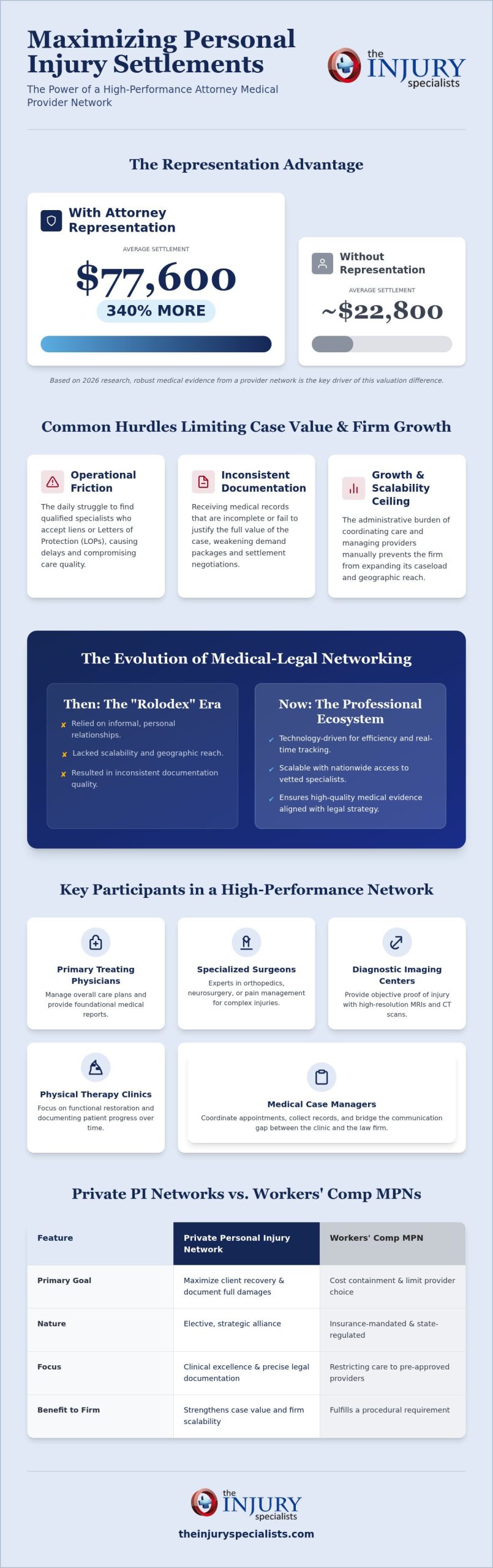
Research from 2026 reveals that claimants with attorney representation receive average settlements of $77,600, which is 340% more than those without legal counsel. This valuation isn’t accidental; it’s the direct result of robust medical evidence. For many firms, managing an attorney medical provider network remains the most significant hurdle to achieving these results. Firms frequently encounter the daily friction of finding specialists who accept liens or LOPs, only to receive inconsistent documentation that fails to justify the full value of the case.
The administrative burden of coordinating care across multiple providers often creates a ceiling on a firm’s growth and scalability. This guide provides the blueprint for a high-performance network that streamlines case management and maximizes settlement value for personal injury law firms. You’ll discover how to replace fragmented manual workflows with a strategic, technology-driven ecosystem that bridges the gap between clinical care and legal documentation. We will analyze the latest benchmarks for medical-legal synergy, including why in-network injured workers now access specialists nearly three days sooner than those outside these systems. This shift ensures higher quality documentation and improved client recovery.
Key Takeaways
- Understand the evolution of the attorney medical provider network into a technology-driven ecosystem that prioritizes high-quality medical documentation and streamlined care coordination.
- Learn how to integrate medical expertise into your legal strategy from day one to accurately identify long-term care needs and projected medical costs.
- Distinguish between the regulatory restrictions of state-mandated workers’ comp networks and the strategic flexibility offered by private personal injury ecosystems.
- Identify critical criteria for vetting healthcare providers, focusing on board certification, geographic accessibility, and experience with medical-legal testimony.
- Discover how to scale your firm’s operations by accessing a national referral network that utilizes integrated case management technology for maximum efficiency.
Defining the Attorney Medical Provider Network in 2026
An attorney medical provider network is a curated ecosystem of healthcare professionals who specialize in treating personal injury victims while maintaining high standards for legal documentation. Unlike insurance-mandated Medical Provider Networks (MPNs) found in many state-specific workers’ compensation systems, these elective partnerships are strategic alliances. They prioritize clinical excellence and administrative precision to ensure that medical evidence aligns with legal requirements. While insurance-run networks often focus on cost containment and limiting provider choice, an elective network focuses on maximizing patient recovery and documenting the full extent of damages.
Modern networks have evolved beyond simple lists of doctors. They now function as sophisticated professional services networks that integrate clinical care with legal strategy. This shift is driven by the need for real-time case tracking and seamless communication. A high-performance network provides law firms with immediate access to a broad range of specialists, including orthopedic surgeons, neurologists, and diagnostic imaging centers. These providers understand the nuances of working on a lien or Letter of Protection (LOP) basis, which is critical for maintaining cash flow and case momentum in 2026.
The Evolution of Medical-Legal Networking
The transition from informal “rolodex” referrals to professionalized networks marks a significant shift in the personal injury sector. In the past, attorneys relied on personal relationships with a handful of local doctors. This approach lacked scalability and often resulted in inconsistent documentation. Today, successful firms utilize a structured law firm medical referral program to manage their provider relationships. This professionalized model allows firms to scale their operations across multiple jurisdictions without sacrificing the quality of medical evidence. Nationwide access ensures that even multi-jurisdictional firms can find vetted specialists who are familiar with local court requirements and billing standards.
Key Participants in a Professional Network
A comprehensive attorney medical provider network involves multiple stakeholders who work in tandem to support the client’s recovery and the firm’s case value. These participants include:
- Primary Treating Physicians: Doctors who manage the overall care plan and provide the foundational medical reports.
- Specialized Surgeons: Experts in orthopedics, neurosurgery, or pain management who address complex injuries.
- Diagnostic Imaging Centers: Facilities providing high-resolution MRIs and CT scans that offer objective proof of injury.
- Physical Therapy Clinics: Providers focused on functional restoration and documenting the patient’s progress over time.
- Medical Case Managers: Facilitators who coordinate appointments, collect records, and bridge the communication gap between the clinic and the law firm.
This collaborative structure ensures that every aspect of the client’s medical journey is documented accurately. By leveraging these specialized participants, law firms can focus on litigation while the network handles the logistical complexities of medical care coordination.
Core Components of Medical Legal Consulting Services
Professional consulting bridges the gap between raw clinical data and actionable legal strategy. By integrating medical expertise into the case strategy from day one, firms can accurately project the trajectory of a claim. This proactive approach identifies long-term care needs and future medical costs that might otherwise be overlooked during the initial intake. A high-performance attorney medical provider network ensures that these projections are backed by specialists who understand the evidentiary requirements of personal injury litigation. This alignment reduces friction during the demand package phase and provides a clear roadmap for maximum case valuation.
Medical Case Management for Case Integrity
Effective medical case management for attorneys serves as the vital link between clinical treatment and legal evidence. It ensures that care is cohesive and that all providers are aligned with the firm’s specific workflows. By maintaining a continuous oversight model, case managers effectively eliminate treatment gaps that insurance adjusters frequently use to devalue claims. This level of coordination is essential for maintaining the integrity of the medical record throughout the litigation lifecycle. Firms that leverage professional management often see a more streamlined path to resolution because the medical narrative remains consistent and uninterrupted.
Documentation and Evidence Support
High-stakes settlements rely on standardized medical reports that meet the specific evidentiary needs of insurance adjusters. Professional consulting services ensure that every provider in the attorney medical provider network adheres to rigorous documentation standards. This includes prioritizing objective diagnostic evidence, such as high-resolution imaging and functional capacity evaluations, rather than relying solely on subjective patient reports. Medical legal consulting services validate the severity of client injuries by providing a clear, evidence-based narrative of the patient’s impairment and recovery path.
Standardizing these outputs is critical for administrative efficiency. Research indicates that law firms managing medical record requests in-house spend an average of $144 per request when accounting for labor and provider fees. By utilizing a network with integrated documentation support, firms can significantly reduce these overhead costs while improving the quality of the evidence. Implementing a centralized management platform allows your team to focus on high-value legal tasks while the technical aspects of medical evidence gathering are handled by experts. This synergy ensures that every piece of medical data serves the ultimate goal of maximizing the settlement value.
Workers’ Comp MPNs vs. Private Personal Injury Networks
State-mandated Medical Provider Networks (MPNs) operate under a rigid regulatory framework designed primarily for cost containment. These systems rely on statutory fee schedules, such as the California Official Medical Fee Schedule (OMFS), which saw a conversion factor increase to $51.61 in March 2026. While these networks are necessary for workers’ compensation cases, they often restrict an attorney’s ability to influence the quality of care or documentation. In contrast, a private attorney medical provider network offers the flexibility required for high-stakes personal injury litigation. These elective ecosystems operate on medical liens or Letters of Protection (LOPs), allowing for specialized care that isn’t bound by the restrictive caps of state-mandated systems.
The difference in payment structure is fundamental to case success. Statutory fees often limit the time a doctor can spend on a case, which can lead to sparse medical reports. Private networks incentivize thoroughness and clinical precision. By utilizing an attorney physician referral system for non-comp cases, firms ensure they’re partnering with providers who prioritize comprehensive documentation over high-volume throughput.
Understanding the Limitations of Insurance-Run Networks
Insurance-run networks often employ a “gatekeeper” model. This structure requires patients to see a primary physician who controls all subsequent referrals to specialists. For a personal injury firm, this creates a significant bottleneck. It often leads to delayed specialist access and potential bias, as the provider lists are curated by the insurance carriers themselves. If a dispute arises regarding treatment necessity, cases often stall in the Independent Medical Review (IMR) process. This administrative hurdle can delay a client’s recovery by months and negatively impact the case’s momentum. It’s a system built for the insurer’s bottom line, not the claimant’s recovery.
The Strategic Advantage of Private PI Networks
Private networks allow firms to select providers based on clinical excellence and a proven track record of legal reliability. There’s no insurance intermediary to slow down the referral process or dictate the scope of treatment. This direct line of communication is essential for mastering attorney client medical care coordination. By bypassing the gatekeeper, firms ensure their clients see specialists faster. While 2026 data shows that in-network workers generally see doctors three days sooner than out-of-network claimants, private attorney medical provider network partnerships often exceed these benchmarks by removing the IMR and adjuster approval layers entirely. This efficiency ensures that medical evidence is gathered while the injury is fresh, which is critical for maximizing settlement value.
Strategies for Evaluating a Healthcare Provider Network
Selecting an attorney medical provider network requires more than a casual review of a doctor’s CV. Firms must prioritize board certification and a proven history of medical-legal testimony. A provider who excels in the operating room but falters during a deposition can jeopardize the entire case value. Efficient network management must also evaluate whether the system offers sufficient geographic coverage to meet the firm’s specific jurisdictional needs. High-growth firms often require national access to ensure consistency across various state lines.
Key evaluation criteria include:
- Board Certification: Ensuring specialists meet the highest standards of medical proficiency.
- Legal Reliability: A track record of providing clear, defensible testimony and timely reports.
- Administrative Responsiveness: Rapid turnaround for medical records and scheduling inquiries.
- Geographic Reach: The ability to provide specialized care across multiple regions or states.
Vetting for Quality and Compliance
Providers must demonstrate a sophisticated understanding of personal injury liens and Letters of Protection. This financial alignment prevents billing disputes that can delay settlements. Verification of advanced diagnostic imaging, such as high-field MRIs and CT scans, is also essential for providing objective proof of injury. High-quality medical outcomes are the foundation to grow personal injury law firm referrals from professional partners.
Technology and Workflow Integration
A modern attorney medical provider network should eliminate the manual “administrative tax” that burdens legal staff. Centralized platforms allow for real-time tracking of patient status and medical record acquisition. This transparency ensures that paralegals don’t waste hours on follow-up calls. Given that the average cost of an in-house medical record request is approximately $144, including labor and provider fees, automation is a financial necessity. Additionally, the availability of pre-settlement funding within the ecosystem helps maintain treatment continuity for clients facing financial hardship. You can scale your firm’s efficiency today by partnering with The Injury Specialists’ national referral network.
Leveraging The Injury Specialists for National Network Access
The Injury Specialists operates the largest national personal injury referral network in the United States. This scale provides law firms with immediate connectivity to a vetted attorney medical provider network that spans multiple states and specialties. By centralizing the referral process, firms can eliminate the fragmented manual outreach that often delays care. The integration of world-class technology ensures that every referral, from chiropractic and physical therapy to complex imaging, is tracked with precision. This system allows for seamless coordination between legal teams and healthcare providers; it effectively removes the logistical barriers that hinder case momentum.
A Strategic Partner for Law Firm Growth
Strategic growth requires a focus on high-value litigation rather than administrative tasks. By utilizing integrated medical case management workflows, firms can significantly reduce internal overhead. Outsourcing the coordination of medical care to specialized managers allows legal staff to handle a higher volume of complex cases without increasing headcount. This professionalized approach positions your firm as a leader in client-centered care. When you rely on a proven system for imaging center referrals and physician services, you ensure that every client receives the diagnostic attention necessary to validate their claims. The availability of pre-settlement funding further supports injury victims by maintaining treatment continuity; this prevents financial pressure from forcing premature settlements.
Getting Started with The Injury Specialists
Onboarding your firm into this world-class technology ecosystem is a straightforward process designed for immediate impact. Through a single proprietary portal, your team gains access to local and national providers who are already trained in the specific documentation needs of the personal injury sector. This attorney medical provider network is built on a foundation of professional synergy and logistical ease. Whether you need an Attorney Referral Program tailored to your firm’s distinct processes or a robust platform for real-time case tracking, the system is designed to scale with your needs. The Injury Specialists serves as the definitive bridge between high-quality medical care and legal success, providing the infrastructure necessary to maximize settlement values in 2026 and beyond.
Scalable Success through Medical-Legal Integration
It’s clear the landscape of personal injury litigation in 2026 demands more than just medical care; it requires a strategic, technology-driven ecosystem. A high-performance attorney medical provider network bridges the gap between clinical treatment and the rigorous documentation standards essential for maximum settlement value. By transitioning from fragmented manual referrals to a professionalized system, firms can reduce administrative overhead and focus on high-value litigation. This shift ensures that every client receives specialized care that is fully documented and legally defensible.
As the largest personal injury referral network in the United States, The Injury Specialists provides the national coverage and world-class technology needed to streamline your firm’s operations. Our integrated case management technology allows you to scale your practice across all specialties while maintaining the highest standards of client care. Success in modern personal injury law is built on these reliable, high-performance professional synergies. It’s time to elevate your case management strategy. Connect with the nation’s largest personal injury referral network today.
Frequently Asked Questions
What is an attorney medical provider network?
An attorney medical provider network is a specialized group of healthcare professionals who treat injury victims and understand the specific documentation requirements of personal injury litigation. These networks include orthopedic surgeons, neurologists, and imaging centers that accept medical liens or Letters of Protection. By partnering with a curated network, law firms ensure their clients receive specialized care while the firm obtains the precise medical evidence needed to support high-value settlements.
How do medical legal consulting services impact my case settlement?
Medical legal consulting services provide the clinical expertise necessary to identify long-term care requirements and projected future medical costs from the start of a case. Consultants analyze medical records to spot missed diagnoses and provide objective data that validates the severity of a client’s impairment. This ensures that every demand package is backed by professional medical analysis, reducing the likelihood of undervalued settlement offers from insurance adjusters.
Can my client see a specialist outside of an insurance-mandated MPN?
Clients in personal injury cases generally have the right to choose their healthcare providers outside of insurance-mandated networks. While workers’ compensation cases are often restricted to carrier-approved lists, private personal injury litigation allows attorneys to refer clients to specialists who prioritize thorough documentation. This flexibility is a key advantage of utilizing a private attorney medical provider network, as it ensures care is managed according to the client’s actual needs rather than insurance cost-cutting measures.
What is the difference between a medical lien and an LOP?
A medical lien is a legal claim filed by a provider against a patient’s future settlement proceeds to secure payment for services rendered. In contrast, a Letter of Protection (LOP) is a contractual agreement where the attorney guarantees that the provider will be paid directly from the settlement funds. Both tools allow injury victims to access necessary medical care without upfront costs, though the specific legal enforcement mechanisms vary by jurisdiction and state law.
How does medical case management help personal injury attorneys?
Medical case management streamlines the coordination of treatment by acting as a central communication hub between the law firm and healthcare providers. Case managers track patient compliance, schedule appointments, and ensure that all medical records are collected and organized in real time. This proactive oversight prevents gaps in treatment that insurance companies often use to challenge the validity of a claim, ultimately protecting the integrity of the legal evidence.
Is there a cost for law firms to join a medical provider network?
Participation in a high-performance referral network typically involves no direct membership fees for personal injury law firms. The model focuses on creating professional synergy and logistical efficiency between legal and medical partners. Firms benefit from reduced administrative overhead and access to specialized referral services, while providers gain a consistent pipeline of personal injury cases. This mutually beneficial structure allows firms of all sizes to scale their operations without increasing their internal costs.
How do I ensure my medical providers provide legal-ready documentation?
Ensuring legal-ready documentation requires partnering with providers who are experienced in forensic reporting and medical-legal testimony. A professional attorney medical provider network standardizes these outputs by requiring providers to use objective diagnostic evidence and specific reporting templates. This consistency ensures that every medical report clearly addresses causation, impairment ratings, and the necessity of future care. Utilizing integrated case management technology further facilitates the immediate transfer of these documents to the firm’s legal team.
What happens if a provider in the network disagrees with the recommended treatment?
Clinical independence is a cornerstone of any professional medical network, meaning providers make treatment decisions based on patient needs. If a disagreement occurs, the network’s medical case management team facilitates a consultation to review the clinical evidence and treatment goals. This collaborative process ensures that the patient’s recovery remains the priority while maintaining a consistent medical narrative for the legal case. Proper coordination ensures that any adjustments to the treatment plan are documented clearly.
