

Scaling a practice through digital advertising has become a race to the bottom where high cost-per-acquisition eats your margins before a case even reaches discovery. You need a more efficient, technology-driven strategy to grow personal injury law firm referrals without relying on unpredictable lead aggregators. For firms looking to diversify their intake, you can visit EMS Accident Cases to see how motor vehicle accident victims are connected with experienced attorneys. Traditional networking is often too manual and inconsistent to support a dominant market position. Many firms find themselves stuck in a cycle of chasing low-quality leads while their internal administrative costs continue to climb.
Most partners recognize that medical providers are the lifeblood of a practice, yet they struggle with fragmented communication and poor documentation that ultimately devalues settlements. This 2026 guide provides a systematic framework to transform your referral network into a high-volume engine that delivers consistent, high-value cases. We’ll explore how to leverage proprietary case management technology and professional medical-legal partnerships to automate your tracking and maximize case values. You’ll learn to build a scalable ecosystem where medical care and legal strategy align perfectly to reduce overhead and increase firm profitability.
Key Takeaways
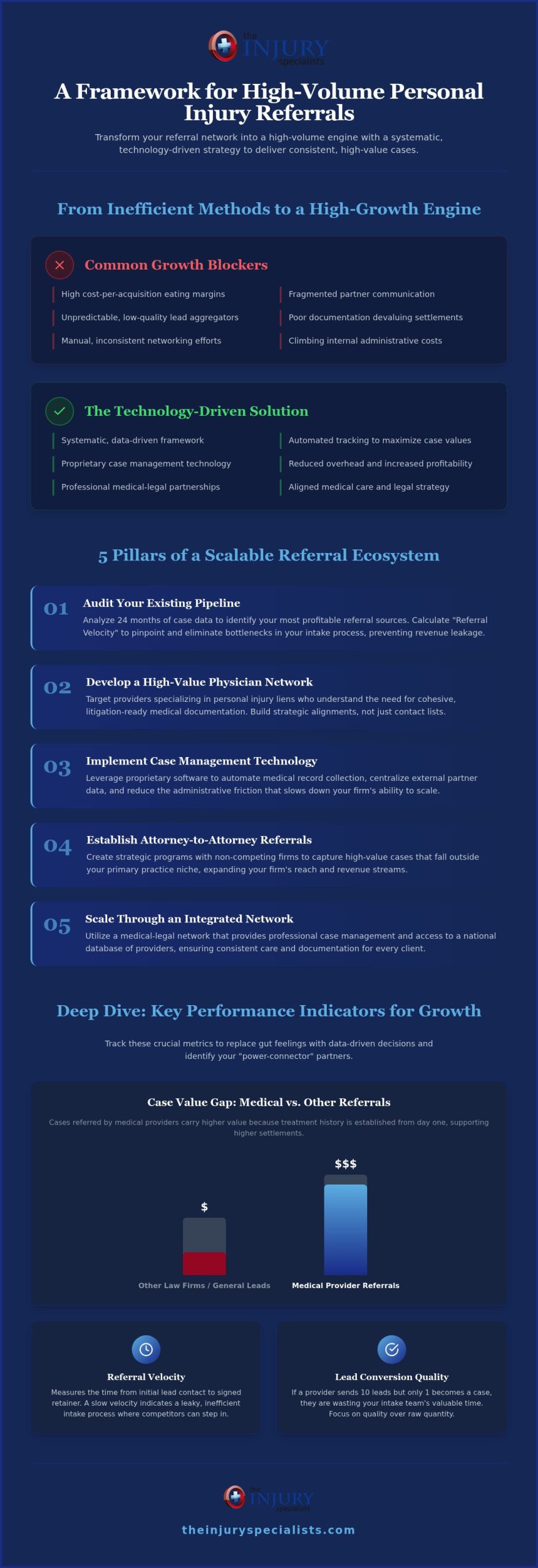
- Audit your existing pipeline by identifying high-profit sources and calculating “Referral Velocity” to pinpoint bottlenecks in your intake process.
- Develop a high-value physician network by targeting providers who specialize in personal injury liens and understand the necessity of cohesive medical documentation.
- Implement proprietary case management technology to grow personal injury law firm referrals by automating record collection and centralizing external partner data.
- Establish strategic attorney-to-attorney referral programs with non-competing firms to capture high-value cases outside your primary practice niche.
- Scale your practice through an integrated medical-legal network that provides professional case management and access to a national database of providers.
Auditing Your Current Personal Injury Referral Pipeline
High-growth firms don’t rely on gut feelings or casual networking to scale. They use rigorous data to identify which partners actually drive revenue. To begin your audit, pull your case data from the last 24 months. Identify your most profitable referral sources by looking past the number of leads and focusing on the total settlement value generated. Many firms realize that a high volume of leads from a single source might actually result in lower total revenue if those cases are difficult to prove or settle. You’re looking for the “power-connectors” who provide high-value cases with clear liability and significant damages.
Once you’ve identified the sources, calculate your Referral Velocity. This metric measures the time elapsed from the initial lead contact to the signed retainer. If your velocity is slow, your intake process is leaking potential revenue and allowing competitors to step in. You must also analyze the Case Value Gap. This involves comparing the average settlement value of cases referred by medical providers versus those from other law firms. Generally, medical referrals carry higher value because the treatment history is established from day one. Understanding this gap helps you decide where to allocate your networking resources to effectively grow personal injury law firm referrals.
Evaluate the administrative friction in your current intake process. If your staff spends hours every week calling clinics for missing bills or records, your referral system is inefficient. This friction increases your overhead and slows down your ability to scale. A well-oiled pipeline should move cases from referral to treatment to settlement with minimal manual intervention from your legal team.
To streamline this process further and reduce the burden on your intake staff, you can explore Legal Lead Generation and Referrals to access motor vehicle accident cases that have already undergone a comprehensive initial evaluation.
Key Performance Indicators for Referral Growth
Track the conversion rate of every medical lead. If a provider sends ten leads but only one becomes a case, that partner is wasting your intake team’s time. You should also measure your Referral ROI by accounting for staff time spent on networking and follow-ups. Finally, assess the quality of medical documentation provided by current partners. A physician who provides detailed, litigation-ready notes is worth significantly more than one who sends generic templates that require constant clarification.
Identifying Gaps in Your Medical-Legal Network
A robust network requires more than just general practitioners. Determine if you have adequate coverage for specialized imaging, such as MRI and CT centers, which are critical for documenting traumatic injuries. Gaps in geographic reach can also limit your firm’s expansion into new territories. For example, a firm seeking to handle Florida-based claims effectively might partner with a Personal Injury Attorney in Fort Lauderdale to leverage local expertise. If your firm wants to grow personal injury law firm referrals across a wider region, you need integrated medical case management to bridge these gaps. This ensures every client receives consistent care and documentation, regardless of their location, which directly supports higher settlement values.
How to Build a High-Value Physician Referral Network
Building a network isn’t about collecting business cards; it’s about strategic alignment. Target providers who understand the complexities of personal injury liens. These professionals already know the litigation lifecycle. They don’t need to be taught why a case takes months to settle. When you target specialists, you effectively grow personal injury law firm referrals by ensuring the medical side of the case is handled with a legal mindset from the start.
Your value proposition must shift. Stop promising case volume. Instead, focus on “Cohesive Care.” Doctors are often overwhelmed by the administrative “legal” work that accompanies PI cases. Demonstrate how your firm simplifies their life. Offer resources that help them improve their legal documentation accuracy. When a provider knows their notes will stand up in a deposition, they’re more likely to refer patients to you. You can also utilize physician referral services for personal injury to automate these connections and remove the manual labor of finding qualified partners.
The Role of Medical Case Management in Physician Relations
Professional case management is the bridge between the clinic and the law firm. It reduces a doctor’s administrative burden by handling the heavy lifting of communication. This system ensures medical necessity is clearly documented for every referral, which is vital for maximizing settlement values. By improving attorney-client medical care coordination, you prevent treatment gaps that insurance adjusters love to exploit.
Vetting Medical Partners for Long-Term Success
Not every provider is a fit. Your vetting process should be rigorous. Consider these specific criteria:
- Billing Experience: Does the chiropractor or physical therapist have experience with PI-specific billing and lien structures?
- Diagnostic Capabilities: Can the imaging center provide high-resolution MRI or CT scans on a lien basis with rapid turnaround?
- Litigation Readiness: Is the provider willing to participate in depositions and provide expert testimony without excessive fees or scheduling conflicts?
Specialized PI networks outperform general medical directories because they consist of vetted, litigation-aware professionals. These partners understand that their medical records are essentially legal evidence. This level of specialization is necessary to grow personal injury law firm referrals in a competitive market. If you want to scale faster, consider joining a national medical-legal network to access an existing infrastructure of pre-vetted specialists. This approach replaces the trial-and-error of individual networking with a proven, scalable system. Firms still relying on manual contact lists should also review the attorney physician referral system 2026 framework to understand how an integrated, technology-driven approach eliminates the administrative bottlenecks that cap firm growth.
Leveraging Technology to Streamline Referral Management
Efficiency is the primary differentiator between a stagnant practice and a market leader. Manual spreadsheets and fragmented email chains are insufficient for firms that want to grow personal injury law firm referrals at scale. You must centralize all referral data in a dedicated personal injury case management platform. This allows your team to track every case from the moment of referral through to the final disbursement without losing data in the transition between medical and legal teams.
Automation is the next logical step for a growth-oriented firm. By automating the collection of medical records and billing statements, you remove the administrative bottlenecks that plague most intake departments. Technology should enable real-time status updates for both your legal staff and your medical partners. This transparency builds trust and ensures that no case stalls due to a missing report or an unverified lien. When partners can see the progress of their referrals, they’re more likely to maintain a consistent volume of high-value cases.
Advanced firms are now using data analytics to predict case outcomes. By analyzing provider-specific history, you can identify which medical partners consistently deliver the documentation needed for maximum settlement values. This level of insight allows you to prioritize high-performing referral sources and adjust your strategy based on verifiable results rather than intuition. Using technology to bridge the gap between medical care and legal strategy creates a predictable engine for firm expansion.
Firms looking to professionalize their expansion may also discover Nexus Legal Group, which provides the end-to-end growth infrastructure necessary for elite plaintiff law firms to scale efficiently.
Automating the Intake Process
Friction during intake is a primary reason why referral partners stop sending cases. Implement digital intake forms that allow medical providers to submit new leads in seconds. Use instant notification systems to alert your intake team the moment a new opportunity arrives. Integrating this data directly into your firm’s primary CRM ensures that every referral is processed immediately. This speed prevents potential clients from seeking other representation and demonstrates your firm’s professionalism to your partners.
Secure Document and Communication Hubs
Security is non-negotiable when handling sensitive medical data. Your technology must ensure full HIPAA compliance when sharing records with external partners. Creating a “Single Source of Truth” for case status, medical liens, and funding prevents the confusion caused by multiple versions of the same document. Centralized case management technology reduces email clutter and ensures your team stays focused on high-value legal work rather than searching for lost attachments. This logistical ease makes your firm the preferred partner for busy medical professionals. Firms that want to go further can explore how medical case management for attorneys maximizes PI settlement value by transforming clinical documentation into a strategic legal asset rather than a clerical afterthought.
Expanding Through Attorney-to-Attorney Referral Programs
Attorney-to-attorney networking is a high-yield channel often overlooked by firms focused solely on digital lead generation. To grow personal injury law firm referrals, you must establish relationships with firms practicing in non-competing areas. Family law, criminal defense, and estate planning attorneys—or international specialists where you can discover Israel Cross Border Law Firm—frequently encounter clients with injury claims but lack the infrastructure or desire to litigate them. By positioning your firm as a strategic partner, you provide these attorneys with a reliable way to monetize their “reject” leads while ensuring their clients receive professional representation. This creates a reciprocal ecosystem where your firm becomes the default choice for any injury-related inquiry.
Niche expertise is your most powerful selling point in the legal community. Generalist firms are common; specialists are rare. If your firm excels in specific injury types, such as commercial trucking accidents or traumatic brain injuries, highlight this during networking events and trial lawyer association meetings. Utilizing specialized resources like the Truck Accident Calculator can help you demonstrate a sophisticated approach to case valuation when discussing potential referrals with other attorneys. Other attorneys are more likely to refer a high-stakes case to a firm with a documented history of success in that specific sub-field. This specialized positioning makes it easier to grow personal injury law firm referrals through peer respect. Formalize these relationships through co-counsel agreements with clear, pre-defined fee-sharing structures. This ensures everyone is aligned on financial expectations and prevents disputes during the disbursement phase. High visibility within state and national trial lawyer associations further solidifies your reputation as a dominant player in the field.
To further grow personal injury law firm referrals, consider branching out into multi-disciplinary groups. A professional networking organization like Network In Action offers a platform for building these high-level connections, helping you establish a robust ecosystem of referral partners across various industries.
This multi-disciplinary approach can also include relationships with insurance professionals who are often the first to discuss coverage with potential claimants; for a look at a professional agency in this space, check out All Insurance LLC.
Types of Strategic Legal Partnerships
Strategic partnerships generally fall into three distinct categories. The Out-of-State Referral is common for firms with cases in jurisdictions where they aren’t barred. These partners need a local expert to navigate regional court rules. The Complex Litigation Referral allows smaller firms to partner with you on catastrophic cases that require significant capital and expert resources they don’t possess. Finally, the Volume Intake Referral involves managing smaller, high-velocity cases for large-scale firms that prefer to focus exclusively on seven-figure litigation. Each type requires a different management approach, and firms can look to industry leaders like Scotland Claims Injury Lawyers to explore Third-party legal cost recovery fees to ensure that all financial aspects of these partnerships are clearly defined for consistent growth potential.
Ethics and Compliance in Legal Referrals
Compliance is non-negotiable. Every state has specific rules regarding referral fees and fee splitting. You must understand these regulations to protect your license and your partner’s professional standing. Best practices include providing full client disclosure and obtaining written consent for any fee-sharing arrangement. Maintain total transparency with the referring firm regarding case progress. This builds the trust necessary for a long-term, high-volume relationship. To scale this process without increasing your administrative burden, use the Attorney Referral Program to manage these partnerships through a professional, technology-driven platform.
Scaling Your Firm with The Injury Specialists Referral Network
The Injury Specialists operates the largest personal injury referral network in the United States, providing a turnkey solution for firms ready to move beyond manual networking. To grow personal injury law firm referrals effectively, you need more than just a list of doctors; you need a system that integrates medical care with legal strategy. Our platform provides access to a pre-vetted national network of providers who understand the lien process and the necessity of detailed documentation. This infrastructure allows your firm to scale into new markets without the overhead of building a medical-legal network from scratch. Firms transitioning away from outdated processes will find that implementing a structured attorney physician referral system is the most direct path to eliminating inconsistent documentation and administrative bottlenecks that limit settlement values.
Beyond physician connections, we offer medical case management for attorneys tailored to your firm’s distinct processes. This service acts as an extension of your staff, handling the logistical complexities of client treatment and record collection. We also facilitate pre-settlement funding to bridge financial gaps for your clients, ensuring they can afford necessary care while you build the case. This comprehensive support system is powered by world-class technology designed specifically for the personal injury ecosystem. It centralizes data, automates tracking, and provides the transparency needed to manage high-volume caseloads with professional precision.
The Advantage of an Integrated Ecosystem
A managed network outperforms a fragmented list of providers by ensuring accountability and consistency across every case. When you utilize an integrated ecosystem, you reduce internal overhead by outsourcing medical coordination to specialists. This allows your legal team to focus on litigation rather than chasing down billing statements. Cohesive care doesn’t just improve the client experience; it leads to higher settlement values because the medical narrative is clear, consistent, and fully documented from day one. This streamlined success is what separates market leaders from their competitors.
Getting Started with the Attorney Referral Program
Onboarding your firm into our national network is a streamlined process. We customize our proprietary technology platform to fit your existing workflow, ensuring a seamless integration with your current CRM. To grow personal injury law firm referrals through our Attorney Referral Program, you simply define your criteria and process. Once integrated, you’ll receive managed medical referrals that are already vetted for quality and documentation standards. This systematic approach replaces the uncertainty of traditional networking with a reliable engine for firm growth. Your first step is a consultation to align our network capabilities with your firm’s specific expansion goals.
Secure Your Firm’s Growth with a Scalable Referral Ecosystem
Transforming your practice from a lead-chasing operation into a high-volume referral engine requires a shift toward automation and strategic alignment. You’ve seen how auditing your pipeline and vetting specialized medical partners can eliminate administrative friction. Implementing these systematic strategies allows you to grow personal injury law firm referrals with a level of predictability that traditional marketing cannot match. By leveraging an integrated medical-legal technology platform and formalizing attorney partnerships, you ensure every case is positioned for maximum settlement value from the outset.
The Injury Specialists has been facilitating professional connections for over 15 years, offering a national reach with local medical expertise. Our integrated system is designed to handle the heavy lifting of case management so your team can focus on litigation. Join the largest personal injury referral network in the US today to access the tools and partners needed to dominate your market. Your firm’s expansion is no longer dependent on unpredictable digital leads but on a well-oiled system built for long-term success.
Frequently Asked Questions
How do I ensure medical providers send high-quality referrals?
Ensure high quality by targeting providers who specialize in personal injury liens and understand that their medical records serve as legal evidence. Provide them with clear documentation standards and regular feedback on case outcomes. When doctors see that their detailed notes lead to successful settlements, they’re more likely to prioritize your firm for high-value referrals. Establishing a standardized communication protocol helps maintain these quality standards over time.
What is the best way to track referrals from other law firms?
Centralize all data in a dedicated case management platform rather than relying on fragmented email chains or manual spreadsheets. A robust system tracks the source, status, and settlement value of every referral. This allows your firm to calculate “Referral Velocity” and identify which legal partners provide the most profitable cases. Maintaining transparency with referring firms regarding case progress also encourages long-term, consistent participation.
Can technology really help grow my personal injury referrals?
Technology is essential to grow personal injury law firm referrals because it automates time-consuming administrative tasks like intake and record collection. Digital forms and automated systems remove friction for your partners, making it easier for them to send you cases. By providing real-time status updates, you build trust with providers and other attorneys. This efficiency allows your team to manage a higher volume of cases without increasing internal overhead.
Is it ethical to pay for personal injury law firm referrals?
Ethical rules regarding referral fees vary by state and usually permit fee-sharing between attorneys if you follow specific disclosure and client consent requirements. However, paying non-lawyers for referrals is typically prohibited under professional conduct rules. Always consult your local bar association’s guidelines. Formalize every agreement with a written co-counsel contract to ensure full compliance and clear financial expectations for all parties involved in the case.
How does medical case management improve my referral network?
Medical case management acts as a professional bridge between clinical care and legal strategy. It reduces the administrative burden on physicians by handling record coordination and communication, making your firm a more attractive partner for busy clinics. This support ensures every client’s medical necessity is documented correctly. Proper documentation directly correlates to higher settlement values and improved case outcomes, which strengthens your reputation among referring partners.
What should I look for in a personal injury medical referral program?
Look for a program that offers an integrated medical-legal ecosystem rather than just a simple directory of names. A high-value program includes proprietary technology for document sharing and a national network of vetted specialists. It should also provide medical case management to streamline the treatment process. This level of professional infrastructure ensures your firm can scale quickly while maintaining high standards for medical documentation and case tracking.
How do I build a referral network if I am a solo practitioner?
Solo practitioners can grow personal injury law firm referrals by joining established networks like The Injury Specialists. You don’t need a massive internal team to manage a high-volume network when you leverage an existing infrastructure. By utilizing an Attorney Referral Program, you gain immediate access to a national database of medical providers and case management technology. This allows you to compete with larger firms by using a pre-built, professional ecosystem.
What is the role of pre-settlement funding in a referral network?
Pre-settlement funding provides a financial bridge that allows clients to continue necessary medical treatment while their case is pending. This is critical for maintaining the integrity of the medical narrative and preventing treatment gaps. If a client stops care due to financial strain, insurance adjusters often use that gap to devalue the claim. Facilitating funding through your referral network protects the case value and ensures consistent care for your clients.
