

Most personal injury firms lose significant settlement value because they treat medical documentation as a clerical task rather than a strategic asset. In 2026, the gap between a standard settlement and a maximum recovery is bridged by a systematic approach to clinical oversight. Implementing professional medical case management for attorneys is no longer just an administrative luxury; it’s a strategic necessity for firms that want to scale their operations without increasing internal overhead.
You’ve likely dealt with the frustration of incomplete medical records stalling a demand or the high administrative burden of sourcing specialists who accept liens. It’s a common bottleneck that prevents firms from reaching their full growth potential and maximizing client recovery. This article shows you how integrated medical case management transforms clinical documentation into strategic legal leverage to maximize your settlement outcomes. We’ll preview how a reliable provider network and proprietary technology create a streamlined path to faster turnarounds, better clinical proof, and a more efficient workflow for your entire legal team.
Key Takeaways
- Integrated medical case management for attorneys prevents low-ball settlement offers by ensuring clinical documentation is comprehensive and strategically aligned with legal needs.
- Distinguish between simple digital filing systems and a managed ecosystem that actively coordinates treatment, documentation, and communication.
- Access a national network of specialized providers to eliminate the administrative bottleneck of sourcing doctors who accept liens.
- Leverage proprietary technology designed specifically for medical-legal interoperability to monitor treatment and curate records in real time.
- Scale your firm’s growth by integrating specialized referral programs that align with your specific internal processes and settlement goals.
Beyond Digital Folders: Why Attorneys Need Clinical Case Management
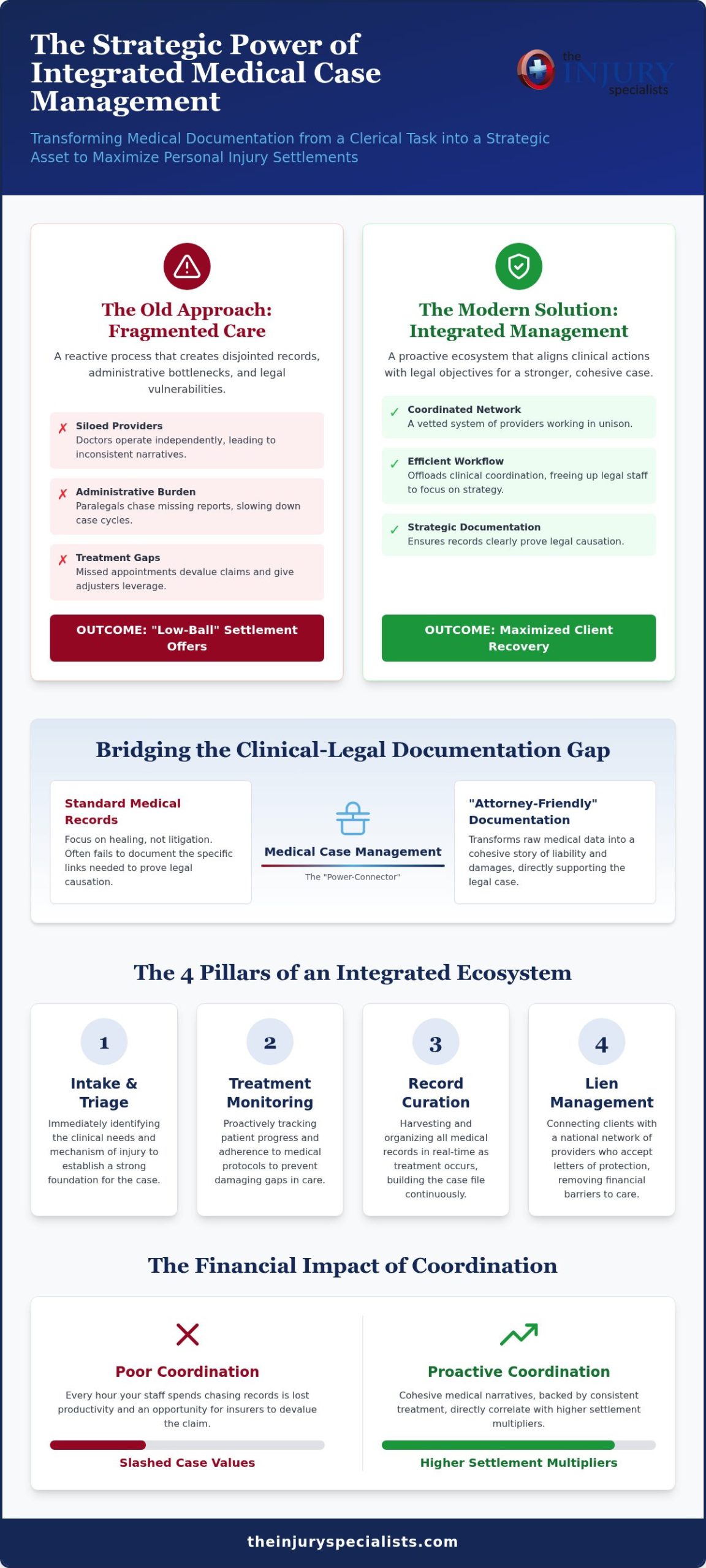
Personal injury litigation is built on evidence, but that evidence is only as strong as the clinical narrative behind it. Many firms mistake a digital filing cabinet for a comprehensive management strategy. This reactive approach creates fragmented treatment plans that ultimately devalue the claim. When medical providers operate in silos, the result is a disjointed record that insurance adjusters use to justify “low-ball” settlement offers.
Fragmented care is a silent profit killer. If a client sees a chiropractor but misses a critical MRI, or if a specialist fails to document the specific mechanism of injury, the narrative breaks. These inconsistencies aren’t just clinical oversights; they’re legal vulnerabilities. Professional medical case management for attorneys shifts the firm from a reactive stance of record collection to a proactive model of medical oversight. This ensures every step of the patient’s journey is documented with the final settlement in mind.
Your paralegals shouldn’t be acting as clinical coordinators. Forcing legal staff to chase missing reports or manage medical referrals creates a massive administrative bottleneck. This inefficient use of high-value labor slows down the case lifecycle and limits the number of files your firm can successfully manage. By offloading these tasks to a dedicated system, you allow your team to focus on litigation and high-level strategy.
The Clinical-Legal Documentation Gap
Standard medical records often fail to prove legal causation because doctors focus on healing, not litigation. Medical case management for attorneys ensures that clinical notes and billing are “attorney-friendly,” meaning they clearly document the link between the incident and the injury. This service bridges the gap between a doctor’s initial diagnosis and the lawyer’s final demand letter by ensuring every clinical touchpoint supports the legal theory of the case. It transforms raw medical data into a cohesive story of liability and damages.
Financial Impact of Poor Medical Coordination
Every hour your staff spends chasing a missing imaging report is an hour of lost productivity. These delays don’t just frustrate your team; they provide insurance adjusters with “easy outs” to deny the severity of an injury based on treatment gaps. Cohesive medical narratives, backed by consistent treatment logs, directly correlate with higher settlement multipliers. Proactive coordination ensures that no report is missing and no treatment interval is skipped, removing the leverage adjusters use to slash case values. Efficient systems lead to faster turnarounds and more reliable outcomes for every file in your cabinet.
The Anatomy of Integrated Medical Case Management for Law Firms
Integrated medical case management for attorneys is a specialized ecosystem that coordinates treatment, documentation, and communication between medical providers and legal teams. It’s more than a repository for files; it’s a proactive service that ensures every clinical action serves the legal objective. While software-only solutions focus on storage, a managed ecosystem focuses on the strategic alignment of medical data to maximize case value.
This model relies on four core pillars that move a case from intake to demand:
- Intake and Triage: Identifying the clinical needs and mechanism of injury immediately after the incident.
- Treatment Monitoring: Tracking patient progress to ensure strict adherence to medical protocols.
- Record Curation: Harvesting and organizing medical records in real time as treatment occurs.
- Lien Management: Connecting clients with a national network of providers who accept letters of protection.
Every law firm has a distinct litigation style. Effective MCM isn’t a one-size-fits-all solution. It’s a “power-connector” that facilitates real-time data flow between physicians and attorneys, customized to fit your firm’s specific internal processes and settlement goals.
Treatment Monitoring and Compliance
Case integrity depends on treatment consistency. When clients miss appointments or ignore referrals, insurance adjusters see an opportunity to devalue the claim. Medical case management ensures clients follow prescribed protocols and attend every scheduled visit. This oversight includes managing referrals to specialists, imaging centers, and physical therapists within a vetted network. Mastering attorney client medical care coordination is a core pillar of firm success. It eliminates the “gap in treatment” defense before it can even be raised.
Documentation and Narrative Cohesion
Providers often use clinical shorthand that doesn’t translate well to a demand letter. MCM ensures medical providers understand the legal requirements for documentation, focusing on consistent coding and terminology across all partners. This alignment makes it easier to build a cohesive narrative. By streamlining the transition from active treatment to demand package preparation, you reduce the time it takes to resolve a case. Firms that optimize their medical-legal workflows see faster turnarounds and more reliable settlement outcomes.
Software vs. Service: Evaluating Your Medical Management Strategy
Standalone case management software often creates a false sense of security for personal injury firms. While these tools provide a digital filing cabinet for records, they lack the active clinical oversight required to drive case value. The fundamental difference between a tool and a strategy is the presence of a managed ecosystem. Professional medical case management for attorneys combines proprietary technology with a human network to ensure that medical data is actively curated rather than just passively stored.
Evaluating the Total Cost of Ownership (TCO) reveals the inefficiency of relying on software alone. Managing medical coordination internally carries high administrative overhead, including the costs of hiring, training, and retaining specialized case managers. An outsourced professional network offers a performance-based ROI by providing immediate access to a “power-connector” model. This approach eliminates the fixed costs of internal staffing while providing the scalability to handle sudden increases in case volume without compromising documentation quality.
Relying on internal staff often leads to inconsistent record collection and treatment gaps. A dedicated network ensures that every case follows a standardized clinical pathway. This consistency is what builds trust with insurance adjusters and leads to higher settlement multipliers.
Limitations of General Legal Software
Standard legal practice management platforms excel at legal workflow automation, but they need a specialized medical management layer to be fully effective for personal injury litigation. These systems are not designed to handle the complex logic of medical liens or the nuances of clinical-legal interoperability. Without a dedicated system for medical oversight, firms often struggle with fragmented data that doesn’t clearly support the demand package. Leveraging integrated medical data allows you to grow personal injury law firm referrals by demonstrating a superior, data-driven approach to case management that other firms and providers respect.
The Value of an Integrated Medical Network
The true strength of a managed ecosystem lies in its connectivity. A high-impact partner provides a pre-vetted list of specialized doctors, imaging centers, and therapists who understand the personal injury landscape and accept liens. This unified technology platform bridges the gap between the doctor’s office and the law firm, reducing the friction of medical-legal consulting. By integrating communication into a single stream, you ensure that medical providers understand the legal requirements for their documentation. This proactive alignment ensures that when it’s time to settle, your demand is backed by a cohesive medical narrative that is difficult for adjusters to challenge.
4 Key Indicators of a High-Impact Medical Case Management Partner
Selecting a strategic partner requires looking beyond simple task management software. A high-impact partner provides the infrastructure necessary to scale your firm’s operations without adding to your internal administrative load. Effective medical case management for attorneys centers on four critical indicators: a vast national network, proprietary technology for medical-legal interoperability, support for pre-settlement funding, and proven scalability. These elements ensure that your firm can handle a high volume of complex cases while maintaining the precise clinical proof needed for maximum recovery.
Scalability is particularly vital for growing firms. A partner must demonstrate the ability to handle hundreds of cases simultaneously without losing the granular detail required for each individual demand package. This requires a system where data flows automatically between providers and the legal team, reducing manual entry and the risk of human error. When your management partner acts as a “power-connector,” your firm gains the capacity to take on more high-stakes files with confidence.
Specialized Imaging and Provider Access
Specialized imaging referrals are the backbone of high-value personal injury cases. Access to a vetted network of imaging centers, chiropractors, and physical therapists ensures that clients receive necessary diagnostic tests without delay. It’s not enough to just find a doctor; those providers must be trained in “legal-ready” clinical documentation. This means their notes explicitly address causation and the impact of the injury on the patient’s life. When every provider in the network operates on the same standard of documentation, the resulting medical narrative is cohesive and difficult for insurance adjusters to challenge. Firms that move beyond manual contact lists and spreadsheets by implementing a structured attorney physician referral system gain a significant competitive advantage in sourcing and retaining high-quality providers.
For personal injury cases requiring aesthetic restoration, selecting providers with a clinical perspective is essential, similar to the standards for choosing top-tier medical-grade clinics in other regions as discussed at skinstitute.com.au.
Lien and Funding Integration
Financial friction often stalls necessary medical treatment, which creates gaps that devalue a case. Integrated pre-settlement funding and medical lien management bridge this gap for both victims and providers. A sophisticated partner uses proprietary technology to track these lien balances in real time. This transparency allows your team to view current medical costs at a glance, streamlining the eventual lien reduction process through established provider relationships. Access the largest personal injury referral network in the United States and optimize your firm’s medical case management today.
Scaling Firm Growth with The Injury Specialists’ Integrated Network
The Injury Specialists provides a world-class technology platform that redefines medical case management for attorneys. This isn’t a generic tool; it’s a proprietary ecosystem designed specifically for medical-legal workflows. Our Attorney Referral Program integrates seamlessly with your firm’s distinct processes, allowing you to maintain control while offloading the logistical burden of medical coordination. By moving beyond simple file organization, you position your firm for strategic expansion and higher case volume.
We operate as the largest personal injury referral network in the United States. This national reach means your firm can handle cases across multiple jurisdictions without losing access to high-quality medical providers. Leveraging this scale transforms your internal operations from a reactive record-gathering department into a proactive litigation powerhouse. You don’t just manage files; you lead a well-oiled system that converts clinical data into legal leverage.
Strategic Networking as a Competitive Advantage
Our “Power-Connector” status provides a significant advantage for your firm’s marketing and growth efforts. When you utilize our ecosystem, you gain immediate access to specialized injury doctors, imaging centers, and chiropractic partners across the country. This connectivity doesn’t just improve case outcomes; it enhances your firm’s reputation among peers and insurance carriers. A firm that demonstrates consistent, high-quality clinical proof is a firm that commands respect at the settlement table. Professional oversight ensures that every case reflects your commitment to excellence and thoroughness.
Getting Started: A Streamlined Path to Success
Integrating our technology platform with your existing workflows is a straightforward process designed for immediate efficiency. We work with your team to align our management tools with your current legal software, ensuring a unified data flow. The process of connecting with our national network is categorical and efficient:
- Onboarding: We integrate your firm into our proprietary management platform.
- Customization: We define your specific referral requirements and geographic needs.
- Connectivity: Your team gains instant access to vetted specialists who accept liens.
- Oversight: You monitor treatment and record curation through real-time dashboards.
Strategic growth requires a partner that understands the intersection of medicine and law. It’s time to stop chasing records and start scaling your success. Streamline your firm’s medical case management with The Injury Specialists.
Secure Your Firm’s Competitive Edge in 2026
Personal injury litigation in 2026 demands more than just organized files; it requires a managed ecosystem that transforms medical data into strategic leverage. By shifting from reactive record collection to proactive clinical oversight, you eliminate the documentation gaps that insurance adjusters exploit. This transition allows your firm to handle higher case volumes while ensuring every demand package is backed by a cohesive medical narrative. It’s the difference between simple administration and strategic growth.
Implementing professional medical case management for attorneys provides the essential infrastructure for national reach and consistent results. The Injury Specialists offers the largest personal injury referral network in the United States, supported by a proprietary medical-legal technology platform and dedicated attorney referral support. These resources allow your team to focus on high-level litigation while we facilitate the clinical-legal synergy your cases require. You’ll gain a reliable partner focused on results, efficiency, and professional synergy.
Optimize your firm’s medical-legal synergy with The Injury Specialists. Take the next step toward streamlined operations and maximum settlement recovery today.
Medical Case Management FAQs
What is the role of a medical case manager in a personal injury law firm?
A medical case manager coordinates treatment, documentation, and communication between medical providers and legal teams. Their primary objective is to ensure that clinical records accurately reflect the mechanism of injury and support the legal theory of the case. By overseeing the patient’s journey, they transform raw medical data into strategic evidence. This proactive approach reduces the administrative burden on your staff and ensures that no critical medical report is overlooked.
How does medical case management differ from standard legal case management?
Legal case management focuses on litigation milestones, court deadlines, and discovery filings. In contrast, medical case management for attorneys focuses on clinical oversight and the quality of medical evidence. While legal software tracks the case file, medical case management ensures the patient follows prescribed protocols and that providers deliver “legal-ready” documentation. This specialized layer bridges the gap between a clinical diagnosis and a successful demand letter.
Can medical case management software integrate with my firm’s existing legal tools?
Specialized medical case management platforms are designed to complement standard legal practice management systems. These systems act as a dedicated medical management layer that handles the complex logic of medical liens and clinical-legal interoperability. By integrating these workflows, firms can maintain their existing legal processes while gaining access to a managed ecosystem of medical data. This connectivity ensures that medical records flow directly into your firm’s established litigation pipeline.
Why do attorneys need specialized medical case management for lien cases?
Lien cases require specialized management because they involve complex financial arrangements and high-stakes clinical documentation. Attorneys need a network of providers who understand the personal injury landscape and accept letters of protection. Dedicated management ensures these liens are tracked in real-time and that providers maintain a consistent narrative. This level of oversight prevents treatment gaps and ensures that medical costs are documented clearly for the eventual settlement negotiation.
How does professional medical oversight increase the value of a PI settlement?
Professional medical oversight increases settlement value by building a cohesive medical narrative that is difficult for insurance adjusters to challenge. It eliminates “gaps in treatment” and ensures that every clinical touchpoint addresses causation and liability. When a case is backed by comprehensive, standardized documentation, it commands higher settlement multipliers. This systematic approach transforms medical records from a clerical task into a high-impact strategic asset for your firm.
What should a law firm look for in a medical referral and case management network?
Firms should prioritize a partner that offers a vast national network of specialized providers and proprietary technology. Look for a system that facilitates real-time data flow between physicians and attorneys while supporting pre-settlement funding. Scalability is also essential; your partner must be able to handle high case volumes without losing attention to detail. A high-impact network acts as a strategic facilitator that bridges the gap between different professional sectors. Upgrading from outdated spreadsheets to a modern attorney physician referral system is a critical step toward building that scalable infrastructure.
Does medical case management help with client treatment compliance?
Yes, medical case management is highly effective for ensuring client treatment compliance. Case managers monitor patient progress and alert the legal team if a client misses appointments or ignores specialist referrals. This proactive tracking ensures that clients follow prescribed protocols, which maintains the integrity of the case. By preventing treatment gaps, you remove the primary leverage that insurance adjusters use to devalue personal injury claims during the settlement process.
Is medical case management available for firms that handle cases nationwide?
Professional medical case management for attorneys is available for firms with a national footprint. The largest referral networks provide access to specialized doctors, imaging centers, and therapists across the country. This allows firms to handle cases in multiple jurisdictions with a consistent standard of medical coordination. Using a unified national network ensures that your documentation remains cohesive regardless of where the client receives treatment, facilitating strategic firm expansion.
