

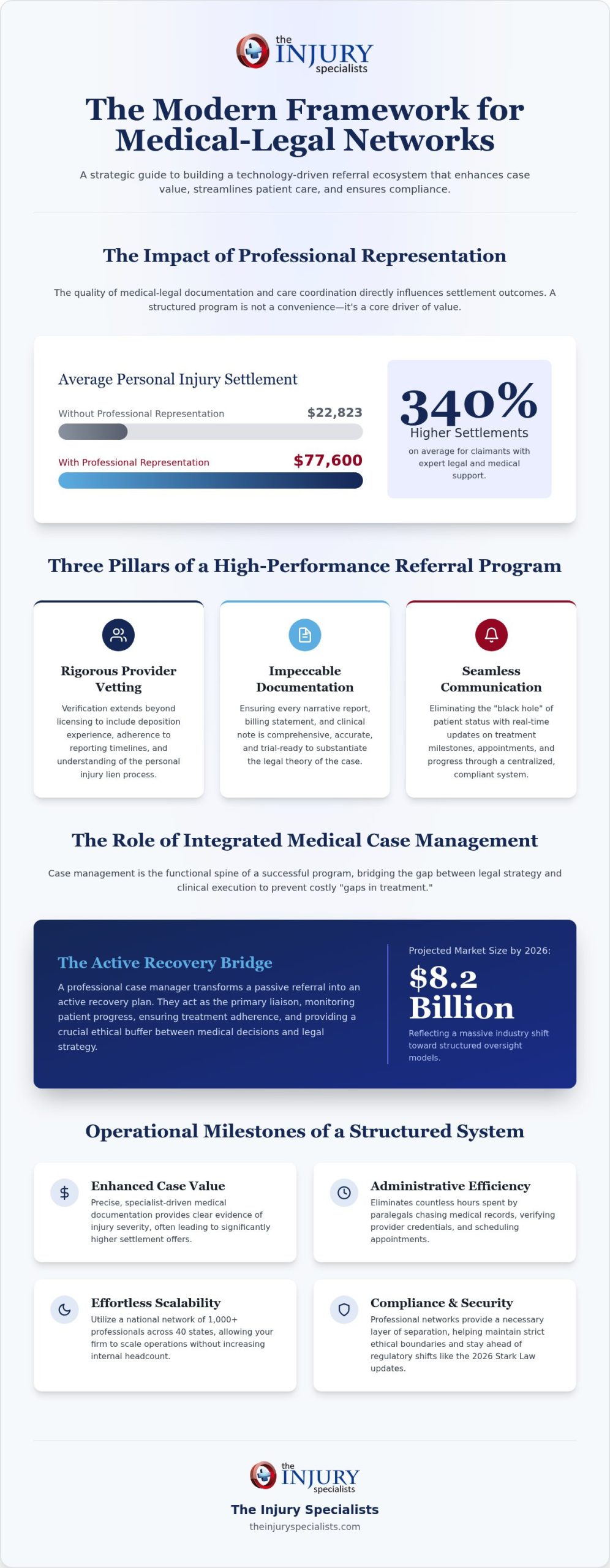
Claimants with professional legal representation receive average settlements of $77,600, which is 340% more than those navigating the process alone. Much of this value depends on the structural integrity of your law firm medical referral program and the quality of the medical-legal documentation produced during the treatment phase. You’ve likely dealt with the frustration of inconsistent clinical notes or providers who don’t grasp the complexities of the personal injury lien process. These inefficiencies don’t just create an administrative burden; they directly erode the settlement potential of your files.
It’s time to transition from a manual list of doctors to a strategic, technology-driven ecosystem. This guide provides the framework to build and scale a high-performance medical-legal network that streamlines patient care and improves documentation accuracy. We’ll explore how to leverage The Injury Specialists’ proprietary case management technology to reduce overhead and stay ahead of 2026 regulatory shifts, such as the updated Stark Law non-monetary compensation limits. You’ll learn the exact steps to transform your referral process into a scalable engine for firm growth and superior client outcomes.
Key Takeaways
- Transition from informal doctor lists to a structured law firm medical referral program that prioritizes high-quality documentation and streamlined clinical care.
- Identify how integrated medical case management acts as the essential bridge between legal strategy and physician compliance to ensure treatment follow-through.
- Master the mechanics of medical liens and professional networking to maintain strict ethical boundaries while securing specialized care for your clients.
- Leverage technology-first infrastructure, including HIPAA-compliant portals and automated status updates, to reduce administrative overhead and scale your practice.
- Discover how a strategic partnership with a national medical-legal network aligns specialized referral workflows with your firm’s distinct internal processes.
Understanding the Law Firm Medical Referral Program Framework
A law firm medical referral program is a specialized infrastructure designed to connect personal injury clients with qualified healthcare providers. It is not merely a directory of local physicians. Instead, it is a managed ecosystem that prioritizes clinical excellence, rigorous documentation, and seamless communication. In 2026, this synergy is more than a convenience; it is a requirement for firms aiming to maintain a competitive edge while managing rising healthcare costs.
A robust program requires three core components: provider vetting, documentation standards, and communication protocols. Vetting involves more than checking a license. It requires verifying a provider’s experience with depositions and their willingness to adhere to strict reporting timelines. Documentation standards ensure that every narrative report and billing statement is trial-ready. Standardized communication protocols eliminate the “black hole” of patient status, providing your team with real-time updates on treatment milestones.
The Evolution of Medical-Legal Partnerships
Traditional referral methods often fail high-stakes firms because they lack oversight. Relying on an informal list of providers leads to inconsistent records and missed appointments. The industry has shifted toward integrated models that emphasize understanding the medical lien process as a tool for access. Modern programs focus on “doctors who take personal injury liens” to ensure clients receive immediate care without upfront costs. This transition reflects a move toward sophisticated Medical-Legal Partnerships (MLPs) that treat healthcare coordination as a strategic asset rather than an administrative afterthought. Building a high-performance attorney medical provider network is now essential for firms seeking to replace fragmented manual workflows with a technology-driven ecosystem that bridges clinical care and legal documentation.
Core Objectives of a Professional Referral System
The primary goal of a professional system is to improve client health outcomes through immediate specialist access. When a client receives timely, appropriate care, the medical record naturally reflects the severity of the injury. This ensures the documentation aligns with the legal theory of the case. A structured program also achieves several operational milestones:
- Enhanced Case Value: Precise medical documentation from specialists often leads to higher settlement offers.
- Administrative Efficiency: Paralegals no longer spend hours chasing records or verifying provider credentials.
- Scalability: By utilizing a national network of over 1,000 professionals across 40 states, firms can scale operations without increasing internal headcount.
- Compliance Security: Professional networks provide a layer of separation that helps maintain ethical boundaries between the legal and medical sectors.
The Role of Integrated Medical Case Management
Medical case management serves as the functional spine of any successful law firm medical referral program. It provides the oversight necessary to ensure that clients don’t just receive a referral but actually complete their prescribed treatment. Without this professional layer, the risk of non-compliance increases, leading to “gaps in treatment” that defense counsel will aggressively exploit during negotiations. By 2026, the medical case management market is projected to reach $8.2 billion, reflecting a widespread industry shift toward this structured oversight model.
A professional case manager acts as the primary link between the legal team and the clinical provider. They monitor patient progress in real-time, identifying potential issues before they become permanent stains on a case file. Integrating medical case management for attorneys transforms a passive referral into an active recovery plan that prioritizes both health and case value.
Bridging the Gap Between Law and Medicine
Attorneys are experts in litigation, not clinical scheduling or medical-legal consulting. Managing a client’s recovery timeline requires a neutral, professional approach that respects medical necessity while understanding legal requirements. Professional case managers serve as a buffer for ethical compliance, ensuring that medical decisions remain independent of legal strategy. This separation is critical when considering state-level regulations for referral services, which often demand clear boundaries between legal and medical operations. Effective management ensures that every specialist, from chiropractors to imaging centers, is working toward a unified treatment goal without administrative friction.
Streamlining Communication and Documentation
A significant bottleneck in personal injury litigation is the delay in receiving trial-ready documentation. Integrated case management ensures that physicians deliver narrative reports and itemized bills that align with the specific needs of a demand package. Case managers facilitate the gathering of imaging results and specialist reports, moving the case forward without placing a burden on your paralegal staff. They verify that all records are organized and complete before they ever reach your desk.
To truly master attorney-client medical care coordination, firms must adopt a system that automates the collection of medical records. This proactive approach prevents the administrative friction that typically occurs at the end of treatment. By utilizing a sophisticated medical-legal networking platform, your firm can maintain high-volume caseloads without sacrificing the quality of documentation or the speed of resolution.
Ethics, Compliance, and the Medical Lien Process
Maintaining ethical boundaries is the most critical factor for any high-growth law firm medical referral program. Attorneys must ensure that their relationships with medical providers don’t compromise the integrity of the case or violate professional conduct rules. Transparency with the client regarding these referral relationships is not just a best practice; it’s a requirement to maintain trust and legal standing. As regulations evolve, staying compliant requires a deep understanding of both state-specific bar rules and federal mandates.
Navigating these complexities involves strict adherence to federal physician self-referral laws, often referred to as the Stark Law. In 2026, the aggregate limit for non-monetary compensation a physician can receive is capped at $535 per year. This highlights the importance of keeping professional interactions strictly business-oriented. A well-structured program ensures that medical decisions remain entirely in the hands of the clinician, preventing any appearance of “kickback” scenarios that could lead to disciplinary action or case dismissal.
Maintaining the Integrity of the Referral
A professional system prioritizes client welfare by ensuring that physicians are selected based on clinical merit rather than financial incentives. This is why a professional attorney physician referral system is essential. It creates a necessary layer of separation, ensuring that medical documentation is objective and defensible. By utilizing a network that understands the nuances of personal injury litigation, firms can avoid the pitfalls of unlicensed entities interfering with clinician decisions, a practice now prohibited in several states by 2026 legislation. This allows your firm to focus on strategy while the medical professionals focus on recovery.
Managing Medical Liens and Funding
The mechanics of medical liens, or Letters of Protection (LOPs), are the engine of the referral process. A structured program manages these liens to ensure providers are paid promptly upon settlement, which maintains the health of the referral network. For clients who are uninsured or underinsured, pre-settlement funding provides a critical bridge. This allows the client to access necessary care without placing an immediate financial burden on the firm or the individual. Structured lien management reduces the risk of unpaid medical bills and ensures that the final disbursement process is efficient and accurate. This logistical ease allows the firm to focus on maximizing case value while the network handles the financial complexities of provider compensation.
Evaluating Referral Networks: Technology and Infrastructure
Efficiency in a modern law firm medical referral program depends on its digital infrastructure. Manual tracking via fragmented email chains and static documents creates massive administrative drag that limits firm growth. Scaling a personal injury law firm referral strategy requires a centralized, web-based platform that acts as a single source of truth. By 2026, web-based case management holds a 34.4% market share because it solves the information silo problem common in medical-legal coordination. This infrastructure allows your team to manage hundreds of active referrals with the same precision as a dozen.
A centralized platform provides more than just storage; it offers a dashboard for tracking all active medical referrals simultaneously. This high-level view allows firm leadership to spot bottlenecks in the treatment phase before they impact the case’s statute of limitations or settlement timeline. Automated alerts can notify your team if a client misses an appointment or if a provider is late with a narrative report. These features transform the referral process from a reactive chore into a proactive management system.
The Power of a Unified Case Management Platform
Moving away from spreadsheets is the first step toward operational maturity. A unified platform provides real-time visibility into client treatment status for the entire legal team, from intake to final discharge. This transparency ensures that paralegals aren’t wasting hours on manual status calls or record retrieval requests. Key features must include HIPAA-compliant document sharing, automated status updates, and secure portal access for both the firm and the provider. Implementing personal injury case management technology delivers a high ROI by reducing administrative overhead and accelerating the demand package timeline.
Vetting Potential Medical Partners
Technology also facilitates more rigorous vetting of physicians, chiropractors, and imaging centers. Firms should evaluate partners based on the quality of their medical narratives and the transparency of their billing. Data analytics within a referral platform can identify which partners consistently provide trial-ready documentation and which ones cause delays. For firms handling cases across multiple jurisdictions, a network with national reach is essential to maintain consistency. As of 2026, the legal sector’s adoption of AI and advanced analytics is expected to reach 79%, making these tools indispensable for identifying high-performance medical partners within your attorney medical provider network.
Access our proprietary case management technology platform to streamline your referral workflow today.
Scaling Your Firm with The Injury Specialists
The Injury Specialists operates as a strategic facilitator for firms seeking a scalable law firm medical referral program. We provide more than a simple directory; we offer a sophisticated networking platform that bridges the gap between legal representation and medical care coordination. Our approach centers on your firm’s distinct process. We align our referral and management systems with your specific internal workflow to ensure that every case moves from intake to settlement without administrative friction.
Joining the largest personal injury referral network in the United States provides immediate access to a vetted ecosystem of over 1,000 professionals across 40 states. This scale allows your firm to handle complex, multi-jurisdictional cases with the same efficiency as local files. By professionalizing your medical networking through our platform, you eliminate the logistical burden of provider vetting and record retrieval. This allows your attorneys to focus on high-level litigation strategy while we manage the clinical logistics.
A Strategic Partnership for Growth
Growth depends on connectivity and reliable data. Our integrated marketing and networking tools help you grow your own referral partner base by positioning your firm as a preferred partner for top-tier medical providers. You gain direct access to specialized imaging and diagnostic networks, which are essential for building the objective evidence required for high-value settlements. We act as a power-connector in the medical-legal community, facilitating the professional synergy needed to maximize case outcomes and streamline client recovery.
Getting Started: Implementing Your Custom Program
Professionalizing your medical-legal infrastructure follows a logical, sequential path designed to respect your team’s time. We move quickly from initial assessment to full operational integration.
- Step 1: Workflow Consultation. We conduct a thorough analysis to map your firm’s current medical-legal workflow and identify specific documentation needs.
- Step 2: Technology Integration. Your team is onboarded onto our proprietary case management technology platform, centralizing all medical updates and HIPAA-compliant document sharing.
- Step. 3: Network Activation. You gain immediate access to our national network of vetted specialists, ensuring your clients receive immediate care from providers who understand the lien process.
This methodical implementation ensures that your firm can scale its caseload without a proportional increase in administrative headcount. By 2026, the firms that dominate the market will be those that treat their medical referral network as a core business asset rather than a secondary concern.
Operationalize Your Medical-Legal Strategy for 2026
Building a high-performance law firm medical referral program is no longer about maintaining a simple list of contacts. It requires a sophisticated integration of clinical case management, trial-ready documentation, and HIPAA-compliant technology. By shifting to a structured ecosystem, your firm can eliminate treatment gaps and reduce the administrative burden on your staff. This strategic alignment ensures that every client receives specialized care while your legal team benefits from consistent, high-quality medical narratives that maximize settlement values.
The Injury Specialists provides the infrastructure you need to scale without increasing internal overhead. You gain immediate access to the largest personal injury referral network in the United States, supported by integrated personal injury case management technology and workflows customized to your firm’s distinct process. It’s time to transform your medical networking into a predictable engine for firm growth. Join the largest personal injury referral network and scale your firm today.
Frequently Asked Questions
What is a law firm medical referral program?
A law firm medical referral program is a structured system for connecting clients with specialized healthcare providers who understand the personal injury landscape. It moves beyond a simple list by integrating case management and rigorous documentation standards. This framework ensures that medical treatment aligns with legal theories while providing your team with real-time visibility into the patient’s clinical progress.
Is it ethical for a lawyer to refer a client to a specific doctor?
It’s ethical for a lawyer to refer a client to a specific doctor as long as the attorney prioritizes the client’s health and maintains professional independence. Ethical compliance requires full transparency and ensuring clinical decisions remain solely with the physician. Firms must avoid “kickback” scenarios by strictly adhering to state bar rules and federal physician self-referral laws regarding non-monetary compensation.
How do medical liens work within a law firm referral program?
Medical liens, or Letters of Protection, allow clients to receive treatment with the agreement that the provider is paid from the final settlement proceeds. A professional program manages these liens to ensure prompt, accurate payment upon case resolution. This structured approach reduces financial risk for the provider and the law firm while ensuring clients access necessary care without upfront costs.
What are the benefits of using a professional referral network over an internal list?
Professional networks offer scalability and oversight that internal lists cannot match. They provide a vetted national network of specialists and integrated case management to track treatment milestones in real-time. This reduces the administrative burden on your paralegals while ensuring consistent, trial-ready documentation across all files. It transforms a manual task into a predictable, growth-oriented operational system.
Can a medical referral program help increase the settlement value of a case?
A law firm medical referral program maximizes case value by ensuring precise and objective documentation of injuries. When specialists provide detailed narrative reports and diagnostic results, it significantly strengthens the demand package. Accurate clinical records from vetted providers often lead to higher settlement offers because they leave less room for defense counsel to dispute the severity of the injury.
How does technology improve the medical-legal referral process?
Technology centralizes communication and document sharing through secure, HIPAA-compliant portals. It provides your legal team with real-time visibility into client treatment status, which eliminates the need for manual status calls or record retrieval requests. Automated alerts ensure that providers deliver narrative reports on time, which accelerates the resolution timeline and reduces the overall administrative overhead for your firm.
What should I look for when choosing a medical referral partner?
You should look for partners who offer national reach and proprietary case management technology. Vetting must include an assessment of their documentation quality and their understanding of the personal injury lien process. A reliable partner acts as a strategic facilitator, aligning their services with your firm’s distinct internal workflows to ensure seamless communication and high-quality clinical outcomes for every client.
Does The Injury Specialists program work for firms with their own distinct processes?
The Injury Specialists program is specifically designed to integrate with each firm’s own distinct internal processes. The onboarding sequence includes a strategic consultation to map your current medical-legal operations and identify bottlenecks. This ensures the referral system enhances your existing efficiency and supports your firm’s growth goals rather than forcing you to adopt a rigid, one-size-fits-all model.
