

A referral in the personal injury sector isn’t just a point of access. It’s the strategic foundation of a high-functioning medical-legal ecosystem. When these connections fail, the entire case suffers. You’ve likely dealt with the administrative headaches of fragmented communication between law firms and medical providers. Finding specialists who understand medical liens is difficult; meanwhile, delayed documentation often pushes settlement timelines back by months. Managing personal injury physical therapy referrals shouldn’t feel like an uphill battle against constant logistical friction.
This guide provides a professional roadmap to master the complexities of medical-legal integration to ensure superior patient outcomes and streamlined case management. You’ll learn how to build a reliable referral pipeline that prioritizes coordinated care and predictable billing workflows. We will explore the essential components of a well-oiled system, including the role of proprietary technology and integrated case management in scaling your professional network and driving predictable results.
Key Takeaways
- Learn why specialized medical-legal documentation is the critical differentiator between a standard clinical visit and a successful legal recovery.
- Master the financial lifecycle of personal injury physical therapy referrals by understanding the mechanics of medical liens and Letters of Protection.
- Discover why integrated referral networks outperform direct access models by ensuring causation is documented correctly from the initial intake.
- Implement standardized communication workflows to eliminate administrative friction and ensure real-time updates between clinics and law firms.
- Scale your operations by leveraging a national ecosystem that combines marketing, networking, and integrated case management technology.
Understanding Personal Injury Physical Therapy Referrals and Their Strategic Value
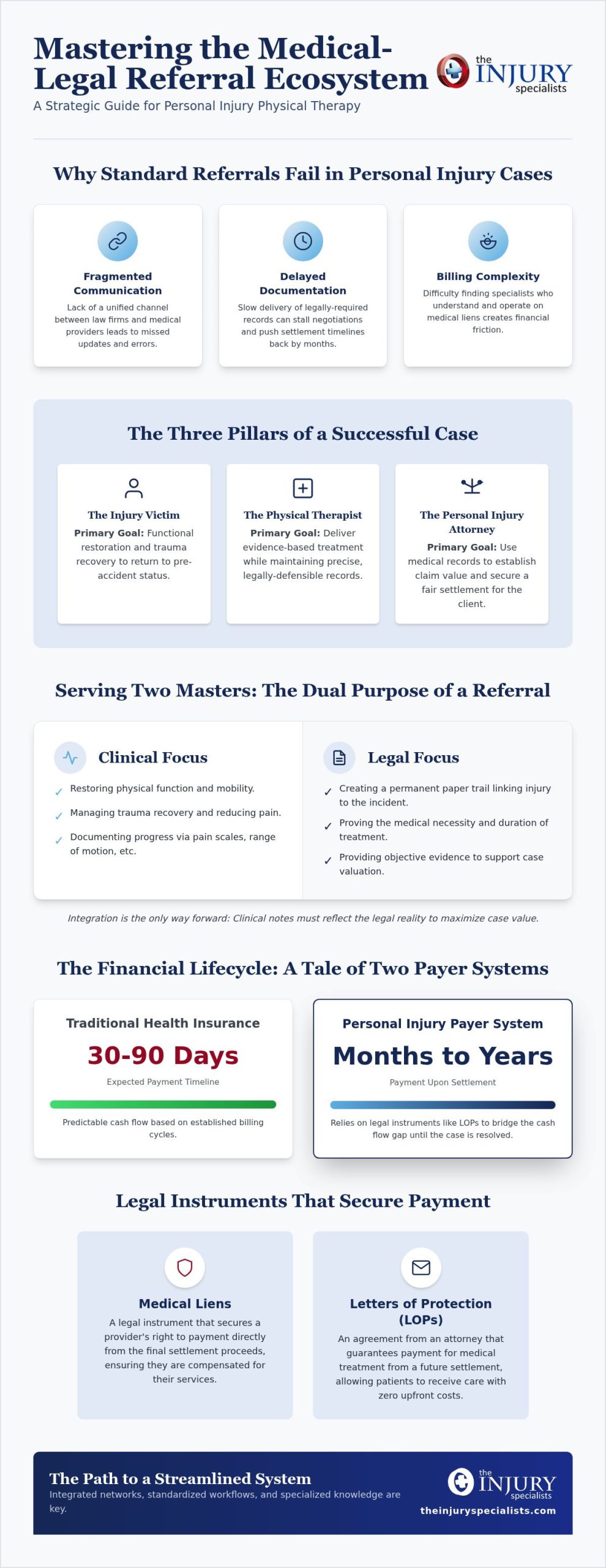
Personal injury physical therapy referrals serve as a formal bridge between legal representation and rehabilitative care. In the 2026 medical-legal landscape, the industry has shifted away from casual hand-offs. We now operate in an era of strategic partnerships where every referral is a high-stakes professional transaction. A standard clinical referral often fails because it lacks the rigorous documentation standards required for litigation. It focuses on medical necessity but ignores the legal necessity of proving causation and injury duration. Without this specific data, a case can stall during negotiations. Efficiency is the priority. Results matter most.
Success in this process requires absolute clarity between three primary stakeholders:
- The Injury Victim: The patient requires immediate functional restoration and long-term trauma recovery to return to pre-accident status.
- The Physical Therapist: The provider delivers evidence-based treatment while maintaining the precise, chronological records necessary for legal scrutiny.
- The Personal Injury Attorney: The legal professional relies on those records to establish the financial value of the claim and secure a settlement.
The Clinical vs. Legal Purpose of Referrals
A successful referral serves two masters simultaneously. From a clinical perspective, the goal is restoring function and managing trauma recovery. The therapist focuses on range of motion, strength, and pain scales. From a legal perspective, however, the referral establishes a permanent paper trail. This documentation proves the necessity of the treatment and links the injury directly to the specific incident. Synthesizing these needs ensures the patient heals while the legal case remains supported by objective evidence. If the clinical notes don’t reflect the legal reality, the case valuation drops. Integration is the only way forward.
Why Attorneys Prioritize Specialized PT Referrals
Attorneys prioritize specialized personal injury physical therapy referrals because they offer reliability in high-pressure environments. These providers understand the Personal Injury Payer System, which functions differently than traditional health insurance. They operate comfortably under Letters of Protection (LOPs) and medical liens, ensuring that treatment continues without upfront patient costs. This specialized knowledge prevents the administrative bottlenecks that occur when clinics demand immediate payment or fail to provide timely records. Many legal professionals explore Physical therapy and rehabilitation services from specialized centers like SIAPT to ensure that clinical care and legal documentation are perfectly aligned. When a PT understands the legal stakes, they produce documentation that supports higher case valuations and faster settlement timelines. This synergy is the difference between a disorganized file and a winnable case.
The Mechanics of the Personal Injury Payer System and Medical Liens
The financial lifecycle of personal injury physical therapy referrals follows a distinct trajectory compared to traditional medical billing. In a standard health insurance model, providers expect payment within 30 to 90 days. In the personal injury sector, the timeline extends from the initial intake to the final settlement, which can take months or years. This delay creates a cash flow gap that many clinical practices find difficult to manage. Understanding the mechanics of this system is essential for any provider looking to scale their involvement in medical-legal cases. Efficiency is the priority. Results matter most.
A primary friction point in this industry is the skepticism many physical therapists feel regarding payment reliability. They often view personal injury as a high-risk gamble. However, specialized referral networks solve this uncertainty by vetting cases and ensuring all legal protections are in place before treatment begins. Pre-settlement funding also plays a critical role in this ecosystem. It maintains care continuity by providing liquidity to the patient or provider while the case progresses. This financial stability allows the clinical focus to remain on recovery rather than collections. When the financial engine is stable, the care is superior.
Navigating Medical Liens for Physical Therapists
Medical liens and Letters of Protection (LOPs) are the legal instruments that secure a provider’s right to payment from the settlement proceeds. These agreements allow patients to receive essential rehabilitative care without any upfront costs. The attorney acts as the fiduciary, protecting the provider’s financial interest when the case closes. For a deeper analysis of these mechanisms, professionals should review this guide to medical-legal finance. Establishing these protocols early ensures that the practice is legally entitled to its full fee once the settlement is reached.
Mitigating Administrative Burdens in PI Billing
Efficiency in billing requires more than just clinical accuracy. It demands a standardized approach to injury-specific rehabilitation coding. Practices must also implement tracking systems to monitor case status and settlement timelines in real-time. This visibility eliminates the black hole effect where providers lose track of pending payments. You can significantly optimize these workflows by utilizing integrated case management technology to reduce the paperwork headache. High-functioning systems replace manual follow-ups with automated logic. This ensures nothing falls through the cracks. The transition from manual tracking to a well-oiled system is what defines a market leader.
Managing these financial complexities requires a specific set of tools:
- Standardized Billing: Using specific codes that insurance adjusters recognize for trauma-related care.
- Real-Time Tracking: Knowing exactly where a case stands in the litigation process.
- Legal Verification: Ensuring every LOP is signed and filed correctly to protect the lien.
Direct Access vs. Integrated Referral Networks: A Comparative Analysis
The direct access model is often marketed to the general public as a way to “skip the wait” for rehabilitative care. For professionals in the personal injury field, however, skipping the wait without a coordinated plan is a tactical error. Integrated networks ensure that personal injury physical therapy referrals are part of a verifiable medical-legal chain of custody. This system-initiated approach provides a cohesive care ecosystem that independent, patient-led care cannot replicate. Relying on a structured network ensures that every session is documented as part of a larger medical-legal strategy from day one.
Isolated providers operating under direct access often lack the infrastructure to prove that treatment is directly tied to the incident in question. Large-scale national referral networks drive efficiency by standardizing the administrative side of care. They replace fragmented, one-off interactions with a scalable model that supports high case volumes. This professional synergy allows law firms to focus on litigation while the network handles the logistical complexities of the medical process. Moving from a direct access mindset to an integrated strategy is a hallmark of a growing, successful practice. Professionals seeking a deeper understanding of how these systems function in 2026 should consult the comprehensive guide to personal injury referral networks in 2026, which details how automated case management and vetted specialist connections eliminate gaps in care across the entire litigation lifecycle.
The Limitations of Direct Access in Litigation
Insurance adjusters frequently challenge direct access treatments by arguing a lack of medical necessity. Without a formal referral from a physician or a coordinated network, establishing a legal link between the accident and the therapy becomes a retroactive struggle. Attorneys prefer a managed referral path because it eliminates these vulnerabilities. It provides a clear, defensible timeline that adjusters cannot easily dismiss. When care is initiated outside of a coordinated system, the risk of insurance denial increases. This often leaves the patient with unpaid bills and the firm with a devalued case.
Strategic Advantages of Integrated Networks
Integrated networks provide a level of connectivity that independent clinics don’t possess. These systems offer instant access to a vetted pool of providers who are already fluent in personal injury workflows. They utilize centralized communication hubs to eliminate the phone tag that often occurs between law firms and medical offices. This connectivity ensures that documentation remains uniform across different medical specialties. Key benefits include:
- Vetted Expertise: Providers are selected based on their proven ability to handle medical liens and rigorous documentation standards.
- Centralized Hubs: A single point of contact for case status updates and record requests simplifies the administrative load.
- Uniform Reporting: Consistent data formats make it easier for legal teams to synthesize medical evidence for settlement demands.
Efficiency is the priority in these partnerships. By utilizing personal injury physical therapy referrals through an established network, firms gain predictability. Results matter most, and a well-oiled referral system is the most reliable way to achieve them.
Best Practices for Managing Physical Therapy Referrals in Legal Cases
Establishing a standardized intake process for personal injury physical therapy referrals is the first step toward operational excellence. This process must capture critical data points including accident date, insurance information, and the legal representative on record. Without this foundation, clinics often struggle to produce the specific documentation required for settlement. Efficiency is the priority. Results matter most. A high-performing intake protocol ensures that all legal protections are in place before the first rehabilitative session begins.
Real-time communication between the clinic and the law firm eliminates the information silos that cause delays. When both parties operate from a single source of truth, the administrative burden drops significantly. This transparency ensures that the legal team is never surprised by a sudden discharge or a change in treatment plan. It creates a predictable environment for both rehabilitative care and case management. Standardizing these touchpoints allows for a higher volume of cases without a corresponding increase in staff hours. Success in this field is built on the reliability of your data and the speed of your communication. Firms that want to get better personal injury cases and increase case volume in 2026 must prioritize building this kind of superior medical-legal infrastructure over relying on expensive digital lead generation alone.
The Role of Medical Case Management
Medical case management serves as the essential liaison between clinical and legal teams. These specialists ensure that every treatment plan aligns perfectly with the documented injuries; this prevents any scope creep that adjusters might use to devalue a claim. They also monitor patient compliance throughout the treatment lifecycle. If a patient misses sessions, it creates a gap in treatment that can be fatal to a legal case. Case managers intervene early to keep the patient on track and the legal file strong. Their oversight provides a layer of quality control that independent providers often lack. Strengthening this oversight with objective imaging data through coordinated personal injury diagnostic imaging referrals ensures that soft tissue injuries are documented with the precision required to support maximum case valuations.
Leveraging Technology for Referral Efficiency
Fax machines and manual spreadsheets are obsolete. High-growth firms now leverage secure, cloud-based case management platforms to automate document requests and status updates. This technology tracks medical records and billing statements automatically. It ensures that the final demand package is complete the moment treatment concludes. Utilizing a world-class technology platform provides a competitive advantage by shortening settlement timelines and increasing the accuracy of medical evidence. This digital infrastructure allows you to scale your network without losing control of the details. To optimize your workflow and eliminate administrative headaches, you must integrate these professional tools into your daily operations.
A modernized referral system includes several key technological features:
- Automated Record Retrieval: Instant access to treatment notes and billing ledgers.
- Status Dashboards: Visual tracking of where each patient stands in their recovery and litigation.
- Secure Document Portals: HIPAA-compliant sharing of sensitive medical-legal files.
Scaling Your Network with The Injury Specialists’ Referral Ecosystem
The Injury Specialists operates as the largest national personal injury referral network in the United States. We serve as the primary power-connector between elite law firms and high-performing medical providers. Our ecosystem does not just provide names; it integrates marketing, networking, and expert case management into a single, scalable platform. This comprehensive approach eliminates the logistical friction that typically plagues personal injury physical therapy referrals. Efficiency is the priority. Results matter most. A high-functioning system replaces chaos with professional precision.
Attorneys benefit from specialized referral programs that align with their firm’s distinct internal processes. We don’t force a one-size-fits-all model. Instead, our system adapts to the specific documentation and communication needs of your practice. For providers, the ecosystem offers immediate accessibility to a steady stream of high-quality patient referrals. This allows clinics to expand their personal injury volume without increasing their marketing spend or administrative overhead. Growth is the natural byproduct of a well-oiled system. We provide the infrastructure so you can focus on results. Attorneys who want to understand how technology-driven networks are replacing static provider directories should explore the chiropractic referral network for personal injury attorneys and the shift toward integrated case management systems that keep medical records court-ready from day one.
A National Network with Professional Precision
Our national scope allows for seamless care coordination across the United States. Whether a case originates in a major metropolitan area or a smaller market, our network maintains the same rigorous standards for documentation and communication. You can read more about our Physician Referral Services for Personal Injury to understand how we bridge the gap between different medical specialties. Strategic partnership with a market giant ensures that your practice or firm is positioned for long-term expansion. We provide the connectivity; you provide the expertise.
Streamlining Success with Proprietary Technology
Our world-class technology platform is the engine that drives this ecosystem. It aligns medical and legal workflows by providing real-time visibility into the treatment lifecycle. This transparency ensures that documentation is always ready for settlement demands. To maintain care continuity, we also facilitate pre-settlement funding. This ensures that injury victims receive uninterrupted treatment regardless of their immediate financial situation. By removing financial and administrative barriers, we ensure that the focus remains on recovery and case resolution. The transition to a high-functioning referral pipeline starts with the right partner. You should join the largest personal injury referral network in the United States today to begin scaling your operations with professional precision.
Our ecosystem provides several distinct advantages for professional partners:
- Integrated Case Management: Professional oversight included in the referral program to prevent treatment gaps.
- Scalable Networking: Immediate connectivity to a vetted pool of medical and legal professionals.
- Predictable Workflows: Standardized billing and documentation protocols that respect your time and improve settlement speed.
Mastering the Medical-Legal Ecosystem
The Injury Specialists provides the infrastructure needed to bridge the gap between medical and legal sectors. As the largest national referral network in the United States, we combine a proprietary technology platform with integrated medical case management to eliminate administrative friction. This professional synergy allows you to focus on results while we manage the logistical complexities of the treatment lifecycle. Scale your practice or firm with the nation’s leading personal injury referral network. Your path to a more efficient, growth-oriented operation begins with a single strategic connection.
Frequently Asked Questions
Do I need a formal referral to see a physical therapist for a personal injury case?
Yes, a formal referral from a physician is essential in a legal context to establish medical necessity and causation. While some states allow direct access for clinical treatment, insurance adjusters often deny claims that lack a doctor’s order. A formal referral creates a defensible link between the accident and the rehabilitative care, which is critical for securing a successful settlement.
What is the difference between a standard PT referral and a personal injury referral?
A standard referral focuses purely on clinical outcomes, whereas a personal injury referral prioritizes both medical recovery and legal documentation. Personal injury physical therapy referrals must include specific details regarding injury causation, trauma-related codes, and adherence to medical liens. Unlike standard referrals, these documents serve as evidence in litigation and must meet the rigorous standards of insurance adjusters and defense attorneys.
How do personal injury attorneys find physical therapists who accept medical liens?
Attorneys typically utilize specialized medical-legal referral networks to identify vetted providers in their area. These networks maintain databases of physical therapists who understand the financial lifecycle of a PI case and are willing to work under a Letter of Protection (LOP). This approach eliminates the need for manual searching and ensures that the clinic has the infrastructure to manage lien-based billing.
What should be included in a physical therapy referral for a car accident victim?
The referral must include the date of the accident, specific ICD-10 codes related to the trauma, and a clear statement linking the treatment to the incident. It should also specify the frequency and duration of care to prevent “gaps in treatment” objections from insurance companies. Providing this level of detail ensures that the medical records are immediately useful for the attorney’s final demand package.
Can a physical therapist provide treatment on a lien basis without a doctor’s referral?
Providing care on a lien basis without a physician’s referral is risky for both the provider and the legal case. Most attorneys and lien-based networks require a doctor’s referral to validate the necessity of the care. Without it, the defense can argue that the treatment was patient-initiated rather than medically required, which often devalues the final settlement or leads to a complete denial of the claim.
How does a referral network improve the speed of a personal injury settlement?
A referral network accelerates settlements by standardizing the flow of medical records and billing statements through a centralized platform. Instead of waiting weeks for a clinic to respond to a manual request, an integrated network provides instant access to documentation. This efficiency allows the legal team to file demands as soon as treatment concludes, significantly shortening the overall litigation timeline for all parties.
What is the role of medical case management in the PT referral process?
Medical case management acts as the strategic liaison that monitors patient compliance and documentation accuracy throughout the treatment lifecycle. They ensure that the physical therapy remains focused on the accident-related injuries and that the clinic provides timely updates to the law firm. This oversight prevents administrative errors and treatment gaps that could otherwise stall a case or reduce its ultimate financial recovery.
How can a physical therapy clinic grow its personal injury patient base?
Clinics can expand their patient base by joining a national referral ecosystem that connects them directly with personal injury law firms. Success in this sector requires a clinic to demonstrate proficiency in lien-based billing and personal injury physical therapy referrals. By partnering with a power-connector, a clinic gains immediate accessibility to high-quality referrals without the need for an expensive internal marketing department or sales team.
