

Properly executed physical therapist personal injury liens achieve a 45-65% collection rate on average, yet many practices struggle with administrative costs that are three times higher than standard insurance claims. You’ve likely experienced the tension of managing high-value cases while waiting 6 to 18 months for settlement proceeds. The friction between clinical providers and law firms often leads to unpaid bills and wasted hours spent chasing records.
This guide establishes a reliable system for medical-legal finance that ensures you get paid for every hour of care. You’ll learn how to leverage integrated case management and proprietary technology to eliminate administrative bottlenecks and reduce financial risk. We’ll show you how to build professional attorney partnerships that significantly increase your case volume. By implementing these streamlined processes, practices can see a revenue increase of 25 to 50 percent per case while maintaining full compliance with current 2026 standards. This transition turns a complex logistical burden into a predictable engine for practice growth.
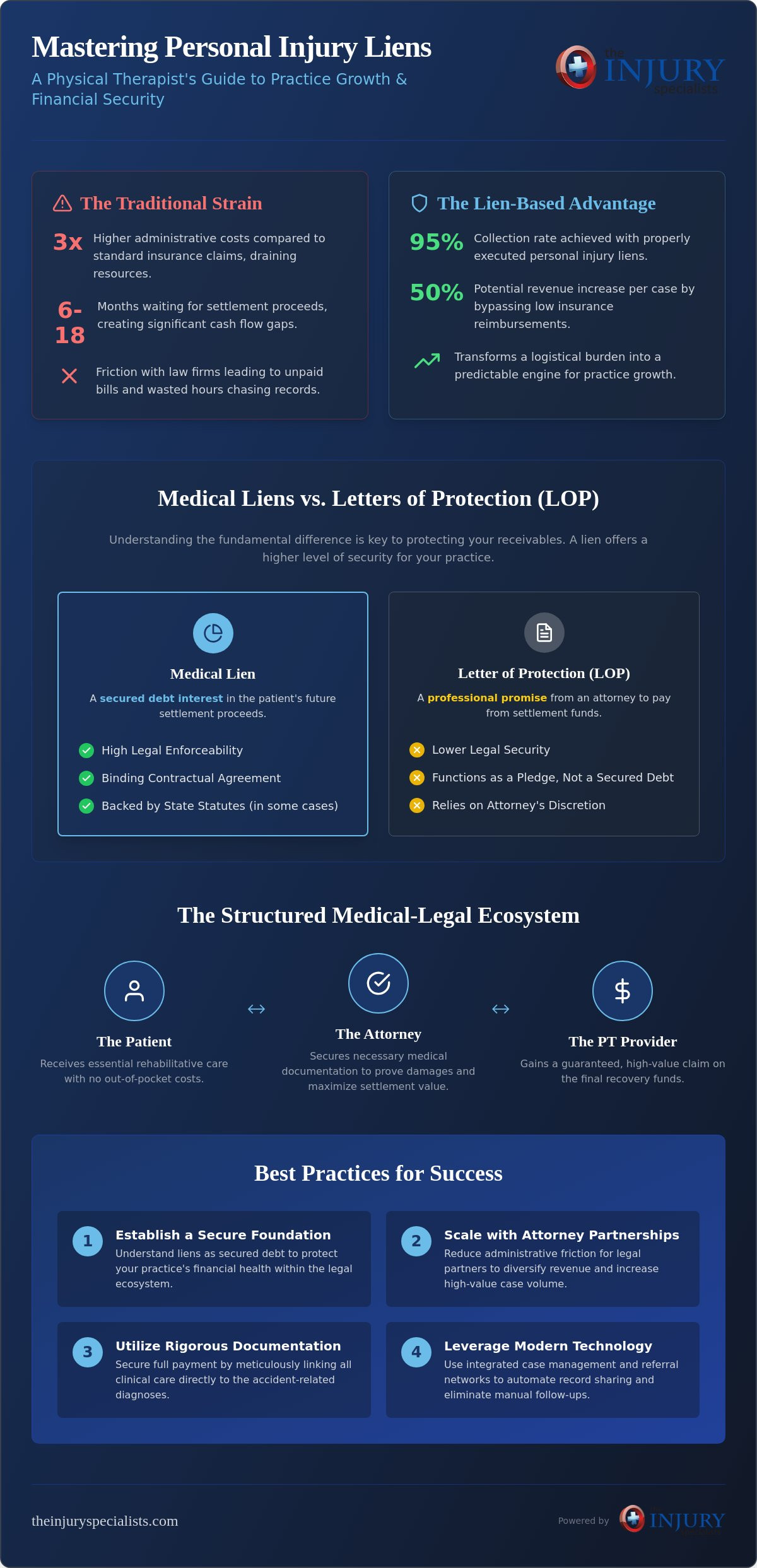
Key Takeaways
- Establish a secure financial foundation by understanding how physical therapist personal injury liens function as secured debt within the modern legal ecosystem.
- Distinguish between the legal weight of statutory liens and Letters of Protection to protect your receivables across different state jurisdictions.
- Scale your practice volume by reducing administrative friction for attorney partners and diversifying revenue beyond traditional insurance reimbursement models.
- Secure full payment at settlement by utilizing rigorous documentation standards that link clinical care directly to accident-related diagnoses.
- Leverage proprietary technology and national referral networks to automate record sharing and eliminate the burden of manual billing follow-ups.
Understanding Physical Therapist Personal Injury Liens in the Modern PI Ecosystem
Physical therapist personal injury liens are binding contractual agreements where a provider delivers rehabilitative services in exchange for a secured interest in the patient’s future settlement proceeds. By 2026, many practices have shifted toward this model to capture a larger share of the personal injury market. This move allows clinics to bypass the declining reimbursement rates of traditional health insurance while securing higher per-case revenue. It’s a pragmatic business strategy that transforms a clinical practice into a high-growth medical-legal partner. This ecosystem operates through a structured three-way relationship. The patient receives essential care without out-of-pocket costs; the attorney secures the necessary medical documentation; and the therapist gains a guaranteed claim on the recovery funds. Understanding the terminology is the first step toward risk mitigation. Consensual liens are created through specific contracts between the provider and the patient. In contrast, statutory liens are granted automatically by state law in certain jurisdictions, though these often have strict caps or filing requirements that vary significantly by state.Why Liens are Essential for Personal Injury Recovery
High-quality rehabilitation is often the most expensive component of a personal injury law claim. Liens remove the “upfront cost” barrier, ensuring patients don’t terminate treatment prematurely due to financial strain. This continuity of care isn’t just a clinical necessity; it’s a strategic legal asset. Consistent treatment records establish the “medical specials” of a case, providing the objective data attorneys need to prove damages and maximize settlement values. Without the lien framework, many patients would be forced to skip the very treatments that validate their legal claims.The Legal Validity of a PT Lien
A lien is only as strong as its execution. To remain enforceable, the agreement must include the patient’s signature, clear identification of the accident date, and explicit language regarding the provider’s right to payment from the settlement. The Attorney Acknowledgement serves as the critical step for lien security by legally binding the law firm to withhold and distribute funds directly to the provider. This document ensures the law firm can’t claim ignorance of the provider’s interest when the settlement check arrives. Even small administrative errors can jeopardize your payment. Common pitfalls include failing to notify all parties of the lien’s existence or neglecting to update the attorney on the total balance as treatment progresses. Without a disciplined system for tracking these documents, providers risk losing their priority status during final settlement negotiations. A well-managed process for physical therapist personal injury liens protects your practice’s bottom line and builds trust with legal partners who value administrative reliability.The Mechanics of Medical Liens vs. Letters of Protection (LOP)
Physical therapist personal injury liens differ fundamentally from Letters of Protection (LOP) in their legal enforceability and financial structure. A lien functions as a secured debt interest in the settlement proceeds, often backed by specific state statutes or a binding contract. An LOP is typically a professional promise from an attorney, pledging to pay the provider from the recovery funds once the case concludes. While both instruments facilitate care without upfront costs, the lien offers a higher level of security by establishing a formal claim that is harder to ignore during the final accounting phase. Jurisdictional rules dictate which instrument is most effective for your practice. For instance, in many areas, certain medical institutions may have automatic lien rights granted by local statutes, rights that outpatient clinics often do not share. This disparity means physical therapy providers must be more diligent in securing contractual liens to ensure their place in the payment queue. When these agreements are presented to insurance adjusters in a demand letter, they signal a professional, secured financial interest that carries more weight than a standard billing statement. Waiting 6 to 18 months for payment involves a significant opportunity cost. Consequently, lien-based billing usually reflects a premium over standard health insurance rates. This adjustment accounts for the time-value of money and the high administrative overhead required to manage personal injury files. To manage these complexities effectively, many growth-oriented practices use professional case management technology to automate the tracking of these financial instruments.When to Use a Lien vs. an LOP
Case risk profiles often determine the chosen instrument. In high-liability cases where a settlement is highly probable, an LOP might suffice for established attorney-provider relationships. However, in complex or contested cases, a formal lien provides essential protection against non-payment. High-volume law firms often standardize on one format to streamline their internal accounting. Some practices also work with funding companies that purchase these liens to provide the clinic with immediate liquidity, though this involves a discount on the total bill.Lien Priority and the ‘First in Time’ Rule
The payment hierarchy is generally governed by the “first in time, first in right” principle. This means the first provider to file a valid lien typically holds priority over those who file later. However, certain “super-liens” held by Medicare or Medicaid always take top priority regardless of filing dates. Hospitals also frequently hold higher statutory priority than outpatient clinics. To protect your revenue, it’s vital to file your physical therapist personal injury liens immediately at the start of treatment to secure your position before the settlement funds are depleted by other claimants.The Business Case: Scaling a Physical Therapy Practice Through Lien-Based Care
Scaling a modern physical therapy practice requires a strategic shift away from the volatility of traditional health insurance. As Medicare and private payers continue to reduce reimbursement rates, physical therapist personal injury liens offer a high-margin alternative that stabilizes long-term revenue. Accepting liens isn’t just a payment method; it’s a growth lever that positions your clinic as a high-value partner in the legal ecosystem. While traditional claims might pay in 30 days, the premium rates associated with personal injury cases often result in a 25 to 50 percent increase in revenue per patient, more than compensating for the 6 to 18-month settlement window. This model creates a “path of least resistance” for law firms. Attorneys prioritize medical providers who remove financial friction for their clients. By accepting liens, you eliminate the need for patients to pay out-of-pocket, which directly increases the likelihood of case retention for the law firm. This reliability builds intense attorney loyalty. One successful case often evolves into a recurring referral stream, transforming a single patient into a consistent source of high-value volume. The legal framework varies by region, such as the specific eligibility requirements found in the Texas hospital lien statute, which underscores why providers must understand their local statutory environment to maximize their ROI.Marketing Your Practice to PI Attorneys
Positioning your clinic as “Lien Friendly” is only the first step. To dominate the local market, your practice must provide specialized documentation that speaks the language of personal injury law. Attorneys need objective data that clearly links treatment to the accident-related diagnosis. Records that prioritize functional limitations and progress toward pre-injury status are far more valuable in settlement negotiations than standard clinical notes. Leveraging established referral networks allows you to bypass expensive traditional marketing, connecting you directly with firms that already have high case volumes ready for placement.Managing Cash Flow During the Settlement Gap
The primary challenge of a lien-based model is the delay between service and payment. Successful practices treat their lien portfolio as an investment account rather than a standard receivable. You must track “Days Sales Outstanding” (DSO) specifically for your personal injury files to maintain a clear picture of future liquidity. For clinics that need immediate capital to cover operating expenses, pre-settlement funding serves as a vital tool. This allows you to receive a portion of the expected settlement value upfront, providing the cash flow necessary to fund payroll and expansion while your high-value cases move through the legal system.Mitigating Risk: Documentation and Case Management Best Practices
The most significant threat to your bottom line isn’t the wait for payment; it’s the request for a lien reduction at the settlement table. Attorneys often pressure providers to accept 30 to 50 percent less than the total billed amount to finalize a case. Protecting physical therapist personal injury liens requires a proactive approach to clinical documentation and professional case management. When your records are bulletproof, you give the attorney the leverage they need to secure the full value of your services from the insurance carrier. Professional medical case management acts as a strategic shield for your receivables. By coordinating care between the PT clinic, referring physicians, and the law firm, these specialists ensure the treatment plan remains cohesive and stays within the scope of the legal claim. This oversight prevents the “over-treatment” arguments that insurance defense teams use to invalidate bills. Maintaining a clear line of sight between your clinic and the law firm’s paralegals ensures that everyone is aligned on the total lien balance as the case progresses toward settlement.Standardizing Records for Legal Scrutiny
Canned or repetitive notes are a major liability. Adjusters look for generic templates as an excuse to deny or reduce payment. Each progress report must tie specific treatments directly to the accident-related diagnosis. Patient compliance is equally critical. Frequent missed appointments suggest the injury is not severe, which can jeopardize the entire value of your physical therapist personal injury liens. Functional Limitation Reporting serves as a quantifiable tool for settlement justification by translating clinical progress into the objective legal evidence adjusters require.Integrating Technology for Automated Record Sharing
Administrative friction often stems from law firm staff “chasing” missing bills and records. This delay slows down the demand letter process and creates unnecessary tension between the provider and the attorney. Integrated technology platforms solve this by providing real-time access to all medical-legal documents. Using a centralized medical case management network ensures that every bill and record is automatically shared, secured, and ready for the settlement demand without manual follow-up. This automation reduces your internal labor costs while speeding up the timeline for final payment.Streamlining the Process: How The Injury Specialists Connect Providers and Attorneys
The Injury Specialists operates the largest personal injury referral network in the United States. We serve as a high-level facilitator, bridging the gap between clinical excellence and legal necessity. Our platform isn’t just a directory; it’s a comprehensive ecosystem that automates the most difficult aspects of medical-legal finance. By functioning as a strategic partner, we eliminate the logistical friction that typically stalls the payment cycle for physical therapist personal injury liens. Our technology advantage provides a world-class platform designed for national-scale case management. This system removes the burden of manual follow-ups, ensuring that every record and bill is accessible to the appropriate legal partners exactly when they need it. We’ve integrated professional medical case management into our core process to ensure care remains cohesive from the initial evaluation through the final settlement. This methodical approach maximizes lien recovery by providing the objective, well-organized data that insurance adjusters require to justify full value.Benefits for Physical Therapy Providers
Practices within our network gain a competitive edge by offloading the administrative complexities of personal injury work. We provide the tools necessary to scale volume while maintaining clinical standards. Benefits include:- Immediate access to a consistent stream of high-quality personal injury referrals from top-tier law firms.
- Reduced internal administrative costs through our automated record-sharing technology and dedicated case management support.
- Specialized marketing and networking tools designed to expand your professional footprint and build long-term referral partnerships nationwide.
- Elimination of the “chasing” of bills through a centralized system that keeps your receivables visible and organized for all parties.
