
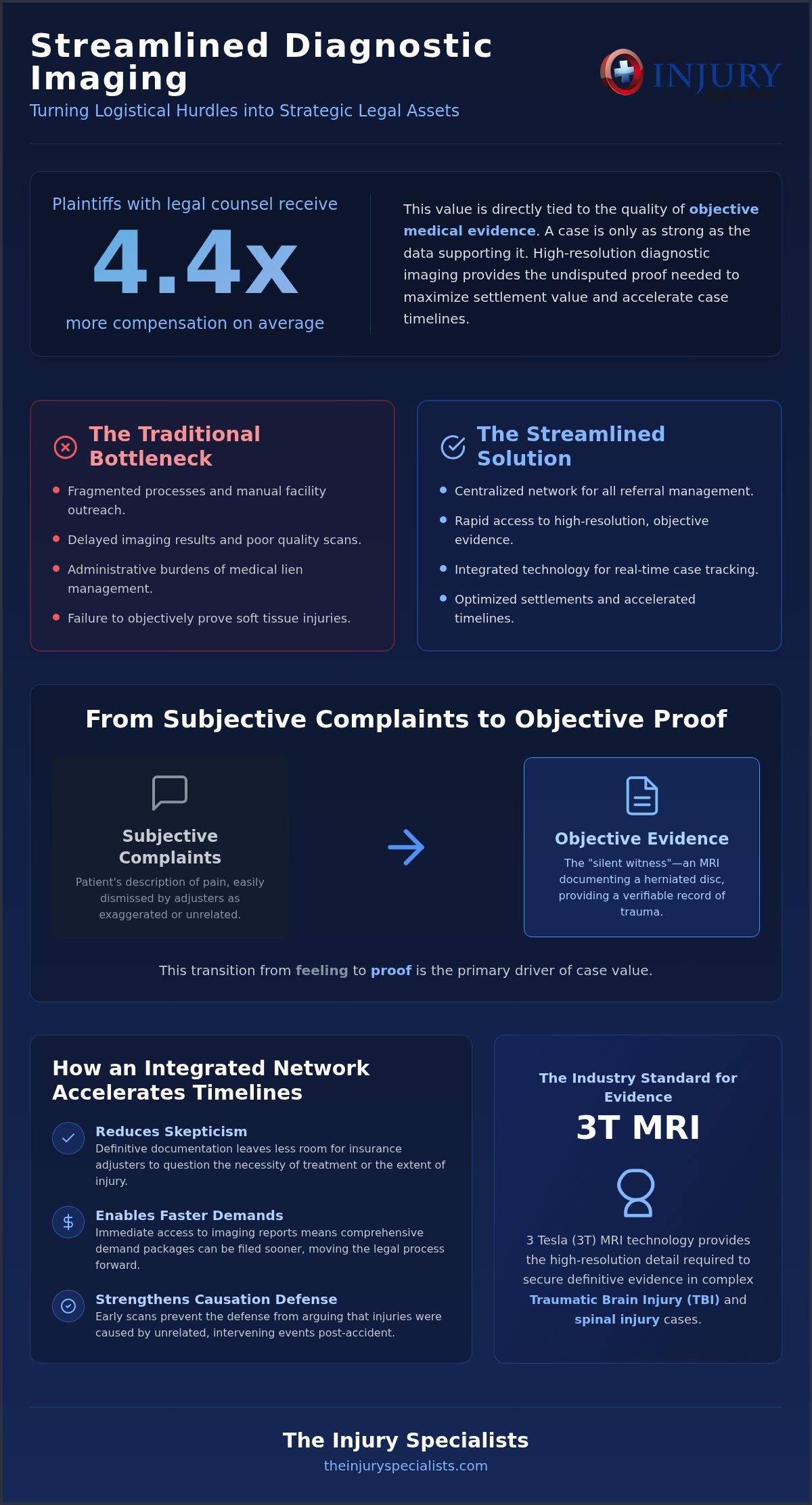
Plaintiffs who hire legal counsel receive over 4.4 times more compensation on average, but that value is strictly tied to the quality of objective medical evidence. You understand that a case is only as strong as the data supporting it. However, many firms struggle with delayed results and poor quality scans that fail to prove soft tissue injuries. Managing personal injury diagnostic imaging referrals shouldn’t be a logistical bottleneck that slows your litigation or complicates your workflow.
You can transform this challenge into a strategic legal asset by utilizing a streamlined referral network. This guide explains how a high-performance system secures objective evidence, accelerates case timelines, and optimizes settlements for your clients. We’ll examine the impact of nationwide subspecialty access and how integrated technology bridges the gap between imaging centers and law firms. It’s time to replace fragmented processes with a professional system designed for efficiency and scale.
Key Takeaways
- Discover how objective imaging data converts subjective patient complaints into verifiable medical evidence that strengthens litigation.
- Understand how a centralized network for personal injury diagnostic imaging referrals eliminates the administrative burden of individual facility outreach and medical lien management.
- Identify why 3 Tesla (3T) MRI technology has become the industry standard for securing the definitive evidence required in complex TBI and spinal injury cases.
- Learn to eliminate common bottlenecks like record retrieval delays through real-time communication and integrated case management technology.
- Explore how aligning diagnostic results with pre-settlement funding and medical case management workflows accelerates overall case resolution timelines.
The Strategic Role of Diagnostic Imaging in Personal Injury Litigation
Diagnostic imaging referrals serve as the critical bridge between a patient’s clinical symptoms and the legal proof required for a successful recovery. In the personal injury sector, a clinical diagnosis is merely a starting point. To secure a settlement that reflects the true extent of a client’s damages, attorneys must present data that cannot be disputed. This is where Forensic radiology principles become essential. By applying clinical imaging to legal questions, firms establish a clear hierarchy of evidence that stands up under the scrutiny of insurance defense teams.
The quality of personal injury diagnostic imaging referrals directly correlates with the final settlement value. High-resolution scans interpreted by subspecialty radiologists provide a level of detail that general reports often miss. When a neuroradiologist identifies a specific annular tear or a subtle traumatic brain injury, that report carries significantly more weight during depositions. This objective data moves the case from a scenario based on testimony into a fact-based negotiation. It’s a pragmatic approach to litigation that prioritizes verifiable data over narrative alone.
Objective Evidence vs. Subjective Complaints
Subjective complaints of pain are easily dismissed by adjusters as exaggerated or unrelated to the accident. Objective evidence provides the necessary counter-narrative. While a patient describes persistent radiating pain, an MRI documents the physical source, such as a herniated disc compressing a nerve root. Diagnostic imaging acts as the “silent witness” in personal injury cases, providing a visual record of trauma that remains consistent regardless of testimony. This transition from feeling to proof is the primary driver of case value. Without this objective anchor, legal teams are left defending the credibility of the victim rather than the reality of the injury.
The Impact on Settlement Timelines
Efficiency in the imaging process is a major factor in case velocity. Rapid imaging results allow legal teams to file comprehensive demand packages much sooner. When “time-to-imaging” is minimized, the causal link between the accident and the injury is much easier to defend. A streamlined process ensures the medical evidence is ready as soon as the client reaches maximum medical improvement.
- Reduced Skepticism: Definitive documentation leaves less room for adjusters to question the necessity of treatment.
- Faster Demands: Immediate access to reports means the legal process moves at the speed of the medical recovery.
- Causation Defense: Early scans prevent the defense from arguing that injuries were caused by intervening events.
By optimizing personal injury diagnostic imaging referrals, firms don’t just prove the injury; they accelerate the entire path to recovery. A well-oiled system removes the administrative friction that typically bogs down the early stages of a case.
Navigating the Personal Injury Imaging Referral Ecosystem
Managing individual facility relationships is a logistical burden that many firms can no longer afford. A centralized system for personal injury diagnostic imaging referrals replaces manual outreach with a scalable, technology-driven model. This ecosystem functions as a strategic bridge, connecting law firms with specialized providers who understand the unique requirements of medical-legal documentation. By standardizing the referral process, firms ensure that every scan is performed at a facility equipped to handle the complexities of personal injury litigation.
Referral platforms do more than just book appointments. They act as a compliance layer, ensuring that imaging centers follow established medical imaging safety standards while producing reports that meet evidentiary criteria. This oversight protects the patient’s health and the case’s integrity, providing a consistent foundation for expert testimony. Case managers play a vital role here, coordinating schedules and record retrieval to keep the attorney informed without adding to their administrative workload.
Medical Liens and Financial Accessibility
The financial mechanics of this ecosystem rely heavily on medical liens and Letters of Protection (LOPs). Many imaging centers hesitate to accept personal injury cases due to the delayed payment structure, but a professional referral network mitigates this risk. By participating in the lien-based model, providers offer injured parties immediate access to high-end diagnostics without upfront costs. This deferred payment strategy is a significant advantage for the plaintiff, as it allows them to receive essential care regardless of their current financial status. It also ensures that the cost of the scan becomes a documented part of the special damages, which are recoverable at the time of settlement.
The Network Advantage for Law Firms
Shifting from individual outreach to a nationwide network provides immediate access to a database of credentialed facilities. This transition offers several operational benefits:
- Credentialed Providers: Access centers that are vetted for subspecialty radiology and high-field equipment.
- Reporting Consistency: Standardized billing and report formats make it easier for paralegals to organize case files.
- Rapid Intake: Streamlined scheduling means new clients can be imaged within days, not weeks.
Law firms that utilize an integrated referral platform often see a significant reduction in administrative hours spent on case setup. This efficiency allows legal teams to focus on the merits of the case rather than the logistics of medical coordination. By leveraging a “power-connector” network, firms gain the reach of a national operator while maintaining the precision required for local litigation. This systematic approach ensures that personal injury diagnostic imaging referrals are handled with the same level of professional rigor as the legal strategy itself.
Overcoming Common Bottlenecks in the Referral Process
The litigation process often stalls at the medical coordination phase. Authorization hurdles, scheduling conflicts, and the slow pace of record retrieval create unnecessary gaps in the case timeline. When personal injury diagnostic imaging referrals aren’t managed through a centralized system, paralegals spend hours on manual follow-ups and repetitive phone calls. This administrative friction directly impacts the firm’s bottom line by increasing the cost per case. Real-time communication between legal and medical professionals is the only way to ensure that every diagnostic step aligns with the ACR Appropriateness Criteria. These standards provide a foundational baseline for determining the appropriate imaging for various clinical conditions, ensuring the evidence is medically sound and legally defensible.
Modern litigation requires reports delivered in a litigation-ready format. This means clear, concise findings that support the demand package without requiring extensive translation by the legal team. Integrated technology platforms remove the guesswork by automating the notification process from the moment an order is placed. When a scan is completed, the firm is notified immediately, allowing for a seamless transition to the next phase of the case. This level of transparency prevents the “black hole” effect where cases disappear for weeks while waiting for medical updates. Firms that invest in a robust medical legal networking platform gain the operational infrastructure needed to eliminate these communication gaps at scale.
Streamlining Record and Image Retrieval
Outdated methods like mailing physical CD-ROMs are a primary cause of evidentiary delays. These physical formats are prone to loss, damage, and require manual handling that slows down the discovery process. Digital access portals are now a necessity for modern personal injury law firms that value efficiency and data security. The The Injury Specialists platform automates these documentation workflows, providing secure, instant access to both raw images and finalized reports. This digital-first approach ensures that the legal team has the objective evidence they need exactly when they need it, without waiting for the mail.
Reducing Scheduling Latency
Scheduling latency is a silent case killer. Every “no-show” or scheduling error pushes the settlement date further into the future. Automated reminders and coordinated case management provide a reliable solution to these recurring problems. By synchronizing the patient’s schedule with the firm’s internal processes, you eliminate the communication gaps that lead to missed appointments and lost momentum. Optimizing personal injury diagnostic imaging referrals through these automated systems ensures that diagnostic milestones are met without constant oversight. This level of coordination keeps the case moving toward a resolution while respecting the time of both the provider and the legal team.
Key Modalities and Technical Standards for Legal Evidence
Not all personal injury diagnostic imaging referrals result in the same quality of evidence. The technical specifications of the equipment and the credentials of the reading physician determine the strength of the medical-legal narrative. While standard X-rays and CT scans are useful for identifying fractures or acute hemorrhages, they often fail to capture the microscopic trauma associated with soft tissue and brain injuries. Establishing a secure chain of custody for digital medical records is also paramount. This ensures that the data presented in court is authentic, untampered, and fully admissible from the moment of capture to the final deposition.
3 Tesla (3T) MRI has emerged as the gold standard for spinal and neurological cases. With double the magnetic field strength of standard 1.5T machines, 3T imaging provides the clarity needed to identify subtle disc herniations and nerve impingements that defense experts might otherwise overlook. This increased resolution allows for thinner slices and better tissue contrast, which are essential when documenting the permanent nature of a client’s injuries. For imaging centers seeking to position themselves as preferred providers in this space, understanding strategic marketing for imaging centers in personal injury networks is increasingly critical to securing consistent referral volume.
Advanced Imaging for Traumatic Brain Injuries (TBI)
Standard CT scans are often negative in the emergency room, even when a patient has suffered significant cognitive impairment. These scans are designed to find life-threatening bleeds, not microscopic axonal damage. Diffusion Tensor Imaging (DTI) fills this critical evidentiary gap by measuring the movement of water molecules along white matter tracts. This advanced modality provides visual evidence of traumatic axonal injury, allowing legal teams to build a concrete medical-legal narrative around “invisible” brain trauma. It transforms a subjective report of “brain fog” into a documented physical disruption of neural pathways.
Subspecialty Radiology and Expert Credibility
A diagnostic report is only as credible as the physician who signs it. In high-stakes litigation, a neuroradiologist’s reading is significantly harder for defense experts to dispute than a general radiology report. Subspecialists focus exclusively on specific anatomical regions, providing a depth of analysis that generalists cannot match. Utilizing the right physician referral services personal injury ensures your clients have immediate access to these elite specialists. This strategic alignment ensures that every personal injury diagnostic imaging referrals contributes to a litigation-focused report that stands up to intense cross-examination. Access our national network of 3T facilities and board-certified neuroradiologists by connecting with our team today.
Scaling Case Success with an Integrated Referral Network
Case success in personal injury litigation isn’t the result of isolated actions. It’s the product of a synchronized workflow that connects medical diagnostics, case management, and financial liquidity. The Injury Specialists platform acts as a high-level facilitator, aligning personal injury diagnostic imaging referrals with the specific operational needs of your law firm. By integrating these services into a single ecosystem, you remove the fragmentation that typically delays settlements and dilutes case value. This approach ensures that every medical milestone supports the legal strategy from the moment of intake.
A personal injury referral network functions as a power-connector between different professional sectors. It provides the scale and reliability needed to handle high-volume caseloads without sacrificing the precision required for individual litigation. When imaging data is seamlessly shared with case managers and legal teams, the entire timeline accelerates. This connectivity allows for a more predictable path to recovery, ensuring that the medical narrative remains consistent and verifiable across all stages of the case.
Integrating Case Management and Marketing
Proprietary technology allows firms to track every referral from intake to settlement with total transparency. You can grow your practice by tapping into an established medical network that understands the nuances of the personal injury sector. This connectivity extends beyond diagnostics. The role of personal injury physical therapy referrals is vital in the full recovery arc, providing the ongoing documentation needed to prove the extent of a client’s damages. By utilizing strategic networking tools, your firm can expand its referral partner base and create a more robust clinical foundation for every demand package.
The Role of Pre-Settlement Funding
Financial constraints shouldn’t dictate the quality of a client’s medical evidence. Pre-settlement funding ensures that victims can afford essential 3T MRIs or DTI scans without immediate financial strain. This funding also bridges the gap for providers who might otherwise hesitate to accept lien-based cases. By integrating funding into the referral process, you ensure that personal injury diagnostic imaging referrals move forward without delay. This strategy positions your firm as a full-service advocate for the client’s health and legal rights, providing a level of care that fragmented firms cannot match.
Closing the gap from the initial injury to the final settlement requires cohesive care and logistical ease. A well-oiled system replaces manual follow-ups with automated efficiency, allowing your legal team to focus on maximizing the recovery. By leveraging a nationwide network and integrated technology, you transform the diagnostic process into a strategic asset that drives firm growth and client success.
Elevate Your Litigation Strategy with Precision Diagnostics
Litigation success depends on the transition from subjective testimony to objective medical data. You’ve seen how high-resolution imaging and subspecialty reports provide the evidentiary weight needed to overcome insurance skepticism. By eliminating administrative bottlenecks and utilizing advanced modalities like 3T MRI, your firm secures a significant advantage in the negotiation room. High-quality data is the most effective tool for increasing settlement values and accelerating case timelines.
Managing personal injury diagnostic imaging referrals through a fragmented approach is no longer sustainable for growth-oriented firms. Efficiency, scale, and reliable results are the hallmarks of a professional system. Our platform acts as a strategic facilitator, bridging the gap between medical providers and legal teams. This ensures that every scan contributes to a faster and more favorable recovery for your clients.
Join the largest personal injury referral network in the United States today. Leverage our world-class case management technology and integrated pre-settlement funding to scale your practice. It’s time to streamline your operations and secure the results your clients deserve.
Frequently Asked Questions
How do diagnostic imaging referrals work in personal injury cases?
Diagnostic imaging referrals function as a formal request for objective medical data to support a legal claim. When a physician or attorney identifies a need for advanced diagnostics, they send a referral to a facility equipped for personal injury cases. These centers specialize in working under medical liens and providing reports that meet strict evidentiary standards. A network simplifies this process by coordinating scheduling and ensuring all documentation is litigation-ready.
Who pays for the MRI or CT scan in a personal injury case?
The injured party doesn’t typically pay for diagnostics out of pocket at the time of service. Imaging centers within a professional network accept medical liens or Letters of Protection (LOPs). This means the provider agrees to wait for payment until the case reaches a settlement or verdict. The final bill is then satisfied directly from the recovery proceeds, ensuring that financial constraints don’t prevent a victim from accessing essential care.
What is the difference between a 1.5T and a 3T MRI for a legal case?
A 3T MRI provides significantly higher image resolution because it has double the magnetic field strength of a standard 1.5T machine. In a legal context, this clarity is vital for proving injuries like small disc herniations or nerve damage that a lower-strength scan might miss. Defense experts find it much harder to dispute findings from a 3T scan. Choosing higher-resolution equipment during the diagnostic phase often leads to a more defensible medical narrative.
How long does it take to get imaging results for a personal injury claim?
Results are generally available within 24 to 48 hours when using a structured referral system. While the scan itself is brief, the reporting and retrieval process can be a bottleneck in fragmented systems. Integrated technology platforms eliminate these delays by providing digital portals for instant access to reports. Fast turnaround times allow legal teams to maintain case momentum and submit demand packages to insurance adjusters without unnecessary waiting periods.
Can an attorney refer a client directly to an imaging center?
Attorneys have the right to refer clients to medical providers, but doing so through a managed network offers better operational control. A network ensures that every facility is vetted for quality and understands the specific needs of personal injury litigation. It also standardizes the billing and reporting process across multiple cases. This consistency reduces the administrative burden on your staff and ensures that every referral aligns with your firm’s specific workflow.
What happens if the imaging results do not show an injury?
Negative results provide important clinical and legal clarity for the case. If a standard MRI is normal despite persistent symptoms, it may indicate the need for more specialized imaging like Diffusion Tensor Imaging (DTI) for traumatic brain injuries. Identifying what isn’t injured is just as important as identifying what is. It allows the legal team to narrow their focus and ensures the medical narrative remains accurate and defensible throughout the litigation process.
What is a medical lien in the context of diagnostic imaging?
A medical lien is a contractual agreement that allows a patient to receive imaging services immediately and pay at a later date. The provider agrees to wait for compensation until the personal injury case is resolved. This lien is filed against the eventual settlement or judgment. It’s a pragmatic solution that provides victims with immediate access to essential diagnostics while ensuring that the imaging center is compensated for its services at the end of the case.
How does a referral network improve my personal injury case settlement?
A network increases settlement values by securing high-quality, objective evidence that is difficult for insurance companies to ignore. By streamlining personal injury diagnostic imaging referrals, the network ensures that subspecialty radiologists interpret every scan. These expert reports carry significant authority during negotiations. Faster case timelines and definitive medical proof reduce the defense’s ability to delay or devalue the claim, leading to more favorable and efficient outcomes for the client.
