

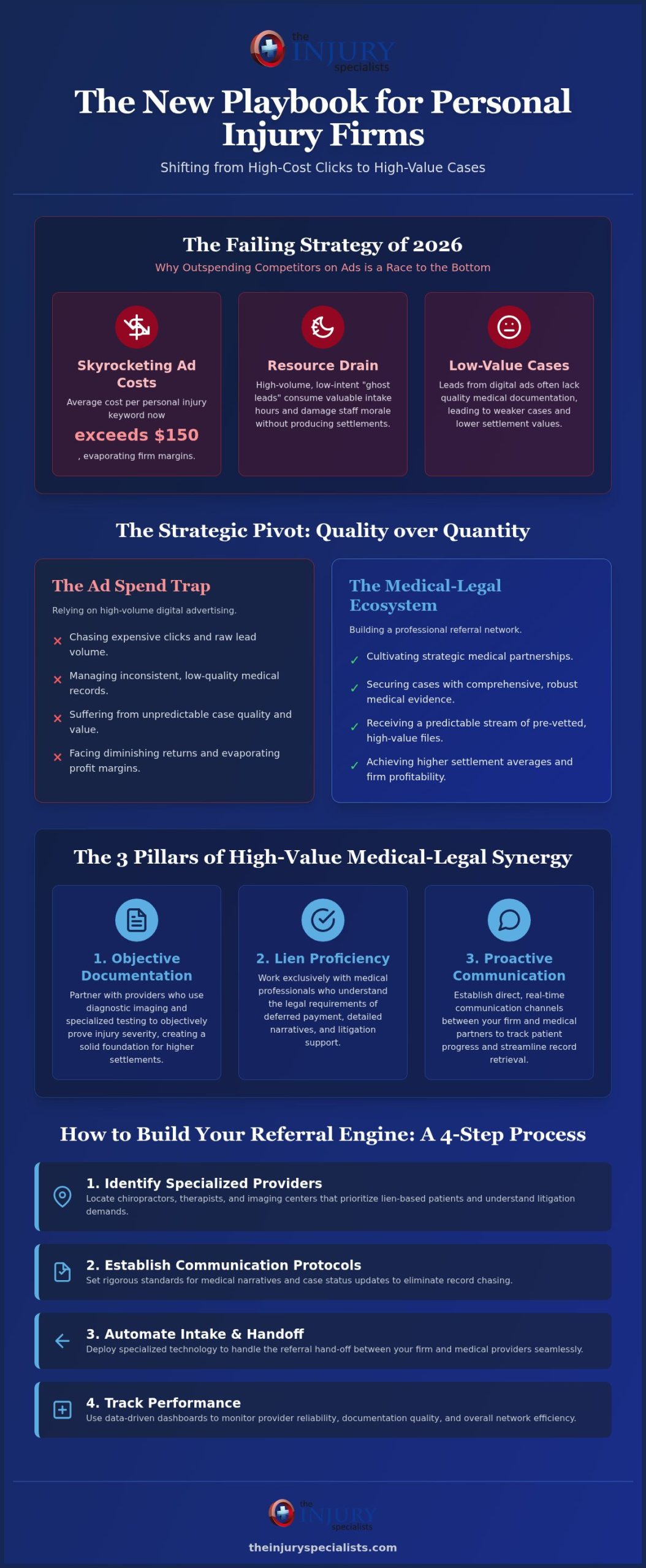
Scaling a firm by outspending competitors on Google Ads is a failing strategy in 2026. With the average cost for a personal injury keyword now exceeding $150, firms that rely solely on digital bidding are seeing their margins evaporate. You likely recognize that high lead volume doesn’t equate to high case value, especially when those leads come with inconsistent medical documentation or providers who don’t grasp the lien process. If you want to learn how to get better personal injury cases, you must stop chasing clicks and start building a superior medical-legal infrastructure.
This article details the strategic shift from expensive, low-quality lead generation to a high-value medical-legal networking model. You’ll discover how to secure a predictable stream of quality cases by leveraging specialized referral programs and integrated case management technology. We will show you how to coordinate more effectively with medical providers to increase settlement values and streamline your operations, ensuring your firm dominates the market through professional synergy rather than just a massive ad budget.
Key Takeaways
- Transition from high-cost digital lead generation to high-value medical-legal networking to secure cases with superior documentation.
- Learn how to get better personal injury cases by prioritizing clear liability and robust medical evidence over raw lead volume.
- Implement integrated medical case management to bridge the gap between treatment and litigation while reducing administrative overhead.
- Utilize a specialized technology stack for real-time referral tracking and seamless communication with your medical partners.
- Leverage a national referral ecosystem to scale your firm’s growth through a consistent stream of high-quality professional referrals.
The Shift from Lead Volume to Case Quality in 2026
High-volume lead generation is no longer a viable path to firm profitability. Understanding how to get better personal injury cases requires a fundamental pivot from raw data acquisition to strategic asset cultivation. A “better” case in 2026 is defined by two non-negotiable factors: indisputable liability and comprehensive, high-quality medical evidence. Traditional digital marketing channels are yielding diminishing returns as saturated markets drive the average cost per personal injury keyword above $150. The new standard for growth is the Medical-Legal Ecosystem. This is a structured network where legal expertise and medical documentation integrate to maximize case value without a proportional increase in ad spend. By focusing on case quality, firms can achieve higher settlement averages while reducing the overhead associated with managing low-value files.
The Problem with Commodity Lead Generation
Commodity leads often lack the necessary intent or medical history to justify the intake time. These high-volume, low-intent inquiries drain firm resources and damage staff morale by forcing intake teams to sift through hundreds of non-viable files. Rising acquisition costs in the personal injury law sector have turned traditional PPC into a race to the bottom. Intake departments spend hours chasing “ghost leads” that never sign or lack actionable damages. Junk leads represent the single greatest threat to firm profitability in 2026 because they consume billable hours without producing compensable settlements.
Defining High-Value Medical-Legal Synergy
High-quality medical documentation serves as the essential foundation for higher settlements. Insurance adjusters and defense counsel evaluate files based on the objective data provided by treating physicians. Success depends on partnering with medical providers who specialize in the personal injury lien process. These professionals understand the necessity of detailed narratives and the logistical requirements of litigation support. Building a referral ecosystem is the most effective way to learn how to get better personal injury cases while maintaining a lean marketing budget. Firms that don’t adapt to this model will find themselves priced out of the market by competitors with superior medical partnerships. Focus on these three pillars:
- Objective Documentation: Using providers who utilize diagnostic imaging and specialized testing to prove injury severity.
- Lien Proficiency: Working with medical professionals who understand the legal requirements of deferred payment and case resolution.
- Proactive Communication: Establishing a direct line between the firm and the medical facility to track patient progress in real-time.
Shift your focus from finding individual clients to building professional referral pipelines that deliver consistent, pre-vetted cases. This transition allows you to increase case volume while ensuring every new file meets your firm’s standards for quality.
Leveraging Professional Medical-Legal Referral Networks
If you want to know how to get better personal injury cases, look past your marketing department and toward your referral infrastructure. While many firms wait for the phone to ring, market leaders build systems. A professional personal injury referral network operates as a high-efficiency engine for case acquisition. It replaces the uncertainty of digital ads with the reliability of professional partnerships. This approach treats case volume as a logistical challenge rather than a creative one.
Implementing a scalable network requires a methodical four-step process:
- Identify Specialized Providers: Locate chiropractors, physical therapists, and imaging centers that prioritize lien-based patients and understand litigation timelines.
- Establish Communication Protocols: Set rigorous standards for medical narratives and case status updates to ensure your legal team isn’t chasing records.
- Automate Intake: Deploy a law firm medical referral program to handle the hand-off between the firm and the provider seamlessly.
- Track Performance: Use data-driven dashboards to monitor provider reliability, documentation quality, and patient compliance.
Why Attorneys Need a Chiropractic Referral Network
Chiropractic care is often the primary touchpoint for personal injury claims. A specialized chiropractic referral network for personal injury attorneys ensures that conservative care is documented correctly from day one. This consistent documentation is vital for proving the long-term impact of soft tissue injuries to insurance adjusters. You need providers who understand how to navigate medical liens without creating administrative friction for your staff. Immediate care doesn’t just help the patient; it anchors the case’s medical necessity early in the lifecycle. Chiropractic providers who invest in chiropractor personal injury marketing strategies are often the most prepared to integrate seamlessly into a firm’s referral ecosystem, as they already understand the legal and documentation requirements that drive case value.
Integrating Diagnostic Imaging for Evidence-Based Claims
Objective evidence is the bedrock of high-stakes litigation. Utilizing personal injury diagnostic imaging referrals allows firms to identify traumatic brain injuries or spinal disc herniations that might otherwise go unnoticed. Imaging centers must prioritize PI timelines to ensure MRI or CT reports are ready for demand letters. This proactive approach is a primary method for how to get better personal injury cases because it transforms subjective complaints into objective, compensable data. Firms looking to scale should consider joining an established physician referral network to gain immediate access to these professional pipelines and stabilize their case volume.
Utilizing Integrated Medical Case Management for Higher Settlements
Integrated medical case management serves as the vital bridge between a patient’s clinical treatment and the firm’s litigation strategy. It isn’t merely an administrative layer; it’s a strategic tool designed to maximize case value. By coordinating care from the initial referral through to the final discharge, this system eliminates the “administrative drag” that typically bogs down paralegals and attorneys. This efficiency is a core component of how to get better personal injury cases, as it ensures every file is settlement-ready from day one.
Coordinated care prevents the “gaps in treatment” that insurance adjusters routinely exploit to devalue claims. When a firm utilizes integrated management, they ensure that medical documentation is continuous, objective, and legally sound. This level of oversight allows attorneys to increase personal injury case volume by offloading the logistical burden of medical tracking. You can handle more clients without sacrificing the individual attention each case requires because the system manages the treatment timeline for you.
Closing Gaps in Treatment and Documentation
Consistent medical records are the primary factor in successful settlement negotiations. Insurance carriers look for any lapse in care to argue that an injury has resolved or was never serious. A dedicated case manager ensures patients follow through with prescribed therapy and diagnostic appointments, maintaining a “clean” medical timeline. Rather than waiting until the end of a case to request a massive stack of records, integrated management collects bills and narratives in real-time. This proactive approach ensures that your demand letters are supported by a complete medical history without last-minute delays.
Reducing Firm Overhead Through Outsourced Expertise
Utilizing a network’s built-in case management infrastructure provides a significant financial advantage. It allows your firm to scale rapidly without the need to hire a massive in-house medical records department. You can position your firm as a “high-touch” advocate for victims while keeping internal labor costs low. This outsourced expertise ensures that your team remains focused on legal strategy and trial preparation rather than chasing down providers for missing notes. It’s a pragmatic solution for firms that want to discover how to get better personal injury cases while maintaining a lean, high-growth business model. Partnering with chiropractic providers who have implemented scalable chiropractor personal injury marketing systems further reduces this overhead, as these clinics are already equipped with the infrastructure to handle high-volume lien-based cases efficiently.
- Scalability: Add cases without increasing headcount.
- Accuracy: Professional oversight reduces errors in medical billing and coding.
- Speed: Real-time record collection accelerates the demand phase.
Modernizing Case Acquisition with Specialized Technology Platforms
Success in 2026 requires a tech stack that does more than store files. If you’re wondering how to get better personal injury cases, you need a system that facilitates professional connectivity rather than just internal organization. Generic legal software often focuses on basic task management. Specialized personal injury case management technology focuses on external growth by bridging the gap between your firm and your medical partners. This transparency ensures that both parties are aligned on case status, treatment progression, and lien accuracy through real-time communication channels.
A robust platform automates the most labor-intensive aspects of the case lifecycle. This includes automated medical record collection and real-time lien tracking. Instead of relying on manual follow-ups, the technology triggers requests based on treatment milestones. This automation reduces human error and significantly accelerates the demand phase of your claims. It also provides networking tools designed to identify and cultivate new referral sources, allowing your firm to scale its case volume without a proportional increase in administrative staff.
The Power of a Unified Networking Platform
Standard legal software often acts as a silo, preventing efficient collaboration with outside providers. A unified networking platform solves this by allowing seamless handoffs between medical facilities and legal teams. When a doctor refers a patient, the data flows directly into your system with HIPAA-compliant security. This immediate integration prevents data loss and ensures that high-intent cases don’t slip through the cracks. Secure, encrypted channels are mandatory for maintaining data integrity and professional trust in the modern legal market.
Leveraging Data to Identify Top-Performing Partners
Technology allows firms to move from intuitive decision-making to data-driven strategy. You can track which medical providers yield the highest settlement multipliers and which ones cause delays in the case lifecycle. Automated reporting identifies bottlenecks, such as slow record turnaround or inconsistent documentation quality. By analyzing this data, you can prioritize high-potential cases and strengthen relationships with your most reliable partners. This analytical approach is the most efficient way to learn how to get better personal injury cases while optimizing your firm’s ROI.
To scale your firm effectively, you must utilize a world-class technology platform that bridges the gap between legal strategy and medical documentation.
Scaling with The Injury Specialists Referral Ecosystem
The Injury Specialists provides the definitive solution for firms focused on high-level expansion. As the largest personal injury referral network in the United States, we offer a technology-driven ecosystem that bridges the gap between legal strategy and medical documentation. Joining this national network grants your firm an immediate competitive advantage by replacing passive marketing with active professional connectivity. This is the most direct path for any firm seeking how to get better personal injury cases without the volatility of traditional lead generation.
The Attorney Referral Program focuses on growing your referral partner base through structured networking and world-class technology. We don’t just provide leads; we provide a framework for professional synergy. This system allows you to increase your personal injury case volume while maintaining the high standards of documentation required for maximum settlements. Our platform ensures that every referral is tracked and managed with precision, giving you full visibility into your growth pipeline.
A Turnkey Solution for Growth-Minded Firms
The Injury Specialists integrates medical case management based on your firm’s distinct processes. We provide immediate access to a vast ecosystem of physicians, chiropractors, and imaging centers already proficient in the lien process. This “power-connector” status is more valuable than any single ad campaign because it builds long-term, sustainable growth. Your firm benefits from a well-oiled system that handles the logistics of care coordination, allowing your attorneys to focus on litigation. This turnkey approach eliminates the need for expensive in-house administrative expansion, as the network handles the heavy lifting of provider outreach and record management.
Ensuring Financial Stability for Victims and Providers
Stabilizing a case often requires more than just legal expertise. Providing pre-settlement funding for injury victims is a strategic necessity in high-stakes litigation. This funding ensures victims can afford necessary care and living expenses during the case lifecycle, preventing premature settlements due to financial desperation. It bridges the gap between medical providers and attorneys, ensuring uninterrupted treatment and consistent documentation. When victims have financial stability, they are more likely to complete their treatment plans, which directly impacts the final case value. Firms that utilize these tools understand how to get better personal injury cases by providing a stable environment for both the client and the clinical team. Join the network to start receiving better cases today and position your firm as a dominant leader in the personal injury sector.
Dominate the 2026 Personal Injury Market
The personal injury landscape in 2026 demands a departure from outdated, high-cost lead generation. Success now depends on your ability to out-coordinate the competition through superior medical-legal infrastructure. You’ve learned that case quality is built on objective medical documentation and seamless provider communication. By adopting specialized technology and integrated case management, your firm can reduce administrative drag while significantly increasing settlement multipliers.
Learning how to get better personal injury cases is no longer about finding the right keywords; it’s about joining the right ecosystem. The Injury Specialists operates the largest personal injury referral network in the United States, providing you with an advanced technology platform for seamless networking. We offer integrated medical case management tailored to your firm’s distinct processes, ensuring your case volume grows without sacrificing quality.
Join the largest personal injury referral network in the United States today.
Take the first step toward a more predictable, high-value practice. We look forward to facilitating your firm’s next phase of growth.
Frequently Asked Questions
How do I increase my personal injury case volume without increasing my ad spend?
Shift focus to professional medical-legal networking. By building relationships with chiropractors, imaging centers, and physical therapists, you create a reciprocal referral pipeline. This organic growth model bypasses the high cost of digital ads. It relies on the quality of your firm’s infrastructure and its ability to manage lien-based cases efficiently. This strategy allows you to scale your practice through professional synergy rather than increasing your monthly marketing budget.
What is the most effective way to get high-quality personal injury leads in 2026?
The most effective method is utilizing a specialized attorney referral program that connects you with pre-vetted medical providers. These providers treat patients with clear liability and documented injuries. This approach is the primary answer for how to get better personal injury cases in 2026. It ensures that every lead comes with established medical necessity and objective evidence, which are the foundations of high-value settlements in a competitive legal market.
Why is medical case management important for personal injury attorneys?
Medical case management bridges the gap between clinical treatment and legal litigation. It ensures that patients follow their prescribed care plans, which eliminates treatment gaps that insurance adjusters use to devalue claims. For attorneys, this reduces administrative overhead by automating the collection of medical records and bills. It allows legal staff to focus on case strategy while professional managers handle the logistics of treatment tracking and provider communication.
How do referral networks for personal injury attorneys work?
Referral networks function as a centralized ecosystem connecting legal and medical professionals. When a medical provider identifies a patient with a personal injury claim, they refer them to an attorney within the network. Conversely, attorneys refer clients to specialized medical providers who accept liens. The network uses technology to track these hand-offs, ensuring HIPAA compliance and data security while facilitating real-time status updates for both the firm and the clinical facility.
Can I get better personal injury cases through medical provider partnerships?
Yes, provider partnerships are essential for securing high-value files. When you partner with imaging centers and specialists, you gain access to objective diagnostic data like MRIs and CT scans early in the case lifecycle. This is a proven strategy for how to get better personal injury cases because it transforms subjective complaints into verifiable medical evidence. These partnerships ensure that your cases are built on a solid clinical foundation from the initial intake.
How does pre-settlement funding help a personal injury firm grow?
Pre-settlement funding stabilizes cases by providing victims with immediate liquidity for living expenses and medical care. This prevents clients from accepting low-ball settlement offers out of financial desperation. For a firm, this stability allows for longer litigation timelines, which often result in higher settlement values. It also ensures that medical providers are confident in the case’s financial viability, fostering stronger long-term referral relationships and enabling consistent firm growth.
What technology is needed to manage personal injury medical referrals?
You need a specialized technology platform that integrates referral tracking, secure document sharing, and real-time communication. Standard legal software often lacks the connectivity required for external medical-legal networking. A world-class system should offer automated medical record collection, lien management dashboards, and HIPAA-compliant data encryption. This technology streamlines the intake process and provides the data analytics necessary to identify your most profitable medical partners and treatment pathways.
How can I find doctors who take personal injury liens nationwide?
The most efficient way is to join the largest personal injury referral network in the United States. These networks maintain extensive databases of pre-vetted physicians, chiropractors, and imaging centers who specialize in lien-based care. Instead of manual outreach, you gain immediate access to a nationwide ecosystem of providers who understand the legal requirements of personal injury documentation. This infrastructure allows your firm to scale nationally with reliable medical partners in any jurisdiction.
