

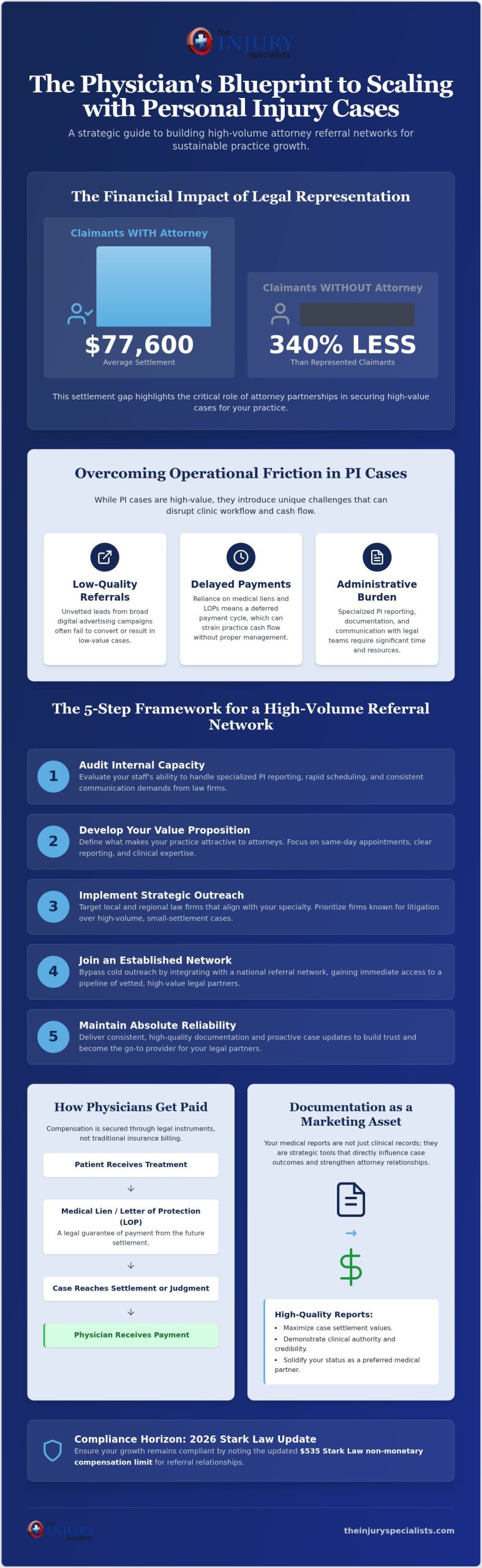
Research confirms that claimants with attorney representation receive average settlements of $77,600, which is 340% more than those without legal counsel. For a medical practice, this data point highlights the clear financial incentive for a robust personal injury marketing for physicians strategy. You already know that these cases represent high-value opportunities, yet they often come with operational friction. Low-quality referrals, delayed payments on medical liens, and the heavy administrative burden of documentation can stall even the most efficient clinics.
This article provides the strategic networking and case management frameworks required to scale your practice through high-volume, reliable referrals. You will learn how to build partnerships with top-tier law firms that respect your clinical autonomy and documentation requirements. We will also examine the 2026 regulatory landscape, including the updated $535 Stark Law non-monetary compensation limit, to ensure your growth remains compliant and profitable. This is your blueprint for transforming case management from a bottleneck into a competitive advantage.
Key Takeaways
- Understand the mechanics of medical liens and Letters of Protection (LOP) to secure physician compensation outside the traditional insurance model.
- Audit your practice’s internal capacity and develop a high-value professional proposition to attract and maintain partnerships with top-tier law firms.
- Transform medical documentation and narrative reports into strategic marketing assets that maximize case settlement values for your legal partners.
- Implement a scalable personal injury marketing for physicians framework by using dedicated case management technology to eliminate administrative friction.
- Leverage national referral networks to build a steady stream of high-value PI patients without the high costs of unproven digital advertising.
Understanding the Personal Injury Ecosystem for Medical Practices
The personal injury market operates on a logic entirely distinct from traditional health insurance. In a standard medical model, providers bill payers for services rendered and receive reimbursement according to a set schedule. In the medical-legal sector, you are treating a patient based on a future settlement. This shift requires a specialized approach to personal injury marketing for physicians because your primary business relationship isn’t with an insurance carrier; it’s with the law firm representing the claimant.
In this ecosystem, personal injury law dictates the pace of practice growth. Attorneys act as the gatekeepers of patient flow. By 2026, the most successful practices have moved away from reactive marketing, where they wait for patients to walk in, toward proactive referral networking. They treat law firms as high-value clients who require specific service levels, including rapid scheduling and precise documentation. If you don’t treat the attorney as the primary customer, your referral pipeline will remain inconsistent.
The Financial Mechanics of PI Referrals
Physician compensation in these cases usually relies on a medical lien or a Letter of Protection (LOP). These documents serve as a legal guarantee that the provider will be paid from the final settlement or judgment. While this model offers higher reimbursement rates than standard health insurance, it introduces a deferred payment cycle. This delay can stress practice cash flow if not managed correctly. Integrated networks often utilize pre-settlement funding to bridge these gaps, allowing clinics to maintain liquidity while waiting for cases to resolve. High-settlement outcomes depend heavily on the quality of your medical documentation, making detailed reporting a direct driver of your practice’s financial health.
Identifying High-Value Legal Partners
Not all law firms provide the same value to a medical practice. Volume firms focus on high-turnover, small-settlement cases, while litigation firms handle complex, high-value claims that require more intensive medical intervention. Your personal injury marketing for physicians efforts should target firms that align with your specialty and geographic footprint. Reliability is the currency of this market. Attorneys prioritize providers who offer clear communication and consistent documentation. Joining an established network for physician referral services personal injury provides immediate access to these top-tier legal partners, bypassing the need for manual outreach and unverified leads.
Building a High-Volume Attorney Referral Network
Digital advertising for medical practices has become prohibitively expensive. With over 164,000 personal injury attorneys in the U.S. market, the competition for patient acquisition is fierce. Traditional PPC and social media campaigns often yield low-quality leads that don’t convert. Successful personal injury marketing for physicians relies on a B2B referral model rather than a B2C advertising model. You aren’t just looking for patients; you’re looking for professional partners who manage hundreds of cases annually.
To build a high-volume pipeline, follow this five-step framework:
- Step 1: Audit internal capacity. Ensure your staff can handle specialized PI reporting and aggressive scheduling demands.
- Step 2: Develop a Value Proposition. Attorneys prioritize providers who offer same-day appointments and clear, jargon-free communication.
- Step 3: Implement strategic outreach. Target local firms that specialize in litigation rather than just high-volume settlement.
- Step 4: Join a network. Bypass the cold-calling phase by joining an established personal injury referral network.
- Step 5: Maintain reliability. Provide consistent case updates to ensure the legal team is never left guessing about a patient’s status.
Direct Outreach vs. Network Integration
Many practices consider hiring an in-house liaison to manage attorney relationships. While this provides a personal touch, it’s often inefficient and costly. Centralized networks offer immediate access to vetted legal partners without the overhead of a dedicated marketing salary. Physicians must balance growth with their ethical obligations for physicians when entering these partnerships. Strategic networking allows you to build professional equity by providing consistent, high-quality care that law firms can rely on for years.
The ‘Power-Connector’ Mentality
Position your practice as a facilitator of the entire recovery process. You aren’t just a medical provider; you’re a strategic partner in the patient’s legal and physical journey. By collaborating with imaging centers and chiropractors, you create a “Care Loop” that keeps the patient within a trusted circle of providers. This holistic approach makes your practice more attractive to law firms. Becoming a recognized injury specialist increases your marketability by demonstrating a deep understanding of the medical-legal landscape. Joining an established personal injury referral network is the most direct path to scaling your patient volume while maintaining these critical professional connections.
Optimizing Medical Documentation as a Marketing Asset
In the medical-legal sector, your medical records are the product you deliver to your primary customer: the attorney. While clinical care is your priority, the documentation of that care is what determines the financial outcome of a case. High-quality personal injury marketing for physicians isn’t just about networking at events; it’s about producing narrative reports that maximize settlement values. When an attorney receives a report that clearly establishes causation and future care needs, you become an indispensable asset to their firm.
Poor documentation is the fastest way to kill a referral relationship. Inconsistent notes, gaps in treatment, or a failure to address pre-existing conditions can compromise a case during deposition. Standardizing your intake and discharge summaries ensures that every file survives legal scrutiny. Attorneys need to see a logical progression from the initial trauma to the final prognosis. By providing this clarity, you reduce the legal team’s workload and solidify your reputation as a reliable expert. Law firms that know how to find doctors for personal injury cases who meet these documentation standards gain a significant competitive advantage in maximizing settlement outcomes.
The Anatomy of a High-Value Medical Report
A high-value report prioritizes objective findings over subjective complaints. While patient pain scales are relevant, insurance adjusters and defense counsel focus on MRI results, EMG studies, and functional capacity evaluations. Your reports must explicitly link these findings to the accident event. Include detailed projections for future medical costs, as these figures often drive the final demand package. To maintain professional integrity and avoid conflicts of interest, physicians should stay informed on ethical guidelines regarding Physician Self-Referral and financial transparency.
Reducing Friction for Law Firm Paralegals
Paralegals often decide which doctors receive the next referral based on how easy it is to get records. If your office takes weeks to respond to a request, you’re creating a bottleneck that costs the law firm money. Implementing a seamless case management system for records requests acts as a silent referral engine. Fast turnaround times and organized digital files make your practice the preferred choice for busy legal teams. Utilizing professional medical case management for personal injury allows you to automate these data flows. This efficiency is a core component of successful personal injury marketing for physicians, as it demonstrates that your practice values the attorney’s time as much as the patient’s health.
Leveraging Technology and Case Management for Scalability
Manual case tracking is a liability for any practice aiming for high-volume growth. Spreadsheets fail to scale when you’re managing hundreds of active medical liens across dozens of different law firms. To succeed in 2026, your practice must implement a digital infrastructure that bridges the communication gap between medical billing and legal settlement. Effective personal injury marketing for physicians relies on your ability to provide real-time data to legal partners without increasing your staff’s administrative workload.
Technology allows you to automate case status updates, ensuring attorneys stay informed without manual intervention. This level of transparency builds professional trust and encourages repeat referrals. Data analytics further refine your strategy by tracking referral ROI and identifying which firms provide the highest-value cases. By monitoring case lifecycle duration, you can optimize your internal workflows to ensure faster resolutions and more predictable cash flow. When you eliminate the guesswork of case management, you transform your practice into a high-efficiency referral engine. Understanding how medical case management for personal injury directly impacts case value is essential for any practice looking to align clinical outcomes with maximum settlement potential.
The Role of a Medical-Legal Networking Platform
Attorneys prioritize medical providers who integrate into their existing digital workflows. A centralized platform allows for the secure sharing of LOPs, medical records, and billing statements in a single environment. This reduces the friction of records requests and ensures that the legal team always has the latest documentation for their demand packages. Utilizing dedicated personal injury case management technology ensures that your practice meets the technical standards of top-tier litigation firms. These systems facilitate professional data sharing while maintaining strict HIPAA compliance. When you adopt the same technology used by the nation’s largest firms, you position your practice as a sophisticated, tech-forward partner.
Scaling Through Integrated Case Coordination
Administrative friction is the primary barrier to medical practice expansion in the personal injury sector. Integrated case coordination offloads this burden from your front-office staff by centralizing communication and documentation. This is especially critical when managing patients who require care across multiple specialties, such as orthopedics, neurology, and physical therapy. A unified system ensures that every provider in the care loop is aligned, preventing gaps in treatment that could devalue a legal claim. The strategic implementation of these tools directly impacts your volume of personal injury patient referrals. By demonstrating logistical ease, you make it simpler for law firms to send you their most complex and high-value cases. To see how these systems work in practice, you can schedule a demonstration of our case management technology today.
Accelerating Practice Growth with The Injury Specialists
The Injury Specialists operates the largest personal injury referral network in the United States. We serve as the primary facilitator for physicians who want to bypass the volatility of traditional marketing. Most personal injury marketing for physicians strategies fail because they rely on expensive, unproven digital ads that don’t target the actual B2B referral source. Our ecosystem eliminates this waste by providing direct, established pathways to top-tier law firms.
Our proprietary case management technology streamlines the entire lifecycle of a case, from the initial intake to the final settlement. By joining our network, you gain access to world-class tools that reduce administrative friction and ensure your practice remains compliant with the latest 2026 regulations. We prioritize professional synergy and results, connecting you with partners who value your medical expertise and documentation quality. This focus on efficiency allows you to scale your practice without the typical growing pains of the medical-legal sector.
Why Physicians Choose Our Network
Connectivity is our greatest asset. Physicians in our network gain instant access to a vast base of personal injury law firms actively looking for reliable medical partners. We provide integrated support for personal injury diagnostic imaging referrals, ensuring that every piece of medical evidence is captured and documented correctly. This level of coordination ensures that your practice isn’t just treating patients, but also building a reputation for logistical excellence. Our proven systems for medical case management allow you to handle a higher volume of cases without overwhelming your front-office staff.
Next Steps: Becoming a Preferred Provider
We maintain high standards for our partners to ensure the ongoing integrity of our national ecosystem. The application and vetting process for medical professionals focuses on clinical specialty, geographic location, and a commitment to rigorous, timely documentation. Once accepted, you can immediately leverage our platform to grow your healthcare provider personal injury network with minimal friction. This is the most efficient way to scale your personal injury marketing for physicians while maintaining high reimbursement rates. If you’re ready to transition from manual outreach to a high-volume, tech-driven system, join the network today and start receiving vetted referrals immediately.
Future-Proofing Your Medical-Legal Strategy
The personal injury landscape in 2026 demands a shift from passive patient acquisition to active, technology-driven networking. Success requires more than clinical excellence. It hinges on your ability to deliver high-quality narrative reports and maintain seamless communication with legal partners. By optimizing your documentation and leveraging integrated platforms, you transform your practice from a medical provider into a strategic legal asset. This approach is the cornerstone of effective personal injury marketing for physicians, allowing you to capture high-value cases while minimizing administrative friction.
Efficiency and reliability are the currencies of the modern referral market. Practices that adopt professional medical-legal networking services and world-class case management technology will outperform those still relying on manual processes. You have the opportunity to join a system built for scale and professional synergy. It’s time to transition from fragmented outreach to a streamlined referral pipeline that delivers consistent results.
Scale your practice with the largest PI referral network in the U.S. today. Gain immediate access to the largest PI network in the USA and start building reliable, long-term partnerships with top-tier law firms. Your practice is ready for high-volume growth.
Frequently Asked Questions
What is the most effective marketing strategy for personal injury physicians?
The most effective strategy is a B2B referral model focused on building direct relationships with law firms. Attorneys act as the primary gatekeepers for patient flow in the medical-legal market. By focusing on professional reliability and high-quality reporting, you secure a consistent stream of high-value cases that traditional digital advertising cannot provide.
How can a medical practice get more referrals from personal injury attorneys?
You can increase referrals by demonstrating logistical ease and clinical reliability. Attorneys prioritize medical providers who offer rapid scheduling, same-day appointments, and jargon-free communication. Joining an established personal injury referral network is the fastest way to access vetted firms without the need for manual outreach or cold-calling.
Is digital marketing like Google Ads worth it for PI physicians?
Digital ads are rarely worth the investment for individual physicians in this sector. The cost per click for personal injury keywords is among the highest in the industry, and the leads are often low-quality. A referral-based approach offers a superior ROI because it targets professional partners who manage hundreds of cases annually.
What is a medical lien and how does it affect practice marketing?
A medical lien is a legal agreement ensuring the provider receives payment from the final settlement or judgment. It allows you to treat patients without requiring upfront insurance or cash payments. Marketing your practice as lien-friendly makes you a preferred choice for attorneys representing claimants who lack traditional health coverage.
How does medical documentation impact a physician’s reputation with law firms?
Documentation is your primary professional deliverable to the legal team. High-quality narrative reports that establish causation and project future care costs help attorneys maximize settlement values. Consistently producing records that survive legal scrutiny builds a reputation for reliability, making your practice a permanent fixture in a firm’s referral rotation.
Why should a physician join a personal injury referral network?
Joining a network provides instant connectivity to a national base of law firms and eliminates the volatility of solo marketing. It provides your practice with a level of professional credibility that takes years to build independently. These ecosystems also offer integrated support for case management, allowing you to scale your patient volume efficiently.
What role does case management technology play in practice growth?
Technology allows you to scale personal injury marketing for physicians by automating the status updates that attorneys require. It bridges the communication gap between your billing department and the law firm’s settlement team. Without a digital infrastructure, the administrative burden of tracking hundreds of liens will eventually stall your practice growth.
How do I handle the administrative burden of personal injury cases?
The most efficient way to manage the workload is through integrated case coordination and dedicated software. These systems centralize Letters of Protection, medical records, and billing statements in a secure environment. By offloading the logistical tracking to a specialized platform, your staff can focus on clinical care while the technology manages the legal documentation flow. A structured approach to medical case management for personal injury ensures that every administrative step is aligned with maximizing the overall value of each claim.
