

The lowest interest rate on a pre-settlement advance is worthless if the funding process delays your medical treatment or creates a lien conflict that slashes your final payout. While many plaintiffs focus solely on the cost of capital, the real value lies in how that funding integrates with your total recovery strategy. A comprehensive Provident Legal Funding comparison reveals that success in 2026 requires more than just cash; it requires a transparent partner that understands the intersection of legal finance and medical case management.
You likely realize that high compounding rates can quickly erode your settlement, leaving you with less than expected after years of litigation. We promise to provide a professional analysis of how Provident compares to industry benchmarks and the specific advantages of using integrated networks to streamline your care. This evaluation covers the impact of new 2026 regulatory requirements, the necessity of non-recourse terms, and how to ensure your funding supports a cohesive plan for both physical and financial restoration. By the end of this guide, you’ll understand how to select a funding partner that maximizes your net recovery rather than just providing a short-term fix.
Key Takeaways
- Understand the 2026 landscape for pre-settlement funding and why non-recourse models are the industry standard for plaintiff protection.
- Learn how to use the “Total Payoff” metric to calculate the long-term impact of an advance on your final settlement amount.
- Access a detailed Provident Legal Funding comparison to see how standalone cash advances measure up against integrated medical-legal networks.
- Identify the critical questions to ask any funding representative to ensure transparent terms and avoid hidden fee structures.
- Discover how bridging the gap between funding and medical case management maximizes your net recovery and ensures uninterrupted treatment.
Provident Legal Funding Comparison: Evaluating Your Pre-Settlement Options
Provident Legal Funding remains a prominent name in the 2026 pre-settlement landscape. However, choosing a partner based on brand recognition alone is a strategic error. A thorough Provident Legal Funding comparison allows attorneys and plaintiffs to evaluate the structural differences between various non-recourse options. In a market where Georgia’s SB 69 now requires litigation funders to register with the Department of Banking and Finance, transparency has become a legal mandate rather than a marketing choice. Professional legal teams must assess how a provider’s terms affect the final distribution of settlement funds.
What is Pre-Settlement Funding?
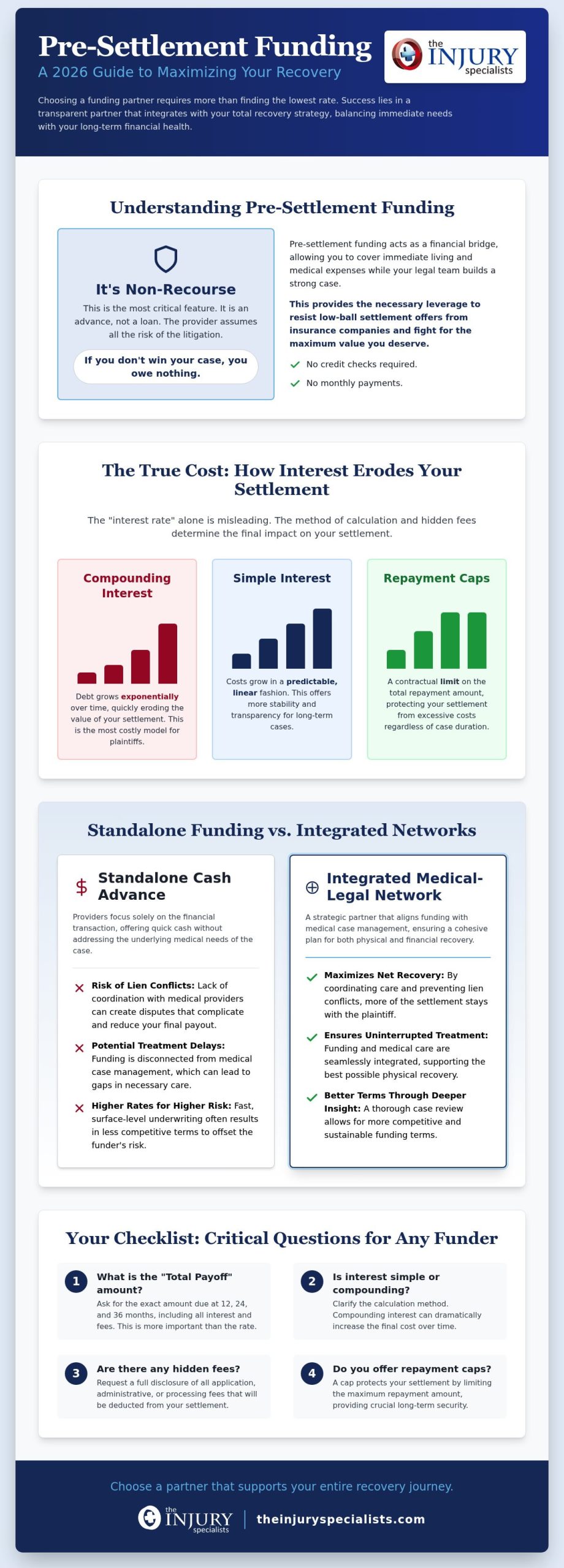
Understanding the fundamental mechanics of What is Legal Financing? is the first step in protecting a settlement. Pre-settlement funding is a non-recourse advance. This means the provider assumes the risk of the litigation; if the case doesn’t result in a recovery, the plaintiff owes nothing. Unlike traditional consumer loans, these advances don’t require credit checks or monthly payments. They function as a financial bridge. This bridge allows plaintiffs to cover immediate living expenses or medical costs while their legal team builds a case for maximum value. It provides the leverage needed to resist low-ball settlement offers from insurance companies.
Why Compare Provident to Other Providers?
Not all funding structures are created equal. A detailed Provident Legal Funding comparison highlights three critical variables that determine the long-term viability of an advance:
- Interest Accumulation: Some providers use compounding interest, where the debt grows exponentially over time. Others utilize simple interest or flat-fee caps that preserve more of the settlement for the victim.
- Fee Structures: Administrative and application fees vary significantly across the industry. These costs are deducted from the final settlement, directly impacting the plaintiff’s net recovery.
- Underwriting Depth: High-speed approvals often come with higher rates to offset the provider’s risk. A more thorough case review usually results in more competitive terms for the client.
Professional legal teams look beyond the initial check. The long-term impact on the settlement distribution determines the true cost of the capital. Identifying the core needs of a case involves balancing immediate liquidity with long-term recovery goals. A standalone funding provider might offer quick cash, but they often lack the infrastructure to coordinate with medical providers. This lack of coordination leads to lien conflicts that complicate the final stages of a case. Evaluating your options requires a focus on how the funding partner facilitates the entire recovery ecosystem.
Key Metrics for Comparing Lawsuit Funding Providers
Selecting a pre-settlement provider requires a standardized framework to ensure the financial health of the case. Many plaintiffs focus on the immediate cash advance without calculating the long-term erosion of their settlement. A professional Provident Legal Funding comparison must prioritize the “Total Payoff” metric. This metric represents the actual amount due at specific intervals, such as 12, 24, and 36 months. By focusing on the total payoff rather than just the stated interest rate, legal teams can identify which partners offer the most sustainable terms for their clients. This data-driven approach prevents surprises during the final distribution of funds.
Transparency in contract terms remains the most reliable indicator of a provider’s professionalism. Reputable firms adhere to ALFA (American Legal Finance Association) industry standards, which mandate clear disclosures of all costs. Evaluating a provider’s commitment to these standards helps avoid predatory practices that often plague the unregulated corners of the industry. For those seeking a higher level of case oversight, choosing a partner that offers integrated medical case management ensures that funding and treatment are perfectly aligned from day one.
Interest Rates and Fee Structures
The method of interest accumulation significantly alters the final repayment amount. Monthly compounding interest can cause debt to spiral; whereas semi-annual compounding or simple interest models offer more predictability. You should also look for “repayment caps.” These caps limit the total amount owed to a specific multiple of the original advance, protecting the plaintiff if the litigation lasts several years. Identifying and eliminating “junk fees”, such as high application, underwriting, or delivery charges, is essential. These costs often diminish the victim’s net recovery before the case even reaches a courtroom. A Provident Legal Funding comparison should verify if these fees are rolled into the principal or charged as separate line items.
Approval Speed and Professionalism
Efficiency in the intake process is a logistical necessity for busy law firms. A provider should review case files and issue a determination within 24 to 48 hours. While speed is vital, it shouldn’t come at the expense of a thorough review. Professionalism is often reflected in a provider’s technology stack. Platforms that streamline the workflow between the funding company and the law firm reduce administrative burdens. This connectivity ensures that attorneys spend less time on paperwork and more time on litigation. High-level facilitators prioritize this technical synergy to act as true strategic partners rather than just passive lenders.
The relationship between the provider and the firm determines the long-term success of the partnership. Providers that understand the distinct processes of different law firms can tailor their funding strategies to match. This alignment minimizes friction during the settlement phase and ensures a smooth distribution of funds. By evaluating these metrics, you can secure a funding partner that adds value to the recovery process without compromising the client’s final payout.
Standalone Funding vs. Integrated Medical-Legal Networks
Traditional pre-settlement funding operates as a siloed financial transaction. While a Provident Legal Funding comparison helps you identify competitive rates, it doesn’t address the primary logistical bottleneck of a personal injury case: securing high-quality medical care. Cash alone isn’t a strategy. It’s a resource that, if not properly managed, can be exhausted before the plaintiff reaches maximum medical improvement. True recovery requires an ecosystem where funding and clinical care work in tandem.
Standalone providers focus on the capital. They provide the liquidity but leave the plaintiff and their attorney to solve the medical puzzle. This disconnection often results in a “funding-to-care gap.” Even with cash in hand, many victims struggle to find specialists who will accept a medical lien. This friction occurs because the funding provider has no relationship with the treating physician. The two entities operate in different worlds, leaving the law firm to act as an uncompensated coordinator for both.
The Gap in Traditional Funding Models
The most significant limitation of standalone models is their isolation from the medical process. Funding providers typically don’t vet the doctors or verify the necessity of specific treatments. They simply issue an advance. This approach creates several risks:
- Lien Conflicts: Without coordination, medical liens and funding liens can exceed the total settlement value. Implementing personal injury lien management software creates the real-time visibility needed to prevent these conflicts before they derail a settlement.
- Treatment Delays: Finding a surgeon or imaging center that accepts third-party funding without an established network is time-consuming.
- Firm Inefficiency: Legal staff spend dozens of hours every month acting as a bridge between the funder and the doctor.
The Advantage of an Integrated Ecosystem
An integrated network solves these problems by functioning as a high-level facilitator. Instead of treating funding as a separate event, it links the advance directly to a curated network of physicians, chiropractors, and imaging centers. This approach ensures that the capital is used strategically to hit recovery milestones. Professional case management replaces the administrative burden on the law firm, allowing attorneys to focus on litigation rather than logistics. For a deeper look at how these systems operate, see our Ultimate Guide to Physician Referral Services.
In this model, the network acts as the power-connector. It streamlines the connection between the victim, the doctor, and the lawyer. This synergy maximizes the settlement value by ensuring a clear, documented path of treatment. When funding is part of a larger ecosystem, it becomes a tool for growth and successful case resolution rather than just a high-interest debt. This is the structural advantage that a simple Provident Legal Funding comparison often overlooks.
How to Choose the Right Funding Partner
Selecting a funding provider is a strategic decision that directly influences the trajectory of a personal injury case. A comprehensive Provident Legal Funding comparison should extend beyond a cursory look at rates. It must involve a rigorous vetting process that assesses the provider’s operational reliability and their ability to function as a seamless extension of your legal team. Vetting ensures that the funding serves its purpose as a catalyst for recovery rather than a source of administrative friction.
Start by evaluating the provider’s history with specific case types. A company that primarily handles minor soft-tissue claims may lack the underwriting sophistication required for complex traumatic brain injury or multi-party commercial vehicle litigation. A professional Provident Legal Funding comparison reveals that the best providers offer more than just capital; they offer dedicated case managers who understand the nuances of your firm’s distinct workflow. Ask for specific examples of how they manage large-scale advances and their protocols for protecting the attorney-client privilege during the documentation exchange.
Questions for Your Potential Funding Provider
Direct communication with a funding representative should yield precise answers. If a provider is evasive about their fee structure, they are likely hiding costs that will appear on the final payoff statement. Use the following checklist to evaluate any broker or direct funder:
- Interest Structure: Is the interest simple or compounding, and at what specific interval does it accrue?
- Ancillary Costs: Are there upfront application fees, delivery charges, or recurring “case maintenance” fees?
- Operational Coordination: How do you coordinate with medical providers to ensure treatment continues without interruption?
For plaintiffs, understanding these terms is critical to maintaining financial stability throughout the litigation process. You can learn more about the mechanics of these transactions in our guide to Pre-Settlement Cash Advances for Victims.
Strategic Considerations for Attorneys
Attorneys require a partner that minimizes the firm’s non-billable hours. A world-class technology platform is essential for tracking advances across multiple cases in real-time. This transparency prevents surprises during the settlement phase and allows for more accurate distribution calculations. The right partner understands that their role is to support the firm’s process, not complicate it. They prioritize professional synergy and logistical ease, acting as a power-connector between financial resources and clinical care. If you are ready to optimize your firm’s case management, partner with an integrated network today to streamline your referral and funding workflows.
Effective funding partners also stay current with evolving regulations, such as the Georgia Courts Access and Consumer Protection Act (SB 69), which requires funders to register with the Department of Banking and Finance. Choosing a provider that proactively complies with these 2026 standards protects your firm from legal complications. By focusing on these strategic metrics, you ensure that the funding partner you select contributes to a streamlined success for both the firm and the client.
The Injury Specialists: Strategic Funding and Cohesive Care
The Injury Specialists operates the largest personal injury referral network in the US, providing a level of integration that standalone providers cannot match. While a Provident Legal Funding comparison is useful for evaluating capital costs, it often highlights the limitations of traditional finance models. We transcend these models by functioning as a high-level facilitator. We don’t just facilitate funding; we integrate it into a comprehensive medical-legal ecosystem. This approach ensures that every financial advance directly supports a stronger case and a more efficient recovery process.
Our role as a power-connector allows us to bridge the gap between different professional sectors. For victims, this means immediate access to capital without the risk of treatment delays. For attorneys, it means a streamlined workflow where funding and medical documentation are managed in parallel. By selecting a partner that understands the functional utility of pre-settlement advances, you ensure that the funding serves the case rather than complicating it. A Provident Legal Funding comparison often misses this strategic synergy, focusing on the transaction rather than the total case outcome.
Bridging the Medical-Legal Gap
We connect victims with a curated network of physicians, chiropractors, and imaging centers that specialize in personal injury. These providers understand the complexities of medical liens and the necessity of detailed documentation. Our integrated medical case management ensures that care is cohesive and uninterrupted. We manage the logistics of the referral process, which significantly reduces the administrative burden on law firms. This coordination results in cleaner medical files and a more compelling narrative for settlement negotiations. By linking funding to a network of specialists, we ensure that the capital is used to hit critical recovery milestones.
The Technology Advantage
Efficiency is the cornerstone of our operations. We utilize proprietary case management technology to manage referrals and funding simultaneously. This world-class platform provides our referral partners with real-time visibility into every case. It removes the friction typically found between law firms and medical providers. Our technology supports growth for our partners by automating the tracking of advances and treatment progress. This transparency prevents the “lien surprises” that often derail settlements at the final hour.
Our platform is designed for high scannability and logistical ease. It allows legal teams to focus on litigation while we handle the complexities of the medical-legal bridge. We maintain a confident and authoritative stance as a market leader, providing the reliability that professional partners demand. Every feature of our system is built to drive streamlined success. By choosing The Injury Specialists, you are choosing a strategic partner focused on results, connectivity, and the maximization of the net recovery for every client.
Strategic Integration: The Future of Pre-Settlement Funding
Success in 2026 requires a shift from viewing pre-settlement advances as isolated financial transactions to seeing them as strategic assets within a recovery ecosystem. A thorough Provident Legal Funding comparison demonstrates that while capital is essential; the coordination of that capital with medical care is what truly maximizes a settlement. By focusing on the “Total Payoff” metric and choosing partners that prioritize transparency, legal teams protect their clients from the debt spirals often associated with unmanaged compounding interest.
The Injury Specialists provides the infrastructure needed to bridge the gap between legal finance and clinical treatment. As the largest personal injury referral network in the United States, we offer integrated medical case management and a world-class technology platform designed for professional synergy. This system ensures that every dollar of funding supports a cohesive treatment plan and a documented path to recovery. High-level facilitators don’t just provide liquidity; they provide the logistical ease required for firm growth. Connect with the largest personal injury referral network to streamline your case funding. Secure a partner that values efficiency and professional excellence as much as you do.
Frequently Asked Questions
Is Provident Legal Funding a reputable company for pre-settlement advances?
Provident is an established name in the legal finance sector, but you must distinguish it from the mortgage lender of the same name. A Provident Legal Funding comparison shows they operate on a non-recourse basis, meaning you only repay if you win. In 2026, verify their registration with state departments, such as Georgia’s Department of Banking and Finance, to ensure full regulatory compliance and consumer protection.
How do Provident’s interest rates compare to other lawsuit loan providers?
Interest rates in the pre-settlement industry typically range from 1% to 5% per month, though specific rates are determined case-by-case. Some providers have advertised set rates around 27.8% annually in specific jurisdictions. When conducting a Provident Legal Funding comparison, focus on whether the interest is simple or compounding. Compounding interest can significantly increase the total payoff amount over the life of a multi-year case.
What happens to my pre-settlement funding if I lose my personal injury case?
You owe nothing if you lose your personal injury case. Pre-settlement funding is structured as a non-recourse advance rather than a traditional loan. The funding provider assumes the entire risk of the litigation. If your attorney doesn’t secure a settlement or a favorable jury verdict, the contract terms stipulate that repayment isn’t required. This protects your personal assets from being seized to cover the advance.
Can I get pre-settlement funding if I already have a medical lien on my case?
You can obtain funding with an existing medical lien, but the provider will evaluate the total lien stack. Over-leveraging a case occurs when the sum of funding advances and medical liens exceeds the realistic settlement value. Integrated networks manage this balance by coordinating with physicians to ensure treatment continues without exhausting the available settlement funds. This prevents conflicts during the final distribution of the recovery proceeds.
How long does the approval process take when comparing different funding companies?
Most reputable funding companies complete the approval process within 24 to 48 hours after receiving the necessary case documentation from your attorney. Speed varies based on the responsiveness of the law firm and the complexity of the case. Technology platforms that integrate with firm management software can reduce this window significantly. Efficient providers prioritize quick determinations to help plaintiffs manage immediate financial pressures without delaying the litigation.
Are there hidden fees I should look for in a Provident Legal Funding contract?
Look for administrative costs that aren’t included in the stated interest rate. Common fees include application charges, underwriting fees, and expedited delivery costs. These are often deducted from the final settlement, reducing your net recovery. Always request a “Total Payoff” table that illustrates the exact amount due at six-month intervals. This transparency helps you identify fees that might be buried in the fine print of a standard contract.
Does my attorney have to agree to the pre-settlement funding?
Your attorney must agree to the funding and sign a formal acknowledgment or lien. This document confirms that the attorney will withhold the repayment amount from the settlement proceeds to pay the funding provider. Most attorneys review these agreements to ensure the terms don’t interfere with the litigation or the client’s interests. Funding providers can’t advance money without this cooperation from the representing law firm.
How does integrated case management help with the funding process?
Integrated case management connects your funding directly to your treatment plan. This ensures that the capital is used strategically to hit recovery milestones and maintain medical compliance. By linking funding with a network of physicians and imaging centers, the process becomes more efficient. This coordination reduces the administrative work for law firms and ensures that medical documentation is readily available to support a higher settlement value.
