

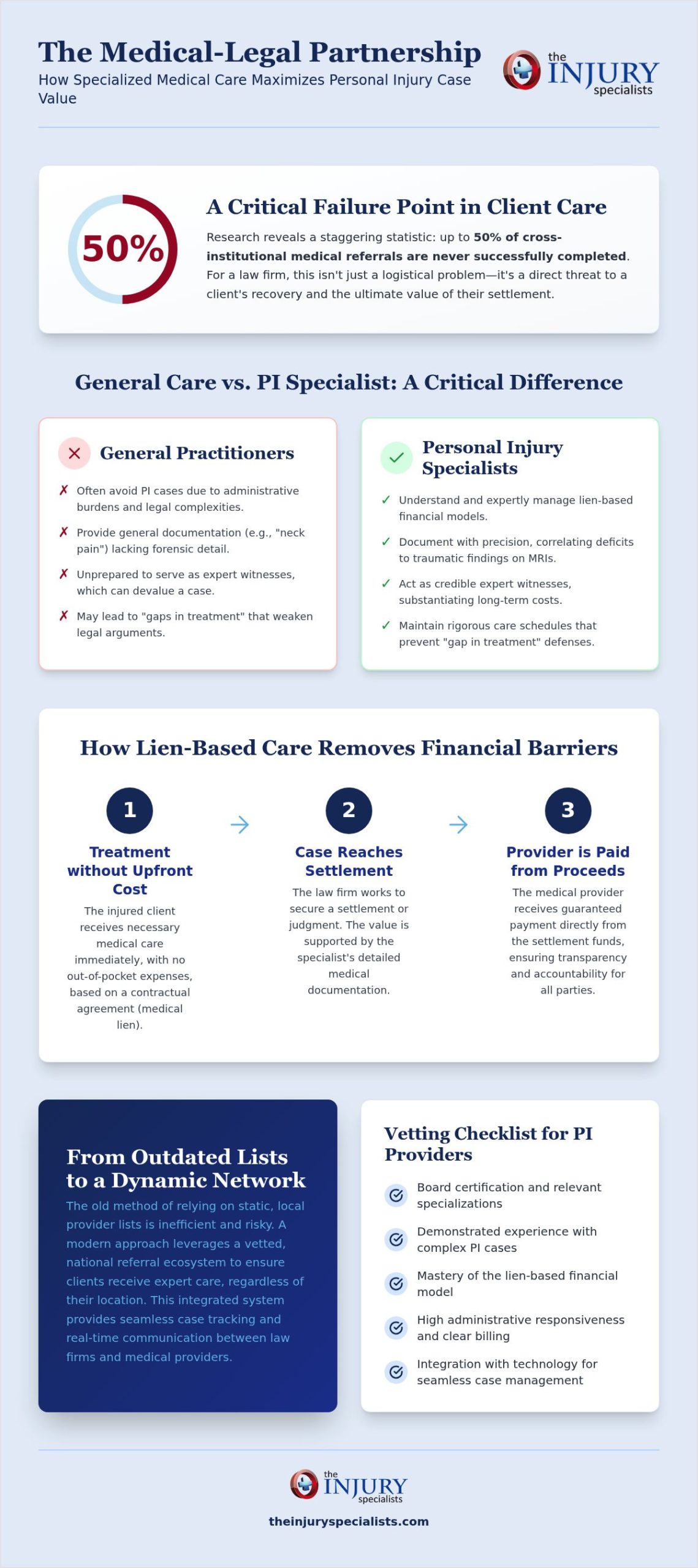
Research shows that up to 50% of cross-institutional medical referrals are never successfully completed. For a law firm, this failure rate isn’t just a logistical hiccup; it’s a direct threat to the integrity of a client’s recovery and the ultimate value of their settlement. You need a reliable way to find doctors for personal injury cases who understand the nuances of lien-based care and the necessity of precise documentation. Relying on an outdated list of local providers often leads to poor communication and inconsistent records that devalue your work.
Building a successful case requires a medical-legal partnership that functions with surgical precision. This guide provides the systematic process you need to identify, evaluate, and connect with high-quality providers who specialize in personal injury. You’ll learn how to move beyond manual searches and leverage a vetted national network to streamline your referral workflow. We’ll examine the criteria for evaluating specialists, the technology required for seamless case tracking, and the strategies for ensuring your medical documentation supports maximum case value.
Key Takeaways
- Understand why specialized medical documentation is the foundation of case value and why general practitioners typically lack the necessary expertise for PI litigation.
- Learn the specific criteria and credentials required to find doctors for personal injury cases who are equipped to handle complex lien-based care and surgical interventions.
- Discover how to transition from static provider lists to a dynamic, national referral ecosystem that ensures coverage for clients regardless of their location.
- Identify methods to integrate medical case management into your firm’s existing workflow to ensure real-time updates and consistent documentation.
- Explore how proprietary technology platforms facilitate seamless communication between law firms and medical providers to minimize settlement delays.
The Strategic Importance of Specialized Medical Providers in PI
Medical documentation serves as the primary currency in any personal injury litigation. It’s the objective evidence that translates physical trauma into a quantifiable demand. When you find doctors for personal injury cases, you aren’t just looking for clinical expertise; you’re seeking a strategic partner who understands that their records must survive the scrutiny of insurance adjusters and defense counsel. Case value isn’t subjective. It’s built on a foundation of objective data and diagnostic imaging that correlates directly to the mechanism of injury.
Many general practitioners and primary care physicians actively avoid personal injury cases. The administrative burden of managing medical liens, coupled with the potential for legal testimony, often exceeds their operational capacity. These providers focus on general wellness rather than the forensic level of detail required to prove causation. A physician who is unprepared to serve as an Expert Witness can inadvertently devalue a high-stakes case during a deposition. Specialists in the PI field understand these requirements. They provide the testimony and documentation necessary to substantiate long term disability or future medical costs.
The Difference Between General Care and PI Specialization
Specialized providers recognize that an insurance adjuster looks for specific indicators within a medical file. While a general doctor might note “neck pain,” a PI specialist documents the specific range of motion deficits and correlates them to traumatic findings on an MRI. This precision is vital for establishing a clear treatment path. Specialized clinics prioritize evidence-based, non-narcotic treatment plans. This approach demonstrates a commitment to functional recovery rather than symptom masking, which strengthens the case’s credibility in court.
Impact on Legal Outcomes and Settlements
Inconsistent care often leads to “gap in treatment” defenses that can derail a settlement. Specialized providers maintain a rigorous schedule of care that prevents these vulnerabilities. They ensure that every visit, referral, and diagnostic test is logged and communicated to the law firm in real time. This streamlined communication reduces friction and accelerates the demand package process. When you find doctors for personal injury cases who operate within an integrated system, the settlement timeline moves faster. You avoid the delays caused by missing records or unresponsive billing departments. High-stakes cases require specialists who can provide the level of detail that forces a fair settlement or supports a successful trial verdict.
Evaluating Credentials and Lien-Based Capabilities
Identifying the right medical provider requires a rigorous vetting process that goes beyond simple clinical competence. When you find doctors for personal injury cases, you must verify their operational alignment with the legal industry’s specific needs. This involves assessing their clinical credentials, their administrative responsiveness, and their mastery of the lien-based financial model. A provider who lacks these capabilities can inadvertently create bottlenecks that delay your demand package and devalue the settlement.
Understanding the Lien Basis Model
A medical lien is a contractual agreement that allows an injured party to receive treatment without immediate payment. The provider agrees to treat the patient in exchange for a guaranteed right to payment from the future settlement or judgment. This system is essential because it removes the financial barriers to high-quality care for clients who may not have adequate health insurance. It differs significantly from traditional insurance billing, which often denies the specialized diagnostic tests or intensive physical therapy common in traumatic injury cases.
Successful lien-based care relies on total financial transparency. Providers must offer clear, itemized billing that reflects the actual cost of care provided. This transparency prevents the defense from successfully claiming that medical bills are artificially inflated. When providers and law firms use a structured system for these agreements, it reduces friction during the final distribution of funds. It’s a pragmatic business arrangement that ensures the patient recovers while the provider is protected.
Vetting Medical Providers for PI Suitability
Board certification is the baseline for any specialist or surgeon involved in litigation. However, certification alone isn’t enough. You must assess the provider’s experience with complex musculoskeletal cases and their history of providing expert testimony. A physician who is comfortable in a deposition and can explain radiographic findings to a jury adds immense value to the case. They must be able to articulate causation and future care needs with authority.
Consider the following criteria when evaluating a potential partner:
- Board Certification: Verify that the physician is recognized by the appropriate specialty board for their field.
- Imaging Capabilities: Ensure they work with imaging centers that provide high-resolution diagnostic data, such as 3T MRIs.
- Staff Responsiveness: Evaluate how quickly the office returns calls and delivers comprehensive medical records.
- Testimony History: Confirm the doctor’s willingness to testify as an expert witness if the case goes to trial.
The role of imaging centers shouldn’t be overlooked. Objective evidence from diagnostic scans is often the deciding factor in high-stakes negotiations. If your firm struggles to maintain a consistent list of vetted specialists, you can access our national network to find providers who meet these exact standards. Efficiency in the referral process directly impacts your ability to resolve cases successfully and grow your firm’s reputation.
Utilizing Integrated Referral Networks for National Scale
Static directories are a liability for growing law firms. They often contain outdated contact information and lead to dead ends that frustrate your staff. To find doctors for personal injury cases at scale, you must transition from passive lists to active referral ecosystems. A personal injury referral network provides a dynamic, managed connection between medical and legal professionals. This shift allows your firm to expand its footprint beyond local boundaries and maintain a high standard of client care across multiple regions.
National law firms require a consistent medical-legal standard across all jurisdictions. Accessing a healthcare provider personal injury network that spans all 50 states ensures your clients receive vetted care regardless of their location. Outsourcing the provider search process to a specialized partner allows your team to focus on litigation and client relations. It turns a time-consuming logistical bottleneck into a scalable asset that supports firm growth.
Step 1: Define the Medical Needs of the Case
Precision begins with identifying the correct specialty for the specific mechanism of injury. You must determine if the client requires a chiropractor for soft tissue management, a neurologist for potential traumatic brain injuries, or an orthopedic surgeon for structural damage. It’s vital to assess the necessity of immediate diagnostic imaging to preserve objective evidence early in the case. Geographic convenience is equally important. If a client has to travel too far for treatment, their compliance with the prescribed care plan often drops, which can weaken the case’s medical foundation.
Step 2: Leverage a Centralized Referral Platform
Managing dozens of individual relationships with local clinics is inefficient and prone to error. A single point of contact simplifies the entire workflow for your paralegals and case managers. Utilizing physician referral services personal injury ensures that every medical partner is pre-vetted for clinical quality and legal compliance. Modern technology bridges the gap by providing a centralized hub for instant referrals and real-time communication. This systematic approach reduces the 30% to 50% failure rate typical of manual medical referrals, ensuring that your clients actually get the care they need to recover and substantiate their claims.
Streamlining Case Management and Documentation Workflows
Identifying the right providers is only the initial step in a successful litigation strategy. The real challenge lies in managing the data they generate. When you find doctors for personal injury cases, you must have a system in place to handle the resulting medical records, bills, and treatment updates. If these elements are siloed or communication is delayed, the case’s settlement value often suffers. Integrated workflows ensure that every piece of evidence is captured, verified, and ready for the demand package without administrative delays.
Effective medical case management for personal injury involves proactive monitoring of treatment compliance and appointment attendance. If a client misses a physical therapy session, it creates a gap in treatment that defense adjusters exploit to lower settlement offers. Modern technology allows firms to monitor these variables in real time. This oversight ensures that the medical narrative remains consistent across multiple providers, preventing contradictions that could be used to devalue the claim.
The Role of Case Management Technology
Modern platforms automate the administrative heavy lifting that typically bogs down a legal team. Instead of paralegals spending hours chasing down missing bills and records, automated systems collect these documents as treatment progresses. This creates a transparent ecosystem where attorneys, medical providers, and case managers share a single source of truth. It accelerates the timeline for demand packages and ensures that every medical expense is accounted for during final negotiations. Scaling your firm requires this level of logistical ease and technical reliability.
Coordinating Multi-Specialty Care
Complex cases often involve a neurologist, an orthopedic surgeon, and a physical therapist working simultaneously. Managing the handoff between these specialists is critical for maintaining the integrity of the case. Without professional coordination, diagnostic imaging results might not reach the surgeon in time, or the therapist might work from outdated clinical notes. A centralized network ensures that high-resolution imaging and specialist reports are shared instantly across the entire care team. This coordination reduces the administrative burden on your legal staff and ensures a cohesive medical narrative from start to finish.
To optimize your firm’s efficiency and protect case value, you should leverage our case management technology to automate your medical-legal workflows and ensure treatment compliance.
Connecting with The Injury Specialists Referral Ecosystem
The Injury Specialists operates the largest national personal injury referral network in the US. This ecosystem serves as a strategic infrastructure designed to connect attorneys with top-tier medical providers. When you need to find doctors for personal injury cases, you’re looking for a partner that removes the friction from the referral process. Our proprietary technology platform facilitates this by providing a world-class interface for case tracking and medical-legal networking. It allows firms to scale their operations without increasing their administrative overhead or compromising on clinical quality.
This network isn’t a passive directory; it’s an active facilitator of growth. By integrating medical case management with a vast array of specialists, we ensure that the communication between law firms and medical offices remains clear and consistent. This connectivity is what enables national law firms to maintain a high standard of care for their clients across different jurisdictions. It turns the complex task of provider identification into a streamlined, business-to-business transaction.
A Strategic Partnership for Growth
Success in the PI sector requires high-volume growth and reliable medical partners. We utilize sophisticated personal injury marketing for physicians to attract and vet the most capable specialists in the country. This ensures that every provider in our network understands the specific documentation and lien-based requirements discussed in previous sections. Top law firms trust our referral programs because they provide a predictable stream of personal injury patient referrals that are managed with surgical precision.
Maintaining care continuity is vital for case value. Our ecosystem includes access to pre-settlement funding, which helps injured victims manage financial pressures while their case is pending. This support ensures that clients don’t drop out of treatment due to financial strain, which protects the integrity of the medical records. It’s a comprehensive approach that bridges the gap between different professional sectors to ensure mutual success and logistical ease.
Immediate Steps to Enhance Your Referral System
Upgrading your firm’s referral process is a straightforward logistical move. You can start by requesting a demonstration of our case management technology to see how it integrates with your current workflow. Our team is available to consult on custom referral workflows that match your firm’s distinct processes. This ensures that the transition to a national network is seamless and immediate. It’s about replacing manual effort with a system that works at scale.
Onboarding your clients into this high-quality care ecosystem provides them with immediate access to imaging centers, chiropractors, and surgeons. It eliminates the guesswork usually involved when you try to find doctors for personal injury cases on your own. By joining the network today, you position your firm as a leader that values efficiency and professional synergy. Growth isn’t about working harder; it’s about utilizing a well-oiled system that delivers consistent results.
Optimizing Your Medical-Legal Infrastructure for Scale
Strategic growth in personal injury litigation requires more than clinical expertise; it demands a systematic approach to medical-legal integration. Transitioning from passive provider lists to an active, technology-driven ecosystem allows your firm to maintain high standards of care across the United States. By prioritizing specialized documentation and lien-based capabilities, you ensure that every case is built on a foundation of objective, forensic-level evidence. This approach minimizes the administrative friction that typically devalues settlements and delays recovery timelines.
The ability to efficiently find doctors for personal injury cases shouldn’t be a bottleneck for your staff. Leveraging a national network equipped with integrated medical case management technology gives your firm a competitive edge. It’s time to replace manual referral processes with a streamlined system designed for professional synergy and logistical ease. You can Join the Largest National Personal Injury Referral Network today to access the industry’s most robust PI referral ecosystem. Professional success is a matter of choosing the right strategic partner.
Frequently Asked Questions
How do I find doctors who take personal injury liens near me?
The most efficient method is to access an integrated referral network that pre-vets providers for their lien-based capabilities. Searching manually often leads to unverified leads and administrative delays. A national network ensures you find doctors for personal injury cases who are operationally equipped to handle the specific legal requirements of your case. This approach saves time and ensures your clients receive treatment from providers who understand the lien-based financial model and the necessity of detailed documentation.
What is the best way for a law firm to build a medical referral network?
You should leverage an established national ecosystem rather than attempting to build a list from scratch. Partnering with a specialized referral service provides immediate access to a vetted pool of physicians, chiropractors, and imaging centers. This strategy allows your firm to scale without the administrative burden of manual vetting. It also ensures that your medical partners are already aligned with your firm’s documentation standards and communication expectations for high-stakes litigation.
Can I find personal injury specialists for out-of-state clients?
Yes, utilizing a national referral network allows you to secure high-quality care for clients regardless of their location. This is essential for firms that handle cases across multiple jurisdictions or for clients who were injured while traveling. A centralized platform provides a single point of contact to coordinate care nationwide. It ensures that the medical-legal standards remain consistent even when the client is receiving treatment far from your firm’s primary office.
What medical specialties are most important for personal injury cases?
Orthopedic surgeons, neurologists, and chiropractors are the primary specialists required for most traumatic injury claims. Pain management specialists and high-resolution imaging centers are also critical for providing objective diagnostic evidence. These providers focus on musculoskeletal and neurological trauma, which are the most common injuries in PI litigation. Ensuring your network includes these specific disciplines allows you to address the unique medical needs of every client while substantiating the mechanism of injury.
How does medical case management improve personal injury settlements?
Medical case management ensures treatment compliance and prevents gaps in care that can devalue a claim. By tracking appointments and medical updates in real time, case managers ensure that the medical narrative remains consistent and complete. This level of oversight provides the detailed documentation insurance adjusters require to justify higher settlement offers. It also reduces the administrative workload for your legal team, allowing them to focus on the strategic aspects of the litigation.
Is there a cost for attorneys to use a physician referral service?
Referral services for attorneys are typically structured as a strategic partnership designed to streamline case workflows. While specific operational models vary, many platforms offer their services to law firms to facilitate better client outcomes and medical-legal synergy. You should consult with a provider to understand their specific onboarding process and how their technology platform integrates with your firm’s existing systems. This investment in infrastructure often pays for itself through increased efficiency and case value.
How do I verify if a doctor has experience with PI depositions?
You should review the physician’s history as an expert witness and their familiarity with the deposition process during the vetting stage. A specialized referral network pre-screens doctors for their willingness and ability to provide legal testimony. It’s helpful to ask for a curriculum vitae that highlights their forensic experience or trial history. Providers who regularly work on personal injury cases understand that their clinical findings must be defensible under cross-examination by defense counsel.
What technology should I use to track my clients medical treatment?
Utilize a proprietary case management platform that offers real-time tracking of referrals, appointments, and medical records. This technology should provide a centralized hub where law firms and medical providers can share updates securely. It automates the collection of bills and records, ensuring your demand packages are comprehensive and timely. Using specialized tech reduces human error and ensures that you can monitor treatment progress across your entire caseload with minimal manual effort.
