

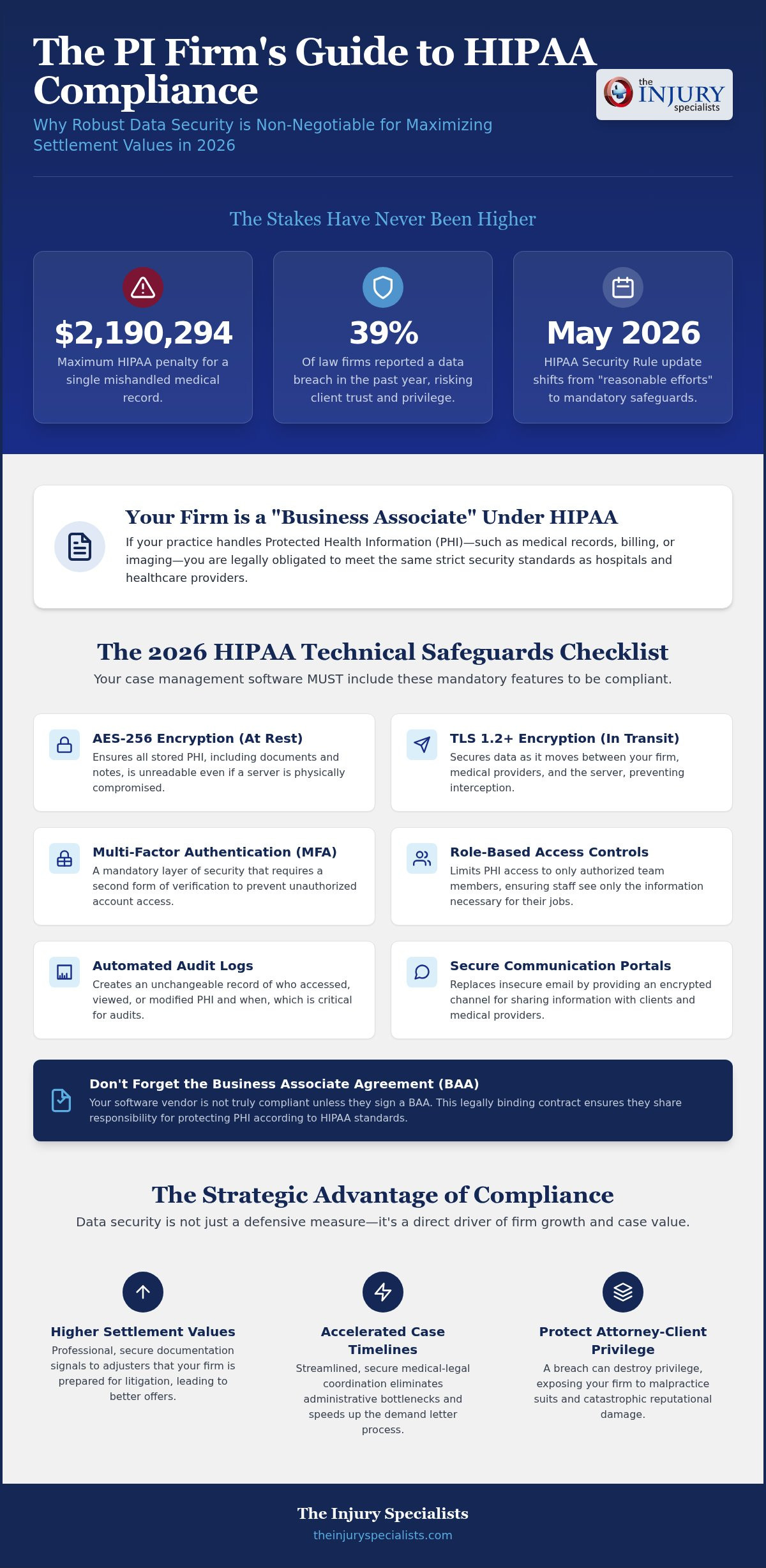
Is your firm prepared to handle a $2,190,294 HIPAA penalty for a single mishandled medical record? With 39% of law firms reporting data breaches in the past year, relying on outdated security protocols is a liability you can’t afford. The May 2026 HIPAA Security Rule update has shifted the industry from “reasonable efforts” to mandatory technical safeguards, making robust data protection a prerequisite for any growing personal injury practice.
You already know that manual medical-legal coordination is a logistical bottleneck that delays settlements and creates constant security anxiety. Implementing the right HIPAA compliant software for law firms is the most effective way to eliminate these administrative hurdles while protecting your firm from massive regulatory fines. This guide compares the leading case management solutions designed to secure your data, streamline provider workflows, and maximize settlement values.
We’ll analyze the top-rated platforms through the lens of the latest 2026 requirements, including mandatory multi-factor authentication and AES-256 encryption. You’ll learn how to choose a system that facilitates seamless medical record management and increases your case volume through better professional networking.
Key Takeaways
- Understand why personal injury firms are classified as “Business Associates” and must meet strict healthcare-level security standards to avoid massive regulatory fines.
- Identify essential features in HIPAA compliant software for law firms, focusing on the 2026 mandatory requirements for AES-256 encryption and multi-factor authentication.
- Compare leading case management platforms to select a system that accelerates settlement values through efficient, secure workflows.
- Gain a competitive edge by connecting your case management tools with a national ecosystem of medical providers who understand the personal injury landscape.
- Discover how to streamline medical logistics and referral management using integrated technology that scales with your firm’s growth.
Why HIPAA Compliance is the Foundation of Modern PI Case Management
HIPAA compliance for law firms ensures the protection of Protected Health Information (PHI) handled during litigation. Any firm managing medical records, billing statements, or imaging files in personal injury cases is classified as a “business associate” under the Health Insurance Portability and Accountability Act (HIPAA). This classification means your firm is legally obligated to meet the same rigorous security standards as healthcare providers and insurance companies.
In 2026, the stakes for data security have never been higher. The maximum civil penalty for HIPAA violations has reached $2,190,294 per violation category, per calendar year. Beyond these staggering fines, a data breach can result in the catastrophic loss of attorney-client privilege. This exposes your firm to malpractice litigation and permanent reputational damage. Leading firms are moving away from insecure methods like emailing medical records or using unsecured cloud storage. They’re adopting centralized, encrypted case management portals to manage sensitive data with professional precision.
Understanding the Business Associate Agreement (BAA)
Your software provider isn’t truly compliant unless they sign a Business Associate Agreement (BAA). This contract is a legal requirement that binds the vendor to HIPAA standards. It addresses the three essential pillars of compliance:
- Administrative safeguards: Internal policies and staff training regarding PHI handling.
- Physical safeguards: Secure hosting environments and restricted access to server hardware.
- Technical safeguards: Mandatory encryption, multi-factor authentication, and detailed audit logs.
A BAA serves as a critical shield for your firm. It ensures that if a software vendor experiences a breach, the legal and financial liability is clearly defined and shared. Without a signed BAA, using HIPAA compliant software for law firms is an incomplete strategy that leaves your practice vulnerable to federal audits.
The Link Between Data Security and Case Value
Data security directly impacts your firm’s bottom line. Efficient, secure medical-legal coordination accelerates the demand letter process by reducing the time spent chasing records and correcting administrative errors. When you utilize HIPAA compliant software for law firms, you demonstrate a level of professionalism that elite medical providers expect. These providers are more likely to partner with firms that prioritize patient privacy and secure data exchange.
Insurance adjusters also take note of how a firm manages its evidence. A firm that presents organized, securely transmitted medical documentation appears more prepared for litigation. This professional presentation often leads to faster negotiations and higher settlement values, as it signals that the firm operates with enterprise-level efficiency and technological sophistication.
Essential Features of HIPAA Compliant Software for Law Firms
Effective HIPAA compliant software for law firms must do more than just store documents. It has to function as a secure vault that satisfies the technical requirements of the HIPAA Security Rule. In 2026, this means implementing AES-256 encryption for data at rest and TLS 1.2 or higher for data in transit. These standards ensure that even if a server is compromised, the sensitive medical data remains unreadable and useless to unauthorized parties.
Role-based access controls are equally vital. Your software should allow you to restrict PHI access to specific team members, ensuring that a billing clerk doesn’t see sensitive medical notes meant only for the lead attorney. Automated audit logs provide the necessary oversight by tracking every instance a file is viewed, edited, or downloaded. This transparency is critical during federal audits or internal security reviews, providing a clear map of data interaction within your firm.
Modern platforms are also replacing unencrypted email with secure communication portals. These portals allow for the safe exchange of information with medical providers, imaging centers, and funding companies. By utilizing medical records management for attorneys, firms can automate the retrieval process while maintaining a closed-loop, secure environment. A unique advantage of top-tier platforms in 2026 is the integration of pre-settlement funding workflows. This allows attorneys to manage client financial needs directly within the secure ecosystem, a feature often overlooked by generic legal tech providers.
Advanced Medical Lien and Treatment Tracking
Settlement errors often stem from outdated lien information. Advanced software provides real-time treatment updates from physicians and chiropractors via secure provider portals. Digital lien storage with automatic balance updates ensures that your settlement math is always accurate. This integrated tracking significantly reduces the administrative burden on paralegals, who no longer need to spend hours on the phone verifying balances across multiple providers. It’s a pragmatic approach to maintaining a well-oiled system.
AI-Driven Medical Chronologies and Summaries
As of 2026, 83% of lawyers report using AI in their work. HIPAA-compliant AI can now summarize thousands of pages of medical records in minutes. These tools identify key injuries and treatment gaps that might otherwise be missed during a manual review. To maintain compliance, you must ensure your software vendor’s BAA explicitly covers these AI features. For firms looking to scale, leveraging a platform that integrates these tools with a national medical network is a strategic necessity. You can explore how a unified network simplifies these logistics to focus on your high-level litigation strategy.
Top HIPAA-Compliant PI Case Management Solutions: 2026 Roundup
Selecting the right HIPAA compliant software for law firms requires a balance between rigorous security and functional utility. As of August 2026, the market has matured to offer specialized tools that go beyond basic organization. These platforms now integrate AI-driven summarization and automated compliance checks as standard features. Choosing a solution that aligns with your firm’s specific scale is essential for maintaining professional efficiency.
- Filevine: A preferred choice for large-scale operations requiring deep customization. While pricing remains custom-quoted, its ability to handle complex litigation workflows with high-level security is unmatched. If you’re exploring other options, see our Best Filevine Alternatives for Personal Injury Firms for a deeper dive.
- SmartAdvocate: Known for high-volume document automation. It offers some of the most rigorous audit trails in the industry, which is essential for firms handling sensitive PHI during the demand process.
- Smokeball: Offers tiered pricing starting at $49 per user, per month for the “Bill” tier. It provides robust legal productivity tools with built-in HIPAA safeguards designed for small to mid-sized practices.
SaaS vs. Integrated Network Platforms
Standalone SaaS products often function as digital ledgers; they store data but don’t actively facilitate the case. In 2026, a “Network-First” approach is gaining traction. Standalone software lacks a built-in medical provider network, forcing staff to manually bridge the gap between the firm and healthcare providers. Integrated platforms solve this by connecting the software directly to an ecosystem of doctors and imaging centers. The ROI of faster settlements and reduced administrative labor often outweighs the initial subscription fees of these more robust systems. It’s a pragmatic shift from simple record-keeping to active case facilitation.
Implementation and Staff Adoption
Migrating data to a new HIPAA-compliant system shouldn’t cause downtime. Modern vendors provide dedicated migration teams to ensure data integrity during the transition. Mobile accessibility is another non-negotiable factor. Your team needs secure, encrypted access to case files while at depositions or court. Ease of use remains the most critical factor for long-term compliance. If a system is too complex, staff may revert to insecure workarounds like personal email or unencrypted messaging, which exposes the firm to significant liability. A well-designed interface ensures that HIPAA compliant software for law firms is actually used as intended.
The Strategic Advantage of Integrated Medical-Legal Networks
Most firms view HIPAA compliant software for law firms as a defensive necessity to avoid regulatory fines. However, elite practices use these secure systems as an offensive tool to build deeper trust with medical providers. A standalone software platform is merely a digital ledger; it records data but doesn’t facilitate the vital professional connections needed to move a case forward. True growth comes from integrating your secure technology with a medical ecosystem that understands the complexities of the personal injury landscape.
Accessing a national network of physicians, chiropractors, and imaging centers that accept personal injury liens provides a massive competitive advantage. It ensures your clients receive immediate care without the friction of upfront payments or insurance delays. Streamlining personal injury case workflow requires this combination of high-level technology and professional case management. By leveraging specialized referral programs for imaging and surgery, firms can drastically reduce administrative labor and focus on high-value litigation tasks.
Professional Medical Case Management for Law Firms
Professional case management bridges the gap between legal strategy and medical oversight. It ensures that medical documentation is cohesive and settlement-ready from day one. Dedicated case managers align patient treatment with your firm’s distinct processes, preventing the treatment gaps that insurance adjusters use to devalue claims. This level of coordination transforms medical logistics from a bottleneck into a streamlined asset, ensuring that every medical record and bill is accounted for before the demand letter is even drafted. It’s about creating a system where medical and legal professionals work in professional synergy.
Scaling Referral Partner Bases Securely
Expanding your referral network requires a secure, scalable foundation. HIPAA compliant software for law firms allows you to vet and communicate with new medical specialists without risking sensitive PHI exposure. Utilizing a centralized platform for imaging center referrals provides high-quality objective evidence, such as MRIs and CT scans, which are essential for proving damages in court. Integrated networking is the primary growth engine for personal injury firms in 2026. This connectivity allows firms to handle higher case volumes without increasing their internal administrative headcount. To maximize your firm’s reach, you can connect with the largest personal injury referral network in the United States to start scaling your practice today.
Maximizing Firm Growth with The Injury Specialists Platform
Software alone is a static asset. The Injury Specialists transform this into a dynamic growth engine by combining world-class case management technology with the largest personal injury referral network in the United States. While most HIPAA compliant software for law firms focuses solely on data storage, our platform facilitates the entire case lifecycle with professional precision. We simplify everything from initial intake and medical referrals to final settlement distribution. This integrated approach removes the friction of manual coordination, allowing firms to handle significantly higher case volumes without increasing internal headcount.
Connectivity is the core of our infrastructure. We provide direct access to pre-settlement funding within our secure environment, ensuring your clients have the financial support they need while you litigate. This eliminates the need for fragmented third-party portals that often increase security risks and administrative delays. Transitioning your firm to this network-driven model is a pragmatic move toward operational excellence. It replaces the “digital ledger” approach with a proactive system designed for settlement acceleration.
The All-in-One Medical-Legal Ecosystem
Top-performing firms are consolidating their tech stacks to eliminate data silos and security gaps. The Injury Specialists platform offers a distinct advantage by housing physician referrals, imaging center coordination, and chiropractic care in one centralized location. This consolidation ensures that HIPAA compliance is maintained across the entire medical-legal journey, not just within your internal office files. We manage the complex medical logistics and provider networking so your team can focus exclusively on litigation strategy. It’s a system built for scale and reliability.
Get Started with a Strategic Partner
Joining our network allows you to act as a high-level facilitator rather than an administrative clerk. You gain immediate access to high-quality, documented referrals from medical providers who are already vetted for compliance and professional synergy. This partnership allows you to scale your practice by leveraging our established influence and reach. We handle the heavy lifting of medical case management, ensuring that every treatment plan and lien is documented and ready for the demand letter. We invite you to schedule a demonstration of our 2026 technology suite to see how integrated networking can transform your firm’s bottom line.
Future-Proof Your Practice Through Integrated Compliance
In 2026, managing medical-legal logistics requires more than a basic digital storage solution. You must implement HIPAA compliant software for law firms that meets the latest mandatory encryption and authentication standards to protect your practice from million-dollar penalties. Beyond security, the most successful firms are those that bridge the gap between litigation and medical treatment through integrated networks. This connectivity ensures that medical documentation is settlement-ready while reducing the administrative burden on your staff.
By partnering with a strategic facilitator, you gain access to the largest PI referral network in the US and integrated HIPAA-compliant case management technology. This allows for customized medical coordination based on your firm’s distinct processes. It’s a strategic move that secures your data while accelerating your settlement timelines. Streamline your firm with The Injury Specialists case management solutions to scale your practice with professional precision. Adopting these world-class systems today positions your firm as a dominant leader in the personal injury landscape.
Frequently Asked Questions
What makes software HIPAA-compliant for a law firm?
Software is HIPAA-compliant when it incorporates the specific technical, administrative, and physical safeguards mandated by the HIPAA Security Rule. This includes AES-256 encryption for data at rest and TLS 1.2 or higher for data in transit. As of the 2026 update, mandatory multi-factor authentication and annual penetration testing are also required. The software provider must also sign a Business Associate Agreement to certify their compliance and shared liability.
Do all personal injury law firms need to be HIPAA compliant?
Yes, any firm that handles Protected Health Information (PHI) is legally classified as a “business associate” under federal law. This applies to firms managing medical records, billing statements, or imaging for personal injury and medical malpractice cases. Failing to meet these standards exposes your practice to civil penalties that can reach $2,190,294 per year. Compliance is a legal mandate, not an optional security preference.
What is a Business Associate Agreement (BAA) and why do I need one?
A BAA is a legally binding contract that ensures a service provider follows HIPAA regulations while handling your firm’s PHI. You need one because it establishes a chain of liability and satisfies federal oversight requirements. Without a signed BAA, using even highly secure HIPAA compliant software for law firms doesn’t fulfill your legal obligations. It is the essential document that protects your firm during a regulatory audit.
Can I use standard email to send medical records if I have a secure case management tool?
No, standard unencrypted email is inherently insecure and usually violates HIPAA standards for transmitting PHI. Even if your internal storage is secure, data in transit must be protected by equivalent encryption levels. You should utilize secure communication portals or encrypted file-sharing features within your case management system. This ensures end-to-end protection and maintains the mandatory audit trail required for federal compliance.
How does integrated case management improve settlement values?
Integrated systems prevent the treatment gaps and administrative errors that insurance adjusters frequently use to devalue claims. By connecting directly with medical providers, these systems ensure that medical documentation is comprehensive and demand letters are issued with greater speed. Professional coordination signals to adjusters that your firm is prepared for litigation. This high level of organization often leads to faster negotiations and higher settlement offers.
Is my firm liable if my software provider has a data breach?
Your firm remains the primary responsible party, but a signed BAA shifts specific legal and financial liabilities to the software vendor. Under 2026 regulations, business associates must notify you within 24 hours of activating a contingency plan. Utilizing HIPAA compliant software for law firms with a valid BAA provides a critical defense. It demonstrates that your firm took the necessary steps to vet its vendors and protect client data.
What is the difference between a legal CRM and a PI case management solution?
A legal CRM focuses primarily on intake and marketing, while a PI case management solution handles the entire litigation lifecycle. PI-specific tools include specialized fields for medical treatment dates, provider lien balances, and settlement calculators. Most general legal CRMs lack the rigorous technical safeguards and specialized workflows required for handling sensitive medical records. Case management solutions are built to manage the logistical complexities of medical-legal coordination.
How does The Injury Specialists platform handle data security?
The platform utilizes proprietary HIPAA-compliant technology designed specifically for secure medical-legal networking. It features end-to-end encryption and role-based access controls to protect PHI during the referral and case coordination process. By integrating world-class case management with a national provider network, it ensures that data remains protected from initial intake through final distribution. This creates a secure ecosystem that manages medical logistics so firms can focus on litigation.
