

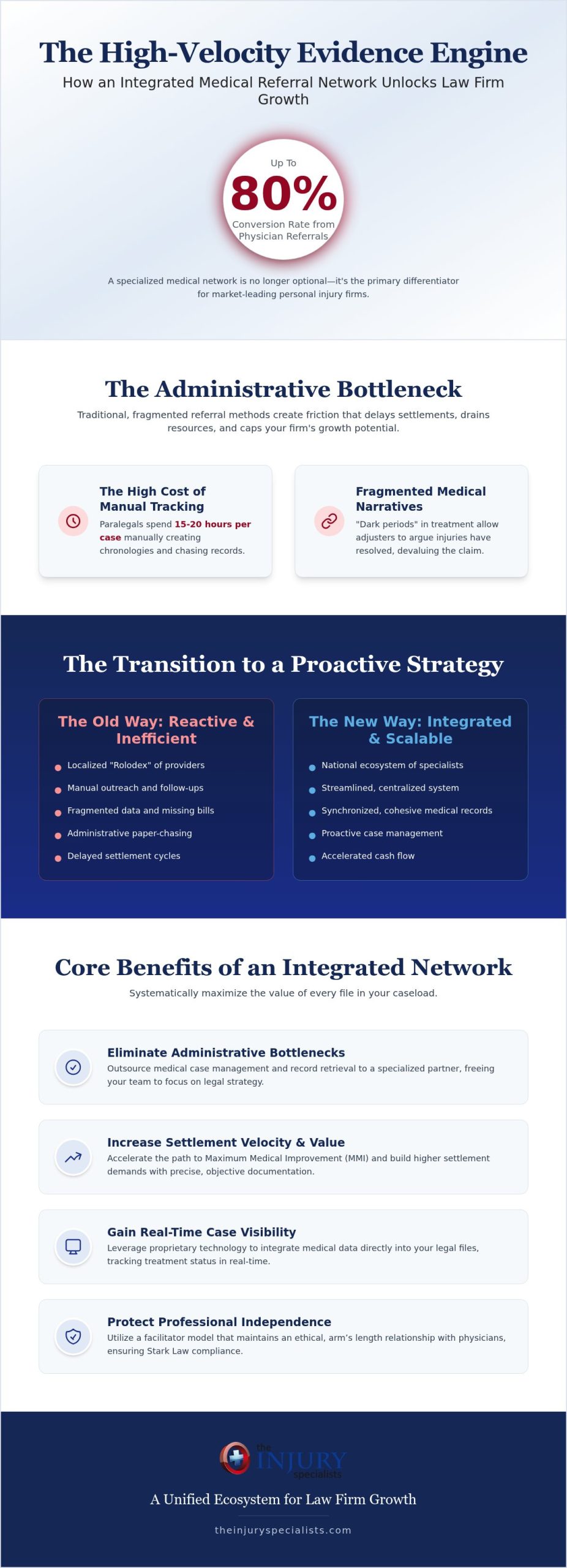
A physician referral can convert into a high-value legal client at a rate as high as 80 percent, yet many personal injury firms still treat medical networking as a secondary administrative task. This oversight creates a significant gap in case velocity and settlement potential. Understanding the strategic benefits of a medical referral network for law firms is no longer optional for those aiming to dominate the market in 2026. It’s the primary differentiator between a practice that struggles with fragmented data and one that operates as a high-velocity evidence engine.
Managing a growing caseload often means your team spends dozens of hours chasing missing bills or deciphering inconsistent medical records. You recognize that these administrative bottlenecks directly delay your settlement cycles and drain your firm’s overhead. This article explains how an integrated medical referral network eliminates these hurdles by securing high-quality evidence and providing access to credentialed specialists who understand the lien process. We will examine how national scale, proprietary case management technology, and streamlined medical-legal synchronization allow you to scale your practice while maintaining professional standards and maximizing case value.
Key Takeaways
- Eliminate administrative bottlenecks by outsourcing medical case management and record retrieval to a specialized third-party partner.
- Discover the core benefits of a medical referral network for law firms, including increased settlement velocity and higher-quality evidence that meets 2026 litigation standards.
- Protect your firm’s professional independence by utilizing a facilitator model that maintains an arm’s length relationship with treating physicians.
- Gain real-time visibility into every patient’s treatment status through proprietary case management technology that integrates medical data directly into your legal files.
- Accelerate firm growth by accessing a national ecosystem of credentialed specialists and integrated pre-settlement funding options.
The Administrative Bottleneck: Why Traditional Referral Methods Cap Firm Growth
Traditional referral methods often rely on a localized “Rolodex” that fails to scale alongside a modern practice. Relying on a handful of local providers limits your firm’s reach and creates significant administrative friction, especially in multi-state cases. One of the primary benefits of a medical referral network for law firms is the transition from a reactive posture to a proactive case management strategy. While building these connections, firms must remain cognizant of Stark Law and professional independence to ensure all medical-legal partnerships remain ethically sound and legally compliant. A centralized network replaces manual outreach with a streamlined system that prioritizes growth over paperwork.
The Hidden Costs of Manual Case Tracking
Paralegals often spend 15 to 20 hours manually creating a medical chronology for a single complex case. This time sink is compounded when teams must verify patient compliance and appointment status through endless phone calls and emails. Missing bills often go unnoticed until the final settlement demand, causing delays that can stretch for months and reduce the firm’s immediate cash flow. When a bill is omitted from the initial demand, it forces a renegotiation that weakens the firm’s position with insurance adjusters. Manual referral tracking is a resource-heavy process that converts high-value legal staff into administrative paper-chasers.
Fragmentation in the Medical-Legal Workflow
Disconnected medical providers create gaps in the patient’s medical narrative. These “dark periods” in treatment allow insurance adjusters to argue that injuries have resolved or are unrelated to the accident. Maximizing the benefits of a medical referral network for law firms involves closing these gaps through a unified ecosystem. When specialists, chiropractors, and imaging centers operate within a synchronized network, they contribute to a cohesive medical record that tells a complete story. This synchronized approach provides the objective evidence that adjusters require to justify higher settlement values. By leveraging a centralized system, your firm gains real-time visibility into treatment, ensuring that no gap in care weakens the final demand. This visibility allows you to address non-compliance issues before they become permanent stains on the case file.
Core Benefits: How an Integrated Network Scales Settlement Value
Scaling a personal injury practice requires more than just high case volume. It requires a system that consistently maximizes the value of every file. One of the primary benefits of a medical referral network for law firms is the ability to mirror the high-value outcomes typically seen in complex litigation across your entire caseload. By integrating professional medical case management, firms can create a unified ecosystem for law firm growth that transforms clinical treatment into actionable legal evidence. This strategic alignment ensures that every specialist involved in the case understands the necessity of timely, objective documentation.
Accelerating the Path to Maximum Medical Improvement
Insurance adjusters frequently exploit gaps in treatment to devalue claims or deny liability. A coordinated care plan ensures that patients move through their recovery without the administrative delays common in traditional healthcare settings. Immediate access to a national network of neurologists and orthopedic surgeons prevents the “wait-and-see” approach that often stalls a case for months. Utilizing Personal Injury Diagnostic Imaging Referrals allows for objective proof of injury to be established early in the treatment cycle. This objective data, including MRI and CT results, shortens the time from the date of injury to Maximum Medical Improvement (MMI). Faster recovery cycles mean faster settlement demands, significantly increasing your firm’s cash flow and settlement velocity.
Higher Settlement Demands Through Precise Documentation
Documentation precision is the primary driver of adjuster valuation in modern personal injury litigation. In 2026, vague medical reports that fail to link injuries to the specific mechanics of an accident are insufficient. An integrated network standardizes reporting to include specific ICD-10 codes and explicit causal relationships. Medical case management ensures that every provider remains aligned with the legal timeline, preventing the common problem of missing bills or incomplete charts. When your demand package includes detailed, synchronized reports from credentialed specialists, the insurance company has fewer avenues to contest the damages. This level of precision often leads to a “300% factor” in outcomes, where professional medical evidence justifies significantly higher settlements than uncoordinated care. Firms looking to optimize this workflow can benefit from partnering with a national network that handles the logistical heavy lifting. This allows your legal team to focus on litigation strategy rather than tracking down medical records.
Navigating Ethics: Compliance and Professional Independence
In personal injury litigation, the credibility of medical evidence is paramount. Defense counsel often attempts to undermine cases by alleging “doctor-lawyer collusion” or the “pre-selection” of biased providers. One of the strategic benefits of a medical referral network for law firms is that it establishes a formal buffer between the legal and medical professionals. By utilizing a third-party facilitator, firms can prove that treatment decisions are made independently of the legal strategy, preserving the integrity of the medical record. This structure shields the firm from accusations of impropriety while ensuring the client receives necessary care.
The Role of the Independent Referral Coordinator
Using a network removes the appearance of collusion by placing an independent coordinator between the law office and the treating physician. This coordinator manages the logistics of the referral without influencing the clinical findings. This “arm’s length” relationship is vital when a physician is called to testify. An objective medical opinion carries significantly more weight in court than one perceived as being directed by the firm. Implementing a standardized Attorney Physician Referral System ensures that your practice adheres to the 2026 framework for professional networking. This approach avoids fee-splitting prohibitions and maintains the professional independence required by state bar associations.
Data Integrity and HIPAA Compliance
Protecting patient information is a legal and ethical requirement that grows more complex as digital systems evolve. Fragmented referral methods often rely on insecure email chains or unencrypted file sharing, which creates significant liability for the firm. A centralized referral network provides a secure, encrypted platform for exchanging sensitive medical-legal data. This ensures that all providers in the chain adhere to uniform security protocols, regardless of their size or location. It’s a proactive way to mitigate the risk of data breaches that could compromise both the case and the firm’s reputation.
Beyond security, a unified technology platform simplifies the audit trail for compliance purposes. If a firm’s referral practices are ever questioned, having a documented, transparent process through a third-party network provides a ready-made defense. This systematic approach to data integrity is among the most overlooked benefits of a medical referral network for law firms. It allows you to scale your practice with the confidence that your data handling meets the most rigorous 2026 regulatory standards. A centralized system ensures that every interaction is logged, creating a transparent history that supports the firm’s commitment to ethical practice.
Leveraging Proprietary Case Management Technology
High-growth firms don’t rely on manual follow-ups to track patient progress. They use automated systems to synchronize medical and legal workflows. One of the primary benefits of a medical referral network for law firms is the immediate, real-time visibility into every patient’s treatment status. Instead of your paralegals spending hours on the phone, they access a centralized portal that tracks every milestone from initial intake to final discharge. This automation allows a small team to handle 100 cases with the same administrative effort typically required for 10, creating a scalable model for firm expansion.
Moving Beyond Spreadsheets to Integrated Platforms
Traditional legal software serves general document needs well but often lacks deep integration with medical electronic medical records (EMRs). Dedicated Personal Injury Case Management Technology bridges this gap by creating a bidirectional flow of data between the provider and the firm. Automated record collection ensures that medical billing and clinical notes are integrated directly into the legal file as soon as they are generated. This eliminates the delay-heavy process of requesting records at the end of treatment. By receiving structured data rather than flat PDFs, your team can instantly identify treatment gaps and ensure the medical narrative remains consistent throughout the litigation phases.
Predictive Analytics for Case Valuation
Real-time data is critical for firm-wide resource allocation and accurate case prioritization. Predictive analytics tools within a referral network can estimate future medical costs and settlement ranges based on historical treatment data and objective injury codes. The system automatically flags “at-risk” cases where treatment has stalled or records are missing, allowing your firm to intervene before the case value diminishes. This proactive monitoring ensures that every file moves toward a resolution without unnecessary friction. Access our world-class technology platform to streamline your firm’s medical-legal synchronization and maximize your settlement velocity.
Workflow synchronization ensures that medical provider milestones align perfectly with your firm’s litigation schedule. When a patient reaches Maximum Medical Improvement, the system notifies your team and prepares the comprehensive record package for the demand letter. This level of technical integration turns medical care into a high-velocity evidence engine. By leveraging these benefits of a medical referral network for law firms, you remove the guesswork from case management and replace it with a predictable, data-driven system.
The Injury Specialists: A Unified Ecosystem for Law Firm Growth
The Injury Specialists operates the largest national personal injury referral network in the United States. This unified ecosystem provides more than just names in a directory. It functions as a strategic growth partner by integrating medical case management directly into your firm’s existing operations. One of the most significant benefits of a medical referral network for law firms is the ability to customize these services to match your distinct internal processes. This ensures that every referral follows your specific workflow, from the initial intake through the final discharge.
Accessing a national network of physicians, chiropractors, and imaging centers allows your firm to handle cases across state lines with zero administrative friction. You don’t have to spend months vetting providers or verifying their willingness to work on a medical lien. Every provider in the network is credentialed and understands the specific documentation requirements of personal injury litigation. This reliability allows you to focus on high-level legal strategy while we handle the logistical complexities of medical case management.
Bridging the Financial Gap with Pre-Settlement Funding
Financial pressure often forces clients to accept lowball settlement offers before their treatment is complete. This premature resolution devalues the case and hurts your firm’s bottom line. The Injury Specialists integrates Pre-Settlement Funding for Injury Victims directly into the referral ecosystem. This funding provides clients with the liquidity they need to cover living expenses while their case matures. It also ensures that medical providers remain confident in the lien process, knowing that the client’s immediate financial needs are managed. By removing the rush to settle, you maximize the final settlement value for both the client and the firm.
A Partner in Professional Networking
The Injury Specialists acts as a power-connector for modern personal injury firms. We don’t just facilitate medical care; we help you grow your referral partner base through a proven facilitator model. Our platform bridges the gap between different professional sectors, ensuring that your firm remains at the center of a well-oiled medical-legal system. Getting started with an integrated Law Firm Medical Referral Program is the fastest way to achieve national scale. By joining this unified ecosystem, you transition from a localized practice to a dominant market player with the technology and network support to sustain long-term growth. This systematic approach to expansion is one of the primary benefits of a medical referral network for law firms looking to dominate the 2026 legal market.
Dominating the 2026 Personal Injury Market
The transition from manual Rolodexes to integrated ecosystems represents a fundamental shift in how high-growth firms operate. By removing the administrative friction of record retrieval and treatment tracking, your team can focus on high-level litigation. One of the primary benefits of a medical referral network for law firms is the ability to secure superior evidence that directly increases settlement velocity. This systematic approach ensures every file is backed by objective medical data and credentialed specialist opinions.
Success in the 2026 legal landscape requires a strategic partner that bridges the gap between medical care and legal evidence. The Injury Specialists provides a world-class technology platform for seamless case management alongside specialized imaging and physician referral programs. With integrated pre-settlement funding for injury victims, your clients receive the financial support they need while you build maximum case value.
Scale your firm today with the largest national personal injury referral network.
Modernizing your referral workflow is the most effective way to ensure long-term scalability and professional independence. Your practice is ready for the next level of growth.
Frequently Asked Questions
What are the primary benefits of joining a medical referral network for a small law firm?
Small firms gain immediate access to a national infrastructure that typically requires a large administrative staff. One of the primary benefits of a medical referral network for law firms is the ability to outsource medical case management. This reduces firm overhead by eliminating the need for paralegals to manually chase records and bills. It allows small practices to handle complex, multi-state cases with the same efficiency as a national market leader.
How does a medical referral network help with HIPAA compliance?
A medical referral network provides a centralized, encrypted platform for the secure exchange of medical-legal data. This system ensures that all providers within the ecosystem adhere to uniform data security protocols. By using a secure portal rather than fragmented email chains, your firm maintains a clear audit trail for compliance purposes. This proactive approach mitigates the risk of data breaches and ensures patient information remains protected throughout the entire litigation lifecycle.
Can a referral network improve the speed of my personal injury settlements?
Yes, a network significantly improves settlement velocity by reducing the time from Maximum Medical Improvement to the final demand. Real-time visibility into treatment status allows your team to prepare demand packages as soon as care is completed. Automated record collection eliminates the months-long wait for billing and clinical notes. This synchronized workflow ensures that insurance adjusters receive comprehensive evidence packages faster, leading to shorter settlement cycles and improved firm cash flow.
What is the difference between a doctor directory and a medical referral network?
A doctor directory is merely a static list of names, while a medical referral network is a unified ecosystem. Directories offer no support after the initial contact, leaving your firm to handle the heavy administrative burden. A network provides integrated medical case management, proprietary technology for tracking treatment, and pre-settlement funding. It acts as a strategic growth partner that synchronizes the medical and legal workflows to maximize the value of every case.
Does using a medical referral network create ethical issues for my law firm?
Using a third-party facilitator actually strengthens your firm’s ethical position by creating a buffer against accusations of doctor-lawyer collusion. The network maintains an arm’s length relationship between the attorney and the treating physician. This ensures that medical opinions remain objective and credible in court. By following a standardized referral system, your firm avoids fee-splitting prohibitions and adheres to 2026 regulatory standards for professional independence and medical liens.
How does medical case management integrate with my existing legal software?
Proprietary case management technology bridges the gap between legal platforms like Filevine or Clio and medical electronic records. This integration allows for a bidirectional flow of data, ensuring that clinical notes and bills are uploaded directly into the legal file. You don’t have to manually enter data or switch between multiple applications. This level of synchronization ensures that your legal team has real-time access to the most current medical evidence without administrative delays.
What types of medical specialists are typically available in a national PI network?
A national personal injury network typically includes a comprehensive range of credentialed specialists such as orthopedic surgeons, neurologists, and pain management physicians. You also gain access to chiropractors, physical therapists, and specialized imaging centers for MRI or CT scans. This diversity ensures that regardless of the injury type, your client receives immediate care from providers who understand the lien process. Access to this broad pool is one of the key benefits of a medical referral network for law firms.
How does pre-settlement funding within a network benefit the attorney?
Pre-settlement funding benefits the attorney by providing clients with the financial liquidity needed to resist lowball settlement offers. When a client can cover their living expenses, they don’t feel pressured to settle prematurely due to financial strain. This allows the attorney to build the case to its maximum potential value. It also ensures that medical providers remain confident in the lien process, which supports uninterrupted care and a stronger medical narrative for the final settlement demand.

Leave A Comment
You must be logged in to post a comment.