

In 2026, the most successful personal injury firms treat orthopedic referrals as a data-driven infrastructure problem rather than a casual networking task. Securing reliable orthopedic surgeon referrals for attorneys is often the difference between a stalled case and a high-value recovery. You’ve likely dealt with doctors who refuse to work on a lien basis or medical records that arrive too late and too incomplete to support a settlement. These administrative bottlenecks don’t just frustrate your paralegals; they directly impact your firm’s bottom line by stalling case momentum.
You recognize that a successful outcome depends on the synergy between surgical expertise and legal-ready documentation. This guide explores how to secure high-quality medical partners that bridge this gap. You’ll learn how to streamline your medical-legal workflow by accessing a nationwide network of board-certified, fellowship-trained specialists who understand the nuances of personal injury litigation. We will examine the technology and processes that allow you to track client treatment progress across multiple providers, reduce administrative overhead, and ultimately achieve faster settlement times through superior clinical evidence.
Key Takeaways
- High-value personal injury litigation depends on surgeons who balance clinical precision with the rigorous documentation required for legal success.
- Credibility in 2026 requires board-certified, fellowship-trained specialists who possess extensive experience in depositions and expert witness testimony.
- Scalable firm growth is achieved by replacing manual doctor lists with integrated networks that manage credentialing and compliance automatically.
- Secure high-quality orthopedic surgeon referrals for attorneys through proprietary technology that matches clients with the correct sub-specialists based on case needs.
- Reduce administrative overhead and accelerate settlement times by utilizing a national medical-legal workflow designed for lien-based care.
The Challenge of Securing Quality Orthopedic Surgeon Referrals for Attorneys
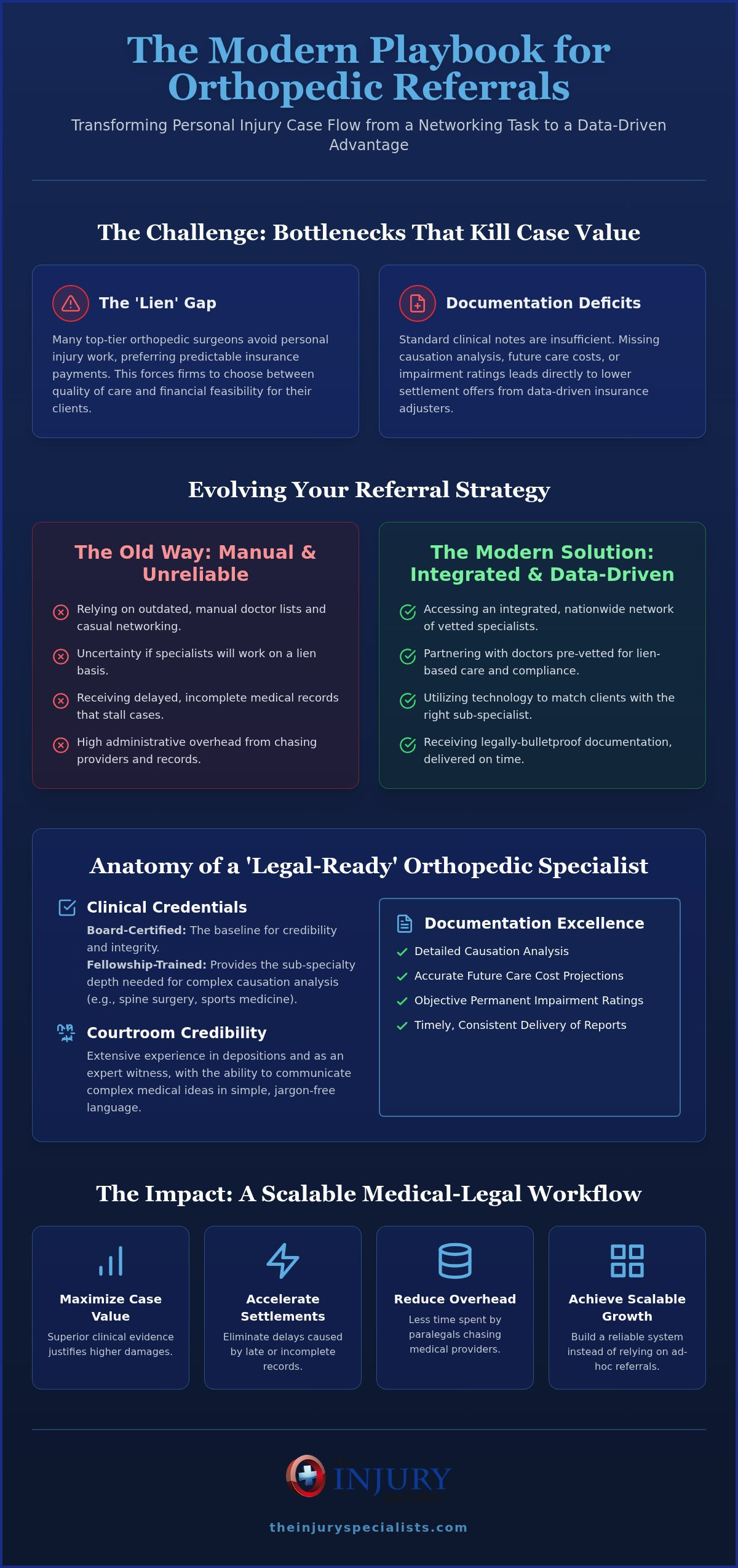
Orthopedic injuries often represent the highest potential value in personal injury litigation. These cases frequently involve complex surgeries, long-term rehabilitation, and permanent disability ratings. While these factors increase case value, they also increase the burden of proof. Fragmented communication between a law firm and a medical office leads to lower settlement offers. If a surgeon doesn’t understand the legal requirements of a case, the resulting documentation will fail to justify the damages sought. This disconnect is why securing reliable orthopedic surgeon referrals for attorneys remains a primary challenge for growing firms.
The ‘Lien’ Gap in Traditional Orthopedics
Many high-tier orthopedic surgeons avoid personal injury work entirely. They prefer the predictability of private insurance over the complexities of a medical lien. Managing liens requires a dedicated administrative staff to track case status and ensure payment upon settlement. Most independent practices don’t have this infrastructure. This creates a significant hurdle for firms looking to scale. When top-tier specialists opt out of the personal injury sector, clients are often left with providers who lack the necessary credentials or the clinical sophistication required for complex litigation. It’s a logistical bottleneck that forces firms to choose between quality care and financial feasibility.
Documentation Deficits That Kill Case Value
Standard clinical notes rarely suffice as legal evidence. A surgeon might record that a patient has a torn meniscus, but they may fail to explicitly link it to the accident or provide a detailed estimate for future care costs. These omissions are devastating during negotiations. A provider must be prepared to act as an expert witness, offering testimony that survives rigorous cross-examination. In 2026, insurance adjusters use data-driven models to evaluate claims. If your medical records lack specific causation analysis or permanent impairment ratings, those models will trigger a lower settlement offer.
Delayed medical records also impact firm cash flow. When you’re waiting months for a final narrative report, you aren’t just losing time; you’re losing the leverage needed to close the case. Firms need a system that ensures documentation is both clinically accurate and legally bulletproof from day one. To maximize case outcomes, your documentation must include:
- Detailed Causation Analysis: Clear medical opinions linking the injury to the specific incident.
- Future Care Estimates: Accurate projections of costs for ongoing therapy or secondary surgeries.
- Impairment Ratings: Objective assessments based on the latest medical guidelines.
- Timely Records: Consistent delivery of reports to avoid settlement delays.
Without these elements, even the most skilled surgeon becomes a liability to the legal process. Successful firms recognize that medical expertise is only half the battle. The other half is the administrative reliability that turns a clinical visit into a winning case file.
Defining the ‘Legal-Ready’ Orthopedic Specialist
A “legal-ready” orthopedic specialist is more than a skilled clinician; they are a strategic asset to your firm. While many doctors can treat a fracture, few possess the administrative and forensic expertise required to support a high-value personal injury claim. When evaluating orthopedic surgeon referrals for attorneys, you must look beyond basic medical licenses. The ideal partner understands that their medical conclusions must withstand the scrutiny of defense counsel, insurance adjusters, and eventually, a jury. This requires a specific combination of clinical pedigree and courtroom experience.
Clinical Credentials vs. Courtroom Credibility
Board certification is the baseline for credibility, but fellowship training in sub-specialties like spine surgery or sports medicine is what provides the depth needed for complex causation analysis. Surgeons who adhere to the ABOS Standards of Professionalism demonstrate a commitment to integrity that is vital during cross-examination. In 2026, top-tier experts command rates between $1,000 and $1,600 per hour for trial testimony. This investment is only justified if the surgeon can communicate complex medical concepts in jargon-free language that a jury can understand. You need a provider with a balanced history of testifying for both the plaintiff and the defense to avoid accusations of bias. This versatility reinforces their standing as an objective medical authority rather than a “hired gun.”
The Role of Specialized Diagnostic Evidence
Objective findings are the backbone of any musculoskeletal claim, especially those involving soft tissue injuries. A legal-ready surgeon doesn’t rely on subjective pain reports alone. They utilize personal injury diagnostic imaging referrals to secure high-resolution evidence of pathology. This coordination between the surgeon and the imaging center ensures a cohesive medical narrative. When an MRI or CT scan clearly illustrates the injury, the surgeon can provide more accurate impairment ratings according to the latest AMA guides. These objective findings make it difficult for adjusters to minimize the claim. Firms that prioritize these credentials often choose to partner with established referral networks to ensure every provider meets these rigorous standards.
Beyond the initial diagnosis, the specialist must be willing to provide comprehensive future care plans. This includes detailed cost projections for potential secondary surgeries, long-term physical therapy, or permanent medical equipment. Without a documented roadmap for future care, your firm leaves significant money on the table. A legal-ready specialist ensures that every possible future medical expense is accounted for and justified through clinical data. This proactive approach to documentation is what differentiates a standard referral from a high-value medical-legal partnership.
Direct Practice Referrals vs. Integrated Referral Networks
Efficiency is the primary driver of firm growth. While maintaining a private list of local providers might seem cost-effective initially, the long-term administrative burden often outweighs the perceived benefits of a direct relationship. Law firms in 2026 are increasingly moving away from manual doctor lists in favor of professionalized systems. The choice between managing individual relationships and leveraging a national network determines how quickly your staff can move a case from intake to settlement. High-quality orthopedic surgeon referrals for attorneys require more than just medical skill; they require a logistical framework that supports the legal process.
The Hidden Costs of the ‘DIY’ Referral Model
The “Do-It-Yourself” approach to medical referrals carries significant invisible costs. Paralegals often spend 20% to 30% of their week chasing medical records, clarifying billing errors, or following up on missing lien agreements. This administrative friction stalls your firm’s cash flow. Relying on a small handful of local doctors also leads to “referral fatigue.” When a single practice is overwhelmed by your firm’s volume, the quality of their narrative reports and their responsiveness to deposition requests inevitably declines. Inconsistency in documentation across different independent practices makes it difficult to standardize your firm’s internal demand-package workflow.
Why Integrated Networks are the 2026 Standard
Modern personal injury firms operate as data-driven businesses. Access to a personal injury referral network that vets providers for you ensures that your firm remains compliant without wasting internal resources. These networks act as a strategic buffer, handling the rigorous credentialing processes that independent firms often overlook. By utilizing a single point of contact for all medical-legal coordination, you eliminate the need to manage dozens of separate provider relationships. A unified platform provides several key advantages:
- Centralized Case Management: Track client treatment progress across multiple providers from a single dashboard.
- Automated Credentialing: Ensure every surgeon is board-certified and fellowship-trained without manual verification.
- Streamlined Lien Management: Standardized billing formats and lien agreements reduce the time spent on financial reconciliation.
- Scalability: Easily handle cases across different jurisdictions without needing to build new local medical connections from scratch.
Transitioning to an integrated network allows your firm to focus on litigation rather than logistics. When you secure orthopedic surgeon referrals for attorneys through a national infrastructure, you gain the reliability of a market leader. This system ensures that every provider in the chain understands the “legal-ready” documentation standards required to maximize settlement values. It’s a shift from a fragmented, manual process to a streamlined, professionalized workflow that supports rapid firm expansion.
Building a Scalable Referral Workflow for Your Firm
Scaling a personal injury firm requires more than just increasing case volume; it requires a repeatable, automated system for medical management. High-value orthopedic surgeon referrals for attorneys are most effective when integrated into a structured, five-step workflow. This prevents cases from stalling and ensures every client receives specialized care without overwhelming your internal staff. By standardizing these processes, you transform medical coordination from a manual chore into a competitive advantage.
- Step 1: Standardized Intake. Implement a uniform checklist during the initial client interview to identify specific orthopedic needs, such as spinal trauma, joint pain, or extremity injuries.
- Step 2: Precision Matching. Leverage network data to match clients with the correct sub-specialist. A general orthopedist is rarely sufficient for complex spine or hand surgeries.
- Step 3: CRM Integration. Sync your medical referral data directly with your firm’s existing CRM to maintain a single source of truth for every case.
- Step 4: Milestone Tracking. Set automated alerts for critical treatment milestones, including MRI results, surgical interventions, and the delivery of final narrative reports.
- Step 5: Care Continuity. Utilize financial tools to ensure that treatment remains uninterrupted, regardless of the client’s immediate liquidity.
The Role of Case Management Technology
Proprietary personal injury case management technology bridges the communication gap between law firms and medical providers. In 2026, relying on phone calls and faxes is a liability. Modern platforms provide real-time visibility into client treatment status and appointment compliance. This transparency allows your paralegals to identify non-compliant clients before they jeopardize the case’s value. Secure, HIPAA-compliant document exchange ensures that medical records are available the moment they’re signed, eliminating the weeks of delay that traditionally plague the settlement process.
Financial Coordination and Pre-Settlement Support
Orthopedic recovery is often a long-term commitment that clients struggle to afford. Integrating pre-settlement funding for injury victims supports the clinical process by covering essential living expenses. When clients are financially stable, drop-out rates decrease and treatment compliance improves. This financial coordination also gives surgeons confidence in the eventual lien resolution. It ensures that the medical-legal partnership remains focused on clinical excellence and comprehensive documentation rather than financial risk.
To optimize your firm’s medical-legal logistics, partner with The Injury Specialists to manage your entire referral infrastructure. This strategic alignment allows your firm to handle a higher volume of orthopedic surgeon referrals for attorneys while maintaining the high documentation standards required for maximum recovery.
The Injury Specialists: National Orthopedic Referral Infrastructure
The Injury Specialists operates the largest national personal injury referral network in the United States. This infrastructure provides a centralized solution for firms that require high-quality orthopedic surgeon referrals for attorneys without the limitations of local, fragmented practices. While a local clinic might offer a handful of providers in one specific area, our network offers a standardized, scalable framework that spans the entire country. This scale ensures that your clients receive board-certified care and “legal-ready” documentation regardless of their location. We act as a strategic power-connector, bridging the gap between medical excellence and legal necessity through a single, authoritative platform.
Unmatched National Scale
Relying on local providers often leads to inconsistent results and administrative headaches. In contrast, our national infrastructure provides a uniform experience for every case. You gain access to top-tier providers across various jurisdictions while maintaining a single point of contact for all medical-legal coordination. This simplified vendor management model allows your firm to consolidate its medical referral needs into one efficient system. Whether your case involves complex spinal trauma or joint reconstruction, the documentation standards remain consistent. This reliability is vital for firms that handle high-volume caseloads and require predictable, high-quality medical evidence to drive settlements.
Your Partner in Firm Expansion
We don’t just provide referrals; we provide a comprehensive law firm medical referral program designed to fuel your firm’s growth. Our proprietary technology and medical case management services handle the logistical heavy lifting. This allows your staff to focus entirely on legal strategy and trial preparation rather than chasing records or verifying credentials. We provide the marketing and networking tools necessary to help you expand your firm’s reach and increase your overall case value.
Our commitment to efficiency is reflected in our integrated technology platform. It offers real-time visibility into treatment progress and automates the delivery of settlement-ready reports. In 2026, the most successful firms are those that leverage these sophisticated systems to reduce overhead and accelerate recovery timelines. Partnering with a market leader gives you the confidence to take on larger, more complex orthopedic cases with the certainty that the medical documentation will support your demands. To see how our national infrastructure can transform your firm’s medical-legal workflow, schedule a demonstration of our platform today. We are ready to help you streamline your orthopedic surgeon referrals for attorneys and achieve the results your clients deserve.
Strategic Medical-Legal Integration for 2026 and Beyond
High-value personal injury outcomes in 2026 require a fundamental shift from manual doctor lists to professionalized referral infrastructure. You’ve seen how board-certified, fellowship-trained specialists and “legal-ready” documentation create the evidentiary foundation needed for maximum settlements. Securing orthopedic surgeon referrals for attorneys shouldn’t be a source of administrative friction; it should be a streamlined engine for firm growth. When your medical partners understand the nuances of liens and causation analysis, your paralegals spend less time chasing records and more time on high-level strategy.
By leveraging the largest personal injury referral network in the United States, your firm gains immediate access to elite specialists and proprietary medical-legal case management technology designed to accelerate recovery timelines. This integrated approach ensures that every client receives superior care while every case file remains settlement-ready from day one. It’s about moving beyond local limitations to embrace a national standard of excellence. Scale your firm’s medical-legal efficiency with The Injury Specialists network today. Position your firm as a dominant market leader by integrating these high-performance systems into your daily workflow. Success in complex litigation starts with the right medical partners.
Frequently Asked Questions
Why is it difficult to find orthopedic surgeons who take personal injury liens?
Most private orthopedic practices avoid personal injury liens because of the administrative burden and financial risk. These offices often lack the staff to track long-term legal cases or manage the specific billing requirements of a medical lien. They typically prefer the immediate reimbursement cycles of commercial insurance or Medicare. Integrated networks solve this by providing the infrastructure needed to manage these cases, allowing top-tier surgeons to focus on clinical care.
What should an attorney look for in an orthopedic surgeon’s medical report?
A high-value medical report must provide explicit causation analysis and objective clinical findings. You should look for detailed impairment ratings based on the latest AMA guides and clear projections for future medical costs. If a report lacks specific links between the incident and the injury, or fails to estimate long-term rehabilitation needs, insurance adjusters will likely devalue the claim. The documentation must be settlement-ready and capable of withstanding defense scrutiny.
How do physician referral services for personal injury improve case timelines?
Physician referral services eliminate the time-consuming process of searching for and vetting individual providers. These services provide immediate access to pre-vetted specialists, which allows your firm to move clients into treatment faster. Integrated systems ensure that medical records and final narrative reports are delivered promptly after treatment milestones. This consistency allows firms to file demands sooner, directly reducing the total time from intake to settlement for complex orthopedic surgeon referrals for attorneys.
Can a referral network help with board-certified specialists in rural areas?
A national referral network provides reliable orthopedic surgeon referrals for attorneys regardless of their geographic location. While local firms often struggle to find specialists outside major metropolitan hubs, a national infrastructure connects attorneys with board-certified and fellowship-trained surgeons across the United States. This ensures that every client receives consistent, high-quality care. A national scope allows for standardized documentation and credentialing, maintaining the same level of case value even in remote jurisdictions.
What is the role of medical case management in an orthopedic referral?
Medical case management acts as a strategic bridge between the surgical clinic and the law firm. It ensures the client follows the prescribed treatment plan, which prevents gaps in care that adjusters use to devalue claims. Case managers coordinate between sub-specialists, track appointment compliance, and ensure all diagnostic imaging is completed. This oversight guarantees that the final medical file is comprehensive and that the treatment narrative supports the legal strategy.
How does case management technology benefit a personal injury law firm?
Proprietary case management technology provides real-time visibility into client treatment status through a centralized dashboard. This replaces outdated communication methods like faxes with secure, HIPAA-compliant document exchange. By integrating with a firm’s existing CRM, it reduces manual data entry and administrative overhead for paralegals. This transparency allows your staff to identify non-compliant clients early, ensuring that medical evidence is gathered efficiently and that settlement-ready reports are available the moment treatment concludes.
Are there orthopedic surgeons who specialize in traumatic brain injury (TBI) and orthopedic overlap?
Many orthopedic trauma and spine specialists work in multidisciplinary environments to address cases involving both orthopedic injuries and TBIs. An integrated referral network facilitates this collaboration, ensuring that the medical narrative accounts for how physical trauma and neurological deficits interact. This coordination is vital for documenting the full scope of a client’s impairment. It allows for a cohesive presentation of damages that reflects the complex reality of polytrauma cases often seen in high-value litigation.
How can pre-settlement funding help a client afford orthopedic surgery?
Pre-settlement funding ensures uninterrupted care by providing injury victims with the liquidity needed for living expenses during their recovery. Orthopedic surgeries often involve long-term rehabilitation and significant lost wages, which can lead to financial desperation. By covering these immediate costs, funding allows the client to complete their full course of treatment. This financial stability prevents clients from settling prematurely for a lower amount and ensures the surgeon is confident in the eventual resolution of the lien.
