

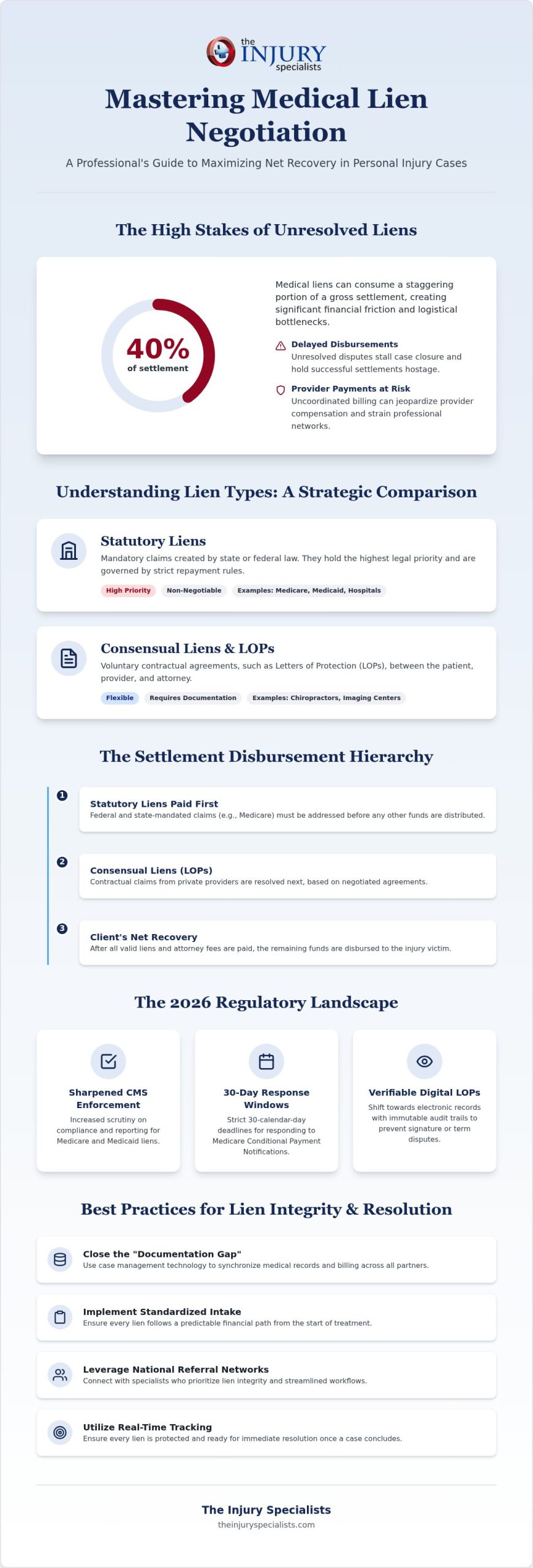
Medical liens can consume 40% of a gross settlement before an attorney fee is even calculated. This financial friction creates a logistical bottleneck that delays disbursements and puts provider payments at risk. Effectively negotiating medical liens in personal injury cases is no longer just a courtesy; it’s a core operational requirement for high-growth firms and medical networks. You face the administrative burden of manual lien tracking and the constant threat of unresolved disputes stalling your most valuable cases.
It’s frustrating when a successful settlement is held hostage by uncoordinated billing or aggressive subrogation claims. This guide provides the advanced negotiation strategies and technology-driven workflows you need to protect lien integrity while maximizing net recovery. We’ll examine the 2026 regulatory landscape, including sharpened CMS enforcement and the critical 30-day response windows for Medicare notifications. By the end of this article, you’ll have a professional roadmap to streamline your disbursement process, guarantee provider payments, and secure higher net recoveries for injury victims.
Key Takeaways
- Learn to distinguish between statutory hospital liens and consensual agreements to identify the most flexible paths for professional negotiation.
- Optimize your settlement outcomes by mastering the specific strategies for negotiating medical liens in personal injury cases within the 2026 regulatory environment.
- Close the “documentation gap” using proprietary case management technology that keeps medical records and billing updates synchronized across all professional partners.
- Leverage national referral networks to connect with imaging and chiropractic specialists who prioritize lien integrity and streamlined disbursement workflows.
- Implement standardized intake and real-time tracking to ensure every lien is protected and ready for immediate resolution once a case concludes.
The Fundamentals of Protecting Medical Liens in Injury Cases
A medical lien acts as a secured interest in the proceeds of a legal recovery. Understanding What is a Lien? is the first step toward mastering the financial logistics of any personal injury case. In its simplest form, it’s a legal claim by a healthcare provider against a future settlement or judgment. Successfully negotiating medical liens in personal injury cases requires a deep understanding of these claims’ legal weight and their impact on the final disbursement. By 2026, enforcement standards have tightened, particularly regarding digital signature verification for Letters of Protection and strict 30-calendar-day response windows for Medicare Conditional Payment Notifications.
Consensual vs. Statutory Liens
The legal strength of a claim depends on its origin. Distinguishing between these categories is vital for prioritizing payments during the settlement phase. The hierarchy of these claims dictates the flow of funds once a case is resolved.
- Statutory Liens: These are mandatory claims created by state or federal law. Hospitals, Medicare, and Medicaid fall into this category. They often take legal precedence over other claims and are governed by strict repayment rules, such as the Medicare Secondary Payer Act.
- Consensual Liens: These arise from a voluntary contractual agreement between the patient and a private provider, such as a chiropractor or imaging center. While they offer more flexibility, they require precise documentation to remain enforceable.
Priority is generally determined by specific state statutes or the date of filing. Statutory liens typically sit at the top of the financial hierarchy. This means they must be addressed before private providers or the client receives their portion of the settlement funds.
The Impact of Liens on Settlement Value
Unresolved liens are the primary cause of friction during the disbursement phase. When negotiating medical liens in personal injury cases, the goal is to resolve these claims early to avoid “stale” cases that linger in accounting. Attorneys face significant personal liability if they distribute funds while ignoring a valid lien. This professional risk makes it essential to establish a settlement-ready documentation standard for every provider in the referral network.
Missing records or inconsistent billing leads to automatic lien reductions and unnecessary delays. Maintaining a centralized system for tracking treatment ensures that all parties remain aligned before the final demand is sent. This proactive approach turns a complex logistical hurdle into a streamlined professional workflow that guarantees provider payment and optimizes the victim’s net recovery.
Strategic Differences Between Letters of Protection (LOPs) and Liens
A Letter of Protection (LOP) is a three-party contractual agreement between the patient, the medical provider, and the attorney. Unlike statutory liens, which are often non-negotiable and governed by rigid state laws, LOPs offer a higher degree of flexibility during the settlement phase. This flexibility is essential when negotiating medical liens in personal injury cases, as it allows for nuanced adjustments based on the final settlement amount. By 2026, the industry has shifted toward digital, verifiable LOP trails. These electronic records provide an immutable audit trail that prevents disputes over signature authenticity or terms, ensuring all parties are aligned from the start of treatment.
When to Utilize an LOP vs. a Medical Lien
Choosing between an LOP and a standard medical lien depends on the provider’s risk tolerance and the specific insurance environment. A lien alone might be insufficient if the provider requires a direct contractual promise from the attorney to withhold funds from the recovery. While attorneys have a statutory obligation to pay perfected liens, an LOP adds a layer of professional accountability that protects the provider’s financial interest. Implementing a law firm medical referral program helps standardize these contracts. This ensures that every case follows a predictable financial path, reducing the administrative friction typically associated with manual lien tracking.
Perfecting the Claim: Steps for Providers
A lien is only as strong as its perfection. Providers must take active steps to ensure their claim is legally recognized and ready for resolution. This begins with verifying liability limits and insurance coverage before treatment starts. If the available policy is small, the provider needs to know immediately to adjust the treatment plan or the lien structure. Timely filing is equally critical. A “lost” lien that isn’t filed within state-mandated windows can be easily dismissed during negotiations. Accurate medical coding serves as the final line of defense. If the coding doesn’t match the injury’s severity, the lien’s value will be the first thing an adjuster attacks. Utilizing professional case management technology ensures these administrative benchmarks are met for every patient, keeping the documentation settlement-ready.
Why Medical Liens Fail: Identifying Vulnerabilities in the Settlement Process
Lien failure is rarely a result of poor lawyering; it’s usually a byproduct of administrative neglect. When negotiating medical liens in personal injury cases, the most common vulnerability is the “Documentation Gap.” If a provider’s billing statement doesn’t perfectly align with the medical records, insurance adjusters will use the discrepancy to justify automatic reductions. These gaps often occur because of communication silos between medical billing departments and law firm paralegals. Without a shared source of truth, critical treatment data gets lost, leaving the lien defenseless during the final settlement phase.
Another critical failure point is the late identification of “super-liens,” such as those held by Medicare or ERISA plans. For example, a Conditional Payment Notification (CPN) from the Centers for Medicare and Medicaid Services (CMS) has a strict 30-calendar-day response window. Missing this deadline can lead to interest accrual and complicates the entire disbursement timeline. Inconsistent billing rates also create risk. If a provider charges significantly different rates for the same procedure across various cases, the defensibility of the lien collapses under scrutiny. Professional networks avoid this by standardizing billing protocols to ensure every claim is settlement-ready.
Leveraging Personal Injury Case Management Technology
Centralizing records is the only way to ensure no treatment data is lost during the high-pressure negotiation phase. Modern personal injury case management technology automates oversight by providing real-time treatment and billing updates to all stakeholders. This technology eliminates last-minute settlement surprises by sending automated reminders for lien verification. It bridges the gap between the clinic and the law firm, ensuring that every dollar billed is supported by a corresponding medical record. This level of transparency is essential for protecting the integrity of the lien and ensuring a smooth disbursement process.
Navigating Statutory Priority and Competing Claims
When multiple providers are involved, understanding the “first-in-time” rule is vital for managing competing claims. Generally, the order in which liens are filed determines their priority, but statutory hospital liens often take precedence over private specialist claims. Managing these dynamics requires a strategic approach to ensure all providers are compensated fairly without exhausting the settlement funds. You can negotiate reductions effectively by presenting a clear hierarchy of claims to the client. This professional transparency allows you to reach a resolution that protects long-term provider-attorney relationships while still maximizing the victim’s net recovery.
Best Practices for Safeguarding Lien Integrity and Resolution
Standardized intake protocols are the first line of defense for any medical-legal practice. By establishing a uniform process for every lien-based patient, you ensure that insurance information, liability limits, and attorney contact data are captured correctly from day one. This proactive approach simplifies negotiating medical liens in personal injury cases by providing a clean data set for all parties. Maintaining a shared technology portal allows for real-time treatment and billing updates, which eliminates the need for manual status requests. Regular lien audits are also necessary. These audits identify missing records or unbilled services before they become a problem during the settlement phase. Finally, every specialist referral must be backed by an attorney-signed LOP to ensure payment priority is clear. Once treatment concludes, implementing a ‘Letter of Final Bill’ protocol locks in negotiation figures, preventing providers from adding unexpected charges later.
Aligning Attorney and Provider Workflows
Efficiency in the medical-legal ecosystem depends on clear expectations. Attorneys need medical records delivered within a specific timeframe, and providers need timely billing updates. Utilizing physician referral services personal injury streamlines this communication by acting as a central hub for case logistics. This integration reduces administrative friction and ensures that medical case management is handled with professional precision. When workflows are aligned, the focus shifts from resolving disputes to optimizing the recovery for the victim. A professional approach to negotiating medical liens in personal injury cases requires this level of operational synergy.
Pre-Settlement Funding as a Protective Layer
Financial pressure often forces attorneys to accept “fire-sale” settlements that don’t fully cover medical costs. This is where pre-settlement funding for injury victims acts as a critical protective layer. By providing victims with immediate capital for essential costs, funding stabilizes the case and allows the legal team to hold out for a fair settlement. This protection ensures that the final recovery is large enough to satisfy all medical liens and provide a meaningful net recovery. It bridges the gap while the lien is pending, securing the financial interests of both the provider and the patient. To secure your firm’s financial ecosystem, you can join our professional referral network today.
Leveraging National Networks for Seamless Lien Negotiation and Recovery
National networks serve as the connective tissue between the medical and legal sectors. They provide the infrastructure necessary to handle the complex logistics of negotiating medical liens in personal injury cases at scale. A personal injury referral network acts as the ultimate safety net, ensuring that every provider in the chain understands the litigation lifecycle. This alignment is critical because it eliminates the friction of dealing with “lien-unfriendly” providers who don’t grasp the necessity of deferred payment or the documentation standards required for a successful settlement. By centralizing these relationships, you move away from a fragmented, case-by-case approach toward a streamlined, technology-backed system that prioritizes professional synergy and financial recovery.
A power-connector in this ecosystem does more than just make introductions. It provides a standardized framework that protects the interests of all parties. This centralized oversight is essential for scaling a practice. It allows attorneys to focus on litigation and physicians to focus on patient care, while the network handles the administrative burden of lien tracking and verification. When every provider is vetted and every document is settlement-ready, the resolution process moves from months to weeks. This speed is a direct result of utilizing a network that treats lien recovery as a logistical challenge rather than a legal conflict.
The Injury Specialists Advantage
The Injury Specialists provides a distinct advantage by connecting attorneys with a national roster of providers who prioritize accurate lien documentation. This isn’t just about referrals; it’s about integrated case management. Our proprietary technology automates the oversight process, ensuring that treatment data and billing updates are always current. This automation prevents the communication silos that typically lead to lien failures. With national reach, we ensure cohesive care for clients regardless of their location, maintaining a high standard of representation. This level of connectivity ensures that when it’s time for negotiating medical liens in personal injury cases, you have a complete, bulletproof data set to defend the claim value.
Strategic Growth for Professionals
Growth in the personal injury sector requires a reliable partner. Physicians can expand their PI practice with confidence, knowing their liens are protected by a network that understands the legal requirements of 2026. This security allows for higher volume without the associated risk of non-payment. Similarly, law firms can ensure their clients receive top-tier care from specialists who are comfortable working on a lien basis. This professional trust is the foundation of a successful referral program. It creates a cycle of growth where high-quality care leads to better settlements, which in turn attracts more referral partners. To secure your firm’s position in this evolving landscape, you should Join the largest personal injury referral network in the US and start leveraging our national infrastructure today.
Secure Your Settlement Ecosystem for 2026 and Beyond
Master the complexities of negotiating medical liens in personal injury cases by moving beyond manual tracking. The 2026 landscape demands a shift toward technology-driven workflows and standardized LOP protocols. By closing the documentation gap and aligning provider-attorney communication, you eliminate the administrative friction that typically stalls disbursements. These strategic adjustments ensure that every case is settlement-ready from the first day of treatment.
Professional growth in the personal injury sector relies on access to a reliable, national medical-legal infrastructure. You don’t have to manage these logistical challenges in isolation. Our world-class case management technology platform, national network of lien-friendly medical specialists, and integrated pre-settlement funding solutions provide the stability your practice needs to scale efficiently. This integrated approach protects your financial interests while ensuring victims receive the top-tier care they deserve.
Take control of your settlement outcomes and streamline your professional workflows today. Join the Largest National Personal Injury Referral Network and start building a more efficient, profitable future for your firm. Your path to optimized recovery and professional synergy begins here.
Frequently Asked Questions
What is the difference between a medical lien and a letter of protection (LOP)?
A medical lien is a legal claim against settlement proceeds, often statutory or filed with a county clerk to secure a debt. An LOP is a three-party contract between the provider, patient, and attorney. While a lien secures the interest, the LOP acts as a direct promise of payment from the attorney’s trust account. LOPs typically provide more flexibility than rigid statutory liens during the final disbursement phase of a case.
Can an attorney legally ignore a medical lien during a settlement?
No, attorneys cannot legally ignore a perfected medical lien without risking personal liability or ethical sanctions. If a lien is valid and the attorney has received notice, they must resolve it before distributing funds to the client. This obligation is particularly strict for government claims. Ignoring these liens can lead to the attorney being held responsible for the full amount plus interest and legal fees after the case concludes.
How do I protect my medical practice from unpaid liens in personal injury cases?
Protecting your practice requires a standardized intake process and the use of verifiable, digital LOPs. You should verify liability limits before treatment starts and ensure all billing is settlement-ready. Utilizing a national referral network helps by connecting you with attorneys who respect lien integrity. Case management technology also automates the tracking of these claims, which reduces the risk of a lien being lost during a long litigation cycle.
What happens if the settlement is less than the total amount of medical liens?
When settlement funds are insufficient, providers and attorneys must negotiate pro-rata reductions. This process often involves the “Made-Whole” doctrine, which argues that a lienholder shouldn’t recover unless the victim is fully compensated. Negotiating medical liens in personal injury cases under these circumstances requires total transparency. Providers may accept a lower percentage to ensure the client receives a net recovery while still securing a portion of their billed fees.
Are medical liens legally binding across all 50 states?
Yes, medical liens are recognized across the United States, but the specific laws governing them vary by state. Most states have specific statutes for hospital liens, while private provider liens are often handled through consensual contracts like LOPs. It’s essential to understand local filing requirements and deadlines. A failure to perfect the lien according to state-specific rules can make the claim unenforceable during the settlement process, leading to non-payment.
How do Medicare and Medicaid ‘super-liens’ affect a personal injury settlement?
Super-liens have absolute priority over other claims and are governed by federal laws like the Medicare Secondary Payer Act. Medicare conditional payments must be repaid within 60 days of the Final Demand Letter to avoid interest. These liens are non-negotiable in the traditional sense, but you can dispute specific charges within a 30-calendar-day window. Failure to address these government claims results in severe penalties for both the attorney and the injury victim.
Can a medical provider file a lien after the personal injury case has settled?
Filing a lien after a settlement has been reached is difficult and often legally ineffective if the funds have already been distributed. Most state statutes require liens to be filed or notice provided before the settlement is finalized. If a provider misses this window, they lose their secured interest in the settlement proceeds. In such cases, the provider might have to pursue the patient directly for payment through standard debt collection methods.
How does case management technology improve the lien negotiation process?
Case management technology centralizes all medical records and billing data into a single, accessible portal. This transparency is vital when negotiating medical liens in personal injury cases because it provides an immutable audit trail. It automates reminders for lien verification and ensures all parties have real-time updates on treatment status. This prevents last-minute surprises and ensures that the final demand package is fully supported by accurate, settlement-ready documentation.
