

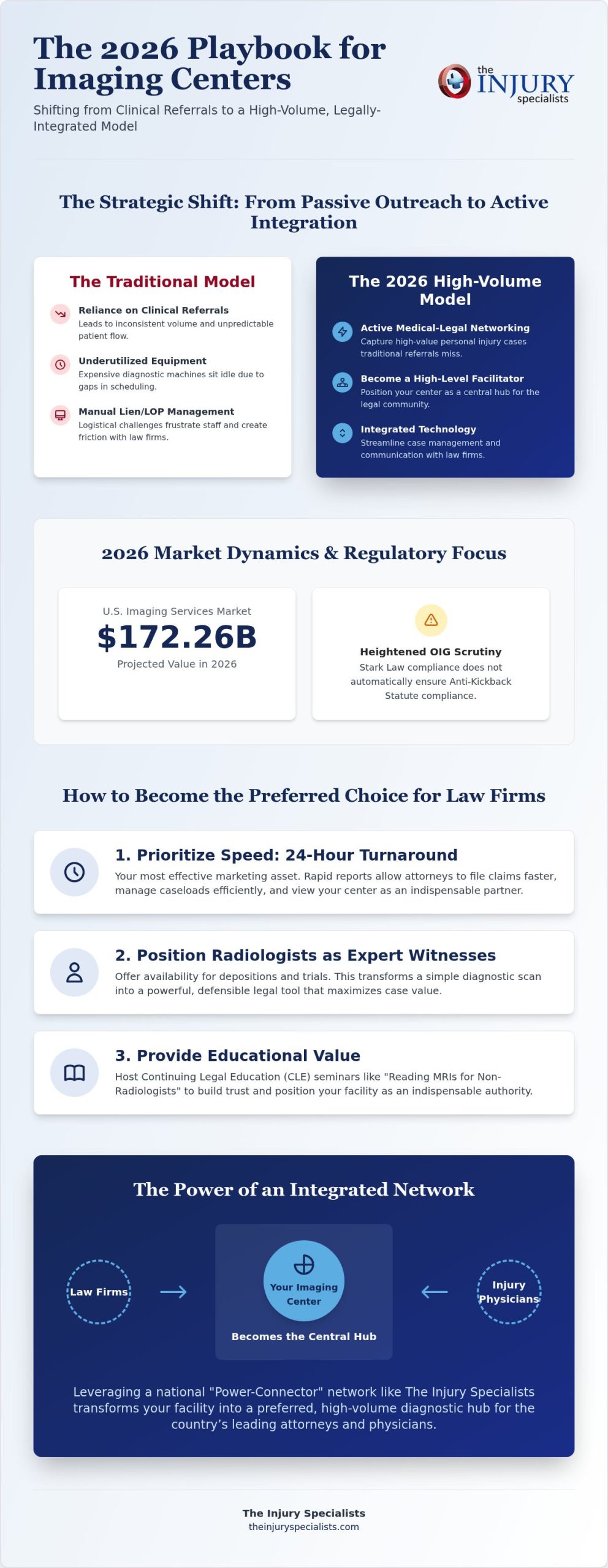
In 2026, imaging center marketing is no longer about visibility; it’s about infrastructure and network integration. You likely recognize that relying on traditional clinical referrals often results in inconsistent volume and underutilized equipment. Managing medical liens and Letters of Protection (LOPs) presents a logistical challenge that can frustrate your staff and drive attorneys toward competitors with better communication tools. Effective marketing for imaging centers personal injury requires a shift from passive outreach to becoming a high-level facilitator for the legal community.
This guide provides a strategic roadmap to transform your diagnostic facility into a high-volume referral hub by mastering the medical-legal landscape. You’ll learn how to implement the communication systems law firms demand and leverage the national reach of The Injury Specialists to secure higher reimbursement. We’ll examine the 2026 regulatory shifts, including the latest OIG guidance on the Anti-Kickback Statute, to ensure your growth remains compliant and scalable. By the end of this article, you’ll have the tools to secure a consistent stream of personal injury referrals and position your center as a dominant market leader.
Key Takeaways
- Transition from passive clinical outreach to active medical-legal networking to capture high-value personal injury cases that traditional referrals often miss.
- Implement sophisticated marketing for imaging centers personal injury by positioning your radiologists as expert witnesses and prioritizing 24-hour report turnaround times.
- Adopt integrated case management technology to streamline communication with law firms and simplify the complex logistics of managing medical liens and Letters of Protection.
- Evaluate potential referral networks based on their national scope and their ability to provide the technological infrastructure needed to manage a high volume of referrals.
- Leverage the national scale of The Injury Specialists to transform your facility into a preferred diagnostic hub for the country’s leading personal injury attorneys.
Understanding the Personal Injury Imaging Market Landscape
Personal injury imaging marketing is the strategic positioning of diagnostic services specifically to attorneys and specialized injury physicians. It represents a fundamental departure from traditional clinical outreach. While clinical referrals focus on routine patient care and insurance-based reimbursement, marketing for imaging centers personal injury focuses on the diagnostic data that drives legal outcomes. You aren’t just providing a scan; you’re providing the objective evidence required to validate a claim and secure a settlement.
Attorneys operate with an evidence-based mindset. They prioritize centers that provide high-resolution imaging and clear, defensible reports that can withstand intense scrutiny during litigation. This shift requires imaging centers to master the management of Letters of Protection (LOPs) and medical liens. These financial instruments allow patients to receive care without upfront costs, but they require your facility to carry the account receivable until the case settles. Success in this market depends on your ability to manage these liens with professional precision while maintaining the highest diagnostic standards.
The 2026 Regulatory and Market Climate
The U.S. imaging services market is projected to reach approximately $172.26 billion in 2026. As settlement values for complex injuries rise, the demand for high-resolution MRI and CT scans has surged. However, the regulatory environment is increasingly complex. In April 2026, the Office of Inspector General (OIG) updated its guidance to clarify that compliance with the Stark Law doesn’t automatically ensure compliance with the Anti-Kickback Statute. This heightened focus makes integrated “Power-Connector” networks like The Injury Specialists essential for maintaining compliance. You must move beyond being a mere service provider to becoming a strategic partner that understands the legal nuances of every referral.
Identifying Your Primary Marketing Targets
Personal injury law firms are the ultimate decision-makers in the diagnostic process. They direct their clients to facilities that offer reliable scheduling, professional report delivery, and an understanding of the litigation lifecycle. Simultaneously, you must cultivate relationships with specialized injury physicians, including orthopedic surgeons and chiropractors, who form a secondary referral loop. Medical-legal networking is a method for synchronizing care and documentation between these disparate professional sectors to maximize case efficiency. By positioning your center as the central hub for this data, you ensure your facility remains the preferred choice for the country’s most influential legal and medical professionals.
Marketing Imaging Centers for Personal Injury
Marketing for imaging centers personal injury depends on your center’s ability to solve specific legal pain points. While clinical accuracy is a baseline requirement, it isn’t a primary competitive advantage in the personal injury sector. Attorneys select centers that minimize their workload and maximize the evidentiary value of the medical record. You’re not just selling a scan; you’re selling a streamlined path to a settlement.
Position your radiologists as expert witnesses rather than just physicians. Offer their availability for depositions and trials. This professional reliability turns a simple diagnostic scan into a powerful legal tool. Speed wins in this industry. Your 24-hour report turnaround time is your most effective marketing asset. Law firms operate on tight deadlines. Providing rapid access to diagnostic data allows them to file claims faster and manage their caseloads more efficiently.
Building a robust referral partner base requires participation in physician referral services personal injury. These networks connect your facility with orthopedic and chiropractic providers who require immediate diagnostic support for their patients. This creates a secondary referral loop that keeps your magnets running at high capacity.
Direct Attorney Engagement Tactics
Host Continuing Legal Education (CLE) seminars titled “Reading MRIs for Non-Radiologists.” This positions your facility as an educational authority and builds trust with decision-makers. Your specialized intake protocols should mirror law firm workflows; ensure that all necessary legal documentation, such as the Letter of Protection, is captured at the point of service. Your marketing collateral must emphasize “Legal Readiness” over “Patient Comfort.” Attorneys care about the quality of the evidence and the ease of the administrative process. To scale these efforts, consider joining a national personal injury referral network that handles the heavy lifting of provider connectivity.
Leveraging Financial Support as a Marketing Tool
Financial flexibility is a powerful differentiator. Offering medical lien funding options allows your center to compete with hospital-owned facilities that often demand upfront payment or traditional insurance. You can market your facility as a “No Out-of-Pocket” center for accident victims. Integrating pre-settlement funding for injury victims into your service descriptions addresses the attorney’s primary concern: client medical costs. This approach removes the financial barrier to high-quality care. It ensures that necessary diagnostics are performed without delay, which ultimately drives higher case values for your partners.
Technology as the Ultimate Marketing Differentiator
Modern law firms operate on digital efficiency. If your facility relies on fax machines and manual follow-ups, you’re creating friction for your referral partners. Effective marketing for imaging centers personal injury now centers on your technological infrastructure. Attorneys prioritize diagnostic centers that integrate seamlessly into their digital workflows, allowing them to manage cases with minimal administrative overhead. By providing high-level connectivity, you transform your center from a vendor into a strategic asset.
Securing repeat business requires more than clinical accuracy; it requires a robust medical legal networking platform. This technology automates the delivery of radiology reports and billing statements directly to legal teams. Instead of calling for status updates, law firms should have secure, real-time portal access to view diagnostic images and download documentation. This level of transparency builds professional confidence and ensures your facility remains at the top of their referral list.
The Importance of Integrated Case Management
Law firm paralegals are often the primary gatekeepers for diagnostic referrals. Implementing personal injury case management technology reduces the friction these professionals face daily. When your system synchronizes documentation automatically, it ensures that every report meets the specific evidentiary standards required for high-stakes litigation. Positioning your center as a tech-forward facility attracts firms that handle complex, high-value cases where precision and speed are mandatory.
Streamlining the Referral Loop
Digital platforms allow you to manage the intake of personal injury diagnostic imaging referrals with zero lag time. Real-time communication serves as a powerful marketing tool; providing instant status updates on patient appointments demonstrates a level of reliability that manual centers cannot match. Automated reporting increases trust between radiologists and attorneys by providing a consistent, verifiable trail of diagnostic evidence. This streamlined loop ensures that every referral is handled with the logistical ease that modern legal professionals demand.
Selection Criteria: Evaluating a Personal Injury Referral Network
Choosing a referral network is a high-stakes business decision that dictates your facility’s volume and administrative efficiency. Many imaging centers make the mistake of prioritizing local saturation over national reach. While local connections matter, a national network provides a more consistent stream of referrals by tapping into larger, multi-jurisdictional law firms. This breadth of connectivity ensures your magnets remain active even when local market conditions fluctuate. Marketing for imaging centers personal injury is most effective when your facility is part of a broad, professional ecosystem that values scale and reliability.
Evaluation should focus on the quality of the network’s legal partners. High-volume personal injury specialists require sophisticated diagnostic support and don’t have time for manual follow-ups. You must determine if the network facilitates essential support services, such as pre-settlement funding and medical case management. These features aren’t just perks; they’re the infrastructure that allows a case to move forward without financial or administrative bottlenecks. To secure your center’s growth, apply to join a dominant national referral network that connects you with elite legal teams.
The Referral Network Checklist
When vetting a partner, verify if they offer personal injury referral network features like automated attorney-matching. The platform must demonstrate a clear ability to handle complex medical documentation for personal injury legal review, ensuring that every scan is accompanied by the necessary evidentiary paperwork. Assess the network’s reputation for facilitating cohesive care across multiple providers. A network that synchronizes your imaging data with the patient’s chiropractic or orthopedic treatment plan creates a more defensible medical record for the attorney.
Avoiding the ‘Lead Gen’ Trap
There’s a critical difference between buying leads and joining a professional referral ecosystem. Lead generation services often provide low-quality, unvetted contacts that waste your intake team’s time. Instead, prioritize networks that emphasize medical case management over raw lead volume. This approach focuses on sustainable growth through long-term professional relationships rather than one-off transactions. By integrating with a network that understands the nuances of the 2026 regulatory landscape, including the recent OIG guidance on financial arrangements, you protect your facility from compliance risks while ensuring a steady flow of high-value personal injury cases.
Scaling Your Center with The Injury Specialists
The Injury Specialists operates as the largest national personal injury referral network in the United States. We provide the infrastructure necessary to move your facility beyond traditional, low-volume clinical models. By integrating your center into our world-class technology platform, you gain immediate access to a professional ecosystem designed for scale. This platform serves as your center’s primary marketing engine, demonstrating to every professional partner that your facility values efficiency and logistical precision. Marketing for imaging centers personal injury becomes an automated process when your facility is backed by a dominant market leader.
Strategic marketing for imaging centers personal injury isn’t just about finding new leads; it’s about retaining them through superior service delivery. Our system facilitates seamless connectivity between imaging centers, physicians, and law firms to ensure your magnets remain at peak capacity. You aren’t just joining a directory; you’re adopting a comprehensive business model that prioritizes higher reimbursement and streamlined communication. This integration allows your center to function as a high-volume referral hub without the need for an expansive internal marketing team.
A Strategic Partnership for Growth
Participation in our specialized law firm medical referral program gives your center direct visibility to elite litigation teams across the country. We handle the administrative heavy lifting through integrated medical case management, allowing your staff to focus on diagnostic excellence rather than chasing documentation or lien status. We invite imaging center directors to book a demo of the technology platform to witness how automated workflows can transform their daily operations. This partnership ensures that your facility remains the preferred choice for attorneys who demand professional reliability and rapid results.
The Injury Specialists Advantage
Our national scale provides a level of stability that local networks cannot match. We offer a pragmatic, results-oriented environment where logistical ease is the standard, not the exception. By removing the friction from medical-legal interactions, we facilitate a faster path to settlement for attorneys and more consistent volume for your diagnostic facility. We bridge the gap between different professional sectors to ensure that every case is handled with the sophistication it deserves. Join the professional network designed for imaging center success and position your facility as a dominant leader in the 2026 market.
Dominating the 2026 Medical-Legal Market
Success in the personal injury sector requires a fundamental shift from clinical outreach to strategic network integration. You must prioritize high-resolution diagnostic evidence and rapid report turnaround to meet the rigorous standards of modern law firms. Speed wins in this industry. Implementing advanced case management technology removes the administrative friction that often stalls high-volume growth. This transition ensures your facility remains an indispensable asset to both attorneys and specialized injury physicians.
Strategic marketing for imaging centers personal injury is no longer a luxury; it’s a necessity for facilities aiming to capture consistent, high-value referrals. The Injury Specialists provides the national scale, integrated case management, and world-class professional networking needed to automate this expansion. It’s time to move beyond fragmented local outreach and embrace a system built for logistical ease and professional synergy.
Join the largest personal injury referral network in the United States to secure your facility’s position as a preferred diagnostic partner. Your center’s growth depends on choosing the right infrastructure for an evolving landscape.
Frequently Asked Questions
How do I start marketing my imaging center to personal injury attorneys?
Effective marketing for imaging centers personal injury begins by identifying high-volume law firms and presenting a value proposition centered on rapid turnaround times. Your facility must emphasize its ability to handle Letters of Protection and provide litigation-ready reports. Establishing a presence in professional networking circles ensures your center is the first choice when a firm needs reliable diagnostic support.
What is the best way to manage medical liens in an imaging center?
The most efficient way to manage medical liens is through integrated case management technology that tracks every case from intake to settlement. This software reduces administrative overhead by automating follow-ups and ensuring all legal documentation is centralized. By using a structured system, your center maintains clear financial records and minimizes the risk of non-payment when a case concludes.
Why is diagnostic imaging so important for personal injury settlements?
Diagnostic imaging provides objective, verifiable evidence of an injury that subjective clinical notes cannot match. High-resolution MRI and CT scans are often the deciding factor in determining case value and securing higher settlements. Attorneys rely on these scans to prove the severity of structural damage; it’s the cornerstone of a successful legal argument.
Can a referral network really help grow my radiology practice volume?
Joining a professional network provides immediate access to a pre-vetted pool of attorneys and physicians who require consistent diagnostic services. These networks act as a force multiplier for your internal marketing efforts, driving volume that traditional clinical referrals often miss. By participating in a broader ecosystem, your center benefits from high-value cases without the cost of a dedicated sales force.
What technological tools do attorneys expect from an imaging center?
Attorneys expect real-time access to diagnostic images and reports through secure digital portals. They require facilities that automate the delivery of billing statements and medical records to their paralegals. Providing these technological tools differentiates your center as a modern partner that understands the fast-paced requirements of the legal industry and prioritizes their operational efficiency.
How does pre-settlement funding impact imaging center marketing?
Offering pre-settlement funding options makes your center more attractive to attorneys concerned about their clients’ immediate medical costs. This financial tool bridges the care gap, allowing patients to receive necessary diagnostics without upfront payment. Marketing this capability demonstrates that your facility is a full-service partner committed to the success of the legal case and the recovery of the victim.
Is there a national network for personal injury imaging providers?
The Injury Specialists provides the largest national referral network in the United States specifically for personal injury providers. This network connects imaging centers with a vast array of law firms and physicians through a world-class technology platform. It offers the scale and professional infrastructure required to manage complex medical-legal cases across multiple jurisdictions while maintaining high standards.
What are the common mistakes in marketing for imaging centers personal injury?
One of the most common mistakes in marketing for imaging centers personal injury is focusing on patient comfort rather than legal readiness and evidentiary quality. Many centers also fail to implement the digital communication tools that law firm paralegals require to manage their caseloads. Neglecting to stay updated on regulatory shifts, such as the 2026 OIG guidance, can also expose your facility to unnecessary compliance risks. A thorough understanding of medical documentation for personal injury requirements is essential to avoid the documentation gaps that insurance adjusters use to deny otherwise valid claims.
