

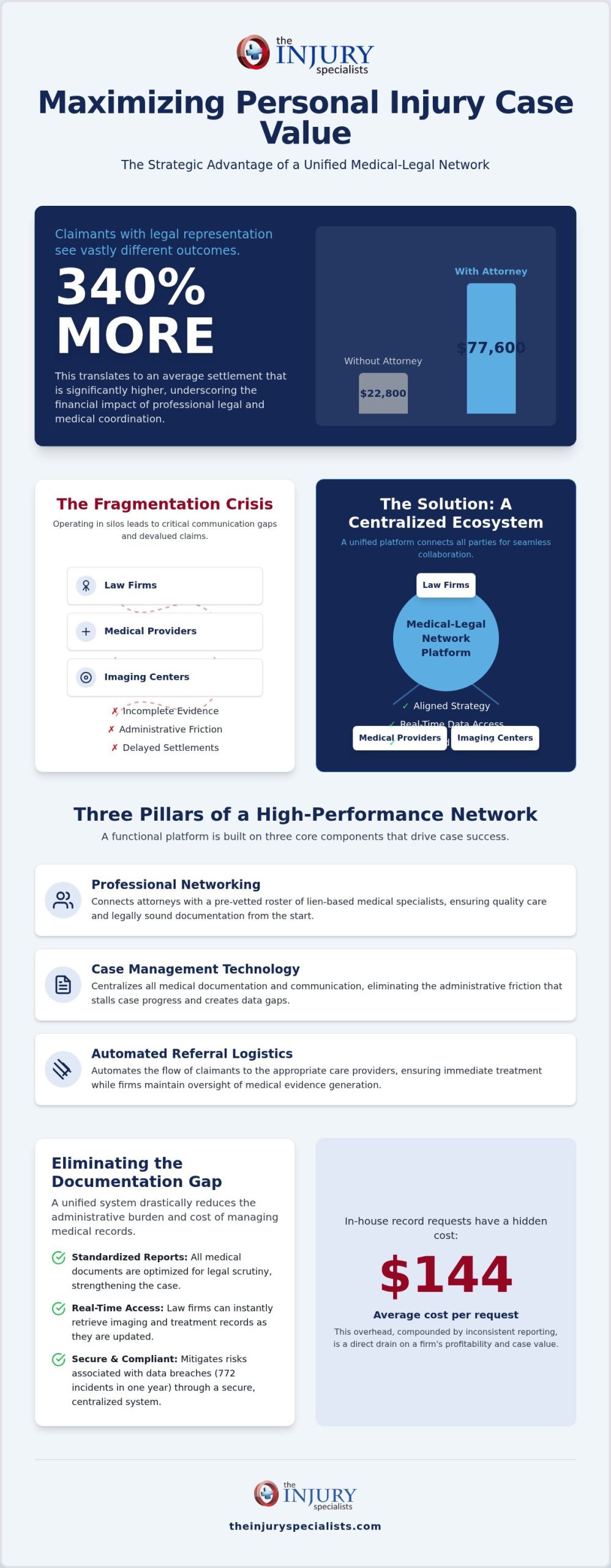
Claimants represented by an attorney receive average settlements of $77,600, which is 340% more than those navigating the process alone. While the potential for high-value outcomes is clear, the path to a successful settlement is often obstructed by fragmented communication and inconsistent medical documentation. Most personal injury professionals understand that a firm is only as strong as its external partnerships. Utilizing a sophisticated medical legal networking platform is no longer optional for those aiming to scale; it is the strategic foundation for operational excellence.
You likely recognize the frustration of searching for reliable providers who accept medical liens or chasing down records that never seem to arrive on time. We promise to show you how a centralized ecosystem transforms these administrative hurdles into a streamlined workflow that connects elite providers with top law firms. This guide provides a comprehensive look at maximizing case value through integrated case management, automated referrals, and the professional synergy required to accelerate settlement times and drive consistent growth.
Key Takeaways
- Learn how a centralized medical legal networking platform integrates medical providers, law firms, and imaging centers into a single, high-performance ecosystem.
- Identify the specific communication gaps that lead to lower settlement values and discover how unified data exchange protects medical liens.
- Explore the essential technology features, including centralized referral dashboards and automated case management tools designed for personal injury workflows.
- Understand the direct correlation between coordinated medical care and the production of the comprehensive documentation necessary to maximize case value.
- Gain a clear roadmap for integrating national networking strategies into your existing firm or clinic operations to drive consistent referral growth.
What is a Medical Legal Networking Platform?
A medical legal networking platform is a centralized ecosystem designed to bridge the gap between law firms, medical providers, and imaging centers. It functions as a strategic hub for the personal injury sector, facilitating a seamless exchange of data and professional referrals. This isn’t just a simple directory; it is a sophisticated application of Legal Technology that manages the entire lifecycle of a personal injury case from initial referral to final settlement. It replaces fragmented communication with a unified system that ensures every stakeholder has real-time access to the information they need.
The industry has evolved significantly from the days of manual rolodexes and local word-of-mouth. Modern platforms utilize cloud-based case management technology to standardize workflows across different professional sectors. It’s also vital to distinguish these commercial entities from non-profit medical-legal partnerships. While non-profits typically focus on addressing social determinants of health for low-income populations, a commercial medical legal networking platform is built for professional synergy and growth. It focuses on maximizing case value by ensuring that medical treatment and legal strategy are perfectly aligned.
The Three Pillars of a Functional Platform
A high-performance network rests on three structural foundations that drive case success. First, professional networking connects attorneys with a pre-vetted roster of lien-based medical specialists. Second, case management technology centralizes all medical documentation and communication, which eliminates the administrative friction that often stalls case progress. Finally, referral logistics automate the flow of injury victims to the appropriate care providers. This automation ensures that patients receive immediate treatment while firms maintain oversight of the medical evidence being generated.
Who Benefits from These Networks?
The utility of these platforms extends across the entire personal injury landscape. Law firms gain access to elite physician referral services personal injury professionals who are experienced in working on a lien basis and providing court-ready documentation. Medical providers benefit by scaling their patient volume through a steady stream of high-quality referrals without increasing their marketing spend. Additionally, diagnostic imaging centers find value in the consistent case flow, ensuring their facilities operate at peak capacity while providing the essential evidence attorneys need to secure fair settlements. For imaging facilities looking to formalize this growth, understanding marketing for imaging centers personal injury is a critical step toward becoming a preferred partner within a national referral network.
Solving the Fragmentation Crisis in Personal Injury
Fragmentation in personal injury cases represents a significant financial liability for both law firms and medical providers. When these two sectors operate in silos, the resulting communication gaps often lead to incomplete medical evidence and undervalued claims. Statistics show that claimants with attorney representation receive average settlements of $77,600, but reaching this figure requires a seamless flow of data. As the largest personal injury referral network in the United States, a medical legal networking platform eliminates the friction caused by manual record requests and disconnected workflows. By centralizing case data, it ensures that legal strategy and medical treatment remain perfectly aligned throughout the case lifecycle.
Eliminating the Documentation Gap
Research indicates that law firms managing medical record requests in-house spend an average of $144 per request. This administrative overhead is often compounded by inconsistent reporting standards that fail to withstand legal scrutiny. A modern medical legal networking platform standardizes medical reports, ensuring they meet the specific requirements of personal injury litigation. As technology evolves, professionals must also consider the risks associated with new tools, such as Generative AI and Medical Malpractice. This is particularly relevant given that 2025 was the worst year on record for large healthcare data breaches, with 772 incidents reported. Utilizing a unified system provides several advantages for documentation management:
- Standardized medical reports designed for legal scrutiny.
- Real-time access to imaging and treatment records for law firms.
- Significant reduction in the administrative burden on clinical staff.
Mitigating Financial Risk
Protecting provider revenue requires a transparent approach to medical liens. Without clear oversight, providers face the risk of unpaid bills, while law firms struggle to track the total cost of treatment. An integrated platform manages these liens with total clarity, allowing all parties to monitor the financial status of a case in real time. This level of oversight is essential for ensuring that care continuity isn’t interrupted by funding gaps. Professionals looking to optimize these financial outcomes can benefit from exploring the integrated referral and case management tools available through established national networks. A unified financial strategy includes:
- Transparent lien management that protects all stakeholders.
- Access to pre-settlement funding to maintain treatment continuity.
- Verified legal networking that ensures consistent provider revenue.
Essential Features of a Modern Medical Legal Platform
A sophisticated medical legal networking platform serves as more than just a bridge; it’s a high-performance engine for case growth. While organizations like the National Center for Medical-Legal Partnership advocate for the integration of health and legal services at a policy level, commercial platforms provide the specialized tools necessary for the personal injury market. This technology must handle the specific administrative and clinical complexities of lien-based care. It replaces the uncertainty of manual networking with a predictable, data-driven ecosystem.
Advanced Case Management Technology
Efficiency in personal injury depends on the ability to align external medical data with internal legal processes. Modern platforms utilize workflow automation that adapts to a firm’s distinct operational requirements. This allows for the real-time tracking of patient recovery milestones, ensuring that legal teams are never behind on the clinical status of their clients. A critical component of this is the digital management of personal injury diagnostic imaging referrals. By centralizing these requests, firms ensure that objective evidence, such as MRIs or CT scans, is captured early and integrated directly into the case file without the typical delays associated with manual processing.
Strategic Marketing and Networking Tools
Growth-oriented professionals require more than just a list of contacts. They need a proactive system for expanding their referral partner base. Attorneys utilize searchable databases to find specialized injury specialists who understand the nuances of lien-based documentation. Conversely, these tools allow physicians to showcase their specific expertise and clinical outcomes to top-tier law firms. Integrated analytics provide the following benefits:
- Physician profiles that highlight specific expertise and court-ready documentation capabilities.
- Searchable databases that allow attorneys to find specialists by geographic reach and specialty.
- Performance analytics to track the quality and volume of referrals in real-time.
Security remains a non-negotiable priority in this sector. Given the rise in healthcare data breaches, a medical legal networking platform must provide secure, HIPAA-compliant storage and data sharing. This includes mandatory encryption for all electronic protected health information (ePHI) at rest and in transit. By automating these security protocols, platforms reduce the administrative burden on clinical staff while protecting law firms from the significant liabilities associated with data mishandling. The result is a well-oiled system that prioritizes both case velocity and professional reliability.
Maximizing Case Value through Unified Networking
Unified networking is the primary driver of case valuation. When medical providers and legal teams operate on a single medical legal networking platform, they eliminate the “dead time” that often stalls litigation. This coordination ensures that every aspect of the victim’s recovery is documented through a lens that supports legal merit. Comprehensive care isn’t just about patient health; it’s a strategic necessity for demonstrating the full scope of damages to insurance adjusters and defense counsel. Cases that utilize specialized imaging and chiropractic care from the outset often show higher merit because the objective evidence is established before defense tactics can take root.
Strengthening the Medical Evidence
Strong medical evidence requires more than just a diagnosis. It demands a consistent record of treatment that proves the severity and duration of an injury. A medical legal networking platform facilitates this by ensuring all diagnostic tests are performed early and documented correctly. For instance, personal injury physical therapy referrals are essential for demonstrating the long-term impact of an accident on a client’s daily life. These records provide the objective data needed to justify higher settlement figures. Coordination through a unified platform also allows for the seamless identification of expert witnesses. These specialists can interpret complex medical files and provide court-ready testimony that reinforces the case’s value during depositions or trial.
Accelerating the Settlement Timeline
Speed is a critical factor in maintaining firm profitability and client satisfaction. Automated scheduling and follow-ups reduce the administrative friction that leads to treatment gaps. Defense counsel often exploits these gaps to argue that an injury was not severe or has already resolved. By using technology to maintain treatment continuity, firms protect the integrity of the claim and prevent common defense objections.
A unified system also streamlines the creation of demand packages. With medical files organized and ready to go, legal teams can submit comprehensive demands much faster than firms relying on manual collection methods. This organized approach builds a reputation for efficiency that encourages insurance carriers to offer fairer settlements earlier in the process. When insurance adjusters see a complete, well-documented file from a known high-performance network, they’re less likely to engage in low-ball negotiation tactics. To start maximizing your case outcomes and streamlining your firm’s growth, access our integrated referral and case management technology.
Implementing a National Medical Legal Strategy
Growth-oriented firms and clinics don’t rely on local word-of-mouth alone. They leverage a medical legal networking platform to access a national ecosystem of professional partners. Joining a personal injury referral network provides immediate access to pre-vetted specialists and established law firms. The transition begins with integrating existing firm workflows with centralized platform technology. This ensures that case management remains consistent while benefiting from automated tracking and communication tools that local, manual systems can’t match.
Training staff is a critical step for maximizing ROI. Administrative teams must understand how to leverage networking tools to reduce manual data entry and expedite record collection. Establishing a presence in a national ecosystem future-proofs your practice against local market fluctuations and ensures a diversified portfolio of referral sources. This strategic shift allows professionals to focus on high-level case strategy rather than the logistics of finding reliable partners.
For Law Firms: Enhancing Your Referral Program
Selecting the right law firm medical referral program is about scalability and precision. Firms should look for platforms that allow for customization based on their specific litigation style. Whether you focus on high-velocity soft tissue cases or complex catastrophic injuries, the platform should adapt to your needs. This flexibility allows you to expand your network of trusted medical providers nationwide without increasing your internal headcount or administrative overhead. Success depends on selecting partners who provide medical documentation for personal injury that aligns with your firm’s distinct processes and meets the rigorous standards required for litigation.
For Medical Providers: Becoming a Preferred Partner
Success for medical providers within a medical legal networking platform depends on visibility and proven reliability. Optimizing your profile ensures that top-tier law firms can easily find your specialty and geographic reach. Providers must use the integrated case management technology to demonstrate their reliability through consistent, high-quality documentation and timely communication. Engaging with attorneys through the platform’s marketing features creates a professional synergy that leads to long-term, high-volume referral partnerships. By proving your practice can handle the administrative rigors of personal injury cases, you become a preferred partner for the nation’s leading firms.
Scale Your Practice Through Professional Synergy
Success in the personal injury sector is no longer just about individual legal or medical expertise. It’s about the speed and accuracy of the data exchange between these two disciplines. Transitioning from fragmented communication to a unified medical legal networking platform allows you to reclaim lost administrative hours and focus on high-level strategy. By integrating clinical care with legal requirements, you protect case merit from the initial referral through to the final settlement.
Growth-oriented firms and providers need a partner that provides more than just contacts. You require a system that offers world-class case management technology and integrated medical case management tailored to your distinct processes. This level of professional connectivity ensures that treatment gaps are eliminated and documentation remains court-ready. To future-proof your practice and gain access to the nation’s largest network of PI specialists, Join the Largest Personal Injury Referral Network in the U.S. today. Your path to streamlined success and maximized case value starts with a single, powerful connection.
Frequently Asked Questions
What is a medical legal networking platform?
A medical legal networking platform is a centralized technology ecosystem that connects law firms, medical providers, and imaging centers to manage personal injury cases. It facilitates automated referrals and real-time data exchange to ensure all parties stay aligned throughout the case lifecycle. This system replaces outdated manual methods with a scalable, digital infrastructure for professional collaboration and growth.
How do these platforms help personal injury attorneys find doctors?
Attorneys access a searchable database of pre-vetted specialists who specifically accept medical liens and understand the rigors of personal injury litigation. The platform filters providers by specialty and geographic reach, allowing firms to secure immediate care for their clients. This eliminates the time-consuming process of cold-calling clinics to verify their willingness to work on a lien basis or provide court-ready documentation.
Is the data shared on a medical-legal platform HIPAA compliant?
Professional platforms utilize mandatory encryption and multi-factor authentication to meet all HIPAA and HITECH requirements. These systems are designed to protect electronic protected health information while allowing secure access for authorized legal and medical personnel. Maintaining this level of security is essential for reducing the liability risks associated with data breaches and ensuring the integrity of sensitive medical records.
Can a networking platform help increase my personal injury case volume?
A medical legal networking platform increases case volume by automating the referral process and expanding your professional reach. It connects you with a steady stream of high-quality partners, allowing for faster case intake and more efficient processing. By reducing administrative overhead, your team can manage a higher number of files without sacrificing the quality of the medical evidence or legal strategy.
What is the difference between case management software and a networking platform?
Case management software typically focuses on internal firm tasks like billing and scheduling, while a networking platform bridges the gap between external partners. The platform facilitates the actual flow of referrals and documentation between clinics and law firms. It acts as a facilitator that integrates the workflows of multiple independent businesses into a single, high-performance ecosystem for mutual success.
Do medical providers pay to be part of these referral networks?
Business models vary across the industry, but many high-performance networks focus on creating professional synergy rather than charging direct membership fees. The value is generated through logistical efficiency and the increased volume of court-ready cases. Providers join these platforms to prove their reliability to top-tier law firms and to scale their personal injury practice through a consistent and verified referral pipeline.
How does a medical-legal platform improve patient care?
These platforms improve care by ensuring injury victims receive immediate access to specialized treatment without financial delays. Automated scheduling and follow-ups prevent treatment gaps that could hinder a patient’s recovery. By centralizing records, every provider in the care chain has access to the same diagnostic data, leading to more coordinated treatment plans and better long-term health outcomes for the client.
Can small law firms benefit from a national networking platform?
Small firms gain a competitive advantage by accessing the same national infrastructure used by market leaders. The platform provides the technology and provider network necessary to handle complex cases that might otherwise be out of reach. This allows smaller practices to scale their operations and maximize case values without needing a massive internal administrative department to manage medical referrals and medical documentation for personal injury collection.
