

In 2026, the traditional distinction between a law firm’s legal file and a provider’s medical record has officially collapsed. Managing personal injury cases often feels like a constant battle against fragmented data and delayed responses from medical partners. You likely find yourself stuck in a cycle of manual lien tracking and endless follow-up calls just to confirm a treatment status. It’s a logistical bottleneck that delays settlements and limits firm growth.
Modern personal injury case management technology now serves as the essential bridge between these two sectors, ensuring that every medical milestone translates directly into legal leverage. By adopting a unified system, you can eliminate communication gaps and maximize the value of every case through superior documentation. This strategic guide explores how digital connectivity transforms fragmented workflows into a high-speed referral engine. We will detail the specific tools and processes that allow firms and providers to scale together with precision and reliability.
Key Takeaways
- Transition from manual filing to proactive systems that automate the entire medical-legal lifecycle of every claim.
- Utilize modern personal injury case management technology to bridge communication gaps between law firms and medical providers for real-time treatment tracking.
- Avoid the limitations of standalone software by joining an integrated network that automates both referral and documentation processes.
- Increase settlement values through a tech-first workflow that ensures every medical milestone is accurately documented and easily accessible.
- Scale referral volume and firm growth by aligning your technology stack with specialized medical case management workflows.
The Evolution of Personal Injury Case Management Technology in 2026
By 2026, the definition of legal efficiency has shifted. Personal injury case management technology is no longer just a digital filing cabinet for storing PDFs and contact info. It’s a specialized tech stack that automates the entire medical-legal lifecycle of an injury claim. This evolution represents a move away from passive record-keeping toward proactive growth engines that drive firm revenue.
Artificial intelligence now plays a central role in this ecosystem. Modern platforms use AI for predictive settlement modeling, which helps firms forecast case values based on historical data and current medical trends. These systems also perform automated medical record analysis to identify gaps in treatment documentation early. This prevents the “missing record” delays that traditionally stall settlements for weeks or months.
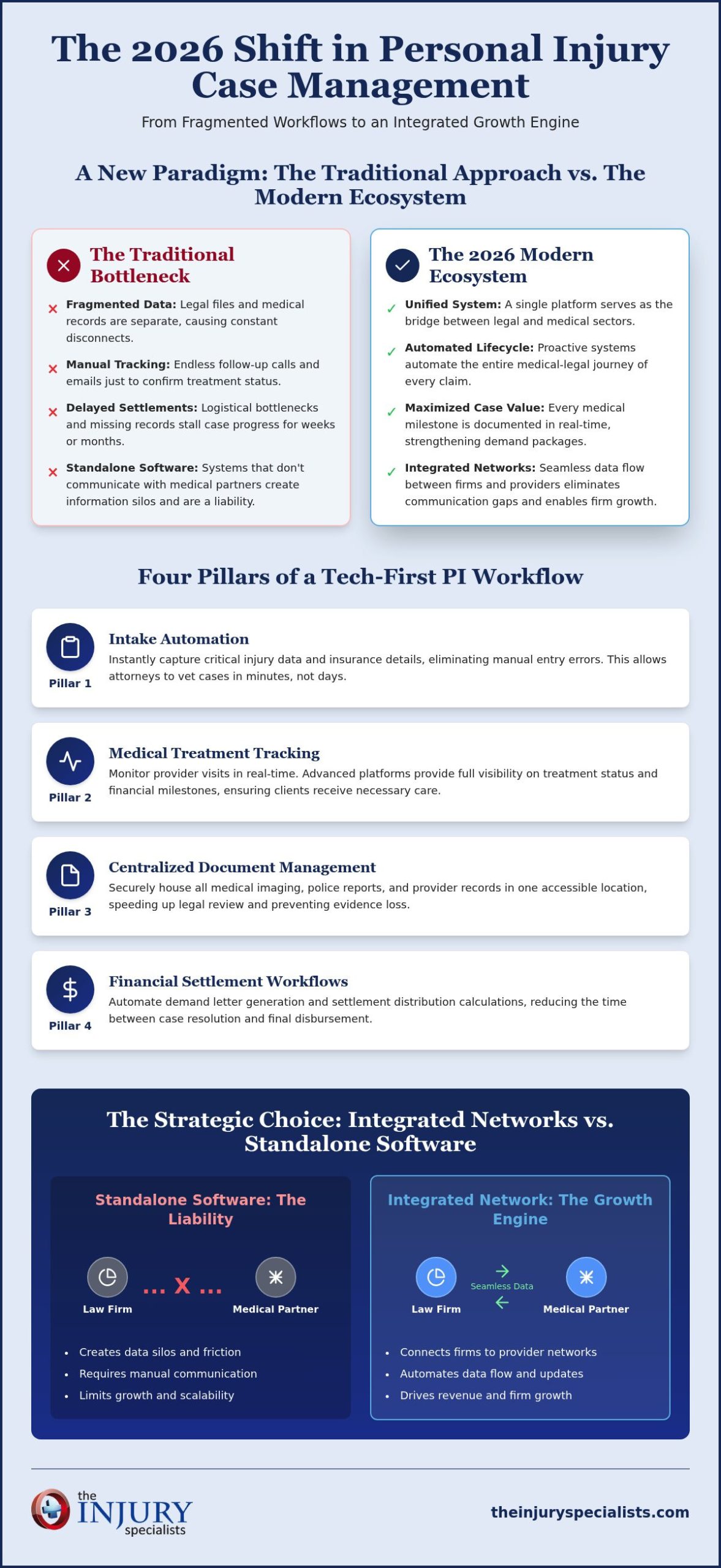
The era of standalone software silos is over. In 2026, software that doesn’t communicate with external medical partners is a liability. Firms now prioritize connectivity, ensuring that data flows seamlessly between the legal team and the healthcare provider without manual intervention.
From General Practice to PI-Specific Solutions
General legal software often fails to meet the unique demands of a personal injury practice. Standard Legal case management systems aren’t built for the complexities of contingency-fee-based workflows. They often lack the specialized modules needed for high-stakes injury work.
- Automated Lien Tracking: Systems now monitor medical liens and subrogation interests in real-time.
- Treatment Milestones: Automation alerts the legal team when a client misses an appointment or completes a phase of care.
- Document Retrieval: Automated requests ensure that medical records and bills are collected as treatment occurs, not months later.
Specialized personal injury case management technology ensures that every aspect of the client’s medical journey is captured. This level of detail is essential for building the comprehensive demand packages required to maximize settlement values.
The Rise of the Integrated Referral Ecosystem
The most significant shift in 2026 is the emergence of technology as a bridge. It connects law firms directly to a national network of medical providers. This integration removes the friction of manual communication. You don’t need to send emails or make phone calls to check a treatment status; the data is already in your system.
This visibility allows firms to manage larger case volumes without increasing administrative staff. When the legal and medical workflows are aligned, the entire process moves faster. Integrated networking is the key to 2026 firm growth.
Core Pillars of Modern Personal Injury Technology
Efficiency in 2026 depends on four foundational pillars. Modern personal injury case management technology has moved from basic record-keeping to a system of active intelligence. These pillars ensure that every case moves from intake to settlement with zero administrative friction. By focusing on these core areas, firms can handle higher case volumes without sacrificing quality or documentation standards.
- Intake Automation: Every second counts after an accident. Automated intake tools capture critical injury data and insurance details instantly. This removes manual entry errors and allows attorneys to vet cases in minutes rather than days.
- Medical Treatment Tracking: Systems now monitor provider visits in real-time. Unlike basic software, advanced platforms integrate pre-settlement funding for injury victims directly into the medical case management workflow. This ensures clients receive necessary care while the firm maintains full visibility on treatment status and financial milestones.
- Document Management: Centralization is key. Modern systems securely house medical imaging, police reports, and provider records in one accessible location. This accessibility speeds up the legal review process and ensures no evidence is lost during the litigation lifecycle.
- Financial Settlement Workflows: Automation extends to the end of the case. Demand letters are generated using structured data, and settlement distributions are calculated automatically. This reduces the time between case resolution and final disbursement.
Advanced Medical Case Management Integration
High-value settlements require more than just a stack of papers. They require Medical Records Management for Attorneys: Streamlining PI Case Workflows in 2026. By aligning medical records with legal strategy through structured data, firms ensure cohesive care across multiple specialists. This coordination prevents fragmented treatment plans that can devalue a claim during negotiations.
HIPAA Compliance and Data Security in 2026
Security is non-negotiable. The current standard involves end-to-end encrypted communication between attorneys and medical providers. Modern platforms offer secure portals for sensitive imaging data and maintain detailed audit trails for every document accessed. For a deeper dive into these requirements, consult our HIPAA Software for Law Firms: 2026 PI Case Management Guide. Utilizing a connected technology ecosystem ensures that your firm remains compliant while scaling operations and expanding your referral network.
Integrated Networks vs. Standalone Software: The Strategic Choice
Many firms invest heavily in standalone software only to encounter the “Silo Problem.” Even the most sophisticated internal tools fail if they don’t connect directly to your medical providers. Standalone systems prioritize internal organization, acting as a high-end filing cabinet for data you already possess. They don’t accelerate the acquisition of new data. You’re still stuck waiting for records, bills, and treatment updates via traditional, slow communication channels.
The strategic choice in 2026 is between internal efficiency and external growth. Standalone software helps your staff work faster on existing files. Network-integrated personal injury case management technology, however, automates the referral process itself. It creates a seamless loop where physicians and lawyers exchange data without manual intervention. This shift turns your management tool into a proactive revenue generator by facilitating faster case movement and better provider relationships.
Bridging the Medical-Legal Communication Gap
Eliminating phone tag and faxing is the first step toward a modern workflow. Shared secure portals provide a direct, encrypted line between the law firm and the medical facility. When imaging centers provide real-time updates through these portals, demand letter preparation begins the moment treatment concludes. This transparency also makes it easier for medical providers to accept personal injury liens. They gain confidence in the process when the technology ensures their documentation is received and tracked accurately.
Evaluating ROI: Efficiency vs. Revenue Growth
Calculating the value of saved administrative hours is a standard way to measure ROI, but it’s incomplete. The true value lies in the revenue multiplier created by a tech-enabled referral partner base. Integrated pre-settlement funding is a key component of this growth. By providing clients with financial stability, you ensure case longevity. This prevents premature settlements driven by client financial pressure, allowing the firm to hold out for maximum value.
Selecting the right platform requires looking beyond the user interface to the underlying network capabilities. If your current system feels like an isolated silo, explore our Best Filevine Alternatives for Personal Injury Firms: 2026 Comparison Guide to find a solution that prioritizes connectivity and external expansion.
Implementing a Tech-First Workflow for Personal Injury Success
Adopting personal injury case management technology requires more than a software subscription. It demands a structural overhaul of how your firm interacts with the medical community. A tech-first approach ensures that your staff focuses on high-value legal work rather than chasing down missing bills or treatment updates. By following a structured implementation roadmap, you can transform your operations into a high-velocity settlement engine.
- Step 1: Audit Bottlenecks. Review your current case lifecycle to identify exactly where medical record retrieval stalls and where communication with providers breaks down.
- Step 2: Select a Growth-Oriented Platform. Choose a system that supports national networking and integrated medical case management. The goal is a platform that expands your reach, not just one that organizes your current files.
- Step 3: Standardize Documentation. Establish clear requirements for all medical referral partners. When every provider uses the same digital submission standards, your review process becomes instantaneous.
- Step 4: Automate Financial Tracking. Use automation to monitor medical liens and pre-settlement funding needs. This prevents financial surprises during the settlement phase and ensures all interests are protected.
- Step 5: Leverage Reporting. Use built-in analytics to identify which referral sources provide the highest-quality documentation and case values.
Standardizing the Intake and Referral Process
Every case should begin with a uniform digital “handshake” between the firm and the doctor. This process ensures that the provider receives complete insurance and injury data immediately, preventing delays in care or billing errors. When the intake process is standardized, the risk of missing critical documentation decreases. For a comprehensive roadmap on this transition, see our Streamlining Personal Injury Case Workflow: 2026 Guide.
Optimizing Case Velocity with Real-Time Data
Velocity is the lifeblood of a personal injury practice. Modern technology identifies “stalled” cases where treatment has stopped unexpectedly, allowing your team to intervene before the case loses momentum. Proactive alerts for medical milestones and the statute of limitations keep your docket moving without constant manual oversight. This level of data transparency significantly reduces the time from initial intake to the final demand letter. To start building your high-velocity workflow, connect with our technology experts today.
The Injury Specialists: A World-Class Technology Ecosystem
The Injury Specialists operate the largest personal injury referral network in the U.S. through a proprietary platform designed for professional synergy. Our personal injury case management technology isn’t just a tool for organization. It’s a high-level facilitator that aligns your firm’s distinct processes with a national network of medical experts. This ecosystem removes the friction of coordination, allowing your team to focus on litigation while we manage the logistical complexities of medical care.
Our platform integrates medical case management, imaging referrals, and pre-settlement funding into a single, unified workflow. This level of integration is unique in the 2026 market. It ensures that every stakeholder has real-time visibility into the status of a claim. For example, when an imaging center uploads a report, the legal team and the case manager receive an immediate notification. This transparency eliminates the wait times that typically stall a case. By centralizing these services, your firm gains a competitive advantage, positioning you as a sophisticated leader in the medical-legal community.
National Scale with Professional Synergy
Growth requires access to reliable partners. The Injury Specialists connect your firm with top-tier physicians, chiropractors, and imaging centers nationwide. Our networking tools aren’t passive directories. They’re active marketing engines that grow your referral partner base through proven connectivity. Medical case management plays a vital role here, ensuring that client care remains cohesive across multiple specialists. This coordination results in superior medical documentation and higher settlement values, as insurance adjusters are presented with a complete and logical treatment history.
We provide direct access to the most extensive personal injury referral network in the country. This isn’t just about finding a doctor; it’s about building a sustainable pipeline of high-quality cases. Our marketing and networking tools allow you to identify and connect with the best-performing providers in your specific region. This synergy ensures that every referral is backed by a technology stack that prioritizes documentation and legal deadlines. When imaging centers and specialists are part of the same ecosystem, the friction of gathering evidence disappears.
Getting Started with a Tech-Enabled Network
Professional partners trust The Injury Specialists because we provide a reliable system for streamlined success. Our personal injury case management technology offers immediate benefits, from faster record retrieval to automated lien tracking. You don’t have to build these connections from scratch. Instead, you leverage an established market giant to scale your operations quickly.
The 2026 legal market rewards firms that prioritize connectivity over isolation. By joining our ecosystem, you gain the tools and the network needed to dominate your local market while maintaining operational ease. Experience the power of our integrated personal injury technology.
Securing Your Firm’s Future with Integrated Technology
The 2026 legal landscape demands a shift from passive data storage to proactive, integrated ecosystems. Success no longer relies on isolated software; it depends on your ability to connect seamlessly with medical providers. By adopting modern personal injury case management technology, you eliminate the communication silos that traditionally delay settlements and devalue claims. This connectivity ensures that every medical milestone is captured and utilized to build the strongest possible legal case.
The Injury Specialists provide the infrastructure for this transformation. We operate the largest personal injury referral network in the United States, offering a platform that integrates medical case management and pre-settlement funding directly into your workflow. Trusted by thousands of medical and legal professionals, our system is designed to accelerate case velocity and maximize settlement values through professional synergy.
Scale your firm with our world-class personal injury technology platform today. Your firm is ready to move beyond manual tracking and into a future of streamlined, high-growth success.
Frequently Asked Questions
What is personal injury case management technology?
Personal injury case management technology is a specialized digital ecosystem designed to automate the entire medical-legal lifecycle of an injury claim. It moves beyond basic document storage to facilitate real-time data exchange between law firms and medical providers. This system ensures that every treatment milestone, medical record, and legal deadline is tracked in a unified environment, eliminating the fragmented communication that often stalls case progression.
How does technology help personal injury lawyers manage medical records?
Technology automates the retrieval and organization of medical records by providing secure portals for direct provider uploads. This eliminates manual follow-ups and ensures that records are collected immediately as treatment occurs. Centralized management allows legal teams to review imaging and bills instantly, which prevents delays in building demand packages. It ensures your firm maintains a complete and accurate medical history for every client file.
Can case management software help increase my referral network?
Integrated platforms connect law firms with a national network of vetted medical providers, facilitating a high-volume referral loop. By using a shared system, firms can demonstrate professional reliability to new partners and encourage more frequent referrals. The technology acts as a networking engine that identifies top-performing providers in your region. This connectivity turns a standard management tool into a proactive growth asset for your firm.
Is personal injury technology HIPAA compliant?
Modern personal injury case management technology must adhere to strict HIPAA standards to protect sensitive health data. Compliant systems use end-to-end encryption for all communications and document transfers between attorneys and doctors. They also maintain detailed audit trails to track who accessed medical information at any time. This ensures full regulatory security for both law firms and medical offices while maintaining professional standards.
How does technology accelerate the settlement process in injury cases?
Technology speeds up settlements by reducing the administrative time spent on manual document collection and status checking. Real-time visibility into medical treatment allows firms to prepare demand letters the moment care is completed. Automated workflows ensure that no case stalls due to missing information or unmonitored milestones. This transparency significantly reduces the time from initial intake to the final disbursement of settlement funds.
What features should I look for in a PI-specific management platform?
You should look for a platform that prioritizes external connectivity, such as secure provider portals and integrated medical case management. The system must include automated lien tracking, real-time treatment alerts, and robust reporting tools. Selecting a personal injury case management technology that offers pre-settlement funding for injury victims integration provides a significant advantage. These features ensure you can manage client expectations and case longevity with high-level precision.
How does integrated technology benefit medical providers in PI cases?
Integrated systems reduce the administrative burden on medical staff by standardizing how records and bills are submitted to law firms. Providers gain confidence in the personal injury lien process when they have a transparent, secure way to track their documentation. This efficiency makes it easier for specialists to accept injury cases and maintain long-term partnerships. It ensures that medical offices are paid accurately and promptly.
Does technology assist with pre-settlement funding for injury victims?
Advanced platforms integrate pre-settlement funding requests directly into the case management workflow for maximum efficiency. This allows attorneys to monitor a client’s financial needs alongside their medical treatment milestones in one place. Seamless integration ensures that funding is processed quickly based on documented case value. This assistance helps clients stay compliant with their treatment plans while the firm works toward a maximum settlement value.
