

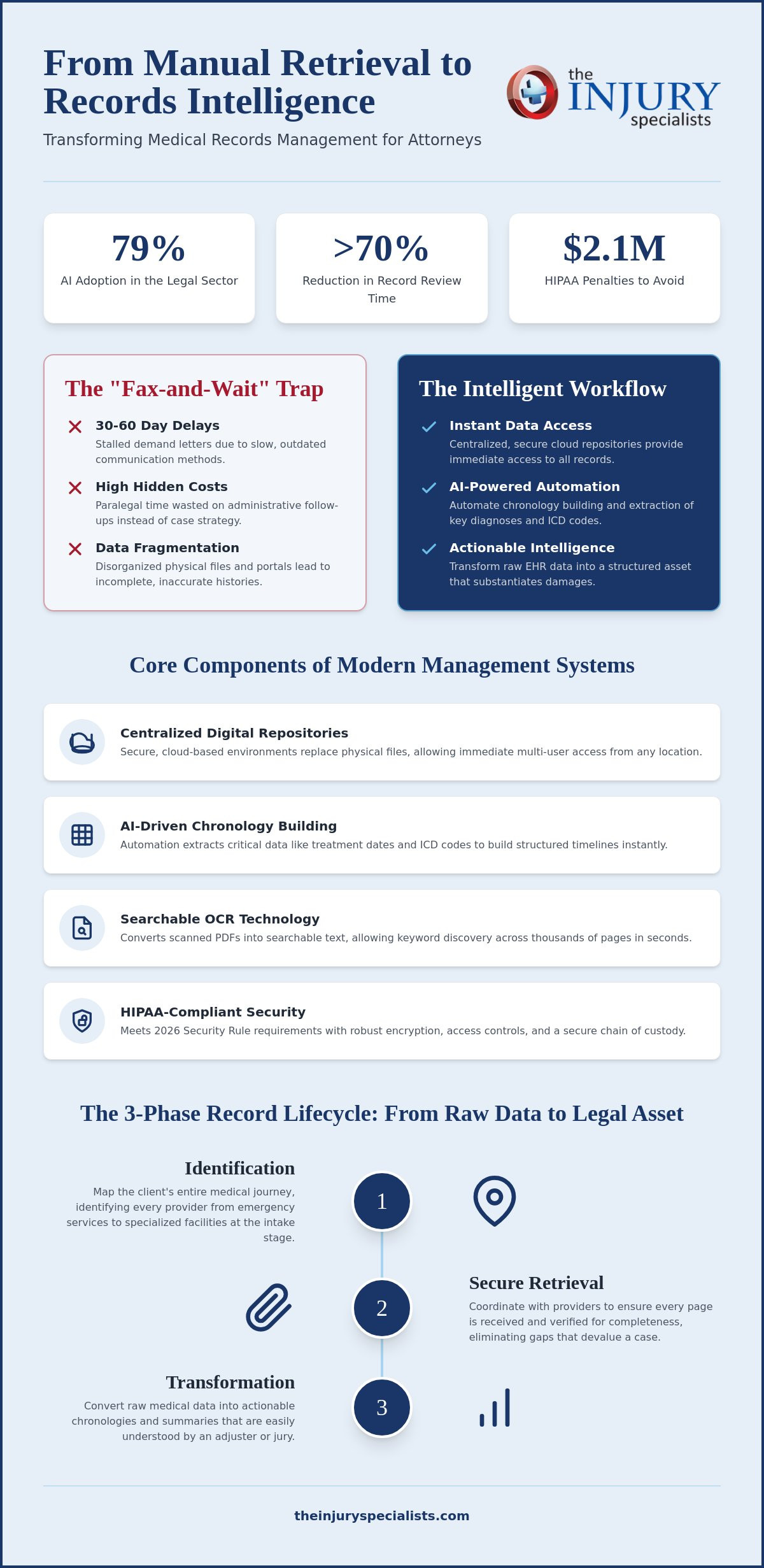
In 2026, firms that still rely on manual retrieval are fighting a losing battle against overhead. With AI adoption in the legal sector hitting 79 percent, the industry has shifted from waiting for faxes to instant data integration. Efficient medical records management for attorneys is no longer just a clerical task; it’s a strategic necessity to avoid the $2.1 million penalties associated with the latest HIPAA Security Rule updates.
You likely know the frustration of demand letters stalled by a single missing provider or paralegals burnt out from chasing non-responsive clinics. We understand that incomplete medical histories don’t just slow down your workflow; they actively devalue your client settlements. This guide shows you how to transform your medical records from a logistical bottleneck into a high-speed asset that substantiates damages and accelerates case resolution. We’ll explore the mandatory 2026 security requirements, the cost-saving benefits of specialized referral networks, and the technology-driven workflows that can reduce record review time by over 70 percent.
Key Takeaways
- Transition from passive record retrieval to proactive “records intelligence” to secure higher settlements and faster case resolutions.
- Modernize your medical records management for attorneys by shifting to centralized digital repositories that ensure immediate data accessibility and security.
- Utilize AI-powered chronology building to automate the extraction of critical diagnoses and ICD codes, reducing manual review time by over 70 percent.
- Streamline your demand letter drafting by implementing early record identification at the intake stage to eliminate the common demand stage bottleneck.
- Integrate your firm’s unique workflows with proprietary case management technology to bridge the communication gap between legal and medical professionals.
What is Medical Records Management for Attorneys?
Medical records management for attorneys is the end-to-end process of identifying, retrieving, organizing, and analyzing healthcare documentation for legal use. It is far more than a clerical task of gathering paperwork; it is a strategic function that dictates the pace and profitability of a personal injury practice. In 2026, the legal industry has moved beyond simple “record retrieval” toward “records intelligence.” This shift emphasizes the transformation of a raw Electronic Health Record (EHR) into a structured, searchable, and actionable legal asset.
Effective medical records management for attorneys relies on several core components designed to handle the massive volume of data inherent in modern litigation. These include:
- HIPAA-Compliant Storage: Secure, cloud-based environments that meet the 2026 Security Rule requirements for encryption and access control.
- OCR-Enhanced Indexing: Technology that converts scanned PDFs into searchable text, allowing for instant keyword discovery across thousands of pages.
- Medical-Legal Chronologies: The distillation of complex medical histories into timelines that highlight key treatments, pre-existing conditions, and causation.
Manual management is the primary efficiency killer for modern personal injury firms. When staff members spend dozens of hours on administrative follow-up, case velocity drops. This creates a manual retrieval bottleneck that delays demand letters and forces attorneys to negotiate with incomplete data. Relying on disorganized folders or physical files is no longer a viable way to scale a practice.
The Lifecycle of a Medical Record in PI Litigation
Success in personal injury cases depends on a methodical workflow that begins at intake. The lifecycle generally follows three distinct phases:
- Phase 1: Identification. This involves mapping out the client’s entire medical journey. Firms must identify every treating provider, including emergency services, primary care, and specialized imaging facilities.
- Phase 2: Secure Retrieval. Firms coordinate with providers to ensure the verification of completeness. Missing a single page of an operative report can devalue a case significantly.
- Phase 3: Transformation. The final step is converting raw data into actionable summaries that an adjuster or jury can easily understand.
Why Traditional Retrieval Methods Fail Today
Many firms remain stuck in the “fax-and-wait” trap. This analog approach relies on outdated communication methods that result in 30 to 60-day delays. Relying on in-house paralegals for record-chasing carries high hidden costs. Their time is better spent on high-level case strategy rather than administrative chores. Additionally, data fragmentation across various portals and physical offices makes it nearly impossible to maintain a single, accurate version of the client’s medical history without a unified management system.
Core Components of Modern Management Systems
Modern medical records management for attorneys requires a transition from fragmented local storage to unified cloud infrastructure. This shift ensures that every piece of evidence is accessible, searchable, and secure. Understanding the legal process for EHRs is vital for maintaining the chain of custody and ensuring records are admissible during discovery. A robust system does more than store files; it organizes data to serve as a strategic tool throughout the litigation lifecycle.
To achieve high-level efficiency, a management system must include several critical features:
- Centralized Digital Repositories: Secure cloud environments replace physical filing cabinets and local servers. This allows for immediate, multi-user access regardless of office location.
- AI-Driven Chronology Building: Automation extracts ICD codes, treatment dates, and provider names. This transforms raw data into a structured timeline without manual entry.
- Searchable OCR Technology: Optical Character Recognition turns static, scanned PDFs into searchable datasets. Attorneys can find specific keywords, such as “loss of consciousness” or “disc herniation,” in seconds.
- Integrated Billing Analysis: Matching clinical records with invoices simplifies lien resolution. It ensures that every billed service is substantiated by a treatment note.
- Granular User Access Controls: Role-based permissions protect sensitive ePHI. This ensures your firm meets 2026 HIPAA standards and SOC 2 Type 2 security requirements.
Firms looking to upgrade their infrastructure often find that integrated case management technology provides the most reliable path to operational efficiency and data security.
Automated Medical Chronologies and Summaries
AI-powered systems don’t just list dates; they identify critical gaps in treatment history that could devalue a case. These systems flag missing follow-up appointments or gaps in care that insurance adjusters often exploit. The most effective platforms provide hyperlinked summaries. This feature allows you to click a specific event in the chronology and jump directly to the corresponding page in the source medical record. This level of connectivity replaces the need for exhaustive, manual paralegal reviews.
Data Security and HIPAA Compliance in 2026
In 2026, data security is a mandatory pillar of legal operations. Firms must implement AES-256 encryption for data at rest and TLS 1.2 or higher for data in transit. Comprehensive audit trails are essential; you must know exactly who accessed a record and when. Partnering with vendors that hold SOC 2 Type 2 certification is the only way to ensure your client data is protected against the rising frequency of healthcare-related data breaches. These standards aren’t just best practices; they’re requirements for any firm acting as a HIPAA business associate.
Traditional Retrieval vs. AI-Powered vs. Network-Integrated Management
Attorneys today must choose between three distinct models for handling healthcare data. Each model offers different levels of efficiency, cost, and risk. Understanding these differences is essential for optimizing medical records management for attorneys. The industry has evolved from manual chasing to automated analysis, but the 2026 “gold standard” is now network-integrated management, where data flows seamlessly between pre-vetted providers and law firms.
Traditional retrieval relies heavily on manual labor. Law firms managing this in-house spend an average of $144 per request when accounting for labor and provider fees. With a standard personal injury case requiring records from six to eight providers, costs can reach $1,100 before a demand letter is even drafted. This model is slow, prone to errors, and creates a significant administrative burden on paralegals. While third-party retrieval services can lower per-request fees to between $40 and $75, they still operate on a “request-and-wait” basis that doesn’t address the need for data analysis.
AI-powered review has introduced massive time savings. AI tools can save law firms up to 72 percent of the time typically spent on medical record reviews. These systems excel at creating chronologies and reducing costs by up to 90 percent compared to manual methods. However, AI is only as good as the data it receives. If the initial retrieval is incomplete or the scans are low-quality, the resulting analysis will be flawed. This model improves speed but doesn’t solve the underlying problem of data accessibility.
Network-integrated management represents the highest level of 2026 data interoperability. In this model, law firms partner with medical networks that use unified technology platforms. Records aren’t “retrieved” in the traditional sense; they’re shared instantly through secure, HIPAA-compliant channels. This eliminates the 30 to 60-day waiting periods permitted under federal law. It also ensures that firms stay compliant with the latest HIPAA regulations for legal professionals, which now mandate strict multi-factor authentication and end-to-end encryption for all ePHI transmissions.
The Problem with Software-Only Solutions
Software alone cannot fix a provider who refuses to respond to a request. Many AI-driven platforms promise instant summaries but fail to account for the “garbage in, garbage out” risk. If a provider sends a disorganized or incomplete file, the AI may miss critical details. Professional facilitation remains necessary for complex cases where nuanced medical-legal arguments are required. Technology should support, not replace, the human oversight needed to verify that every page of an operative report or diagnostic scan is present.
The Power of the Medical-Legal Ecosystem
A unified medical-legal ecosystem removes the friction between treatment and documentation. When attorneys work within a network of pre-vetted providers, they benefit from standardized reporting. These providers understand exactly what documentation is needed to substantiate damages, from specific ICD-10 codes to detailed functional capacity evaluations. This alignment reduces the time spent on follow-up and simplifies the resolution of medical liens. By integrating medical case management with legal workflows, firms can ensure that the clinical data they receive is already optimized for their demand letters.
Best Practices for Streamlining Legal Workflows
Effective medical records management for attorneys begins at the intake stage, not when the demand letter is due. Waiting until the end of treatment to request files creates a high-pressure bottleneck that stalls case progression. By identifying all treating providers immediately, firms can initiate requests while treatment is ongoing. This proactive approach ensures that the file is complete the moment the client is discharged. Using standardized request templates further reduces friction by minimizing provider rejection rates, which are often caused by minor administrative errors or incomplete authorizations.
Integrating your medical records management for attorneys with Case Management Software (CMS) like Filevine or Litify creates a single source of truth. This centralized digital environment eliminates the need to search through disconnected email threads or local folders. When records flow directly into your CMS, every team member has real-time access to the most current evidence. This visibility is critical for maintaining momentum in high-volume personal injury practices. This level of organization is especially vital when coordinating with treating physicians who accept medical liens, as it ensures all treatment and billing data stay perfectly aligned. Firms evaluating their current platform should also consider Filevine alternatives for personal injury that offer deeper medical-legal integration and more seamless referral network connectivity.
To see how a unified platform can optimize your firm’s operations, join our national referral network and case management platform.
Optimizing Paralegal and Staff Time
Modern workflows move paralegals from being document chasers to acting as case strategists. Instead of spending hours on the phone with medical billing departments, staff can use automated follow-up triggers to track outstanding requests. Firm-wide dashboards provide a high-level view of record status across all active cases. This allows managers to identify and resolve delays before they impact deadlines. This shift increases internal capacity without the need for additional hiring. It allows your best talent to focus on substantiating claims rather than performing administrative chores. Firms looking to take this further can benefit from a comprehensive approach to streamlining personal injury case workflow that aligns internal legal operations with external medical coordination for maximum pre-litigation efficiency.
Substantiating Damages with Comprehensive Records
Attorneys must ensure that all diagnostic imaging, such as MRI or CT scans, is cross-referenced with clinical treatment notes. Discrepancies between a radiologist’s report and a treating physician’s assessment can weaken a case if not addressed early. Additionally, tracking future care recommendations is essential for maximizing settlement valuations. Accurate and comprehensive medical records directly correlate to higher settlement multipliers by providing undeniable evidence of the client’s long-term damages. Capturing every detail of the medical journey ensures that no value is left on the table during negotiations with insurance adjusters.
The Injury Specialists: A Unified Approach to Case Management
The Injury Specialists provides the infrastructure necessary to move beyond the fragmented retrieval models of the past. By offering a proprietary technology platform and a national referral network, we integrate medical case management directly into your legal workflows. This connectivity eliminates the manual retrieval bottleneck by ensuring that documentation is available as treatment occurs. When you leverage our system, medical records management for attorneys becomes a streamlined, automated process rather than an administrative burden. Our platform bridges the gap between professional sectors, acting as a strategic partner for growth-oriented firms.
Our approach is built on deep customization. We align our medical case management with your firm’s distinct processes. This ensures that the data you receive is formatted and indexed according to your specific litigation needs. As the largest personal injury referral network in the United States, we connect you with specialized medical providers who understand the nuances of legal documentation. For cases involving complex chronic conditions, centers like Sunridge Medical represent the type of specialized facilities that provide the comprehensive clinical data required for substantiating damages. These providers prioritize the accuracy and timeliness of the records they produce, ensuring your demand letters are never delayed by missing clinical notes or incomplete treatment histories.
Technology Meets Networking
Our platform serves as a high-level facilitator for seamless communication between law firms and medical offices. It provides real-time updates on client treatment status and documentation availability. You don’t have to call multiple clinics to check on a client’s progress or verify if a report has been signed. The system tracks every milestone from the initial referral to the final discharge. Additionally, our integrated marketing and networking tools allow you to grow your referral base. You can connect with professional partners who value efficiency and professional synergy.
For firms aiming to further optimize their internal structures, IntegraSense provides specialist consultancy in communication, governance, and professional practice, helping to ensure that every aspect of the business operates with the same level of precision as its case management.
Beyond Records: Facilitating the Full PI Ecosystem
We provide a comprehensive solution that supports every phase of the personal injury lifecycle. This includes connecting your clients with specialized imaging centers and surgical facilities that accept medical liens. Our ecosystem also supports your cases through pre-settlement funding and professional medical lien management. These services ensure that your clients receive necessary care while your firm maintains the financial liquidity needed to pursue complex litigation. By centralizing these functions, we help you substantiate damages more effectively and resolve cases with greater speed.
Streamline your medical-legal workflow with The Injury Specialists.
Future-Proof Your Practice with Strategic Records Intelligence
Modern personal injury litigation requires a decisive shift from manual administrative tasks to automated data integration. Adopting advanced medical records management for attorneys ensures your firm remains compliant with 2026 security standards while significantly reducing operational overhead. By moving away from the “fax-and-wait” model and embracing a network-integrated approach, you eliminate the primary bottleneck that stalls demand letters and case progression.
The Injury Specialists provides the essential tools to bridge the gap between clinical data and legal strategy. Our platform offers proprietary case management technology designed specifically for PI firms, paired with the largest national network of pre-vetted medical providers in the United States. Whether you require specialized support for imaging, surgery, or chiropractic referrals, our ecosystem is built to substantiate damages and accelerate resolution. Join the largest medical-legal referral network in the US and transform your medical records from a clerical burden into a powerful strategic asset. Your firm’s growth depends on the efficiency of your systems. There’s never been a better time to optimize your workflow and secure the results your clients deserve.
Frequently Asked Questions
What is the fastest way to retrieve medical records for a law firm?
The fastest way to retrieve medical records is through network-integrated management where data flows directly from the provider to the firm via a unified platform. This approach bypasses the traditional 30 to 60-day federal response window permitted under HIPAA. By working with pre-vetted providers who use synchronized technology, you gain immediate access to treatment notes and diagnostic reports as soon as they are finalized by the clinician.
How does AI help in medical record review for attorneys?
AI assists in medical records management for attorneys by automating the extraction of critical data points like ICD-10 codes, treatment dates, and specific diagnoses. These tools transform thousands of scanned PDF pages into searchable, indexed datasets in a fraction of the time required for manual review. This technology also identifies gaps in treatment history that human reviewers might overlook, ensuring the demand letter is based on a complete clinical picture.
Are medical record retrieval companies HIPAA compliant?
Reputable medical record retrieval companies are HIPAA compliant and operate as business associates under federal law. In 2026, compliance requires adherence to strict new security standards, including multi-factor authentication and end-to-end encryption for all electronic protected health information (ePHI). Firms must verify that their vendors hold SOC 2 Type 2 certification to ensure the highest level of data security and audit transparency across all record transmissions.
What is a medical chronology and why do attorneys need one?
A medical chronology is a concise, chronological timeline of a client’s medical history, treatment, and recovery following an injury. Attorneys need these summaries to quickly identify causation, substantiate damages, and prepare for depositions without sifting through hundreds of disorganized pages. A well-structured chronology highlights key evidence, such as objective findings from imaging, and cross-references them with subjective patient complaints to build a stronger case for liability.
How much do medical record retrieval services typically cost?
Third-party retrieval services typically charge a per-request fee plus any provider-mandated search and duplication costs. While these fees vary by state and the volume of records, outsourcing often proves more cost-effective than using in-house paralegal labor. Firms should evaluate the total cost of ownership, including the time saved on follow-up and the increased case velocity achieved through faster record availability rather than focusing solely on the per-page rate.
Can I integrate medical records management with my current case management software?
Most modern systems for medical records management for attorneys can be integrated directly with case management software (CMS) like Filevine or Litify via API. This integration ensures that records are automatically filed into the correct client folder, creating a single source of truth for the entire legal team. Automating this data transfer eliminates manual entry errors and ensures that attorneys always work with the most current medical evidence available. Firms that find their current platform limiting should explore top Filevine alternatives for personal injury firms that offer native medical-legal workflow integration without the steep learning curve.
What happens if a medical provider refuses to release records?
If a provider refuses to release records, the firm can leverage the HIPAA Right of Access, which mandates that providers respond within 30 calendar days. Persistent delays often stem from incomplete authorization forms or administrative bottlenecks at the facility. Working within a specialized referral network minimizes these issues, as participating providers are pre-vetted and committed to standardized, timely documentation sharing specifically for personal injury litigation purposes.
How does better medical records management increase settlement values?
Better management increases settlement values by ensuring no compensable injury or future care recommendation is omitted from the demand letter. Comprehensive, organized records allow attorneys to present a clearer link between the accident and the client’s long-term medical needs. When every diagnostic scan and specialist referral is indexed and substantiated, insurance adjusters have fewer opportunities to dispute the severity of the damages or the necessity of the treatment provided.
