

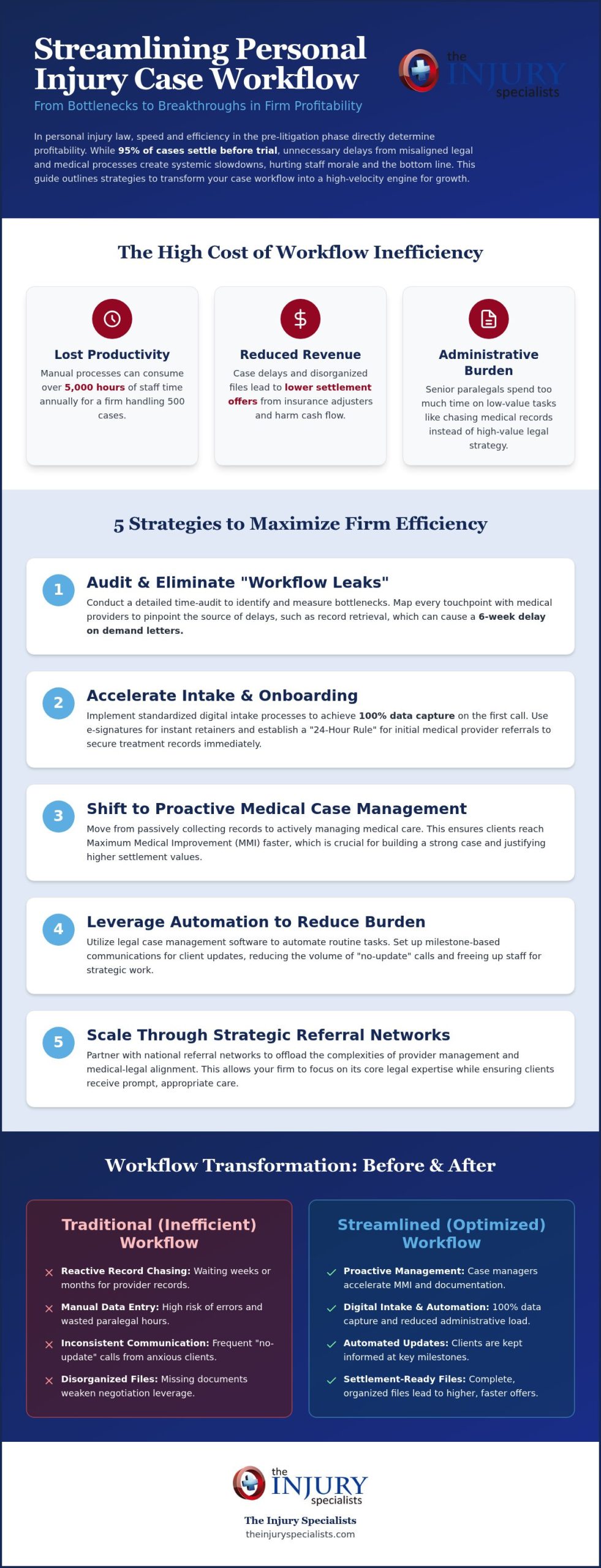
A law firm’s profitability in 2026 isn’t determined by the total number of cases on the docket, but by the speed at which those cases move through the pre-litigation phase. To streamline personal injury case workflow, firms must bridge the gap between internal legal operations and external medical coordination. When these two sectors aren’t aligned, the result is a systemic slowdown that impacts every aspect of the practice, from staff morale to the bottom line.
You’ve likely experienced the frustration of slow medical record retrieval and inconsistent intake processes that stall case progression for months. These bottlenecks, along with the difficulty of tracking medical liens and provider communications, create a heavy administrative burden on your staff. It’s a common reality where approximately 95% of personal injury cases settle before trial, yet the time it takes to reach those resolutions is often unnecessarily extended by logistical friction.
This guide outlines the specific strategies and technologies needed to eliminate these hurdles and maximize your firm’s profitability through a refined case workflow. You’ll learn how to leverage advanced medical case management and national referral networks to accelerate documentation. We’ll also examine how to utilize proprietary technology to ensure your clients reach maximum medical improvement faster, leading to higher settlement values and more efficient resolutions for your firm.
Key Takeaways
- Identify and eliminate common “workflow leaks” like delayed medical record requests to establish a baseline for firm-wide efficiency.
- Accelerate the onboarding phase by implementing standardized digital intake processes that ensure 100% data capture on the first call.
- Master the strategies to streamline personal injury case workflow by shifting from passive record collection to proactive medical case management.
- Reduce staff administrative burden by leveraging automation for routine client updates and milestone-based communications.
- Scale your practice through strategic referral networks that offload the complexities of provider management and medical-legal alignment.
Auditing Your Current Personal Injury Case Workflow
A personal injury case workflow is the comprehensive, end-to-end lifecycle of a legal claim, beginning at the initial intake and concluding with the final disbursement of funds. To Legal case management effectively, you must treat it as more than just a filing system; it’s a strategic engine that controls the flow of information between legal staff, medical providers, and insurance carriers. Without a rigorous audit of this process, firms often operate in a reactive state, losing significant time to “workflow leaks” that drain resources. These leaks typically manifest as delayed medical record requests, missed provider follow-ups, and inconsistent client check-ins that prevent cases from reaching settlement readiness on schedule.
To successfully streamline personal injury case workflow, you must first perform a detailed time-audit on your staff. Track the minutes spent on manual data entry, scanning documents, and chasing medical liens. It’s vital to distinguish between low-level administrative tasks and high-value legal strategy. If your senior paralegals spend nearly half their day on phone tag with imaging centers, you aren’t maximizing their professional expertise. High-growth firms isolate these repetitive tasks to prioritize them for automation or specialized medical case management solutions; for cases involving complex corporate defendants where verifying claims is crucial, you can visit International Investigative Group for expert investigative support and due diligence.
Identifying Bottlenecks in the Pre-Litigation Phase
Start by mapping out every touchpoint between your firm and medical providers. You need to determine the average turnaround time for medical record retrieval and final billing statements. If a provider consistently takes six weeks to deliver records, that creates a six-week delay on your demand letter. Another critical metric is the frequency of “no-update” calls from clients. A high volume of these calls indicates a failure in your communication system. Tracking these interactions helps you pinpoint exactly where friction occurs during the pre-litigation phase, allowing you to implement targeted fixes.
The Cost of Inefficiency: Calculating Lost Firm Revenue
Inefficiency carries a measurable price tag that impacts the bottom line. Case delays directly hurt firm cash flow, often increasing the reliance on pre-settlement funding to bridge operational gaps. When files are disorganized, your negotiation leverage suffers. Insurance adjusters quickly identify missing documentation or gaps in treatment history, leading to lower initial offers. Consider the overhead cost of manual data entry. If your current manual process adds ten hours of labor per case, a firm handling 500 cases loses 5,000 hours of productivity annually. This lost time represents thousands of dollars in uncaptured revenue and significantly slower case turnover rates.
Optimizing the Intake and Onboarding Phase for Speed
The intake phase is the most critical juncture in the case lifecycle. If this process is slow or disorganized, the rest of the workflow will inevitably suffer from data gaps and delays. To effectively streamline personal injury case workflow, firms must treat the intake phase as a high-velocity data acquisition event rather than a casual conversation. Speed wins in this industry. A delayed intake allows evidence to disappear and witnesses to fade; conversely, a rapid onboarding process secures the client and sets a professional tone for the entire relationship.
Efficiency begins with immediate action. You should implement digital signature solutions to finalize retainers and medical authorizations instantly. Waiting for a physical mailer or an in-person meeting creates a window for the client to reconsider or for a competitor to intervene. By investing in the right legal case management software, you can ensure that these signed documents trigger the automated creation of a digital case file structure. This removes the manual burden of folder creation and naming conventions from your staff, allowing them to focus on case merits immediately.
Establishing a “24-hour rule” for initial medical provider referrals is equally vital. Ensuring the victim receives care within the first day of signing not only aids their recovery but also establishes a contemporary record of treatment. Utilizing a professional physician referral service allows your team to offload this coordination while maintaining strict oversight of the treatment timeline.
Standardizing Your Intake Checklist
A high-conversion intake captures medical authorizations on day one. To achieve this, you need a standardized template that includes insurance details, witness contact info, and accident scene data. Use conditional logic in your digital forms to skip irrelevant questions. If a client wasn’t in a commercial vehicle, the form shouldn’t ask for DOT numbers. This logic keeps the process fast and ensures 100% data capture without fatigue. This data then flows directly into your system, eliminating the risk of transcription errors.
Accelerating Client Onboarding with Tech
Modern clients expect mobile-first communication. Integrate SMS-based onboarding for victims who prefer texting over lengthy phone calls or emails. Automated welcome emails should go out immediately to set clear expectations and provide a visual roadmap of the legal process. You can also leverage client portals to allow victims to upload photos of their injuries or vehicle damage directly to their file. This self-service model reduces the administrative hours your staff spends on basic document collection and keeps the case moving toward the demand phase without unnecessary friction.
Integrating Medical Case Management to Prevent Bottlenecks
Medical case management for attorneys is the operational engine of any high-performing personal injury practice. Many firms treat medical coordination as a passive, clerical task, but this approach inevitably leads to stalled cases and reduced settlement values. To truly streamline personal injury case workflow, you must shift toward proactive coordination with medical providers. This means moving beyond the “waiting for records” phase and establishing a care ecosystem where doctors, imaging centers, and legal teams share a unified view of the case progression.
Centralizing the tracking of medical liens is a vital step in preventing negotiation delays. When your firm has a real-time view of every outstanding medical bill and lien, you eliminate the risk of late-stage surprises that can derail a settlement. This proactive visibility allows your team to negotiate from a position of strength, armed with organized documentation that proves the full extent of the client’s treatment and costs. A well-oiled system ensures that by the time you reach the demand phase, every dollar of medical expense is accounted for and verified.
Streamlining Medical Records Management
Disorganized medical files are one of the most common “workflow leaks” in the pre-litigation phase. You should adopt a standardized naming convention for every document, such as Date_Provider_Type, to ensure staff can find critical evidence in seconds. Implementing digital request tracking allows your team to automate follow-ups every 14 days, removing the manual burden of checking request statuses. For a deeper look at these strategies, refer to our guide on Medical Records Management for Attorneys, which details how to eliminate clerical friction in the records department.
Coordinating with Specialized PI Medical Networks
Working with “lien-friendly” providers who understand the specific documentation requirements of a legal claim is a major competitive advantage. These providers know how to draft narrative reports that clearly link injuries to the accident, which directly impacts case valuation. By using a centralized platform to manage referrals to chiropractors, physical therapists, and imaging centers, you remove the administrative headache of provider management. This “power-connector” model allows your firm to access a national network of specialists without the burden of maintaining individual relationships in every jurisdiction. It ensures your clients get immediate care while your staff stays focused on high-value legal strategy.
Leveraging Technology and Automation for Seamless Case Progression
Technology is the infrastructure of a modern firm’s growth. To streamline personal injury case workflow, you must transition from general practice management tools to specialized platforms that integrate with medical-legal networks. This connectivity ensures that data from medical providers flows directly into your legal files without manual intervention. When evaluating software, focus on its ability to bridge the gap between your staff and the external care ecosystem. If your technology operates in a silo, you’re missing the primary benefit of automation. Equally important is ensuring that any platform you adopt meets the mandatory technical safeguards introduced in the May 2026 update; selecting HIPAA compliant software for law firms is now a non-negotiable prerequisite for any practice handling sensitive medical records at scale.
AI-driven document search has revolutionized the review of voluminous medical files. Instead of a paralegal manually scanning a 500-page record to find a specific diagnostic code or injury mention, AI can locate that data in seconds. This capability accelerates the demand drafting process and improves the accuracy of your settlement evaluations. If your firm isn’t using these tools, you’re losing hours of billable-level productivity to clerical searching. For those evaluating their current systems, explore Filevine alternatives for personal injury to find a solution that offers deeper integration with medical case management.
Automation also solves the communication gaps that lead to client frustration. By setting up SMS or email triggers based on case milestones, you keep clients informed without manual effort. For example, when a case status changes from “Medical Collection” to “Demand Review,” a notification can automatically reach the client. This proactive approach significantly reduces the volume of inbound “status check” calls, freeing your team to focus on high-value litigation tasks. To optimize your firm’s tech stack, consider adopting proprietary case management technology designed specifically for medical-legal alignment.
Essential Features for PI Workflow Software
Your software must do more than store documents; it must drive the case forward. Essential features include task automation that generates specific “To-Do” lists when a case enters a new phase. Integrated calendaring is equally critical for syncing Statutes of Limitations (SOL) and court deadlines across all devices. Real-time lien tracking is another non-negotiable feature. Your team needs immediate visibility into the total medical spend and outstanding balances to ensure settlement negotiations are based on accurate, up-to-date figures.
Standardizing Digital Folder Hierarchies
A “clean file” is one where any staff member can find a specific record in under 30 seconds. To achieve this, your digital folder hierarchy should mirror a logical case structure. Use standard subfolders such as “Pleadings,” “Medical Records,” “Correspondence,” and “Discovery.” Implement strict version control to ensure that the latest version of a demand letter or motion is always the one accessed. This level of organization prevents the confusion and errors that occur when multiple staff members work on the same file across different phases of the workflow.
Scaling Through Strategic Referral Networks and Partnerships
Strategic networking is the ultimate workflow hack for firms looking to scale without exponentially increasing their internal headcount. While previous sections focused on internal audits and software, the final step to streamline personal injury case workflow involves looking outside your firm’s walls. By leveraging a personal injury referral network, you effectively offload the massive administrative burden of provider management to a specialized partner. This allows your team to stop acting as medical coordinators and start acting as firm strategists.
A significant bottleneck in case progression occurs when clients face financial strain that prevents them from completing their treatment plans. Integrated pre-settlement funding is a critical tool in this care ecosystem. It ensures that the workflow doesn’t grind to a halt because a client can’t afford transportation to therapy or basic living expenses during recovery. When funding is integrated directly into your referral network, the transition is seamless, keeping the medical record growing and the case moving toward a high-value demand.
Outsourcing these logistical hurdles transforms your firm’s operational capacity. Instead of managing individual relationships with dozens of local clinics, you interface with a single, sophisticated partner. This shift reduces the “noise” in your firm, allowing your senior staff to focus on litigation strategy and trial preparation rather than chasing missing billing statements or confirming appointment dates. Success in 2026 belongs to the “power-connectors” who build systems that thrive on professional synergy and external expertise.
For law firms whose growth strategy involves acquiring or valuing medical practices to strengthen their provider network, Healthcare Biz Brokers, Inc. offers the specialized expertise needed to navigate complex healthcare business transactions.
The Power-Connector Advantage
Utilizing national networks allows your firm to handle medical coordination across multiple jurisdictions with zero added friction. These platforms connect law firms directly to a vetted list of providers who understand the nuances of personal injury documentation. By leveraging this technology, you ensure that your care ecosystem is managed by experts. Your staff stays focused on high-level legal strategy while the network manages the doctors, imaging centers, and specialists. This connectivity is the foundation of a truly scalable practice.
Next Steps: Implementation Roadmap
Transformation doesn’t happen overnight, but it can happen in a single month. Follow this roadmap to begin optimizing your practice immediately:
- Days 1-30: Conduct a comprehensive audit of your most delayed cases to identify the specific providers or processes causing the friction.
- Week 2: Standardize your digital intake forms and authorizations to ensure you’re capturing 100% of necessary data on the first call.
- Week 4: Integrate your workflow with an external referral partner to offload provider management.
Join The Injury Specialists network to streamline your case management today. By aligning your firm with the largest personal injury referral network in the U.S., you gain the tools and connectivity needed to maximize settlement values and accelerate your path to profitability.
Future-Proofing Your Firm’s Operational Capacity
Transitioning to a high-velocity workflow is a necessity in a legal market defined by court backlogs and complex data requirements. Firms that successfully integrate internal legal tech with external medical coordination will see the most significant gains in 2026. This approach moves beyond simple task management; it creates a unified system where every phase of the case is optimized for speed and accuracy. By removing the clerical friction associated with record collection and provider follow-ups, your staff can focus on the high-level legal strategy that drives case value.
When you eliminate the “workflow leaks” identified in this guide, you directly impact your bottom line. You can streamline personal injury case workflow by adopting standardized intake protocols and leveraging automated communication tools. These changes reduce the administrative burden on your paralegals while ensuring that your clients reach maximum medical improvement without unnecessary delays. Accessing the largest PI referral network in the U.S. provides the connectivity needed to handle cases across multiple jurisdictions with zero added overhead.
Streamline your PI workflow with the world-class technology and referral network at The Injury Specialists. Our proprietary technology is designed for seamless medical-legal coordination, offering professional medical case management built directly into your existing workflow. Your firm is now equipped to lead the market with a more efficient, scalable system that delivers superior results for your clients.
Frequently Asked Questions
What is the best way to streamline personal injury case intake?
Standardizing your intake through digital forms with conditional logic is the most effective method. This ensures 100% data capture on the first call and eliminates redundant questions. Implementing e-signatures allows you to finalize retainers instantly, preventing potential clients from shopping around. A high-velocity intake sets the professional tone for the entire case and secures evidence before it disappears.
How does medical case management improve law firm efficiency?
Medical case management improves efficiency by aligning clinical treatment with legal documentation requirements. It shifts your staff from a reactive “waiting for records” stance to a proactive coordination model. This alignment ensures that every medical milestone is documented correctly, which reduces the time spent on manual follow-ups and prevents gaps in treatment that could lower case valuation.
Should I use manual checklists or case management software for PI cases?
Case management software is the superior choice for firms looking to scale. While manual checklists are a starting point, they don’t offer the automation, task triggers, or real-time visibility needed for high-volume practices. To streamline personal injury case workflow effectively, you need a digital system that integrates with medical networks and automates routine deadlines.
How can I speed up medical record collection in personal injury cases?
Speeding up record collection requires standardized naming conventions and automated digital follow-ups. Set your system to trigger a request status check every 14 days. This removes the administrative burden from your paralegals. Working with a specialized medical network also helps, as these providers are already accustomed to the documentation needs of personal injury firms.
What are the most common bottlenecks in a personal injury workflow?
The most common bottlenecks occur during the pre-litigation phase, specifically during medical record retrieval and the wait for maximum medical improvement. Inconsistent intake processes also create data gaps that stall cases later. Identifying these “workflow leaks” early through a staff time-audit allows you to implement targeted automation to keep the case moving toward the demand phase.
How do I manage medical liens more effectively during a case?
Effective lien management requires real-time visibility into total medical spend and outstanding balances. You should use a centralized platform to track every bill and lien as they occur. This prevents late-stage surprises during settlement negotiations and allows your team to negotiate from a position of strength with fully verified and organized documentation.
Can technology help with client communication in PI law?
Technology significantly improves client communication through automated SMS updates and secure portals. These tools allow you to provide milestone-based updates without manual effort. Automated notifications reduce the volume of inbound “no-update” calls, which frees your staff to focus on high-value litigation tasks while keeping the client informed and satisfied.
What is the role of a referral network in case management?
A referral network acts as a strategic “power-connector” that offloads the burden of provider management. It provides immediate access to a vetted care ecosystem, which is essential to streamline personal injury case workflow across multiple jurisdictions. The network handles the coordination of chiropractors, imaging centers, and specialists, allowing your firm to focus purely on legal strategy.
