

The most expensive bottleneck in a personal injury case isn’t the litigation itself. It’s the administrative friction caused by unverified medical liens and manual tracking. Relying on fragmented spreadsheets and constant phone calls between law firms and clinics is no longer a viable strategy for growth. You likely recognize that these inefficiencies lead to missed liens, frustrated medical partners, and settlements that stall at the finish line. Every hour spent chasing a medical bill is an hour lost on high-value case strategy.
Implementing dedicated personal injury lien management software eliminates these operational hurdles by creating a unified digital bridge between legal and medical professionals. This technology replaces guesswork with real-time visibility into medical balances and automated document exchange for Letters of Protection and billing. In this article, we’ll examine how modern lien management systems secure provider payments, eliminate administrative errors, and significantly accelerate the resolution of medical-legal financial obligations. You’ll discover how to transition from a manual workflow to a high-speed, automated system that prioritizes professional synergy and case velocity.
Key Takeaways
- Replace manual spreadsheets with centralized, cloud-based databases to eliminate administrative friction and secure provider payments.
- Utilize real-time ledger integration and automated notifications to ensure medical balances are verified well before settlement negotiations.
- Identify the difference between basic tracking and full relationship management by implementing a personal injury lien management software that connects directly with provider systems.
- Streamline your medical-legal workflow by auditing existing bottlenecks and adopting technology that facilitates seamless document exchange.
- Leverage an integrated technology platform to gain access to a national referral network while automating the resolution of medical-legal financial obligations.
What is Personal Injury Lien Management Software?
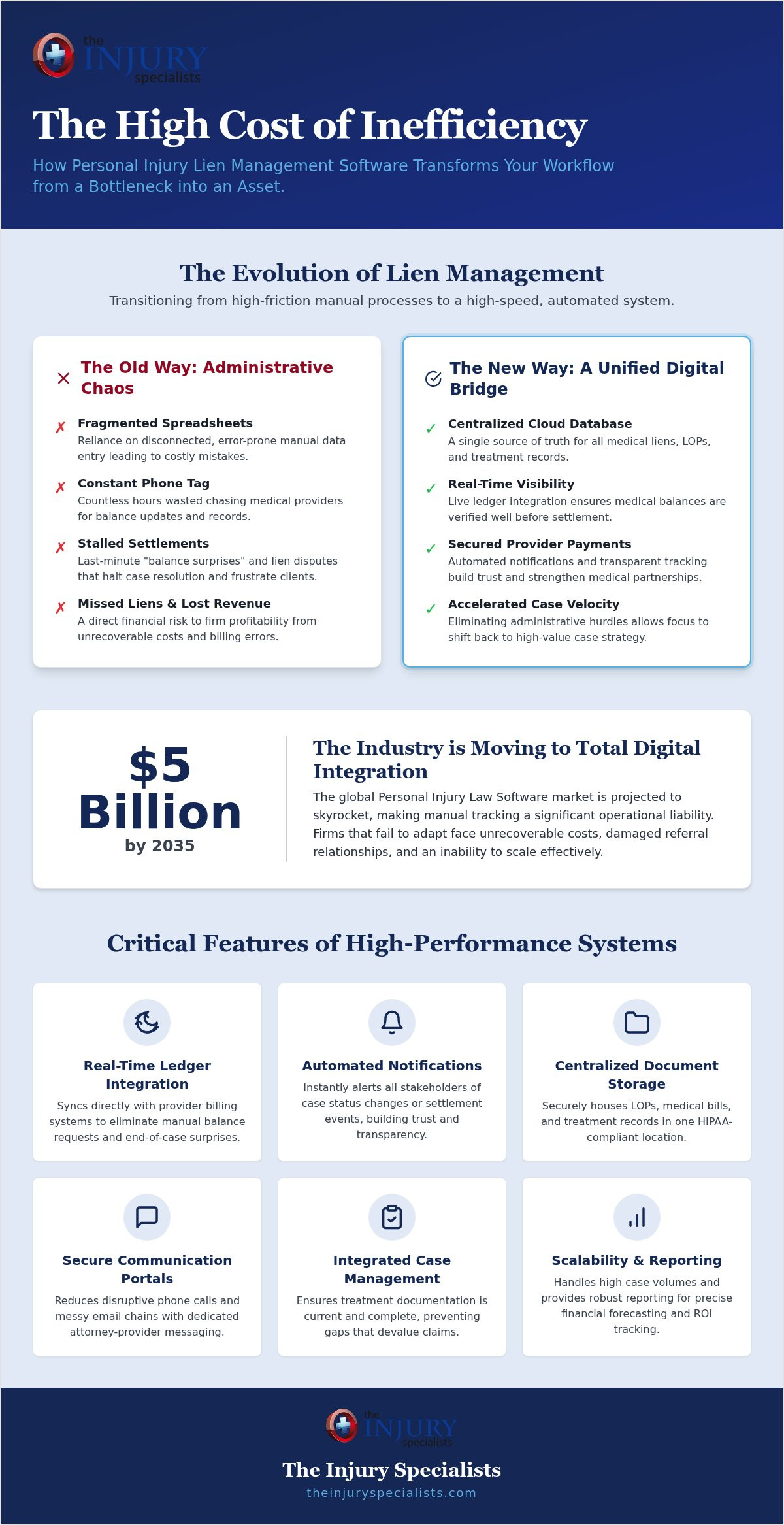
It’s a specialized technology category designed to track, manage, and resolve medical liens and Letters of Protection (LOPs) within personal injury claims. This technology facilitates a critical shift from fragmented manual spreadsheets to centralized, cloud-based databases. It acts as a single source of truth for both legal and medical professionals, ensuring that every financial obligation is accounted for from the moment a patient begins treatment. By maintaining a live, collaborative record, firms can eliminate the chaotic “lien negotiation” phase that typically stalls settlements at the end of a case.
Modern platforms prioritize data integrity and HIPAA compliance across the entire ecosystem. As regulations evolve, with an increasing focus on transparency regarding both billed and paid amounts, the need for precise data becomes even more urgent. High-level Case Management Technology ensures that firms don’t just store documents; they maintain a legally defensible audit trail that protects the interests of the firm, the provider, and the client.
The Core Components of Lien Management Tech
A sophisticated system functions as a strategic facilitator between professional sectors. It replaces traditional bottlenecks with streamlined connectivity through several essential features that ensure every stakeholder remains aligned throughout the case lifecycle:
- Centralized document storage: Securely house LOPs, medical bills, and treatment records in a unified location accessible to authorized stakeholders.
- Automated balance updates: Real-time ledger tracking provides immediate visibility into total medical costs as they accrue, preventing end-of-case surprises.
- Communication portals: These dedicated environments allow for seamless attorney-provider interaction, reducing the need for disruptive phone calls and unorganized email chains.
Why Manual Tracking is a Liability in 2026
With the global Personal Injury Law Software market projected to reach $5 billion by 2035, the industry is moving rapidly toward total digital integration. Relying on paper files or basic spreadsheets is now a significant operational liability that most growth-oriented firms cannot afford. Lost liens and unbilled medical services occur frequently when tracking is disconnected from the provider’s billing department. Human error during manual data entry can lead to unverified balances, causing settlement delays that frustrate clients and damage referral relationships. Manual lien tracking creates a direct financial risk to law firm profitability by introducing unrecoverable costs and increasing the administrative hours required to close each file.
Critical Features of High-Performance Lien Tracking Systems
High-performance personal injury lien management software must do more than just store data; it must actively sync with the medical-legal ecosystem. Real-time ledger integration with provider billing departments is the most critical feature for modern firms. It ensures that the attorney’s case file reflects the same balance as the clinic’s accounting system at all times. This synchronization eliminates the need for manual balance requests, which often take days or weeks to process, and prevents the “balance surprise” that can derail a settlement at the final hour.
Automated notification systems are equally vital for maintaining professional synergy. When a settlement is reached or a case status changes, the software should instantly alert all relevant medical providers. This transparency builds trust and secures the provider’s financial interests. Additionally, integrated medical case management ensures that treatment documentation remains current and complete. This prevents gaps in medical records that could devalue the claim during negotiations with insurance carriers.
Scalability is a non-negotiable requirement for firms managing hundreds of active cases simultaneously. Systems must handle high volumes of data without performance degradation. Robust reporting tools allow for precise financial forecasting and the ability to track provider ROI. By analyzing which medical partners provide the most consistent documentation and outcomes, firms can make data-driven decisions about their growth strategy. Firms looking to optimize these workflows often utilize Case Management Technology that bridges the gap between legal strategy and medical documentation.
Automation and Workflow Efficiency
True efficiency is gained through trigger-based alerts for medical record requests and follow-up tasks. Digital signature integration for LOPs and lien agreements further accelerates the process by removing the friction of physical paperwork. By reducing the number of administrative touchpoints required per case file, legal staff can focus on high-impact case strategy rather than routine data entry. This automation ensures that no lien is overlooked and no document is left unsigned, protecting the firm’s bottom line.
Data Security and HIPAA Compliance
In an era of increasing cyber threats, data security is paramount for professional partners. High-performance personal injury lien management software utilizes encrypted document sharing between legal and medical professionals to maintain strict HIPAA compliance. Detailed audit trails record every modification made to a medical lien ledger, providing total accountability. Cloud-based security protocols are especially important for multi-state law firms, ensuring that data remains secure and accessible across different jurisdictions without compromising integrity.
Evaluating Standalone Software vs. Integrated Networking Platforms
Choosing between standalone personal injury lien management software and an integrated networking platform is a strategic decision that dictates a firm’s growth trajectory. Standalone tools typically focus on the “tracking” aspect, serving as a digital ledger for existing data. While this improves organization, it doesn’t actively cultivate the medical-legal relationship. In contrast, an integrated platform manages the entire lifecycle of the relationship, from the initial referral to the final resolution of the lien. This creates a shared ecosystem where attorneys and physicians operate within the same data framework, ensuring both parties have identical expectations regarding case status and financial obligations.
When conducting a cost-benefit analysis, firms must look beyond monthly subscription fees. Standalone software is a recurring administrative expense. An integrated networking platform acts as a business development engine. By facilitating new patient referrals while simultaneously managing existing liens, these platforms convert a cost center into a growth catalyst. The value of a high-functioning referral network far outweighs the utility of a siloed tracking tool that lacks external connectivity.
The Power of a Unified Medical-Legal Network
A unified network eliminates the “silo effect” that often plagues personal injury litigation. This technology helps attorneys find doctors for personal injury cases who are already vetted and experienced in the medical-legal field. There’s a powerful synergy between case management and physician referral services that allows firms to move from a reactive to a proactive lien resolution strategy. Instead of waiting for a bill to arrive at the end of treatment, the firm sees the treatment ledger as it develops, allowing for more accurate case valuation and faster settlements.
Medical Lien Funding: A Strategic Financial Tool
Cash flow remains a primary concern for medical providers who treat patients on a lien basis. Understanding how medical lien funding solves these issues is essential for maintaining a strong provider network. Funding allows providers to receive immediate payment for services, which in turn secures high-quality care for clients who lack insurance coverage. The software facilitates the funding process for medical providers by providing real-time, verified treatment ledgers that allow funding partners to approve and issue payments without the typical administrative delays. This financial stability ensures that top-tier medical experts remain willing to accept personal injury cases, directly benefiting the firm’s clients and case outcomes.
Implementation Guide: Optimizing Your Medical-Legal Workflow
Successful adoption of personal injury lien management software begins with a comprehensive audit of your current internal processes. Identify specific points where friction occurs, such as delayed medical bill collection or unverified LOP statuses. Select technology that serves the documentation needs of both legal teams and medical providers to ensure high adoption rates across the network. Transitioning from siloed data entry to collaborative case management requires staff training that emphasizes shared visibility. When every team member understands how their input affects the final settlement speed, the entire firm operates with greater precision.
Establishing clear communication protocols is the final step in optimization. Use your software to set expectations for response times and document submissions. Leverage reporting tools to analyze which providers deliver records most efficiently and which cases experience the least administrative lag. This data-driven approach allows you to refine your referral network based on actual performance metrics rather than anecdotal evidence. Directing your team toward a unified system ensures that no financial obligation is overlooked during the fast-paced litigation process.
Standardizing the LOP Process
Standardization is the enemy of administrative delay. Develop a universal Letter of Protection template within your software to ensure consistency across all case files. This eliminates the need for individual negotiations over LOP terms for every new provider. Once executed, the agreement should be instantly accessible to all authorized parties through a secure portal. Automating the delivery of these LOPs to new medical providers ensures that treatment can begin without delay, protecting the client’s health and the case’s momentum.
Monitoring Case Milestones
Efficient workflows rely on milestone tracking to prevent files from stagnating. Configure your system to flag the “Treatment Complete” milestone, which should immediately trigger final billing requests and medical record collection. This proactive approach ensures that the demand package is ready as soon as the client reaches maximum medical improvement. Software also plays a critical role in managing pre-settlement cash advances for clients who need financial support during long litigation cycles. Maintaining transparency with providers regarding these milestones and expected settlement timelines builds long-term professional trust. To see how these features function in a live environment, explore our proprietary Case Management Technology today.
The Injury Specialists: Integrated Technology and Referral Growth
The Injury Specialists provide a world-class technology platform that redefines how law firms manage the medical-legal financial lifecycle. Unlike standalone tools that only track data, our proprietary personal injury lien management software serves as a high-level facilitator for the entire ecosystem. It integrates medical case management with the largest personal injury referral network in the U.S., allowing attorneys to bridge the gap between patient care and case resolution. This unified approach ensures that every medical-legal financial obligation is handled with professional precision, moving cases toward settlement with maximum velocity.
By leveraging a system designed for large-scale operations, firms can transition from managing individual cases to scaling their entire practice. Our platform doesn’t just store information; it creates connectivity between different professional sectors. This strategic alignment allows for the immediate verification of medical balances and the seamless exchange of critical documentation, such as LOPs and medical bills. It acts as a power-connector, ensuring that all professional partners remain focused on results rather than administrative hurdles.
Technology Designed for Professional Synergy
Efficiency is the primary driver of growth in the personal injury sector. Our technology aligns workflows between law firms and medical offices to eliminate the administrative friction that traditionally slows down case progress. This synergy has a direct impact on overall settlement values by ensuring that medical documentation is complete, accurate, and current. When medical and legal professionals operate on the same data plane, the lien negotiation phase becomes a matter of verification rather than conflict. Our platform supports law firm medical referral programs by providing the infrastructure needed to manage high volumes of referrals without sacrificing documentation quality.
Secure Your Firm’s Growth
Firms that utilize our network gain immediate access to specialized imaging and physician referrals nationwide. This scale allows attorneys to provide their clients with high-quality care regardless of geographic location. Beyond referral management, our integrated pre-settlement funding for injury victims services bridge the financial gap between providers and attorneys, ensuring that treatment continues without cash-flow interruptions. We streamline the financial lifecycle of a PI case from the initial intake to the final settlement check. This comprehensive model provides a level of logistical ease that standalone software products cannot match. Join the nation’s leading personal injury network today.
Modernize Your Medical-Legal Operations
Transitioning from fragmented manual tracking to high-performance personal injury lien management software is a prerequisite for scaling any growth-oriented firm. This technology replaces administrative friction with real-time visibility and automated connectivity. By standardizing LOP processes and integrating medical case management directly into your workflow, you eliminate the bottlenecks that traditionally delay case resolutions. A well-oiled system ensures that medical providers are paid accurately and settlements are finalized with maximum speed.
Effective management requires more than just a digital ledger; it demands a comprehensive ecosystem that aligns legal and medical interests. The Injury Specialists provide the infrastructure needed to bridge this gap, offering Proprietary Case Management Technology and Expert Medical Case Management Integration within the Largest Personal Injury Referral Network in the U.S. These tools empower your team to focus on high-value strategy rather than routine data entry. Scale your firm with the nation’s leading medical-legal technology platform. Your practice is ready for a streamlined, results-focused future.
Frequently Asked Questions
What is the difference between case management software and lien management software?
General case management software is designed to handle the broad litigation lifecycle, including discovery and trial scheduling. Conversely, personal injury lien management software focuses specifically on the financial ledger between the law firm and medical providers. It tracks Letters of Protection, verifies medical balances in real-time, and ensures all financial obligations are resolved. This specialization prevents the accounting discrepancies that often occur when using general legal tools to manage complex medical billing.
How does lien management software improve attorney-provider relationships?
This technology improves professional relationships by replacing manual balance requests with immediate, digital transparency. Providers can view case status updates without the need for constant phone calls or emails, which reduces administrative friction. When a firm uses a centralized platform, it demonstrates a commitment to securing the provider’s payment. This transparency builds long-term trust and ensures that medical partners remain willing to accept cases on a lien basis.
Can this software help with medical lien funding for providers?
Yes, advanced Case Management Technology facilitates the medical lien funding process by providing verified treatment data to funding partners. This allows medical providers to receive immediate payment for their services, eliminating the long wait for case resolution. By automating the documentation exchange, the software simplifies the approval process for pre-settlement funding. This financial stability helps maintain a high-quality provider network that is accessible to your clients throughout the litigation process.
Is lien management technology HIPAA compliant?
Professional platforms are engineered with strict HIPAA compliance as a core requirement for medical-legal data exchange. These systems use high-level encryption for document transfers and maintain comprehensive audit trails for every modification made to a patient’s ledger. This level of security ensures that sensitive health information is protected while allowing authorized legal and medical professionals to collaborate. Using a compliant system mitigates the risk of data breaches and ensures your firm meets federal privacy standards.
How much time can a law firm save by automating lien tracking?
Automating your workflow with personal injury lien management software can save legal teams dozens of hours per file by eliminating manual follow-ups. Tasks such as requesting final bills and verifying current balances are handled through automated triggers rather than manual outreach. This efficiency removes the weeks-long “negotiation” phase that often occurs at the end of a case. By streamlining these administrative touchpoints, your staff can focus on high-impact legal strategy and increasing overall case volume.
Does the software integrate with existing legal platforms?
High-performance systems are built to bridge the gap between your existing practice management tools and medical provider ledgers. Through API-driven connectivity, the software ensures that financial data remains synchronized with your primary case files. This allows your team to continue using their preferred legal workflows while gaining specialized oversight for medical-legal financial obligations. This integration prevents the “silo effect” where medical billing data is disconnected from the rest of the case information.
What happens if a medical provider is not on the same software platform?
If a medical provider is not currently using the platform, the software typically offers secure guest portals or unique upload links for document submission. This ensures that the law firm can still maintain a centralized, digital record of all medical bills and LOPs. The system acts as a single source of truth, regardless of the provider’s internal software. Many firms find that their frequent medical partners eventually join the platform once they experience the increased speed of document exchange.
Can I track Letters of Protection (LOPs) across multiple states?
Cloud-based platforms allow firms to track Letters of Protection and medical liens across the entire U.S. without geographic limitations. The software can be configured to align with specific state statutes, ensuring that your documentation meets the legal requirements of different jurisdictions. This national scalability is essential for firms handling cases in multiple regions or working with out-of-state medical experts. Centralized tracking ensures that your firm maintains total visibility into its financial obligations across every active case file.
