

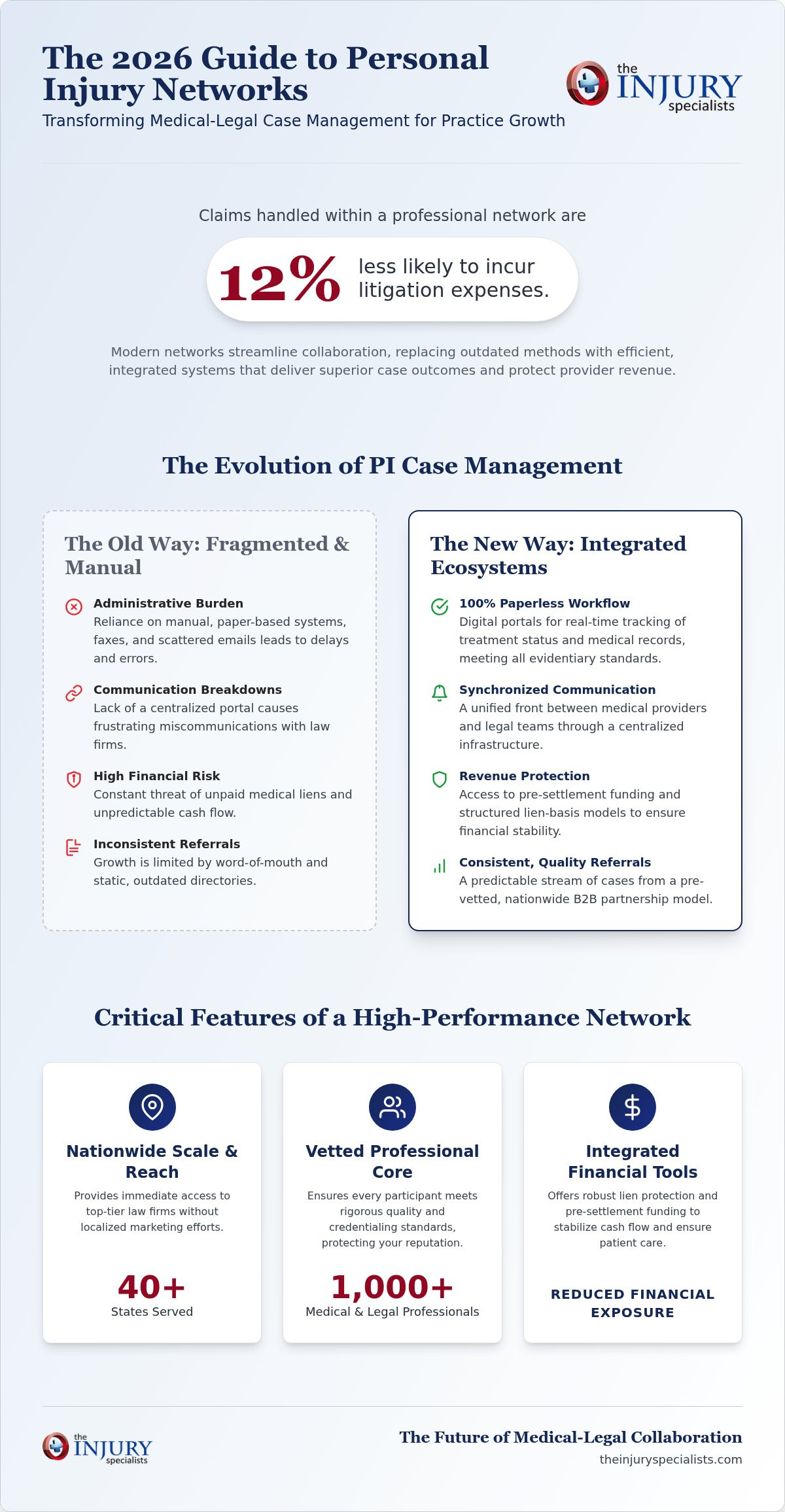
Claims handled within a professional network are 12% less likely to incur litigation expenses, yet many medical practices still rely on fragmented, manual referral systems. In the current landscape, joining a high-performance healthcare provider personal injury network is a strategic necessity for medical groups looking to scale. You’re likely tired of the administrative weight of documentation and the constant risk of unpaid medical liens. It’s frustrating to provide expert care only to face communication breakdowns with law firms or delays in case resolution.
This 2026 professional buying guide will show you how to evaluate and join an elite network to streamline your practice and eliminate manual case management. We’ll examine the technology requirements for the modern medical-legal market, the shift toward paperless attorney coordination, and the criteria for selecting a partner that delivers consistent, high-quality referrals. You’ll learn how to transform your PI department from a logistical burden into a high-yield, well-oiled system that prioritizes both patient outcomes and professional growth.
Key Takeaways
- Transition from static directories to integrated ecosystems that align medical and legal workflows for superior case outcomes.
- Implement 100% paperless communication to track treatment status and medical records in real time without administrative delays.
- Select a healthcare provider personal injury network that offers a high ratio of active attorneys to ensure a consistent stream of quality referrals.
- Reduce financial exposure by leveraging pre-settlement funding and structured lien-basis models designed to protect provider revenue.
- Streamline your practice’s growth by joining an established national network of over 1,000 professionals across 40+ states.
The Evolution of Healthcare Provider Personal Injury Networks in 2026
The definition of a modern personal injury network has shifted. In 2026, a high-performance healthcare provider personal injury network is no longer a static list of contacts. It functions as a strategic ecosystem designed to synchronize medical treatment with legal requirements. This evolution moves beyond simple introductions; it integrates specialized medical care directly into the attorney’s workflow. As insurance companies adopt more aggressive early-denial postures, the need for a unified front between doctors and lawyers has never been more critical.
Power-connectors now lead the market. These facilitators bridge the gap between distinct professional sectors by providing a centralized infrastructure. This model of professional community building is effective in many industries; for instance, you can check out Unique Model & Talent Network to see how it connects aspiring talent with industry experts. Instead of managing dozens of individual relationships, practitioners plug into a pre-vetted system of over 1,000 professionals across 40+ states. This scale ensures reliability and logistical ease. It allows medical providers to focus on patient recovery rather than chasing legal updates or managing fragmented communication channels.
Why Traditional Referral Programs Are Becoming Obsolete
Manual, paper-based communication is a liability in 2026. High-stakes litigation moves too fast for fax machines and scattered email threads. Traditional word-of-mouth referrals fail because they lack the data-driven consistency required to scale a practice. Without a standardized system for medical-legal documentation, providers risk incomplete records that can jeopardize settlement success. Modern networks replace these outdated methods with digital portals that ensure every document meets rigorous evidentiary standards from the first visit.
The ‘B2B’ Revolution in Personal Injury Care
The industry has embraced a pragmatic B2B model. This revolution treats the attorney-provider relationship as a professional partnership rather than a casual exchange. By joining a centralized healthcare provider personal injury network, clinics significantly reduce their individual marketing spend. The network handles the heavy lifting of professional outreach and brand positioning. This creates a streamlined path for growth that doesn’t rely on local networking events or cold outreach.
For multi-state practitioners, this nationwide reach is essential. It provides immediate accessibility to top-tier law firms without the need for localized marketing teams in every territory. This shift toward professional synergy creates a more predictable stream of high-quality PI referrals. It ensures that regardless of geography, your practice operates with the authority of a market leader. Scaling becomes a matter of capacity rather than a struggle for visibility. A well-structured personal injury marketing for physicians strategy is what separates practices that merely participate in this space from those that dominate it.
Critical Features to Evaluate in a Personal Injury Referral Network
Selecting a healthcare provider personal injury network requires a rigorous evaluation of its operational capacity and financial infrastructure. You shouldn’t settle for a basic directory. A high-performing network acts as a strategic partner that manages the complexities of the medical-legal interface. Credentialing standards are the first thing to check. A network that vets its members for quality ensures that every participant maintains the professional standing required for high-stakes litigation. This vetting process protects your practice’s reputation and the integrity of the cases you handle.
Financial integration is another non-negotiable feature. You need a system that offers robust lien protection and access to pre-settlement funding. These tools bridge the gap for patients who can’t afford immediate care, ensuring they reach maximum medical improvement without financial delays. When a network manages these fiscal details, it reduces the risk of unpaid medical liens and stabilizes your practice’s cash flow. It’s about building a predictable revenue stream through a well-oiled professional system.
Assessing Network Scale and Diversity
Network scale is a direct indicator of referral consistency. You need to evaluate the ratio of active attorneys to medical providers within the ecosystem. A multi-specialty network that includes imaging centers, chiropractors, and surgeons increases overall case value by providing a comprehensive care pathway. If the network serves over 40 states, it offers the national visibility necessary for large-scale growth. This diversity ensures that regardless of the injury’s complexity, the network has the specialized resources to support the case from start to finish.
The Role of Integrated Medical Case Management
Medical case management is the engine that prevents gaps in care. These gaps are often exploited by insurance companies to devalue settlements. A robust approach to medical case management for personal injury ensures that every clinical milestone is documented as verifiable evidence, directly strengthening the legal claim. By ensuring all documentation aligns with established physician referral services personal injury standards, the network maintains a clean evidentiary trail. This level of coordination reflects the collaborative models promoted by the National Center for Medical-Legal Partnership, where health and legal professionals work in tandem to improve outcomes.
Effective case management removes the administrative burden from your front desk. It eliminates the constant back-and-forth communication with law firms regarding records and treatment status. This efficiency allows your team to focus on clinical excellence while the network handles the logistical heavy lifting. If you’re ready to modernize your practice’s approach, it’s time to join a national injury network that prioritizes professional synergy and logistical ease.
Case Management Technology: The Engine of a Modern Network
The core of a scalable healthcare provider personal injury network is its proprietary technology. In 2026, efficiency isn’t just a preference; it’s a requirement for maintaining high-volume partnerships. Moving to 100% paperless communication between medical and legal teams eliminates the friction that typically stalls case progression. When your practice utilizes an integrated platform, you’re no longer wasting hours on manual data entry or chasing down missing files. Technology automates these touchpoints, allowing your staff to focus on patient care while the system handles the logistical heavy lifting.
Real-time tracking of patient treatment status and medical records provides a level of transparency that traditional methods can’t match. This visibility ensures that attorneys are always informed of a patient’s progress toward maximum medical improvement. Automated referral triggers further accelerate the process by initiating the intake sequence the moment a new case is identified. This speed is vital for securing early documentation and preventing patients from falling out of care. Beyond speed, the system must maintain rigorous security standards. Modern networks prioritize HIPAA-compliant data encryption and multi-factor authentication to protect sensitive information. This ensures full regulatory alignment and builds a foundation of trust with high-profile law firms.
Digital Portals and 24/7 Access
Attorneys value on-demand access to medical records above almost any other service feature. A digital portal providing 24/7 access removes the traditional bottlenecks associated with the “Request for Records” process. This self-service model saves your administrative team significant time and ensures that legal teams have the evidence they need for timely filings. Utilizing a centralized portal makes it easier to manage personal injury patient referrals at scale. It creates a predictable environment where data flows seamlessly between all stakeholders.
Workflow Alignment with Law Firm Processes
Your technology should adapt to the specific legal workflows of your partner firms. Cohesive, tech-enabled data sharing improves settlement outcomes by providing attorneys with structured, easy-to-digest medical evidence. Automated systems also play a critical role in reducing human error within billing and lien tracking. By digitizing the financial ledger, a healthcare provider personal injury network ensures that every treatment is accounted for and every lien is properly documented. This precision minimizes disputes during the final settlement phase and significantly accelerates your practice’s reimbursement cycle. It’s a pragmatic approach to ensuring that business growth is supported by a stable, error-free financial infrastructure.
Managing Financial Risk: Liens, Funding, and Provider Protection
Financial volatility is the primary deterrent for medical practices entering the personal injury space. To mitigate this, a sophisticated healthcare provider personal injury network must offer more than just connections; it must provide a framework for managing financial risk. The ‘Lien-Basis’ model allows providers to offer essential care without upfront payment, but it carries the inherent risk of unpaid medical liens if a case fails. Successful practitioners rely on networks that integrate financial safeguards directly into the referral workflow. This ensures that every patient entering your clinic represents a vetted opportunity rather than a speculative gamble.
Pre-settlement funding is a critical component of this protective framework. It bridges the gap between the date of injury and the final settlement, providing victims with the liquidity needed to maintain their daily lives. For the provider, this funding creates a synergy that drives referral volume. When patients aren’t stressed by immediate bills, they’re more likely to follow through with their entire treatment plan. This compliance is essential for documenting the full extent of an injury and maximizing the ultimate settlement value. It transforms a high-risk scenario into a predictable professional partnership.
The Advantage of Pre-Settlement Funding Integration
Providing financial stability to injury victims ensures consistent treatment compliance, which is the backbone of any successful legal claim. Funding options make your practice significantly more attractive to high-volume law firms because they know the case won’t collapse due to the client’s financial instability. By utilizing strategic financial partnerships within a healthcare provider personal injury network, you effectively reduce the wait time for reimbursement. These systems allow for a smoother transition from treatment to settlement, stabilizing your practice’s cash flow in a competitive market.
Lien Protection and Vetting Strategies
Top-tier networks utilize rigorous vetting strategies to ensure a higher probability of settlement before a patient ever reaches your office. They evaluate liability and insurance coverage to protect you from taking on dead-end cases. Clear communication regarding doctors who take personal injury liens is vital for maintaining transparency with legal partners. Pre-settlement funding reduces provider risk in 2026 by providing immediate liquidity to injured parties, which ensures they can complete their prescribed medical protocols without the case stalling due to personal financial hardship. If you want to secure your practice against financial uncertainty, you can access our pre-settlement funding and lien protection services today.
Joining The Injury Specialists: Scaling Your Practice Nationwide
Scaling a medical practice in the personal injury sector requires more than clinical expertise; it requires a high-volume, reliable referral pipeline. Joining The Injury Specialists provides immediate entry into a healthcare provider personal injury network that spans over 40 states. You’ll leverage the collective influence of 1,000+ professionals to grow your referral base without the high costs of independent marketing. This is a pragmatic business decision that aligns your clinical capacity with a massive attorney ecosystem. It’s about working smarter by plugging into a system that’s already built for scale.
The onboarding process is designed for speed and professional efficiency. It follows a logical, three-step sequence to get your practice operational within the network quickly. First, you’ll complete a professional vetting process to ensure your credentials align with our high standards. Second, your team will receive comprehensive training on our proprietary digital portal, ensuring everyone is comfortable with paperless communication. Third, you’ll begin receiving and managing cases through the portal, utilizing real-time tracking to maintain treatment momentum. This structured approach ensures your practice is ready to handle increased volume from day one.
Marketing and Networking Support for Providers
We handle the heavy lifting of professional outreach and brand positioning. This allows your team to focus exclusively on patient care while we maintain the relationships with law firms. By participating in the network, you significantly increase your visibility to top-tier attorneys searching for personal injury physical therapy referrals and other specialized medical services. The digital portal also provides unique networking opportunities with other nationwide providers. This creates a professional synergy that drives long-term growth and establishes your practice as a leader in the medical-legal community.
Next Steps: Onboarding and Growth
Your path to nationwide growth begins with an initial consultation. During this session, we align your specific practice goals with the network’s capabilities. Whether you operate an imaging center or a specialized surgical suite, you can customize your participation to fit your facility’s strengths. We recommend requesting a demo to see the industry’s leading digital platform in action. You’ll see exactly how the portal manages lien tracking, document sharing, and patient status updates in a secure environment. Once your staff is trained on the technology, you’ll be positioned as a primary choice for attorneys in your region. Don’t let your practice’s growth be limited by fragmented local connections. Join the largest injury referral network in the US today and start scaling your practice with the authority of a market leader.
Secure Your Practice’s Position in the 2026 Market
The shift toward a technology-driven healthcare provider personal injury network is a permanent market evolution. Success in 2026 requires more than clinical skill; it demands a sophisticated infrastructure that bridges the gap between medical treatment and legal documentation. You’ve seen how proprietary paperless technology and strategic financial vetting eliminate the traditional friction of PI case management. By prioritizing professional synergy and logistical ease, you position your practice as an essential partner for high-volume law firms.
It’s time to move beyond fragmented local directories and join a system built for national scale. With over 1,000 Professionals Nationwide and a presence in 40+ States Served, our ecosystem provides the most robust path for practice expansion. You can eliminate administrative burdens and secure your reimbursement cycle starting today. Request a Demo and Join the Nation’s Largest Injury Referral Network to see our proprietary paperless technology platform in action. Elevate your practice standards and start scaling with confidence.
Frequently Asked Questions
What is a healthcare provider personal injury network?
A healthcare provider personal injury network is a strategic ecosystem that connects medical practitioners with legal firms to facilitate the treatment and documentation of injured parties. It acts as a professional bridge, ensuring that clinical care and legal case management are synchronized through a centralized platform. This specialized infrastructure allows for a more efficient exchange of records and treatment updates than traditional, fragmented referral methods.
How do personal injury networks help physicians get more referrals?
These networks provide direct visibility to a massive ecosystem of personal injury attorneys who are actively seeking qualified medical partners. By joining a healthcare provider personal injury network, physicians gain access to a pre-vetted stream of cases without having to manage individual marketing campaigns. The network facilitates professional introductions and maintains the relationship between the clinic and the law firm, ensuring a consistent referral flow. Physicians looking to maximize this advantage should also explore a dedicated personal injury marketing for physicians blueprint to build compliant, high-volume partnerships with top-tier law firms.
Do providers in the network have to work on a lien basis?
Most personal injury networks operate primarily on a lien-basis model, where providers agree to receive payment from the final settlement proceeds. This arrangement allows patients to receive necessary care without upfront costs. While the lien basis is standard, top-tier networks mitigate the risk of non-payment by vetting cases for liability and insurance coverage before they reach your office or surgical suite.
What kind of technology do top PI networks provide for case management?
Leading networks provide proprietary, paperless platforms that centralize all medical-legal documentation and communication. These systems offer features like real-time treatment tracking, automated record requests, and secure portals for attorney access. This technology eliminates the need for manual faxing or emailing, reducing administrative errors and ensuring that all parties have immediate access to critical case data for timely filings.
Can imaging centers and chiropractors join the same referral network?
Yes, multi-specialty integration is a hallmark of a high-performance healthcare provider personal injury network. These platforms connect a diverse range of professionals, including imaging centers, chiropractors, physical therapists, and surgeons. By including specialized providers—you can learn more about Frankel Foot & Ankle Center as an example—the network ensures that patients have access to a full continuum of care, which ultimately increases the evidentiary value of the legal claim through cohesive, centralized documentation across all specialties.
How does pre-settlement funding benefit the medical provider?
Pre-settlement funding benefits providers by ensuring that patients remain compliant with their prescribed treatment protocols. When patients have the financial liquidity to manage daily expenses, they’re less likely to miss appointments or drop out of care due to financial stress. This stability leads to better clinical outcomes and more thorough medical records, which are essential for securing a successful settlement and ensuring subsequent provider reimbursement.
Is there a cost for healthcare providers to join a personal injury network?
Participation models vary, but many networks focus on a performance-based or membership structure that prioritizes mutual growth. Providers should evaluate whether the network requires initial fees or operates through a service agreement that aligns with their practice’s volume goals. The primary focus should be on the return on investment generated through increased referral quality and the significant reduction in administrative overhead for your staff.
How does a network ensure HIPAA compliance across different states?
Networks maintain HIPAA compliance by utilizing enterprise-grade encryption and secure data storage protocols that meet or exceed federal standards. They implement multi-factor authentication and strict access controls to ensure that sensitive patient data is only accessible to authorized personnel. By centralizing documentation within a secure digital portal, the network provides a consistent compliance framework that applies across all state jurisdictions regardless of local regulations.
