

Your firm’s case management system is either a high-performance profit engine or a silent tax on every settlement. Many personal injury firms treat software as a static overhead cost rather than a strategic asset. You likely see the daily friction of wasted paralegal hours on medical record retrieval and the constant risk of missed deadlines from manual calendaring. These operational bottlenecks don’t just cause staff stress; they actively erode your firm’s bottom line and delay client disbursements.
Calculating ROI on case management software requires moving beyond simple subscription costs to analyze the total impact on your medical-legal workflow. This article provides a comprehensive financial framework to evaluate technology based on labor reduction and settlement speed. You’ll learn how to project clear dollar-value returns and reduce overhead by streamlining communication between medical providers and legal teams. We’ll break down the specific metrics that turn case management technology into a measurable driver of firm growth and medical-legal efficiency.
Key Takeaways
- Distinguish between direct technology costs and the high-value “soft ROI” achieved through reclaimed staff time and reduced administrative friction.
- Learn a precise methodology for calculating ROI on case management software by measuring labor reduction against total annual investment.
- Quantify the financial drain caused by manual medical record retrieval and the resulting delays in settlement documentation.
- Understand how integrated Case Management Technology serves as a profit-driver by aligning medical case management with specific law firm workflows.
- Discover the strategic benefits of connecting firm operations with a national medical-legal referral network to maximize efficiency and growth.
The Fundamentals of ROI in Personal Injury Case Management
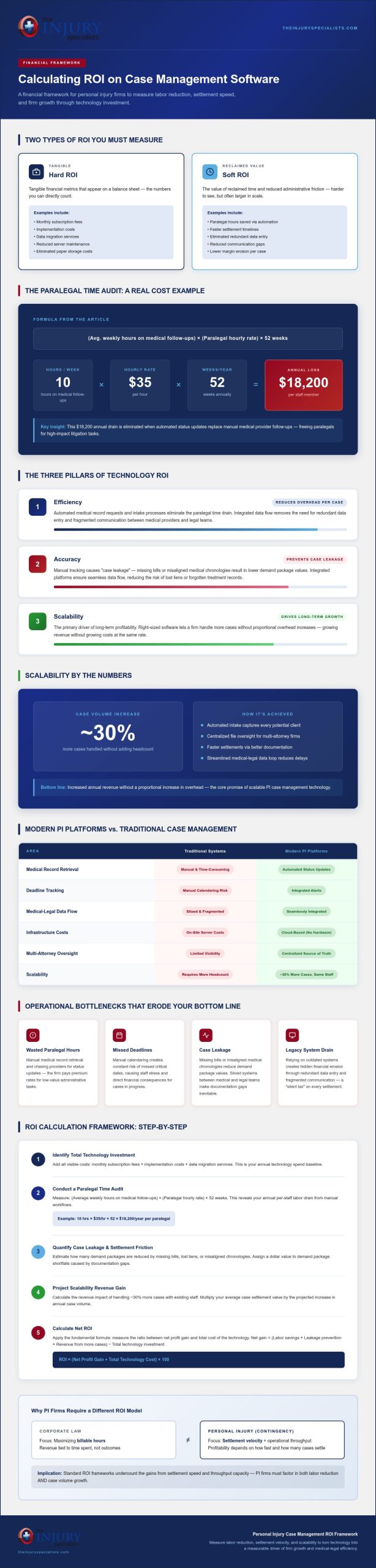
For a personal injury firm, a technology investment is only as valuable as the profit it generates. The basic return on investment formula measures the ratio between net profit gain and the total cost of the technology. However, calculating ROI on case management software for PI firms requires a more nuanced approach than standard corporate law models. While corporate firms focus on maximizing billable hours, PI firms operate on contingency fees, meaning profitability depends on settlement velocity and operational throughput.
Successful firms distinguish between Hard ROI and Soft ROI. Hard ROI consists of tangible financial metrics like reduced software licensing fees or lower IT hardware costs. Soft ROI involves the value of reclaimed time, such as the hours a paralegal saves by using automated medical record requests. To achieve a comprehensive view of firm health, leadership must evaluate the three pillars of technology ROI: Efficiency, Accuracy, and Scalability. These pillars ensure that the firm isn’t just saving money, but is actively positioned for aggressive growth.
Hard Costs vs. Hidden Gains
The total investment in Case Management Technology includes visible expenses like monthly subscription fees, initial implementation costs, and data migration services. These are the figures that typically appear on a balance sheet. To find the true ROI, firms must also account for hidden gains that offset these costs. Transitioning to a modern, cloud-based platform reduces the need for expensive on-site server maintenance and physical paper storage. Perhaps the most critical factor is the cost of inaction. Relying on legacy systems creates a financial drain through redundant data entry and fragmented communication, which can quietly erode a firm’s margins over time.
The Scalability Factor in PI Litigation
Scalability is the primary driver of long-term profitability in personal injury law. Implementing the right software allows a firm to handle approximately 30% more cases without the immediate need to add headcount. This is achieved through automated intake processes that improve lead conversion rates by ensuring no potential client is overlooked. A centralized “source of truth” allows multi-attorney firms to maintain high-level oversight across hundreds of files simultaneously. By streamlining the medical-legal data loop, firms can settle cases faster and with better documentation, directly increasing the firm’s annual revenue without a proportional increase in overhead expenses.
Quantifying the Cost of Manual Medical-Legal Workflows
Administrative friction in the medical-legal data loop is the primary cause of margin erosion in personal injury firms. When paralegals spend their days manually requesting records and chasing providers for status updates, the firm is essentially paying a premium for low-value administrative tasks. This manual labor creates a bottleneck that delays settlement timelines and increases the firm’s overhead per case. Accurately calculating ROI on case management software requires a deep dive into these operational inefficiencies to identify where capital is being wasted.
The Paralegal Time Audit
To understand the true cost of manual workflows, firms should conduct a rigorous time audit. Use this formula: (Average weekly hours spent on medical follow-ups) x (Paralegal hourly rate) x 52 weeks. If a paralegal spends 10 hours per week on these tasks at a rate of $35 per hour, the firm loses $18,200 annually per staff member. Transitioning to automated status updates from medical providers eliminates this drain. By following the standards outlined in the Personal Injury Case Management Technology guide, firms can redirect this labor toward high-impact litigation tasks. Effective financial management for small businesses dictates that labor should always be optimized for the highest possible return.
Reducing Settlement Friction with Better Data
Manual tracking often leads to “case leakage,” where missing bills or misaligned medical chronologies result in lower demand package values. When medical providers and legal teams operate in silos, documentation gaps are inevitable. Integrated Case Management Technology ensures a seamless flow of data, reducing the risk of lost liens or forgotten treatment records. This connectivity is particularly vital when managing Pre-Settlement Funding integration. Software that tracks funding status alongside medical progress ensures that clients remain compliant with their treatment plans, which protects the eventual settlement value.
Case leakage occurs when a firm fails to capture the full scope of a client’s medical treatment due to fragmented communication. If a provider’s bill is missed during the demand phase, that value is permanently lost to the firm and the client. Integrated systems provide a real-time view of every provider interaction, ensuring that 100% of medical evidence is accounted for. Reducing this friction allows firms to settle cases faster and at higher values, directly impacting the bottom line. Firms looking to bridge these gaps should consider an integrated medical-legal technology platform to synchronize their workflows.
A Step-by-Step Framework for Calculating Your ROI
To move beyond abstract estimates, firms must apply a rigorous mathematical framework. This process transforms operational improvements into hard financial data. By following a structured sequence, you can determine exactly how much capital your firm reclaims through technology. Use the following five steps for calculating ROI on case management software with precision.
- Step 1: Calculate Total Annual Investment. Combine all direct expenses, including monthly subscription fees, one-time data migration costs, and staff training hours. This represents your total cost basis.
- Step 2: Estimate Annual Time Savings. Identify the total hours saved across the firm through automation. Multiply these hours by the average hourly rate of the staff members involved, such as paralegals or intake specialists.
- Step 3: Project Revenue Increase. Determine the firm’s expanded capacity. If the software allows your current team to handle five additional cases per year, multiply that number by your firm’s average contingency fee per case.
- Step 4: Factor in Risk Mitigation. Assign a conservative value to the reduction of malpractice risk. Modern systems prevent missed statutes of limitations and filing deadlines, which can save the firm from catastrophic financial loss.
- Step 5: Apply the Formula. Use the standard calculation: [(Total Gains – Total Costs) / Total Costs] x 100. This percentage provides a clear picture of your technology’s financial performance.
The Time-to-Value (TTV) Metric
While long-term ROI is the goal, the speed of recovery is equally important. Time-to-Value (TTV) measures how quickly the platform pays for its own implementation. In the high-stakes environment of personal injury law, “Day 1” utility is critical. Successful onboarding in 2026 requires a system that integrates immediately into existing workflows without months of downtime. A short TTV indicates that the Case Management Technology is actively contributing to firm liquidity rather than sitting as a stagnant expense on the ledger.
Case Value Optimization
Beyond simple time savings, the right technology actively increases the value of every file. Automated documentation and organized medical chronologies can increase average settlement values by 10% to 15% by presenting a more compelling case to insurance adjusters. Integrating networking tools further enhances this effect by connecting firms with high-quality imaging centers and specialty providers. For more on leveraging these connections, consult The Comprehensive Guide to Law Firm Medical Referral Programs. This synergy between software and a national referral network ensures that every case reaches its maximum financial potential.
Comparing Modern PI Platforms vs. Traditional Case Management
Traditional case management software often operates as a digital filing cabinet. While it stores data, it remains isolated from the broader medical-legal ecosystem. In contrast, modern Case Management Technology functions as an integrated hub. It connects the firm directly to medical providers, imaging centers, and referral partners. When calculating ROI on case management software, firms must look beyond internal efficiency and evaluate the revenue-generating potential of this connectivity. A system that bridges the gap between legal and medical sectors provides a strategic advantage that isolated tools cannot match.
Integrated Referral ROI
A personal injury referral network acts as a built-in revenue generator. In a traditional setup, firms spend significant capital on marketing and manual outreach to build provider relationships. An integrated platform provides immediate access to a pre-vetted national network of medical professionals. This connectivity eliminates the search costs and administrative friction of finding reliable partners. Seamless data sharing with imaging centers ensures that diagnostic reports are uploaded directly to the case file. This speed reduces the time between intake and demand, accelerating the firm’s cash flow and increasing the overall settlement velocity.
The Cost of Security and Compliance
Legacy servers carry significant hidden costs and liabilities. Physical hardware requires ongoing maintenance, manual backups, and expensive IT support. More importantly, legacy systems often lack the sophisticated encryption required for modern medical data handling. Non-compliance with HIPAA regulations can lead to severe civil penalties, often reaching thousands of dollars per violation. A HIPAA-compliant cloud platform automates these security protocols. The ROI is found in the avoidance of fines and the elimination of disaster recovery expenses. Automated backups ensure that firm data is protected against ransomware and hardware failure without requiring manual staff intervention.
The “Platform Effect” describes the compounding value of a connected system. When medical case management is built into the software, it reduces the need for expensive third-party outsourcing. The firm gains a strategic facilitator that aligns medical care with legal workflows. This synergy results in more cohesive documentation and stronger evidence for every case. By centralizing these functions, firms drive higher revenue through improved case outcomes and increased referral volume. To see how a connected platform can transform your firm’s profitability, explore the Case Management Technology solutions from The Injury Specialists.
Maximizing ROI with The Injury Specialists Technology
The Injury Specialists platform serves as the essential bridge between high-quality medical care and legal success. While generic software focuses on administrative storage, this Case Management Technology aligns medical case management with your firm’s distinct processes. This alignment ensures that every medical record and billing statement is captured accurately from the start. When calculating ROI on case management software, firms must account for the value of this professional oversight, which prevents the documentation gaps that lead to undervalued settlements.
The strategic advantage of this ecosystem extends to the built-in national referral network. This network provides immediate ROI by connecting firms with pre-vetted medical partners, chiropractic services, and physical therapy providers. For legal partners, this means a reduction in the time spent vetting providers and a significant increase in referral volume. For medical partners, it ensures a steady stream of cases managed with professional precision. This synergy transforms the software from a simple utility into a high-level revenue generator.
A World-Class Technology Ecosystem
This platform streamlines marketing, networking, and case tracking into a single, cohesive care ecosystem. It’s a strategic partnership that drives firm growth through connectivity. By integrating pre-settlement funding directly into the workflow, the system ensures that clients have the financial support needed to complete their treatment. This increases client compliance and protects the integrity of the medical evidence. These factors directly translate to higher settlement values and faster disbursements, providing a measurable boost to the firm’s bottom line.
Next Steps for Implementation
Transitioning from fragmented, manual workflows to an integrated tech platform is a move toward institutional scalability. The process begins with auditing current bottlenecks and replacing them with automated data loops. Professional medical case management ensures that every piece of documentation is audit-ready and legally sound. This level of accuracy is a primary factor in calculating ROI on case management software, as it reduces the risk of disputed liens and denied claims. A well-implemented system allows the firm to focus on litigation strategy while the technology handles the logistical complexities of medical-legal coordination.
By moving away from isolated tools and embracing a connected ecosystem, your firm can transform its operational overhead into a high-yield profit engine. The synergy between world-class technology and the largest personal injury referral network in the United States creates a foundation for sustainable growth. Optimize your firm’s ROI with our Case Management Technology.
Strategic Growth Through Technological Integration
Personal injury firms that prioritize operational efficiency gain a significant competitive edge in a crowded market. By using a structured framework for calculating ROI on case management software, leadership can move from viewing technology as a cost to seeing it as a primary profit engine. The data confirms that reclaimed paralegal hours and reduced administrative friction directly increase settlement velocity and firm capacity. Transitioning to a connected system ensures that no bill is missed and no medical chronology is incomplete.
Maximizing this return requires a system that connects the entire medical-legal ecosystem. The Injury Specialists provides the largest national personal injury referral network; this ensures your firm has immediate access to pre-vetted medical partners. With integrated medical case management workflows and strategic pre-settlement funding access, our platform aligns every case with your firm’s specific processes for maximum financial impact. You don’t have to manage these logistical complexities alone when a world-class technology platform can facilitate the heavy lifting.
Discover how our Case Management Technology drives firm growth. It’s time to transform your firm’s overhead into a scalable engine for long-term success.
Frequently Asked Questions
What is the average ROI for personal injury case management software?
Average ROI for personal injury firms is measured by the ratio of net profit gain to technology cost. While specific percentages vary by firm volume, most firms see significant returns through the elimination of manual administrative tasks. By streamlining the medical-legal data loop, firms can handle more cases without increasing headcount. This efficiency allows the technology to function as a profit engine rather than a static overhead expense.
How long does it take for case management software to pay for itself?
The time-to-value for Case Management Technology typically ranges from six to twelve months. This timeline depends on the speed of data migration and the firm’s commitment to staff training. Firms that transition quickly from manual workflows to integrated systems see faster recovery of their initial investment. Selecting a platform with “Day 1” utility ensures that the software begins contributing to firm liquidity almost immediately after implementation.
Can case management software help increase my firm’s average settlement value?
Yes, case management technology increases settlement values by ensuring all medical evidence is documented and organized. Comprehensive medical chronologies allow attorneys to present stronger demand packages to insurance adjusters. Automated tracking also prevents “case leakage” by capturing every medical bill and lien. This level of documentation accuracy often leads to settlement increases of 10% to 15% compared to cases managed with fragmented, manual systems.
What are the biggest hidden costs of legal technology implementation?
The primary hidden costs include data migration from legacy systems and the billable time lost during staff training. Firms must also account for the ongoing maintenance of on-site servers if they aren’t using cloud-based platforms. However, the most significant hidden expense is the “cost of inaction.” Staying with an inefficient system results in thousands of dollars in lost labor and delayed settlements every single year.
How does medical case management integration impact law firm ROI?
Integrating medical case management into your software directly improves ROI by reducing the administrative burden on paralegals. This alignment ensures that medical providers and legal teams share data seamlessly. It eliminates the need for manual record requests and constant status follow-ups. By synchronizing these workflows, firms reduce overhead costs per case and ensure that the medical documentation supports the legal strategy from the start of treatment.
Is it worth upgrading to a cloud-based PI platform if my current system works?
Upgrading is essential for maintaining HIPAA compliance and accessing modern connectivity features. Legacy systems often lack the security protocols needed to protect sensitive medical data, risking heavy civil penalties. Cloud-based platforms also offer automated backups and disaster recovery, which are high-value ROI components. Most importantly, modern platforms connect your firm to a national referral network, which drives growth in ways that isolated, on-premise software cannot.
How do I calculate the time savings for my paralegal staff?
When calculating ROI on case management software, you must audit the hours saved on repetitive tasks. Multiply the number of hours saved per week by the average hourly rate of your paralegal staff. For example, saving ten hours per week at $35 per hour results in over $18,200 in annual reclaimed labor per employee. This formula provides a concrete dollar value for the efficiency gains provided by the platform.
What role does a referral network play in software ROI?
A referral network acts as a built-in revenue generator that significantly boosts software ROI. Instead of spending capital on external marketing to find medical partners, an integrated platform provides immediate access to a pre-vetted national network. This connectivity reduces the cost of case acquisition and ensures that medical providers are already aligned with your firm’s documentation standards. This synergy turns the software into a strategic tool for firm expansion.

Leave A Comment
You must be logged in to post a comment.