

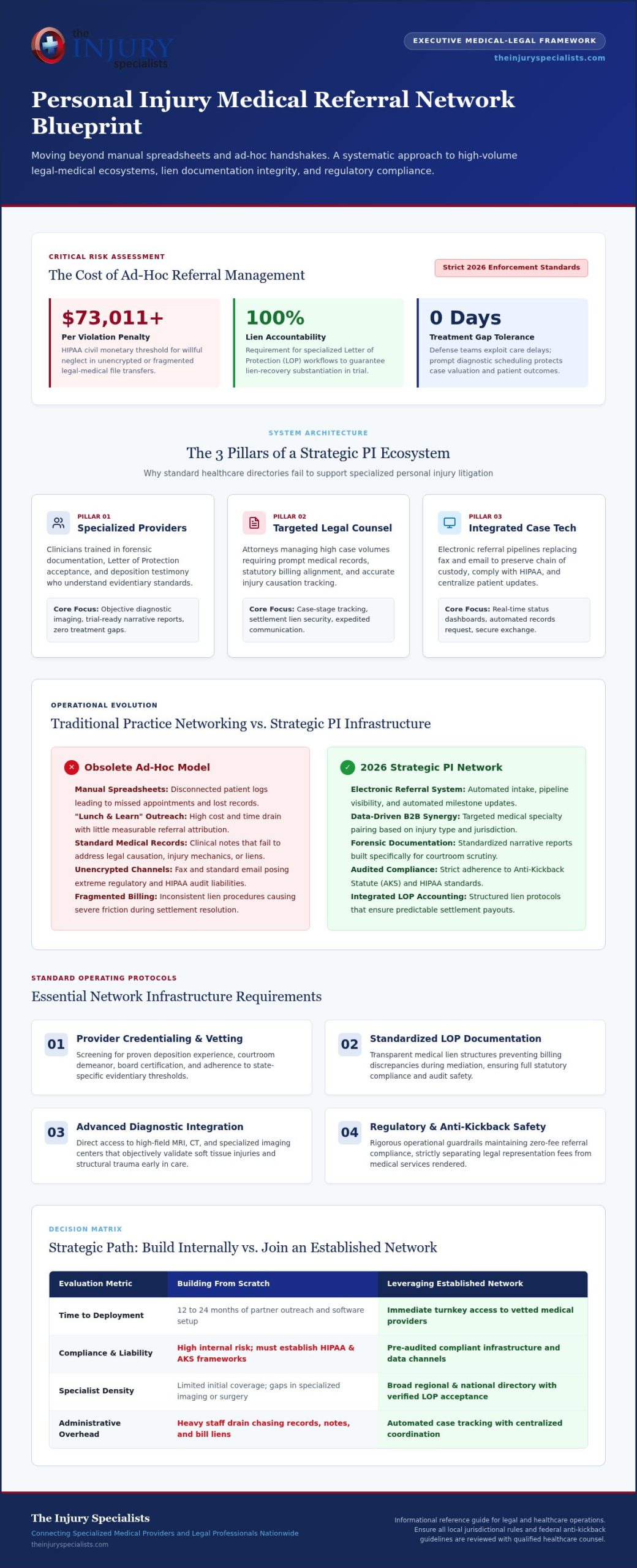
Relying on manual spreadsheets and informal handshakes to grow your practice is no longer just inefficient; it’s a professional liability. With 2026 HIPAA civil penalties now reaching over $73,011 per violation for willful neglect, the margin for error in medical-legal communication has vanished. You recognize that inconsistent case volume and fragmented data exchange between doctors and lawyers stall firm growth. Building a medical referral network from scratch requires more than just clinical skill or legal expertise. It demands a sophisticated, business-to-business infrastructure designed for scale.
This article provides the systematic blueprint for establishing a high-volume, professional network that drives consistent personal injury case growth. You’ll learn how to move away from ad-hoc lists and toward integrated case management technology that respects your time. We’ll examine the essential vetting processes for specialized PI documentation and the compliance frameworks required in the 2026 regulatory environment. By the end of this guide, you’ll have the tools to streamline operations and secure better settlement outcomes through cohesive, professional care.
Key Takeaways
- Understand the fundamental differences between general healthcare networks and strategic personal injury ecosystems designed for legal-medical synergy.
- Identify the essential infrastructure required for building a medical referral network from scratch, including standardized vetting processes and specialized Letter of Protection (LOP) workflows.
- Evaluate the “Build vs. Join” strategic path to determine whether your firm should invest in internal development or leverage an established national network for immediate scale.
- Implement integrated case management technology to automate professional communication and ensure full compliance with 2026 regulatory standards.
- Optimize long-term network performance by utilizing partner data and expanding into high-value diagnostic imaging referrals to drive superior settlement outcomes.
The Fundamentals of a Personal Injury Medical Referral Network
A personal injury (PI) referral network is a strategic ecosystem designed to facilitate high-volume, professional collaboration between legal and medical entities. It’s not a mere directory; it’s a functional infrastructure that supports the entire lifecycle of a case. Professionals attempting the task of building a medical referral network from scratch often realize that simple contact lists are insufficient for modern demands. Success in 2026 depends on three core pillars: qualified medical providers, specialized legal firms, and integrated case management.
General healthcare networks frequently fail in the PI sector because they prioritize standard health insurance reimbursement over lien-based recovery. A general network doesn’t account for the specialized documentation, such as narrative reports and Letters of Protection (LOPs), required to substantiate damages in court. The shift from casual, handshake-based referrals to systematic, data-driven partnerships ensures that every patient interaction contributes to the legal strength of the case. This transition allows firms to move from unpredictable case volume to a reliable, scalable business model.
Why Traditional Networking is Obsolete in 2026
The era of the “lunch-and-learn” model has ended for high-volume firms. Modern practice management requires immediate accessibility and digital-first interactions to secure injury victims quickly. High-growth firms don’t have time for manual follow-ups or chasing medical records via fax. Instead, sophisticated operators now utilize electronic referral systems to standardize communication and track patient status in real time. This digital evolution provides the logistical ease necessary to manage hundreds of active cases without administrative friction.
The Role of the Integrated Specialist
Attorneys increasingly avoid general practitioners in favor of a personal injury specialist network. Specialists who understand the lien environment provide more than just medical treatment; they provide the forensic documentation necessary for high-value settlements. When building a medical referral network from scratch, you must identify partners who function as power-connectors. These specialists ensure that medical records are trial-ready and that billing aligns with state-specific evidentiary thresholds. They understand that a treatment gap isn’t just a clinical issue; it’s a legal vulnerability. By focusing on specialists who prioritize both patient care and case integrity, you create a network that is resilient against insurance defense tactics.
Essential Infrastructure for Your PI Referral System
Establishing the right infrastructure is the difference between a scalable enterprise and an administrative burden. When building a medical referral network from scratch, you must move beyond simple contact lists. You need a framework that handles the high-stakes requirements of personal injury litigation. This includes standardized vetting, specialized documentation for liens, integrated case management, and access to pre-settlement funding. Each component must function as a part of a unified system to ensure that medical care and legal strategy remain aligned throughout the life of a case.
Vetting for Quality and Compliance
A rigorous vetting process protects both the patient and the professional partners. When selecting physician referral services personal injury partners, firms must prioritize providers who demonstrate a deep understanding of forensic documentation. Compliance is non-negotiable. All referral relationships must strictly adhere to federal fraud and abuse laws, including the Anti-Kickback Statute. Providers should be screened for their experience in giving depositions and their ability to provide clear, trial-ready narrative reports. They must also be proficient in managing diagnostic imaging referrals, as these are often the cornerstone of establishing objective evidence of injury.
Documentation systems must be built to handle the complexities of Letters of Protection (LOPs) and medical liens. Under current 2026 standards, transparency is paramount. Modern evidentiary requirements across the country increasingly demand the disclosure of LOP existence and the specific nature of the referral relationship to ensure objectivity. Your infrastructure must track these details automatically to avoid evidentiary challenges. Additionally, integrating pre-settlement funding into your workflow helps bridge financial gaps for patients, ensuring they receive necessary treatment without delay while the case progresses toward a resolution.
The Necessity of Medical Case Management
Medical case management acts as the glue that holds the referral ecosystem together. Without it, patients often experience gaps in treatment, which insurance defense counsel will use to devalue the claim. An effective attorney physician referral system relies on active case management to synchronize appointments and record retrieval. This process ensures that medical records are updated in real time and that the integrity of the medical lien is protected through accurate billing and treatment tracking. For those finding the task of building a medical referral network from scratch too resource-intensive, partnering with an established operator like The Injury Specialists provides immediate access to this critical infrastructure.
The ‘Build vs. Join’ Dilemma: Analyzing the Strategic Path
Building a medical referral network from scratch presents a significant strategic choice for modern firms. You can choose to invest heavily in internal infrastructure for total control, or you can leverage an existing ecosystem for immediate results. Most solo efforts fail because they lack the capital to achieve national reach or maintain consistent volume. The opportunity cost of manual outreach often outweighs the benefits of ownership. A system built on manual spreadsheets cannot compete with the 73% of law firms now utilizing cloud-based practice management tools for intake and litigation tracking. Success in 2026 requires more than just local connections; it requires a sophisticated, business-to-business infrastructure designed for scale.
The Hidden Costs of Building from Scratch
The administrative burden is often the first hurdle. Managing hundreds of provider relationships requires a dedicated team and sophisticated software. Developing a secure platform for data exchange is expensive and requires constant maintenance to meet 2026 security standards. Marketing costs also accumulate quickly. You’re not just competing for cases; you’re competing for the attention of high-value referral partners who are already courted by established networks. Additionally, all partnerships must align with AMA ethical standards on medical referrals to ensure patient welfare remains the priority. This ethical alignment is critical for maintaining professional standing and ensuring treatment remains objective and competent.
Leveraging a Turnkey Referral Ecosystem
Joining a personal injury referral network provides instant credibility. You gain access to a pre-vetted list of national providers who already understand the nuances of personal injury litigation. This eliminates the trial-and-error period often associated with building a medical referral network from scratch. A turnkey system also provides integrated services like pre-settlement funding. You don’t need to build a separate department to manage financial gaps for your clients. Instead, you can focus on case strategy while the network handles the logistical complexities of care coordination and lien management. By utilizing a world-class technology platform, your firm can move from fragmented communication to streamlined, high-volume success. Partnering with an established leader allows you to act as a power-connector without the years of manual relationship-building usually required.
5 Steps to Establishing Your Network Outreach
Successful outreach in 2026 requires a shift from personal favors to professional systems. When building a medical referral network from scratch, your objective is to create a seamless pipeline that reduces friction for both the provider and the law firm. Moving beyond the outdated “lunch-and-learn” model allows you to focus on operational synergy. Follow these five steps to establish a scalable network:
- Step 1: Identify Your Core Specialty Focus. Target high-impact areas such as orthopedic surgery, chiropractic care, or specialized imaging.
- Step 2: Implement Technology. Deploy personal injury case management technology to handle intake and data exchange.
- Step 3: Develop a Value Proposition. Focus on settlement speed and the quality of forensic documentation.
- Step 4: Execute Marketing. Utilize targeted B2B campaigns that highlight your network’s efficiency and reliability.
- Step 5: Standardize the Communication Loop. Establish a bidirectional flow for real-time status updates and record retrieval.
Defining Your Value Proposition
Attorneys already assume clinical competence. To secure a partnership, you must solve their specific administrative pain points. Missing records, slow narrative turnaround, and inflexible lien terms are the primary reasons firms switch providers. Your value proposition should emphasize how your network accelerates settlement speed through rapid documentation. Highlighting your familiarity with 2026 LOP standards and evidentiary requirements demonstrates that you are a strategic partner, not just a service provider. This professional alignment builds the trust necessary for high-volume, consistent referrals.
Scaling Through Technology
Manual networking is a bottleneck that prevents growth. Because 73% of law firms now utilize cloud-based practice management tools, your network must integrate with their digital workflows. Automating the referral intake process ensures that no patient leads are lost and treatment status remains visible to all stakeholders. HIPAA compliance is non-negotiable. Ensure every communication channel meets the updated 2026 security standards to protect your partners from liability. By providing a secure, real-time portal for record exchange, you eliminate the friction that typically stalls case progress. If you want to skip the complexities of building a medical referral network from scratch, partner with an established national network to gain immediate access to world-class technology and pre-vetted providers.
Optimizing the Network for Long-Term Growth
Establishing a network is only the first phase of a successful growth strategy. Long-term profitability depends on your ability to monitor partner performance through data and analytics. High-volume firms in 2026 don’t rely on intuition; they track key metrics such as narrative report turnaround times, patient appointment compliance, and billing accuracy. If a provider consistently fails to meet these standards, they become a liability to the case value. Continuous medical case management ensures the health of the network by identifying these bottlenecks before they result in treatment gaps or lost revenue. This analytical approach allows you to transition from a local operator to a strategic national partner with a predictable flow of high-quality cases.
Expanding Service Offerings
A robust network must evolve to meet the comprehensive needs of injury victims. Integrating chiropractic and physical therapy services provides a foundation for conservative care, but maximizing settlement outcomes requires specialized diagnostics. Incorporating personal injury diagnostic imaging referrals is a strategic necessity. High-quality MRIs and CT scans provide the objective evidence required to substantiate complex injury claims in a legal environment that increasingly scrutinizes “phantom damages.” Additionally, adding pre-settlement funding as a value-add service helps patients manage living expenses during litigation. This comprehensive service mix makes your network indispensable to attorneys who want a single, reliable point of contact for all medical and financial logistical needs.
Scaling with The Injury Specialists
The complexity of building a medical referral network from scratch often detracts from a firm’s primary mission. While total control is appealing, the administrative overhead of managing hundreds of individual providers and maintaining HIPAA-compliant technology is immense. You can skip the “scratch” phase entirely by joining a world-class network that is already operational. This path provides immediate scale and access to a proven national infrastructure.
By partnering with a market leader, you can integrate your firm’s distinct processes into a national platform without the high capital investment of internal development. This allows you to function as a power-connector, leveraging the largest personal injury referral network in the United States to drive consistent growth. You maintain your professional standards while benefiting from streamlined case management and world-class technology. Stop struggling with manual outreach and fragmented data. Join the largest personal injury referral network today to secure your firm’s position in the 2026 medical-legal market.
Securing Your Position in the 2026 Medical-Legal Market
Success in the personal injury sector requires more than clinical expertise; it demands a systematic approach to relationship management and data integrity. You’ve seen that building a medical referral network from scratch involves high capital investment and significant administrative risk. Modern success depends on implementing specialized documentation workflows and integrated case management technology that can withstand the scrutiny of 2026 regulatory standards. Fragmented communication and manual tracking are no longer viable for firms aiming for national reach and consistent volume.
Instead of navigating these complexities alone, you can leverage an established infrastructure designed for immediate scale. Our world-class technology platform and specialized medical case management provide the foundation your practice needs to thrive. Access a national network of pre-vetted providers and ensure your firm remains a market leader. This strategic alignment allows you to focus on case strategy while the system handles the logistical burdens of care coordination.
Scale your practice with the nation’s largest PI referral network and transform your referral volume into a predictable, high-growth asset. Your firm is ready for the next level of professional synergy.
Frequently Asked Questions
How long does it take to build a medical referral network from scratch?
Establishing a functional ecosystem typically requires 12 to 24 months of consistent outreach and infrastructure development. Building a medical referral network from scratch involves vetting dozens of providers and implementing secure data exchange platforms. This timeline accounts for the trial-and-error period needed to find partners who understand the nuances of personal injury litigation. Many firms find that joining an established national network like The Injury Specialists provides immediate scale and eliminates this multi-year development phase.
What are the legal requirements for a personal injury referral network?
Compliance with federal and state regulations is the most critical legal requirement. You must strictly adhere to the Anti-Kickback Statute and state-specific fee-splitting prohibitions. In 2026, HIPAA compliance is even more vital due to updated civil monetary penalties for willful neglect. All referral relationships should focus on operational efficiency rather than financial incentives. Standardizing your Letter of Protection (LOP) language ensures that your network remains transparent and defensible during insurance discovery or trial.
Can a small law firm compete with national referral networks?
Small firms can compete effectively by leveraging integrated technology and specialized partnerships. While national networks have greater resources, a small firm can achieve similar results by using a world-class technology platform for networking and marketing. This levels the playing field by automating administrative tasks and record retrieval. Joining a national ecosystem allows smaller practices to access a pre-vetted list of providers without the high capital investment required for building a medical referral network from scratch.
What software is best for managing medical-legal referrals in 2026?
The most effective software in 2026 utilizes bidirectional portals that integrate with cloud-based practice management tools. Platforms like Litify, Neos, and the proprietary technology offered by The Injury Specialists facilitate real-time communication between clinics and firms. These systems prioritize HIPAA compliance and automate the tracking of medical liens and LOPs. Efficient software reduces the friction of manual follow-ups and ensures that all stakeholders have immediate access to patient status and narrative reports.
How do medical liens work within a referral network?
Medical liens and Letters of Protection (LOPs) act as contractual guarantees that medical bills will be satisfied from settlement proceeds. Within a professional network, these documents are standardized to ensure clarity between the attorney, doctor, and patient. In 2026, transparency is paramount; many jurisdictions now require the disclosure of LOPs and attorney-referral relationships. A well-oiled network uses automated tracking to manage these liens, protecting the provider’s revenue and the attorney’s damage claims.
What is the role of a medical case manager in a referral network?
A medical case manager serves as the central point of contact to ensure cohesive care and record integrity. They prevent treatment gaps by coordinating appointments and tracking patient compliance throughout the recovery process. This role is essential for maintaining the health of the network and protecting the case value. By managing the flow of narrative reports and billing data, case managers ensure that the legal team has the documentation needed for timely and effective settlement negotiations.
How do I vet doctors who take personal injury liens?
Vetting requires a focus on forensic documentation skills and a history of reliable courtroom testimony. You should evaluate a provider’s ability to produce detailed narrative reports and their familiarity with state-specific evidentiary thresholds for medical billing. It’s also important to check for a responsive billing department that understands the lien environment. Providers who have already been pre-vetted by a national network offer a lower risk profile and a higher degree of professional synergy for high-volume firms.
Is pre-settlement funding necessary for a successful referral program?
Pre-settlement funding is a critical value-add that ensures patients can maintain treatment continuity despite financial hardship. It bridges the gap between the injury date and the final settlement, allowing the medical-legal team to focus on the case without interruption. This service is especially vital in a national network where patients may face varying economic pressures. Facilitating pre-settlement funding demonstrates a commitment to the victim’s recovery and strengthens the overall reliability of the referral ecosystem.
