

A personal injury case is only as strong as the medical data supporting it. Despite this, many firms still rely on fragmented fax chains and unreturned voicemails to gather critical evidence. You understand that waiting weeks for records or chasing treatment updates doesn’t just waste time; it stalls settlements and limits your firm’s ability to scale. Integrating a dedicated attorney physician communication portal into your workflow transforms this logistical bottleneck into a strategic advantage by providing immediate, secure access to the facts you need.
This technology replaces insecure, manual methods with a streamlined system that ensures HIPAA compliance and real-time transparency. You’ll discover how a centralized digital bridge accelerates case resolution, secures medical documentation, and removes the friction between legal and medical professionals. We will examine the shift from manual outreach to automated accessibility, focusing on how seamless access to liens and imaging builds a referral network designed for national growth. This approach moves beyond simple data storage to create a high-level facilitator for your firm’s most complex cases.
Key Takeaways
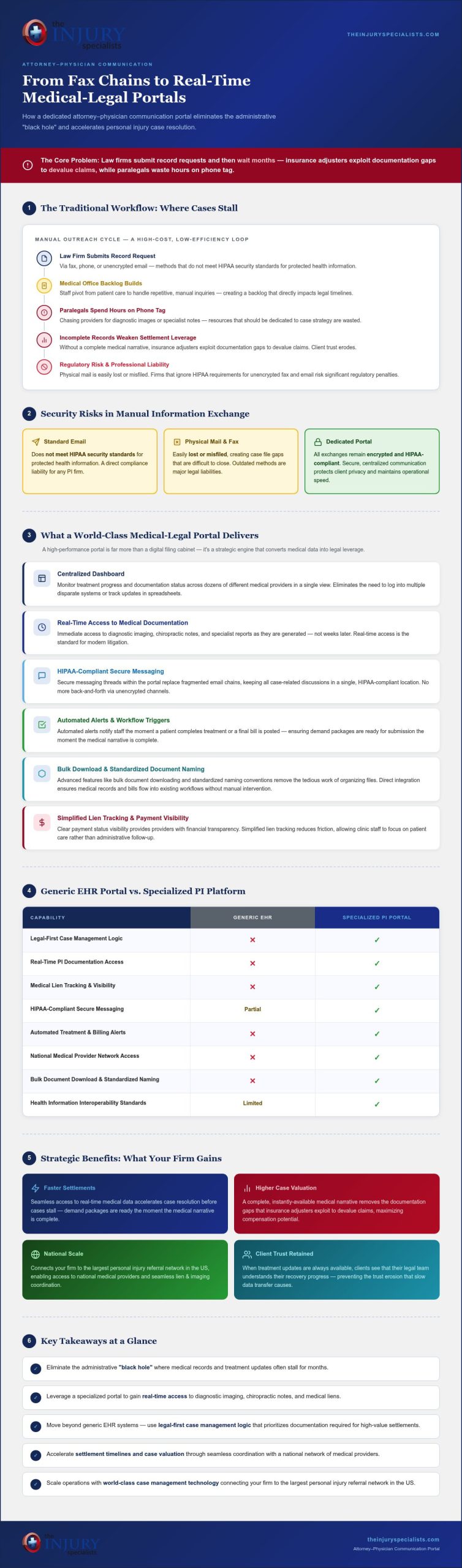
- Eliminate the administrative “black hole” where medical records and treatment updates often stall for months.
- Leverage a specialized attorney physician communication portal to gain real-time access to diagnostic imaging, chiropractic notes, and medical liens.
- Move beyond generic EHR systems by utilizing legal-first case management logic that prioritizes the documentation required for high-value settlements.
- Accelerate your firm’s settlement timelines and case valuation through seamless coordination with a national network of medical providers.
- Scale your operations by integrating world-class case management technology that connects your firm to the largest personal injury referral network in the US.
The Friction in Traditional Attorney Physician Communication
The communication flow in personal injury cases often vanishes into a “black hole” of administrative silence. Law firms submit requests and then wait months for critical medical records. This isn’t just a minor delay; it’s a systemic failure that halts case momentum. Medical practices often struggle with manual requests, creating a backlog that directly impacts legal timelines. Without a modern attorney physician communication portal, your firm remains disconnected from real-time treatment status, making it impossible to manage cases with precision.
Administrative phone tag is a significant drain on profitability. Paralegals spend hours chasing providers for diagnostic images or specialist notes. This manual effort wastes resources that should be dedicated to case strategy. Medical offices face similar burdens, as staff must pivot from patient care to handle repetitive inquiries. It’s a high-cost, low-efficiency cycle that limits the growth of both the firm and the medical practice.
The True Cost of Administrative Delays
Lost hours spent on documentation retrieval directly impact your firm’s bottom line. When treatment updates aren’t available, client trust erodes. Clients want to know their legal team understands their recovery progress. Beyond client relations, slow data transfer weakens your settlement leverage. Insurance adjusters exploit gaps in documentation to devalue claims. If you can’t present a complete medical narrative quickly, you lose the ability to push for maximum compensation.
Security Risks in Manual Information Exchange
Outdated methods like faxing and unencrypted email are major liabilities. Standard email doesn’t meet HIPAA security standards for protected health information. Physical mail is easily lost or misfiled, creating gaps in the case file that are difficult to close. Implementing an attorney physician communication portal ensures that all exchanges remain encrypted and compliant. Firms that ignore these security requirements risk professional liability and significant regulatory penalties. Secure, centralized communication is the only way to protect client privacy while maintaining operational speed.
What Defines a World-Class Medical-Legal Portal?
A high-performance attorney physician communication portal is far more than a digital filing cabinet. It serves as a strategic engine that converts medical data into legal leverage. The most effective platforms provide a centralized dashboard. This allows your team to monitor treatment progress and documentation status across dozens of different medical providers in one view. It eliminates the need to log into multiple disparate systems or track updates in spreadsheets.
Real-time access is the standard for modern litigation. You need immediate entry to diagnostic imaging, chiropractic notes, and specialist reports as they are generated. This level of connectivity relies on robust health information interoperability standards to ensure data moves securely between medical and legal environments. When these systems work together, your firm gains the speed necessary to resolve cases before they stall. Secure messaging threads within the portal replace fragmented email chains, keeping all case-related discussions in a single, HIPAA-compliant location.
Essential Features for Legal Efficiency
Efficiency in a personal injury firm depends on how well your tools communicate. Top-tier portals offer direct integration with personal injury case management technology. This synchronization ensures that medical records and bills flow directly into your existing workflow without manual intervention. Advanced features like bulk document downloading and standardized naming conventions remove the tedious work of organizing files. Automated alerts notify your staff the moment a patient completes treatment or a final bill is posted. This ensures that your demand packages are ready for submission the moment the medical narrative is complete.
The Provider’s Perspective: Why Doctors Use Portals
Physicians prefer using a dedicated portal because it removes the friction of record requests. It significantly reduces the burden on their medical records departments. When a law firm can self-serve the documents they need, the clinic’s staff can focus on patient care. Simplified lien tracking and clear payment status visibility provide providers with the financial transparency they require. This level of professional synergy builds stronger relationships between firms and doctors. It’s a key component of a scalable referral network. Firms that prioritize these collaborative tools often see a significant increase in their operational capacity. You can experience this level of connectivity by exploring the integrated technology solutions provided by industry leaders.
Comparing Generic EHR Portals vs. Specialized PI Platforms
Generic Electronic Health Record (EHR) portals focus on clinical outcomes, not legal resolutions. While these systems serve a purpose in a hospital setting, they often frustrate personal injury firms by lacking the specific logic required for litigation. A specialized attorney physician communication portal bridges this gap by prioritizing “Legal-First” data. Instead of just showing vitals or prescriptions, a specialized platform highlights medical liens, final bills, and diagnostic reports. This distinction is critical for firms aiming to maximize settlement values without getting bogged down in irrelevant clinical data.
Specialized networks go beyond simple record sharing. They facilitate physician referral services personal injury professionals rely on to maintain case momentum. By integrating medical case management directly into the technology, firms ensure that every medical step aligns with the legal strategy. This integrated approach converts a passive data repository into an active tool for case progression. It allows for a level of coordination that generic systems simply cannot match.
The Referral Loop: Beyond Simple Data Sharing
A successful law firm medical referral program requires a closed-loop system. Generic portals allow you to view a file, but they don’t manage the referral lifecycle from intake to settlement. Specialized platforms integrate diagnostic centers and imaging facilities into the same communication flow as the primary treating physician. This ensures that an MRI report doesn’t sit in a separate silo while the attorney waits to file a demand. You gain visibility into every referral, appointment, and missed visit. This transparency allows for immediate intervention when a patient’s treatment plan stalls, keeping the case on track for a timely resolution.
Data Integrity and Evidence Preservation
Litigation requires a higher standard of data integrity than routine clinical care. Every document exchanged must meet strict evidentiary standards to be useful in court or negotiations. A world-class attorney physician communication portal provides comprehensive audit trails. These logs verify exactly when a document was sent, received, and viewed; this is vital for resolving disputes over notice or delivery. Security is non-negotiable. All exchanges must strictly adhere to HIPAA privacy compliance standards to protect the firm from liability. Standardizing documentation across a national network of providers ensures that the evidence remains consistent and professional. This uniformity is essential for firms managing cases across multiple jurisdictions or scaling their operations nationally.
Strategic Benefits: Accelerating Case Outcomes and Firm Growth
Adopting a robust attorney physician communication portal is a strategic move that directly impacts a firm’s bottom line. By ensuring instant document availability, you significantly reduce the time to settlement. When demand packages are compiled in days rather than months, your firm’s cash flow improves and case velocity increases. This efficiency isn’t just about speed; it’s about creating a well-oiled system that handles higher case volumes without increasing administrative headcount.
Integration of financial tools within the portal ecosystem further strengthens the case. For example, facilitating pre-settlement funding for injury victims ensures that clients can afford necessary living expenses while their case matures. This prevents premature settlements driven by financial desperation. When clients remain in treatment, the medical narrative remains unbroken, leading to higher overall valuations. By centralizing these services, you position your firm as a sophisticated operator that manages the entire lifecycle of a personal injury claim.
Maximizing Case Value through Coordination
Precision in medical evidence is the foundation of high-value settlements. Real-time updates from specialists allow your team to draft demand letters with extreme accuracy. Proactive medical case management through the portal prevents gaps in treatment that insurance adjusters often use to devalue claims. You can use the granular data provided by the portal to justify higher settlement figures, showing a clear and documented path of recovery and medical necessity. This level of coordination ensures that no billable detail is overlooked during negotiations.
Scaling Your Referral Network
Technology is a powerful recruitment tool for medical partners. High-quality physicians and specialists are drawn to firms that respect their time and provide streamlined workflows. By standardizing the experience for personal injury physical therapy referrals, you create a predictable and professional environment for providers. This technological ease fosters long-term loyalty among your most efficient partners. You can also use portal metrics to identify which providers deliver the most complete documentation on time, allowing you to focus your referral efforts on the highest-performing medical practices in the network. To start optimizing your firm’s growth and connectivity, consider joining the largest personal injury referral network in the country.
Implementing the Injury Specialists’ Case Management Solution
Joining The Injury Specialists provides immediate entry into the largest national personal injury referral network. This isn’t just a software upgrade; it’s a commitment to a comprehensive ecosystem designed for high-level facilitators. The platform offers integrated medical case management that adapts to your firm’s distinct process. This ensures that every referral, from imaging centers to chiropractic care, follows the specific logic of your practice. By leveraging this world-class technology, you create professional synergy that drives growth through strategic networking and marketing. You aren’t just managing cases; you’re building a scalable infrastructure that commands respect from medical and legal peers alike.
The platform functions as a power-connector, bridging the gap between diverse professional sectors with logistical ease. It allows firms to manage complex referral loops without the administrative burden of manual follow-ups. Because the system is built for national scalability, it supports your firm’s expansion into new markets without requiring a proportional increase in staff. This efficiency is what separates market leaders from firms struggling with administrative overhead.
Seamless Integration and Onboarding
Transitioning to a unified attorney physician communication portal removes the operational drag of legacy systems. The onboarding process focuses on aligning the platform with your existing legal workflows. This ensures that your documentation needs are met without the typical downtime associated with new technology. You can configure custom access for legal teams and medical providers, allowing for secure, role-based interaction. Moving away from fragmented communication methods into a centralized system ensures that no treatment update or medical lien is ever overlooked. It creates a transparent environment where every stakeholder has real-time visibility into case progress.
The Future of Medical-Legal Connectivity
The future of medical-legal connectivity lies in deeper automation and data-driven insights. Future portal developments will likely incorporate advanced automation to further streamline document naming conventions and predictive case timelines. Staying competitive in a tech-driven personal injury market requires a partner that anticipates these shifts. Firms that integrate these systems today are better prepared for the logistical demands of tomorrow. This connectivity is the foundation for a firm that values professional excellence and logistical ease. Join the network and streamline your communication today to leverage a system built for national scalability and success.
Scaling Your Firm Through Digital Integration
A fragmented communication strategy is the primary obstacle to firm growth. By replacing manual outreach with a specialized attorney physician communication portal, you eliminate the administrative friction that stalls settlements. You’ve seen how legal-first logic and real-time data access convert medical records into powerful evidence. This transition ensures your team spends less time chasing documents and more time executing high-level case strategies. It’s the difference between simply managing a caseload and dominating a market through logistical excellence.
The Injury Specialists provides the infrastructure needed to achieve this level of operational success. As the largest personal injury referral network in the United States, we offer integrated medical case management tailored to your firm’s specific processes. Our world-class technology platform ensures seamless networking between law firms, physicians, and imaging centers across the country. Don’t let administrative bottlenecks limit your firm’s potential. Streamline your case management with The Injury Specialists today and position your practice for national scalability. Your firm’s growth depends on the efficiency and reliability of your professional connections.
Frequently Asked Questions
What is an attorney physician communication portal?
An attorney physician communication portal is a specialized technology platform designed to facilitate secure, real-time data exchange between law firms and medical providers. It acts as a centralized hub for managing case documentation, treatment updates, and financial records. Unlike generic email or fax, it provides a structured environment that prioritizes the specific documentation needs of personal injury litigation. This ensures both legal and medical professionals remain aligned throughout the recovery and settlement process.
How does a communication portal improve personal injury case timelines?
A portal improves case timelines by eliminating the administrative delays associated with manual record retrieval. Instead of waiting weeks for mailed documents, legal teams can access final bills and medical notes as soon as they’re uploaded. This immediate availability allows for faster preparation of demand packages. By reducing the time to settlement, firms can increase their case velocity and handle a larger volume of clients without adding administrative staff.
Is a medical-legal portal HIPAA compliant?
Yes, a world-class medical-legal portal is designed with strict encryption and security protocols to ensure full HIPAA compliance. It replaces insecure communication methods like unencrypted email or standard faxing, which often put protected health information at risk. These platforms provide detailed audit trails and role-based access controls to maintain data integrity. This level of security protects law firms from professional liability and ensures patient privacy is maintained across all professional sectors.
Can I track medical liens through a communication portal?
You can track and manage medical liens directly through the portal dashboard. This feature provides real-time visibility into outstanding balances and payment status across multiple cases. By centralizing lien management, firms avoid the confusion of fragmented spreadsheets or phone calls to individual billing departments. This transparency allows for more accurate case valuation and ensures all financial obligations are accounted for before a settlement is finalized.
How do I integrate a communication portal with my existing case management software?
Integration is typically handled through secure APIs or direct synchronization modules that align with your firm’s distinct processes. Modern portals work alongside popular legal technology platforms to ensure a seamless flow of data. This allows medical records and billing documents to populate directly into your existing case files without manual entry. The Injury Specialists provides an attorney physician communication portal that facilitates this level of professional synergy and logistical ease.
What is the difference between a patient portal and an attorney portal?
Patient portals focus on clinical outcomes and health management, while an attorney portal is built with legal-first logic. Patient systems often lack the bulk downloading capabilities and lien-tracking features that law firms require for efficient case management. An attorney-focused portal prioritizes the delivery of diagnostic imaging and specialist reports in a format that meets evidentiary standards. It serves the specific needs of the legal professional rather than the general healthcare consumer.
Why do medical providers prefer using a centralized portal for PI cases?
Medical providers prefer centralized portals because they significantly reduce the administrative burden on their records departments. Instead of responding to repetitive phone inquiries and manual document requests, staff can upload records once for the legal team to access. It provides physicians with clear visibility into lien status and payment history. This efficiency allows medical practices to manage personal injury cases more profitably while maintaining a professional reputation for reliability and collaboration.
Can imaging centers and chiropractors be included in the same portal?
Imaging centers and chiropractors are fully integrated into the same portal ecosystem. This centralized approach allows law firms to manage referrals for different specialties in one place. Whether you’re tracking an MRI report or physical therapy notes, the documentation flows through a unified communication hub. This integration removes the silos that often exist between different medical providers, ensuring a cohesive medical narrative that supports the overall legal strategy for the case.
