

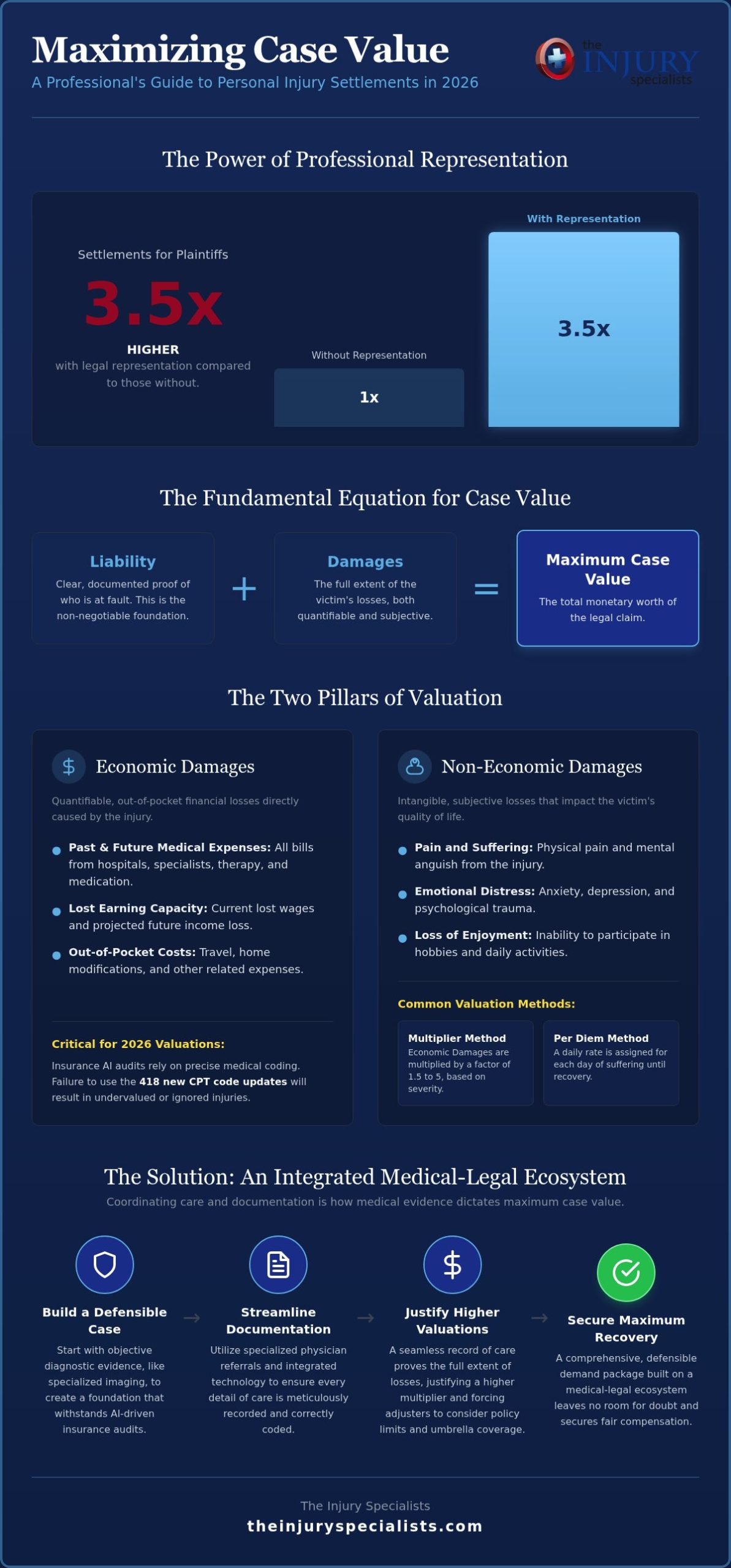
Research indicates that plaintiffs with legal representation secure settlements 3.5 times higher than those who navigate the process alone. Yet, even the most skilled attorneys struggle when insurance adjusters use AI-driven audits to aggressively contest claims. You likely see this trend daily as adjusters undervalue pain and suffering due to a perceived lack of objective diagnostic evidence. Mastering how medical documentation impacts case value is no longer optional; it’s a fundamental requirement for professional growth and client success in 2026.
This guide will show you how to maximize settlement worth by building a coordinated medical-legal ecosystem that leaves no room for doubt. We’ll break down the mechanics of the 2026 CPT code updates and explain how specialized physician referrals generate the evidence needed to satisfy rigorous billing audits. You’ll gain a clear understanding of valuation variables and learn how integrated case management technology ensures every diagnostic detail is captured. By the end of this professional guide, you’ll have a blueprint for securing the maximum compensation your clients deserve.
Key Takeaways
- Move beyond generic settlement calculators by identifying the specific variables of liability and damage multipliers required for accurate 2026 valuations.
- Distinguish between quantifiable economic losses and subjective non-economic damages to build a comprehensive and defensible demand package.
- Understand how medical documentation impacts case value by prioritizing objective diagnostic evidence, such as specialized imaging, over subjective patient statements.
- Leverage trial risk factors and policy limit identification to force insurance adjusters toward higher settlement ceilings and umbrella coverage.
- Utilize an integrated medical-legal ecosystem to streamline care coordination and ensure every injury is documented for maximum recovery.
Understanding Personal Injury Case Valuation: Beyond the Settlement Calculator
Personal injury case valuation is the technical projection of a legal claim’s monetary worth. It isn’t a random number; it’s a calculated figure derived from the intersection of liability and damages. While online settlement calculators promise instant answers, they often provide misleading or oversimplified results. These tools cannot account for the 418 changes to the CPT code set implemented in 2026 or the specific nuances of a patient’s recovery trajectory. In professional practice, insurance adjusters use sophisticated software like Colossus to cap valuations. This software relies on specific medical codes to trigger payouts. This is exactly how medical documentation impacts case value. If a provider fails to use the precise code for a diagnosed condition, the adjuster’s software will effectively ignore the injury during the valuation process.
Modern valuations typically utilize the multiplier method or the per diem approach. The multiplier method totals economic losses and applies a factor, often between 1.5 and 5, to determine non-economic worth. The per diem approach assigns a daily rate to the duration of the victim’s suffering. Both methods require rigorous documentation to survive the scrutiny of a billing audit.
The Formula for a Successful Settlement
The core equation for any claim is Liability + Damages = Case Value. Clear liability is the non-negotiable foundation of a high-value case. If a claimant bears any responsibility under comparative negligence rules, the final recovery amount decreases proportionally. A comprehensive strategy for understanding legal damages involves categorizing both special damages, like medical bills, and general damages, such as emotional distress. Without a clear link between the accident and these damages, the case value remains stagnant.
Why Every Case Needs a Professional Evaluation
It’s a mistake to accept an initial nuisance offer from an insurance carrier. These offers are designed to minimize corporate loss, not to reflect the victim’s actual needs. Professional networks are essential because they identify hidden damages that automated calculators miss. When doctors and lawyers work in a coordinated ecosystem, they create a seamless record of care. This level of medical-legal cohesion is the primary driver of how medical documentation impacts case value. By leveraging specialized referrals and integrated technology, firms can prove the full extent of a client’s losses and secure a settlement that accounts for both current and future medical requirements.
The Critical Pillars of Valuation: Economic vs. Non-Economic Damages
Personal injury case valuation rests on two specific pillars: economic and non-economic damages. Economic damages represent the quantifiable out-of-pocket losses a victim incurs. Non-economic damages cover the intangible, often subjective impact on a person’s life quality. While insurance carriers attempt to isolate these figures, they’re deeply interconnected. A structured network ensures every single expense is captured and categorized correctly from the initial consultation. This systematic approach prevents the “leakage” of value that occurs when small medical costs or out-of-pocket expenses go unrecorded.
Calculating Economic Losses with Precision
Precision is mandatory when documenting past medical expenses. Attorneys should implement best practices for medical record review to establish a clear line of causality between the incident and the treatment. In 2026, the CMS implementation of a 2.5% efficiency adjustment for work RVUs makes accurate coding more vital than ever. If your referral partners don’t utilize the 418 updates to the CPT code set, the valuation will suffer. Projecting future care costs is equally critical for cases involving permanent impairment. Utilizing specialized medical case management for attorneys allows for the projection of future surgery, therapy, and lost earning capacity with mathematical certainty.
The Art of Valuing Pain and Suffering
Non-economic damages are the most contested element of any valuation because they lack a fixed price tag. Juries perceive subjective pain differently than they perceive a hospital bill. To bridge this gap, consistent medical reporting is indispensable. Daily pain journals and regular check-ins with specialists provide a narrative that supports the legal claim. This is a primary example of how medical documentation impacts case value. Without a documented history of distress, adjusters will apply the lowest possible multiplier to the economic totals. Objective evidence from imaging centers creates a baseline that subjective statements simply can’t match.
Future damages are essential for victims facing chronic pain. A coordinated ecosystem connects victims with doctors who understand the requirements of legal testimony. Using an integrated referral network streamlines this process, ensuring every diagnostic detail supports the final demand. By documenting the progression of an injury over time, firms provide the evidence necessary to justify higher non-economic multipliers and secure the client’s long-term financial stability.
Why Medical Documentation and Diagnostic Evidence Dictate Case Value
Insurance adjusters view patient statements as subjective and easily dismissed. A clean MRI or a positive CT scan, however, provides undeniable proof of trauma. This distinction is the core of how medical documentation impacts case value. For a high-level personal injury lawsuit overview, one must recognize that negligence is only half the battle; proving the physical manifestation of that negligence requires diagnostic precision. Without objective evidence, a case is merely a collection of unverified claims.
The Power of Diagnostic Imaging
Soft-tissue claims are notoriously difficult to value because they rely on patient reports of pain. Utilizing personal injury diagnostic imaging referrals allows attorneys to transform these vague complaints into objective medical facts. Within a high-performing personal injury referral network, imaging centers provide specialized reporting that speaks the language of both medicine and law. Objective diagnostic evidence serves as the anchor for all future settlement negotiations. It eliminates the “he said, she said” dynamic and replaces it with visual proof that insurance software can’t ignore.
Cohesive Medical Narratives
Attorneys require referral partners who understand the nuances of personal injury liens and strict documentation standards. Fragmented care leads to conflicting medical opinions, which adjusters use to slash case values. By using physician referral services personal injury professionals can ensure a unified medical history. Chiropractic and physical therapy records are vital here; they build a narrative of recovery and persistence. These records show the insurance company that the victim is committed to their health, which justifies the demand for non-economic damages.
One of the most common pitfalls is the “Gap in Treatment” trap. If a client misses appointments or delays care, adjusters argue the injury wasn’t severe or was caused by an intervening event. This is another critical way how medical documentation impacts case value. Consistent, documented care from a coordinated ecosystem eliminates these gaps. It provides a chronological record that supports the demand for maximum compensation. When every doctor and therapist is on the same page, the resulting medical-legal cohesion creates an airtight case for valuation.
Strategic Factors That Maximize Your Personal Injury Settlement
Insurance carriers operate on a model of risk mitigation. They calculate settlement offers based on the “expected value” of a case, which is the potential jury verdict multiplied by the probability of that verdict occurring. High-quality documentation increases this probability, forcing adjusters to pay more to avoid the unpredictability of a courtroom. This is a fundamental way how medical documentation impacts case value. Beyond the evidence itself, attorneys must identify policy limits and search for secondary umbrella coverage early in the process. Without knowing the hard ceiling on a valuation, a legal team may waste resources on a case where the recovery is capped by a limited insurance policy.
Leveraging Pre-Settlement Funding
Insurance adjusters often use a strategy of attrition. They understand that victims face mounting bills and may accept a low-ball offer out of financial desperation. Utilizing pre-settlement funding for injury victims neutralizes this tactic. Financial stability allows the legal team to wait for a fair valuation rather than settling for a nuisance amount. This strategic advantage is particularly effective during the critical gap between active medical treatment and the final settlement check. It provides the leverage needed to hold out against initial offers that undervalue the long-term impact of the injury. By removing the pressure of immediate debt, firms can focus on building a comprehensive demand package that reflects the true worth of the claim.
Technology-Driven Valuation Preservation
Documentation errors are a primary source of value leaks in personal injury demand packages. Missing invoices, unrecorded diagnostic results, and disjointed provider notes give adjusters a reason to lower settlement offers. Implementing personal injury case management technology eliminates these systemic failures. These platforms align medical providers and law firms in real-time, ensuring that every 2026 CPT code update is applied correctly. Centralized data tracking improves the accuracy of valuation models for complex cases by preventing “unbundled coding” errors that adjusters use to flag and deny claims. This ensures that every piece of evidence is organized, accessible, and ready for inclusion in the final demand. When technology streamlines the flow of information, it reinforces how medical documentation impacts case value by presenting an airtight narrative of the victim’s recovery.
Maximize your firm’s efficiency and secure higher settlements by partnering with a national medical-legal referral network today.
Leveraging Professional Networks for Accurate Case Management and Valuation
Fragmented medical care is the primary cause of undervalued personal injury claims. When a victim sees multiple providers who don’t communicate, the result is a disjointed medical record full of contradictions. Insurance adjusters exploit these inconsistencies to justify lower settlements. Transitioning to an integrated medical-legal ecosystem ensures that every provider, from the initial chiropractor to the orthopedic surgeon, is aligned. The Injury Specialists facilitate this connection, acting as the bridge between victims, healthcare providers, and law firms. This synergy is fundamental to how medical documentation impacts case value, as it creates a single, undeniable narrative of injury and recovery.
The Power of the Referral Network
A high-stakes case requires doctors who specialize in personal injury and possess a deep understanding of the lien process. Using a law firm medical referral program provides access to a pre-vetted network of specialists who prioritize detailed, legally-defensible reporting. This national network offers the scale and reliability necessary for complex litigation. When every specialist is documented on the same platform, the risk of conflicting medical opinions disappears. This level of coordination ensures that the final demand package is supported by a unified front of medical experts, maximizing the case’s settlement potential.
Next Steps: Securing Your Professional Support
Maximizing settlement worth requires a proactive assessment of your firm’s current referral strategy. Identify valuation gaps where documentation is thin or where gaps in treatment have occurred. Accessing an integrated case management technology platform allows for real-time tracking of patient progress and billing accuracy. This technological oversight is another critical factor in how medical documentation impacts case value. It ensures that every diagnostic code and treatment note is preserved for the demand.
To bridge the gaps in your current referral network, contact The Injury Specialists today. Our national network and proprietary technology are designed to streamline care and maximize recovery for your clients. By implementing a structured, professional ecosystem, you can move away from fragmented care and toward a model of consistent, high-value results. This transition allows your firm to focus on legal strategy while our network handles the complexities of medical-legal logistics.
Securing Maximum Settlement Worth Through Professional Synergy
Dominating the personal injury sector in 2026 requires a strategic shift from fragmented care to a structured, data-driven ecosystem. You’ve seen that objective diagnostic evidence is the only effective way to counter aggressive insurance audits and AI-driven claims reviews. By mastering how medical documentation impacts case value, your firm can secure higher multipliers for non-economic damages and eliminate the documentation errors that lead to significant value leaks. Relying on online calculators is no longer sufficient for complex litigation; professional results require professional evidence.
Efficiency and growth are within reach when you leverage the right infrastructure. Connect with the nation’s leading personal injury referral network today. As the largest national network of medical and legal professionals, we provide proprietary case management technology and integrated pre-settlement funding solutions to streamline your operations. These tools ensure your documentation is airtight and your clients have the financial stability to hold out for fair valuations. It’s time to stop leaving money on the table and start delivering the maximum results your clients deserve. We’re ready to help you scale your success.
Frequently Asked Questions
How is the value of a personal injury case calculated?
Case valuation is the sum of economic losses and non-economic damages, adjusted by liability percentages. Economic damages include medical bills, lost wages, and out-of-pocket expenses. Non-economic damages represent intangible losses like pain and suffering. Adjusters often apply a multiplier to the economic total based on the severity of the documented injuries. This process highlights how medical documentation impacts case value, as missing records lead to lower multipliers.
Can a lawyer tell me exactly what my personal injury case is worth?
No attorney can guarantee an exact settlement amount because valuation is a dynamic process. A lawyer provides a professional estimate based on current evidence, policy limits, and liability. The final number often changes as new medical evidence emerges or as the victim’s recovery trajectory becomes clearer. Firms using integrated case management technology can provide more accurate projections by tracking diagnostic data and treatment costs in real-time.
Does having a lawyer increase the value of a personal injury case?
Research from the Insurance Research Council shows that represented plaintiffs receive settlements approximately 3.5 times higher than those without legal counsel. Attorneys identify all available insurance coverage and prevent adjusters from using aggressive tactics to devalue the claim. They also ensure that specialized physician referrals are utilized to create the objective evidence required for a high-value demand. Professional representation transforms a collection of bills into a strategic legal asset.
Why do insurance companies offer low initial settlements?
Insurance companies offer low initial settlements to mitigate their financial risk and close files quickly. These nuisance offers target victims who may be experiencing financial pressure. Adjusters rely on the fact that many claimants don’t understand the full scope of their future medical needs. Without a coordinated medical-legal network, victims often lack the objective proof needed to push back against these low-ball offers and secure a fair valuation.
How do medical liens affect the final amount I receive?
Medical liens are legal claims placed on your settlement by healthcare providers to ensure payment for services rendered. These liens are paid directly from the final settlement amount before you receive your portion. Utilizing a structured referral network helps manage these liens efficiently. Doctors who understand the personal injury lien process are more likely to provide the consistent reporting that justifies the total claim value during negotiations.
What happens if my medical bills exceed the insurance policy limits?
If medical bills exceed policy limits, the insurance company is typically not obligated to pay more than the stated cap. In these scenarios, attorneys search for secondary umbrella policies or identify additional defendants to increase the total recovery pool. Proving the necessity of these high costs depends on how medical documentation impacts case value. Clear, objective evidence of permanent impairment is essential when negotiating for every available dollar of coverage.
How does diagnostic imaging impact the settlement value of my case?
Diagnostic imaging like MRIs and CT scans provides objective proof of injury that subjective patient statements cannot match. These reports serve as the anchor for settlement negotiations because they are difficult for insurance software to dismiss. High-value cases often hinge on specialized imaging center referrals that provide detailed medical-legal reporting. This visual evidence justifies higher multipliers for non-economic damages by proving the physical reality of the claimant’s pain.
Is pre-settlement funding a good idea for my injury case?
Pre-settlement funding is a strategic tool that provides financial stability while a case is being litigated. It prevents victims from accepting low-value settlements out of desperation. This funding allows the legal team to wait for the maximum valuation rather than settling prematurely. It bridges the gap between active treatment and the final check, ensuring that the victim’s recovery and the legal strategy remain on a professional, growth-oriented track.

Leave A Comment
You must be logged in to post a comment.