

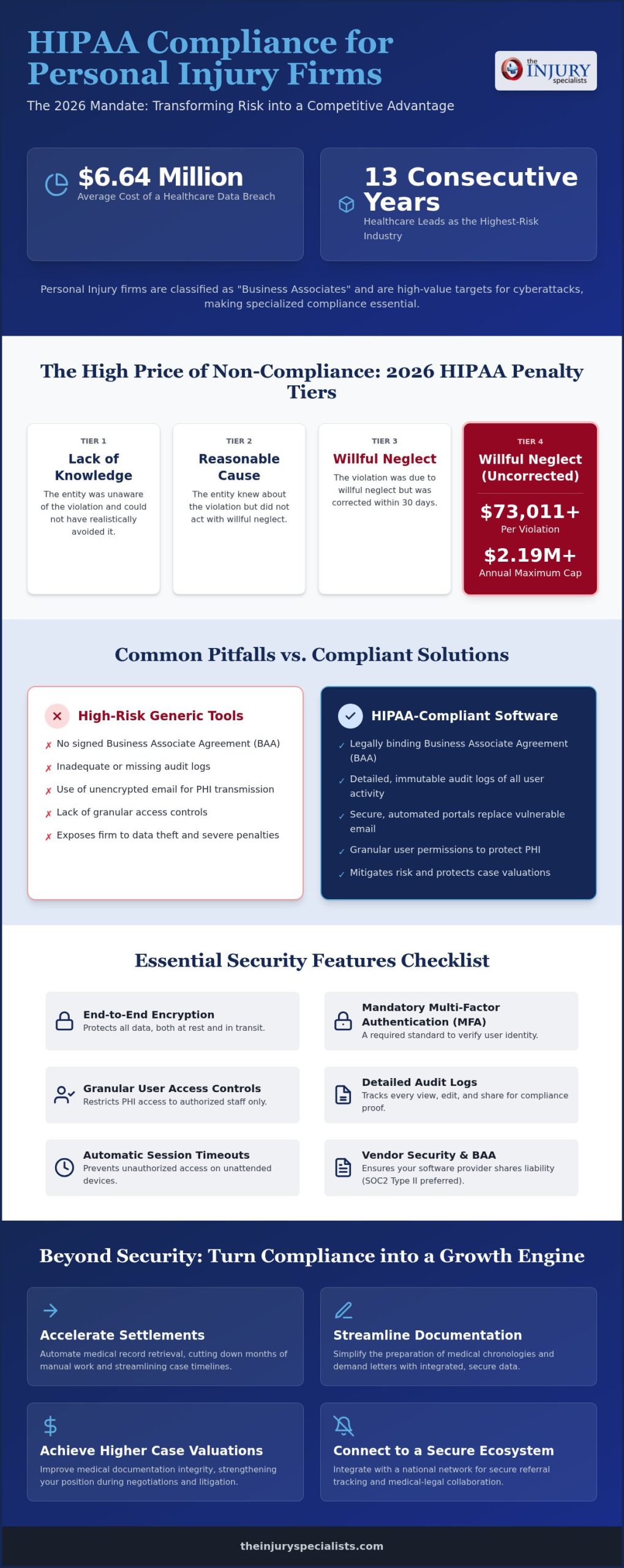
The average healthcare data breach in 2026 now costs $6.64 million, marking the 13th consecutive year this sector has led in financial risk. For personal injury firms, these numbers represent more than just a distant threat. As a business associate handling protected health information, your firm faces mandatory multi-factor authentication and stricter encryption requirements under the latest HIPAA Security Rule updates. You likely already feel the friction of manual medical record retrieval taking months and the constant pressure to avoid violations during provider communication. Implementing HIPAA compliant software for personal injury attorneys is no longer an optional upgrade; it’s a requirement for operational survival.
It’s time to move beyond basic security and treat compliance as a growth engine. You’ll discover how to secure your practice and accelerate settlements using specialized technology designed for the medical-legal ecosystem. This guide examines the 2026 penalty tiers, automated referral tracking, and methods for achieving higher case valuations through better medical documentation. We provide the technical roadmap to turn logistical hurdles into a streamlined, high-velocity system for your firm.
Key Takeaways
- Understand how the 2026 HIPAA Security Rule updates transform previously flexible standards into mandatory requirements for all personal injury firms.
- Identify the core technical requirements for HIPAA compliant software for personal injury attorneys, focusing on end-to-end encryption and granular user access.
- Learn how specialized case management technology accelerates settlements by automating medical record retrieval and streamlining the preparation of medical chronologies.
- Discover the framework for evaluating software based on its ability to facilitate medical-legal synergy rather than just basic document storage.
- Explore the benefits of connecting your practice to a national ecosystem that integrates medical case management with secure referral tracking and networking.
Why Personal Injury Firms Require Specialized HIPAA Compliance
Personal injury litigation relies on the seamless exchange of sensitive medical data. While attorney-client privilege protects your legal strategy, it doesn’t exempt your firm from the federal mandates of the Health Insurance Portability and Accountability Act (HIPAA). Within a personal injury case file, Protected Health Information (PHI) includes any individually identifiable health data, such as diagnostic imaging, treatment notes, and billing records, that links a specific patient to their past, present, or future physical or mental health condition. Failing to secure this data triggers severe consequences. In 2026, Tier 4 penalties for willful neglect start at $73,011 per violation and can reach an annual cap of $2,190,294.
Many firms mistakenly rely on generic cloud storage like Dropbox or Google Drive. These platforms often fail the PI security test because they aren’t configured for the specific workflows of a litigation practice. Without a signed Business Associate Agreement (BAA) and granular audit logs, these tools leave your firm exposed. Implementing HIPAA compliant software for personal injury attorneys ensures every file transfer and storage event meets federal standards from the moment a case opens.
The Legal Liability of Handling Medical Records
Law firms are classified as “Business Associates” when they handle PHI on behalf of covered entities like hospitals or clinics. This status requires a formal, signed BAA to remain compliant. Your firm must manage the entire lifecycle of medical evidence, from the initial intake and record retrieval to the final settlement or trial. Modern Case Management Technology automates this process. It ensures that every hand-off between a physician and a paralegal remains within a secure, encrypted environment that tracks every access point.
Data Breach Risks in Modern Litigation
Personal injury firms are high-value targets for cyberattacks in 2026. The average cost of a healthcare data breach has climbed to $6.64 million, the highest of any industry. Hackers target law firms because they often use unencrypted email for medical record transmission, creating easy entry points for data theft. A single breach does more than just incur fines; it destroys active litigation and client trust. If your firm’s data is compromised, opposing counsel may challenge the integrity of your evidence. Using HIPAA compliant software for personal injury attorneys mitigates these risks by replacing vulnerable email threads with secure, automated portals that protect your firm’s reputation and case valuations.
Essential Security Features for Legal-Medical Data Management
Effective data management requires more than simple password protection. High-level HIPAA Security and Privacy Rules demand rigorous technical safeguards that generic platforms often ignore. To remain compliant in 2026, your firm must utilize end-to-end encryption for all data at rest on your servers and all data in transit during transmission. Multi-factor authentication (MFA) is now a mandatory standard for accessing sensitive legal-medical files. Additionally, automatic session timeouts are a critical defensive layer that prevents unauthorized access if a staff member leaves a workstation unattended in a busy office environment.
Granular user access controls are equally vital for maintaining a secure practice. These controls allow administrators to restrict Protected Health Information (PHI) to authorized staff only, ensuring that a receptionist doesn’t have the same access level as a senior paralegal or lead attorney. Detailed audit logs serve as an immutable record of every user who viewed, edited, or shared PHI, providing the forensic evidence required to prove compliance during a federal investigation or a formal HIPAA audit.
Business Associate Agreements (BAA) and Vendor Security
A Business Associate Agreement (BAA) isn’t just a formality; it’s a legal contract that shifts significant liability to your software provider. When selecting HIPAA compliant software for personal injury attorneys, verify that the BAA covers all third-party integrations, such as e-signature tools and cloud storage extensions. You should prioritize vendors that undergo annual SOC2 Type II audits. This certification proves that an independent third party has verified the vendor’s security, availability, and processing integrity over an extended period. Firms looking to scale safely can leverage specialized case management technology that builds these protections directly into the referral and document management process.
Disaster Recovery and Data Redundancy
Personal injury litigation often spans several years, making long-term data integrity a top priority. Your firm requires off-site, encrypted backups to ensure that critical case files remain protected against ransomware or local hardware failures. Reliability is non-negotiable; aim for a provider that guarantees 99.9% uptime to keep your medical-legal workflows moving without interruption. Finally, consider data sovereignty. Ensure your case data is stored on US-based servers to avoid the legal complexities associated with international data privacy laws. This structured approach to security allows your firm to focus on case results rather than technical vulnerabilities.
Beyond Security: How Compliance Accelerates Case Management
Rigorous security standards represent the foundation of a modern practice, but the true value of HIPAA compliant software for personal injury attorneys lies in its ability to drive operational velocity. By 2026, 82% of personal injury lawyers have integrated AI into their workflows to manage the massive influx of digital evidence. Specialized software leverages these tools to automate medical record retrieval through secure portals, replacing the “fax and wait” model with immediate, encrypted access. This technology doesn’t just store data; it uses AI-powered analysis to generate precise medical chronologies, identifying key diagnostic findings that might be overlooked in a manual review. By establishing a verified, encrypted channel for evidence transfer, secure data exchange eliminates the back-and-forth delays that frequently stall settlement negotiations.
Direct communication with medical providers is another area where compliance facilitates speed. Instead of disjointed email threads or unreturned phone calls, advanced platforms allow for real-time, secure messaging between law firms and physicians. This connectivity ensures that questions regarding treatment plans or billing codes are resolved instantly within a protected environment. When your firm utilizes HIPAA compliant software for personal injury attorneys, you remove the administrative friction that typically slows down the medical-legal exchange, allowing your team to focus on high-level case strategy.
Integrated Medical Case Management Workflows
Success in personal injury requires perfect alignment between legal strategy and clinical documentation. Using Personal Injury Case Management Technology allows your firm to track treatment progress in real time. This integration ensures that the care the victim receives is cohesive and fully documented from day one. When attorneys can monitor gaps in treatment or upcoming diagnostic appointments through a shared dashboard, they can proactively manage the case file rather than reacting to missing information months later. This level of oversight is only possible within a unified, compliant ecosystem that bridges the gap between the law office and the clinic.
Maximizing Case Valuation with Accurate Documentation
Accurate documentation is the most powerful tool for increasing case value. Secure portals ensure that every diagnostic image, specialist report, and hospital bill is captured and organized immediately. This systematic approach reduces “missing record” gaps that insurance adjusters frequently use to justify lower settlement offers. By standardizing medical-legal data, your firm can produce more persuasive demand letters backed by comprehensive evidence. A well-organized, fully documented file signals to opposing counsel that your firm is prepared for trial, often leading to higher valuations and faster resolutions.
Evaluating Software: A Framework for Personal Injury Law Firms
Selecting the right technology requires a shift from general legal utility to specialized medical-legal functionality. Most firms start by looking at general practice management tools, but these often lack the specific architecture needed to manage complex injury claims. A “PI-First” design prioritizes the medical evidence lifecycle rather than just billable hours. When you evaluate HIPAA compliant software for personal injury attorneys, you must determine if the system is built to facilitate high-volume data exchange with medical providers or if it simply acts as a static document repository.
Scalability is a primary concern for growth-oriented firms. Your software shouldn’t only manage your current caseload; it must also facilitate the expansion of your referral partner base. A platform that offers strategic networking features allows you to bridge the gap between your firm and a national network of physicians. If the technology doesn’t simplify the way you interact with chiropractic offices, imaging centers, and physical therapists, it will eventually become a bottleneck as your practice grows.
Key Questions for Software Demos
During a demonstration, move beyond the basic user interface and probe the technical capabilities that impact your daily operations. High-performance firms use these specific questions to vet potential vendors:
- Does the platform handle large-scale medical imaging files? Personal injury cases often involve high-resolution DICOM files that crash standard legal software.
- Is there a dedicated portal for medical providers? Secure, direct upload capabilities eliminate the security risks of unencrypted email attachments.
- Does the software support integrated medical case management? Effective HIPAA compliant software for personal injury attorneys must align clinical documentation with legal strategy in a single view.
Hidden Costs and ROI of PI Technology
Understanding the financial impact of your software choice involves looking past the initial subscription price. Per-user pricing models can become prohibitively expensive as you scale your support staff. Flat-fee models often provide better predictability for large firms aiming for rapid expansion. Calculate your ROI by measuring the time saved through automated medical record retrieval. If your staff spends 10 fewer hours per week chasing records, the software pays for itself through labor savings and increased throughput.
The most significant ROI comes from risk mitigation. With 2026 HIPAA penalties for willful neglect starting at $73,011 per violation, the cost of a single error far outweighs the annual expense of a secure platform. Investing in Case Management Technology protects your firm from the $6.64 million average cost of a healthcare data breach while simultaneously increasing your settlement velocity. This dual benefit of security and speed makes specialized technology a prerequisite for any firm operating at scale.
Scaling Your Practice with The Injury Specialists’ Compliant Ecosystem
The Injury Specialists offers more than just HIPAA compliant software for personal injury attorneys; it provides a comprehensive infrastructure for practice expansion. By connecting to the largest personal injury referral network in the United States, your firm gains immediate access to a verified ecosystem of medical providers. This proprietary Case Management Technology facilitates seamless coordination between legal teams and physicians, ensuring that every case moves through the pipeline with maximum efficiency. You don’t have to manage disjointed systems or manual tracking sheets when you utilize a platform built for medical-legal synergy.
Integrating pre-settlement funding and medical case management directly into your workflow removes the financial and administrative barriers that often stall litigation. You can manage the entire case lifecycle within a single, secure environment that prioritizes both compliance and speed. This level of integration allows your team to focus on high-level litigation while the technology handles the logistical complexities of provider coordination. For more information on expanding your reach through strategic connections, see The Comprehensive Guide to Personal Injury Referral Networks in 2026.
A World-Class Technology Platform for PI Growth
Our platform delivers customized medical case management based on your firm’s distinct processes. We recognize that every practice has a unique approach to handling injury claims, so our technology adapts to your specific requirements. We provide the marketing and networking tools necessary to grow your referral partner base while simplifying the connection between injury victims and top-tier providers. This targeted connectivity ensures that your clients receive the care they need while your firm builds the medical evidence required for high-value settlements. It’s a system designed for scale, reliability, and professional synergy.
The Future of Medical-Legal Networking
Strategic partnerships drive modern firm expansion and operational efficiency. The role of technology is to bridge the gap between the medical and legal sectors, creating a unified front that benefits both the provider and the attorney. By utilizing HIPAA compliant software for personal injury attorneys that is part of a larger national network, you position your firm as an authoritative leader in the field. This synergy improves case outcomes and provides the logistical ease necessary to handle a high volume of complex litigation. You’re not just buying software; you’re joining a world-class network designed for streamlined success.
Experience the power of a world-class PI technology platform today.
Future-Proofing Your Firm Through Strategic Compliance
The shift toward integrated medical-legal technology is no longer a luxury for firms aiming for market dominance. By adopting HIPAA compliant software for personal injury attorneys, you transform a regulatory obligation into a strategic advantage that accelerates settlements and secures high-value case documentation. You’ve seen how specialized encryption, granular access controls, and automated medical chronologies remove the administrative friction that traditionally slows down litigation. This isn’t just about avoiding fines; it’s about building a more efficient engine for case resolution.
Operating within a secure ecosystem allows your firm to focus on results rather than technical vulnerabilities. The Injury Specialists provides the infrastructure needed for this transition, offering national coverage and proprietary case management technology designed specifically for medical-legal synergy. You gain access to the largest personal injury referral network in the US, ensuring your clients receive top-tier care while your firm builds the strongest possible evidence.
Grow your practice with our world-class PI technology and referral network. Take the next step toward a more efficient, scalable, and secure future for your practice today.
Frequently Asked Questions
What makes software truly HIPAA compliant for a law firm?
True HIPAA compliance for a law firm requires a combination of technical safeguards and legal documentation. Technical requirements include 256-bit AES encryption for data at rest and TLS 1.3 for data in transit. Additionally, the software must support multi-factor authentication and maintain immutable audit logs that track every instance of PHI access. Legally, the provider must sign a Business Associate Agreement to assume liability for the data they store on your behalf.
Do personal injury attorneys really need a BAA with their software provider?
Yes, personal injury attorneys are classified as Business Associates under federal law when they handle protected health information from covered entities. A signed BAA is a mandatory requirement to satisfy HIPAA Security and Privacy Rules. Without this agreement, your firm is directly liable for any data compromise. Using HIPAA compliant software for personal injury attorneys ensures that these legal protections are in place before you ever upload a single medical record or imaging file.
Can I use standard email to send medical records if I have a disclaimer?
Standard email is fundamentally insecure and does not meet HIPAA encryption standards for transmitting medical records. Legal disclaimers at the bottom of an email provide zero technical protection against interception or hacking. To remain compliant, firms should replace email attachments with secure, encrypted portals. These portals ensure that sensitive medical documentation remains protected during transmission, significantly reducing the risk of a breach that could cost your firm millions in civil penalties.
How does HIPAA-compliant software speed up the settlement process?
HIPAA-compliant software accelerates the settlement process by automating the retrieval and organization of medical evidence. Secure portals allow providers to upload records directly, eliminating the weeks spent waiting for mail or faxes. Integrated Case Management Technology also utilizes AI to prepare medical chronologies quickly. This ensures your demand letters are comprehensive and backed by complete documentation, which reduces the back and forth negotiations with insurance adjusters and leads to faster case resolutions.
What is the difference between general case management and PI-specific software?
General case management software focuses on time tracking and billing, which are secondary for contingency-based practices. In contrast, PI-specific software is designed for medical-legal synergy. It includes features like medical provider referral tracking, support for large imaging files, and integrated medical case management. These tools align your legal strategy with clinical documentation, allowing you to manage the complex lifecycle of a personal injury claim more effectively than a generic legal platform.
How do I transfer my old case files into a new HIPAA-compliant system?
Transferring legacy data into a new system requires a structured migration process to maintain data integrity and compliance. Most modern software providers offer secure data mapping services to move files via encrypted SFTP connections. You should verify that the new vendor provides a BAA before the transfer begins. This ensures that all historical medical records and client files remain protected under HIPAA standards throughout the entire migration and onboarding phase.
Is AI-powered medical record analysis HIPAA compliant?
AI-powered medical record analysis is HIPAA compliant only if the AI model operates within a secure, encrypted environment. The software provider must ensure that the data used for analysis isn’t stored in a way that violates privacy rules or used to train public models. When using HIPAA compliant software for personal injury attorneys, confirm that the AI tools are covered under the vendor’s BAA and that they maintain the same rigorous audit logs as the rest of the platform.
What happens if a software provider has a data breach?
If a software provider suffers a data breach, the Business Associate Agreement dictates the notification and mitigation protocols. The provider is legally required to notify your firm within a specific timeframe, typically 60 days, though many contracts mandate faster reporting. Your firm must then follow the Breach Notification Rule, which may involve notifying affected clients and the Department of Health and Human Services. Having a robust BAA helps shift some liability and defines the recovery steps.
