

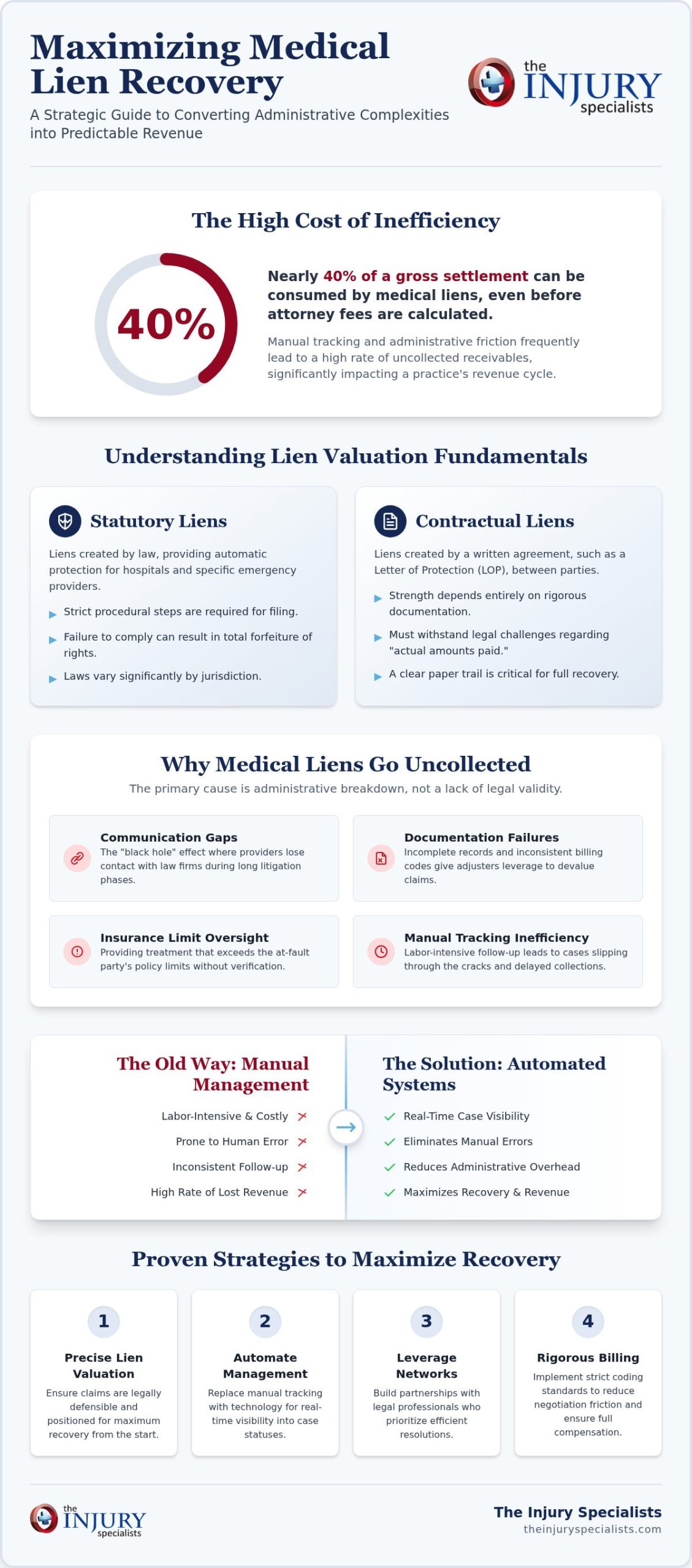
Nearly 40% of a gross settlement can be consumed by medical liens before an attorney even calculates their fee. For providers and legal partners, the friction of manual tracking and settlement negotiations often leads to a high rate of uncollected receivables. Precise medical lien valuation is no longer just a clerical task; it’s a strategic necessity for any practice aiming for scalable growth. You’ve likely felt the strain of labor-intensive case monitoring and the administrative overhead that eats into your margins.
You deserve a system that converts these complexities into predictable success. This guide outlines the professional strategies and technological frameworks required to maximize recovery and streamline your collection process in 2026. We will examine how recent legislative shifts regarding billing transparency and “actual amounts paid” are reshaping the national landscape. You’ll also learn how leveraging a national referral network and integrated case management technology eliminates manual errors, reduces overhead, and strengthens your professional partnerships for a more resilient revenue cycle.
Key Takeaways
- Understand the framework for precise medical lien valuation to ensure your claims are legally defensible and positioned for maximum recovery.
- Identify and eliminate the common administrative “black holes” that result in lost revenue and high rates of uncollected receivables.
- Discover how automated case management technology replaces labor-intensive manual tracking with real-time visibility into case statuses and settlement timelines.
- Leverage a national referral network to build high-value partnerships with legal professionals who prioritize efficient settlement resolutions.
- Implement rigorous billing and coding standards that reduce negotiation friction and ensure your medical services are fully compensated.
The Fundamentals of Medical Lien Valuation in Personal Injury
A medical lien is a legal claim for payment against a personal injury settlement or judgment. It ensures that medical providers receive compensation for services rendered before the patient receives their portion of the award. Understanding What is a Lien? is the first step in mastering medical lien valuation. This process requires a precise calculation of the provider’s interest in the case proceeds. For patients without traditional health insurance, these liens are the primary mechanism for accessing high-quality care without upfront costs. They bridge the gap between immediate medical necessity and the eventual financial resolution of a legal claim.
Statutory vs. Contractual Liens
Providers must distinguish between liens created by law and those created by agreement. Statutory liens provide automatic protection for hospitals and specific emergency providers. In many jurisdictions, providers are required to submit claims to a patient’s health insurer before a lien can be filed. Failure to follow these procedural steps can result in the total forfeiture of lien rights. These laws vary significantly, making it vital to verify specific requirements for filing and perfecting a lien in the public record.
Contractual liens rely entirely on the strength of the written agreement between the parties. These require rigorous documentation to survive legal challenges during the settlement phase. A growing national trend in personal injury litigation involves juries seeing the amounts actually paid for treatment rather than just the initial billed amounts. This shift makes the documentation of a contractual lien’s value even more critical for accurate medical lien valuation. Without a clear paper trail, providers risk seeing their recovery amounts slashed during final negotiations.
The Role of the Letter of Protection (LOP)
The Letter of Protection (LOP) functions as a binding contract between the medical provider, the patient, and the personal injury attorney. It guarantees that the provider will be paid directly from the settlement funds at the conclusion of the case. A well-drafted LOP includes specific clauses that protect the provider’s right to full payment, regardless of whether the settlement covers the total demand. It acts as a financial safeguard, allowing the attorney to secure necessary treatment for their client while providing the doctor with a secured interest in the case.
Common pitfalls in LOP drafting often lead to collection failures. These include:
- Vague language regarding the priority of payment relative to other creditors.
- Missing or unauthorized signatures from the handling attorney’s office.
- Failure to specify that the patient remains personally liable if the legal case is lost or dismissed.
Strategic case management involves verifying these documents early in the litigation process. This proactive approach prevents friction during final negotiations and ensures that the logistical side of the practice remains as efficient as the clinical side.
Why Medical Liens Often Go Uncollected
Uncollected receivables represent a massive leak in practice revenue. The primary cause is rarely a lack of legal validity; it’s an administrative breakdown. When tracking is manual, cases slip through the cracks. Providers often provide extensive care without first verifying the at-fault party’s insurance policy limits. If the treatment costs exceed the available coverage, the lien’s recoverable value drops instantly. This oversight at the intake stage complicates the final medical lien valuation during negotiations.
Documentation Failures and Valuation Disputes
Incomplete records are a catalyst for disputes. Missing SOAP notes, delayed imaging reports, or inconsistent billing codes provide insurance adjusters with the leverage they need to devalue a claim. These gaps directly impact medical lien valuation by introducing doubt regarding the relationship between the accident and the treatment. Precise documentation of medical necessity serves as a definitive barrier against aggressive lien reduction requests during the settlement phase. If your records don’t tell a cohesive story of the patient’s recovery, the financial value of your lien will suffer.
The Communication Gap Between Providers and Attorneys
The “Black Hole” effect occurs when a provider loses contact with the law firm during the long litigation phase. In high-volume practices, manual follow-up is labor-intensive and often inconsistent. Providers frequently don’t realize a case has settled until months after the funds have been disbursed. This lack of transparency leads to friction. Attorneys may assume the provider is willing to accept a deep discount simply because there’s been no active tracking.
Maintaining a consistent connection with legal partners is essential for growth. Utilizing integrated case management technology allows for real-time visibility into case statuses, ensuring you aren’t left behind when a settlement is reached. Without a structured system, your practice is forced into a reactive stance, fighting for scraps after the settlement pie has already been divided. Efficient recovery requires a proactive framework that bridges the gap between the clinic and the courtroom.
Manual vs. Automated Lien Management Systems
Managing a lien portfolio via spreadsheets and manual phone calls is a significant financial liability. It invites human error, creates data silos, and delays the recovery of receivables. When staff members spend hours chasing case updates, the administrative cost of each lien increases, eating into the practice’s net profit. Automated systems replace this friction with a centralized, real-time dashboard. This level of precision is essential for accurate medical lien valuation, as it allows providers to monitor treatment totals against policy limits before costs exceed recoverable amounts.
The Benefits of Integrated Case Management Technology
Modern solutions offer automated alerts for critical case milestones, such as settlement notifications or demand letter filings. This transparency ensures that providers aren’t left in the dark during the litigation phase. Centralized document storage allows for the instant sharing of SOAP notes and billing records with legal partners, removing the delays associated with manual requests. Implementing personal injury case management technology reduces administrative labor and eliminates the “Black Hole” effect discussed earlier. It shifts the practice from a reactive stance to a proactive, tech-driven recovery model.
Scalability for High-Volume Practices
High-volume clinics require a unified platform to manage complex multi-specialty cases. When a patient sees several providers within the same network, a single source of truth prevents fragmented billing and documentation. Proactive revenue cycle management allows practices to identify high-performing legal partners through data analytics. By 2026, AI-driven scoring is expected to help many mid-to-large agencies predict the likelihood of debt resolution, which can improve recovery rates by 15% to 27% above the industry average. This data drives better decision-making regarding future referrals and partnership growth.
Security and compliance are equally vital in a digital ecosystem. Protecting patient data requires HIPAA-compliant frameworks that offer encrypted sharing and detailed audit trails. Automated systems provide a level of security that manual processes, such as faxing or standard email, simply can’t match. By securing the data flow between medical and legal sectors, practices protect their reputation while maximizing their medical lien valuation and recovery rates. Efficiency and security are the dual pillars of a modern, scalable lien management strategy.
Proven Strategies to Maximize Your Lien Recovery Rate
Maximizing recovery starts with clinical and administrative precision. You must establish clear billing and coding standards that mirror current industry benchmarks. This prevents aggressive legal scrutiny during the final medical lien valuation. If your codes are inconsistent or outdated, insurance adjusters will exploit those gaps to lower the settlement offer. You should implement a dedicated medical case management protocol for every personal injury patient. This ensures that every treatment step is justified by medical necessity and documented in real-time. By tracking insurance policy limits at the start of treatment, you avoid the risk of providing care that exceeds the recoverable amount.
Strategic Networking and Partner Selection
Working with lien-friendly law firms is essential for long-term provider sustainability. These firms understand that fair compensation is the foundation of a reliable medical-legal partnership. Joining a personal injury referral network connects you with reputable legal professionals who prioritize efficient settlement resolutions. A structured law firm medical referral program creates a culture of mutual accountability. It aligns the interests of the doctor and the attorney, ensuring that case milestones are shared and communication remains consistent. A national network provides a steady stream of high-quality referrals, which stabilizes your practice’s revenue and protects you from regional economic shifts.
Leveraging Pre-Settlement Funding
Cash flow timing is a significant hurdle for practices that treat patients on a lien basis. Pre-settlement funding for injury victims can often be structured to include medical lien funding. This provides immediate liquidity to your practice, allowing you to cover operational costs while the legal case proceeds. It reduces the financial risk inherent in no-recovery cases by providing a guaranteed payment floor. Utilizing these funding solutions allows your practice to maintain its growth trajectory without being tethered to the slow pace of the court system. You can focus on expanding your service offerings while the funding entity manages the wait for the final settlement.
Professional lien recovery is a byproduct of a well-oiled system. You can leverage our world-class technology platform to streamline your collection process and maximize your recovery rates today.
Streamlining Collections with The Injury Specialists
The Injury Specialists functions as a high-level facilitator for the medical-legal sector. We connect providers with a vast ecosystem of legal professionals through the largest personal injury referral network in the United States. This connectivity is essential for maintaining a stable revenue stream and ensuring that your clinical expertise is matched by administrative excellence. Integrated medical case management ensures that care remains cohesive and settlement resolution stays efficient. By aligning our technology with your specific workflow, we remove the friction that typically slows down the recovery of receivables. This systemic approach is the most effective way to protect your medical lien valuation during final negotiations.
A Technology-First Approach to Lien Management
Our world-class technology platform eliminates the “Black Hole” of lost communication between the clinic and the law firm. We provide real-time networking and communication tools that keep your staff informed of critical case milestones. This transparency is vital for accurate medical lien valuation because it allows you to adjust your collection strategy based on the actual progress of the litigation. Simplifying document exchange expedites the entire settlement cycle, moving cases toward resolution faster than manual methods allow. Whether you manage a high-volume imaging center, a chiropractic clinic, or a multi-specialty physician group, our platform provides the visibility needed to track every case status from initial intake to the final disbursement of funds.
Building Your Referral Future
Joining our national network offers more than just a list of names. It positions your practice within a sophisticated system designed for professional synergy and growth. You gain immediate access to a national pool of high-quality personal injury cases managed by reputable firms that respect the provider’s right to fair compensation. This strategic partnership allows you to professionalize your entire PI revenue cycle. You’ll move away from reactive, manual collections and toward a predictable, scalable model that values your time and expertise.
The Injury Specialists acts as your power-connector, bridging the gap between professional sectors to ensure your practice thrives. We provide the technological framework and the referral volume necessary to sustain a high-performing medical practice. By integrating with our network, you’re not just managing liens; you’re leveraging a well-oiled system built for logistical ease and streamlined success. Take the next step in professionalizing your practice by joining a network that prioritizes your growth and financial reliability.
Professionalize Your Practice Revenue Cycle
Precise medical lien valuation is the foundation of a healthy personal injury practice. You’ve learned that uncollected receivables are often the result of administrative breakdowns rather than legal flaws. By transitioning from manual tracking to automated technology and building a network of lien-friendly legal partners, you eliminate the friction that stalls your revenue cycle. Professionalizing these processes ensures that your clinical expertise is matched by your financial recovery rates.
The Injury Specialists acts as your strategic partner in this transition. We provide access to the largest national personal injury referral network, supported by proprietary case management technology and specialized medical case management protocols. These tools create a seamless flow of information between medical and legal sectors, ensuring cohesive care and efficient settlement resolution. Don’t let your receivables sit in a communication black hole. Streamline your lien management and grow your practice with The Injury Specialists today. Secure your practice’s future with a system built for growth.
Frequently Asked Questions
How long does it typically take to collect on a medical lien?
Collection timelines typically mirror the duration of the personal injury litigation, which often ranges from 12 to 24 months. While some cases resolve quickly through pre-suit settlements, complex litigation can extend the wait significantly. Utilizing proprietary tracking technology ensures you’re notified immediately upon settlement, preventing the administrative delays that occur when providers rely on manual follow-ups. Efficient case management reduces the time between settlement disbursement and actual provider payment.
What happens to a medical lien if the personal injury case is lost?
If a personal injury case results in no recovery, the medical lien typically cannot be satisfied from the legal proceeds. However, the patient generally remains personally liable for the cost of treatment unless the Letter of Protection specifically waives that right. Providers should include clear language in their agreements stating that clinical fees are the patient’s responsibility regardless of the legal outcome. Pre-settlement funding can help mitigate this financial risk for the practice.
Can an attorney settle a case without paying a valid medical lien?
Attorneys are generally legally and ethically bound to satisfy a valid lien before disbursing funds to the client, especially if a Letter of Protection was signed. If a dispute arises regarding the medical lien valuation, the attorney must typically hold the contested funds in a trust account until the matter is resolved. Failure to honor a perfected lien can lead to legal action against the firm or professional responsibility complaints that jeopardize the attorney’s license.
How much can a medical provider expect to negotiate on a lien?
Negotiation rates vary based on the total settlement amount and the strength of the medical documentation. While skilled negotiators frequently reduce liens by 30% to 50% off the initial billed amount, providers can resist excessive reductions by maintaining rigorous coding standards. Using Medicare payment rates or negotiated insurance rates as benchmarks is a common trend in 2026. Consistent case tracking ensures that providers enter these negotiations from a position of authority and strength.
Is a Letter of Protection legally binding in all states?
A Letter of Protection is recognized as a binding contract in most jurisdictions across the United States. It creates a tripartite agreement between the provider, the patient, and the attorney. While specific statutory requirements for perfecting a lien vary by state, the contractual nature of the LOP remains a powerful tool for securing payment. Providers should ensure every LOP contains authorized signatures and clear terms to withstand legal challenges during the final settlement phase.
How does medical case management improve lien collection rates?
Specialized medical case management improves recovery rates by ensuring all treatment is documented and justified by medical necessity. This proactive approach prevents the administrative black holes where cases are lost during the litigation phase. By aligning the clinical workflow with the legal process, case management ensures that every service rendered is accounted for in the final medical lien valuation. This alignment reduces friction during negotiations and leads to higher overall recovery on medical services.
What is the difference between a medical lien and subrogation?
A medical lien is a direct claim for payment filed by a provider against a patient’s future settlement. In contrast, subrogation occurs when an insurance company that has already paid for treatment seeks to step into the shoes of the patient to recover those costs from the at-fault party. While both impact the final distribution of funds, liens are typically managed directly by the provider to secure payment for services that haven’t been reimbursed by any other source.
Can I sell my medical lien receivables to a third party?
Providers can sell their medical lien receivables to third-party funding companies to secure immediate liquidity for the practice. This process, often called lien factoring, allows a practice to receive a portion of the bill’s value upfront in exchange for the right to collect the full amount later. This strategy is particularly useful for practices that need to maintain consistent cash flow while waiting for long litigation cycles to conclude. It transfers the risk of non-recovery to the funding entity.
