

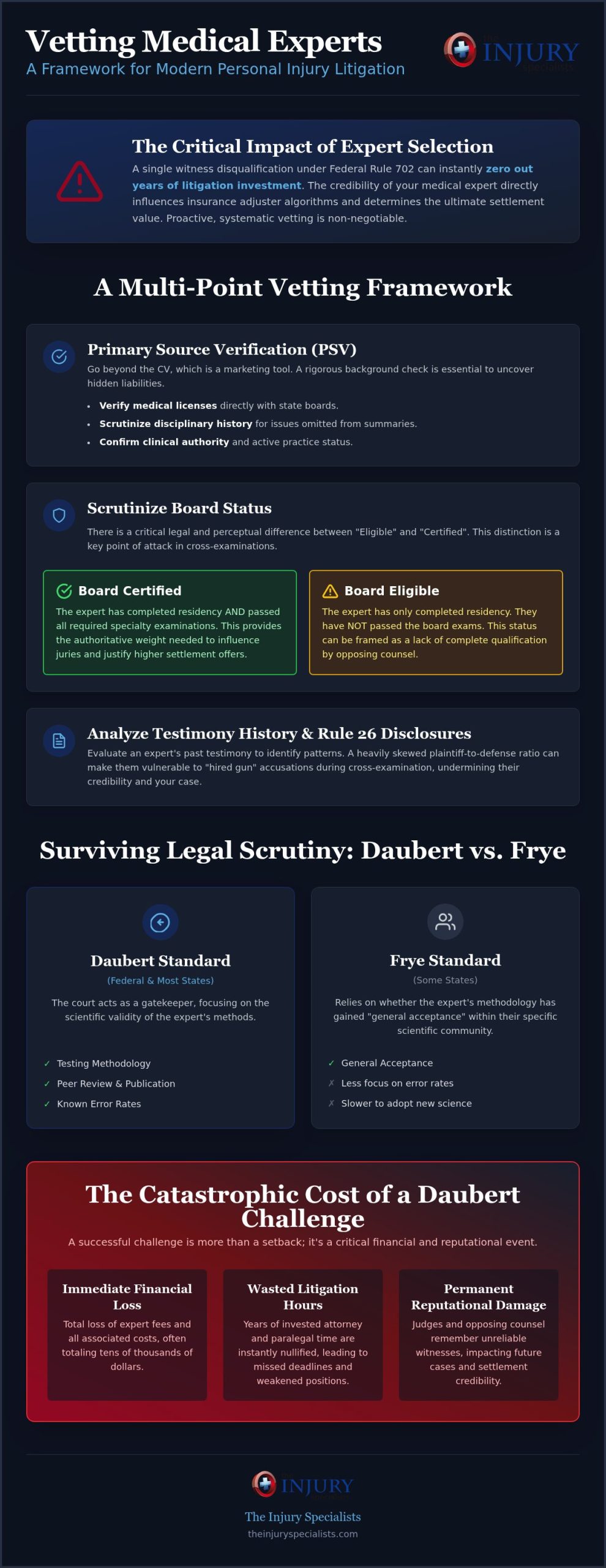
A single witness disqualification under the 2026 application of Federal Rule 702 can instantly zero out years of litigation investment. Since the 2023 amendments, the gatekeeping role of the court has intensified, making the process of vetting medical experts for personal injury cases the most critical phase of trial preparation. You understand that credentials alone no longer guarantee admissibility. An expert’s methodology must be as bulletproof as their CV to survive modern scrutiny and avoid the “hired gun” labels that sink settlement negotiations.
Securing a reliable, board-certified specialist who provides consistent documentation is often the difference between a mediocre settlement and a maximum case value. This guide outlines a repeatable vetting framework designed to withstand the most aggressive Daubert challenges. We’ll examine the protocols for verifying clinical authority and the administrative reliability required for modern litigation. You’ll learn how to utilize Physician Referral Services and Case Management Technology to streamline procurement while maintaining a dominant position at the negotiating table. This approach ensures your experts are trial-ready from the moment of retention.
Key Takeaways
- Analyze the direct correlation between expert credibility and the algorithms used by insurance adjusters to determine settlement offers.
- Distinguish between board eligibility and board certification to protect your testimony against Primary Source Verification challenges.
- Apply a standardized framework for vetting medical experts for personal injury cases to detect hidden disciplinary issues or licensing gaps.
- Evaluate treating physicians for medical-legal literacy to ensure their clinical documentation aligns with your specific litigation strategy.
- Leverage Physician Referral Services and Case Management Technology to automate rigorous vetting protocols across your entire caseload.
The Strategic Impact of Medical Expert Selection in Personal Injury Litigation
The medical expert serves as the structural foundation for every personal injury claim. Without a credible professional to bridge the gap between clinical findings and legal standards of causation, a case lacks the weight required to survive summary judgment or aggressive defense motions. In 2026, the strategic selection of these professionals is no longer a secondary administrative task; it’s the primary driver of case outcomes and firm profitability.
Insurance carriers utilize sophisticated algorithms to analyze risk and set settlement ranges. These systems evaluate more than just injury codes and policy limits. They quantify the strength and history of the testifying expert. High-quality, board-certified specialists increase the perceived risk for the carrier, which directly influences adjuster algorithms toward higher settlement values. Conversely, over-utilizing the same unvetted experts creates a “hired gun” profile that adjusters use to justify lower offers. Systematic vetting medical experts for personal injury cases is the only way to protect a firm’s reputation and ensure that every case is positioned for maximum recovery.
Defining the Role of the Medical Expert
Attorneys must distinguish between treating physicians and forensic expert witnesses early in the litigation cycle. A treating doctor provides testimony based on direct patient care, but a forensic specialist offers the neutral, high-level analysis required to establish the Expert Witness Role and Responsibilities in a trial setting. Specialized knowledge is mandatory in catastrophic injury or product liability cases where the mechanism of injury is technically complex. The right expert bridges the gap between raw medical data and the legal arguments necessary to prove liability.
The Cost of Poor Vetting
A successful Daubert challenge is a catastrophic financial event. It results in the immediate loss of expert fees, years of invested litigation hours, and often the case itself. The administrative burden of replacing an expert mid-litigation is immense and often leads to missed deadlines or weakened positions. Beyond the balance sheet, the reputational damage within a judicial circuit can be permanent. Judges and opposing counsel track the reliability of a firm’s witnesses. Forward-thinking firms now move from reactive procurement to proactive systems. They utilize Case Management Technology to maintain vetting standards and Physician Referral Services to access a national network of pre-vetted specialists. This systematic approach ensures that every witness is a pillar of strength rather than a liability.
Technical Vetting Standards: Beyond the Curriculum Vitae
The Daubert standard is the 2026 benchmark for scientific validity in federal and most state courts. Relying solely on a Curriculum Vitae (CV) is a strategic error that leaves your case vulnerable to disqualification. A CV is essentially a marketing tool; technical vetting requires a deep dive into Primary Source Verification (PSV) to confirm the expert’s actual standing. You must verify medical licenses directly with state boards and scrutinize disciplinary histories that are frequently omitted from professional summaries.
Board certification is a primary filter, but you have to look closer at the terminology. “Board eligible” isn’t the same as “Board Certified.” Eligibility simply means the physician completed a residency program but hasn’t yet passed the required examinations. In high-stakes litigation, only a certified specialist provides the authoritative weight needed to influence adjusters and juries. Additionally, evaluating an expert’s “Rule 26” disclosure history is mandatory. You need to identify their testimony patterns and determine if a skewed plaintiff-to-defense ratio makes them susceptible to “hired gun” labels during cross-examination.
Understanding Daubert and Frye Challenges
Success in vetting medical experts for personal injury cases depends on understanding how different jurisdictions evaluate scientific evidence. The Daubert standard requires a focus on testing methodology, peer review, and known error rates. Conversely, the Frye standard relies on “general acceptance” within the relevant medical community. You should vet an expert’s specific methodology before they draft their first report. Ask if their theories have been peer-reviewed and if their conclusions are based on sufficient facts or data. This proactive screening prevents expensive mistakes during the discovery phase.
Academic vs. Clinical Experience
While academic credentials provide prestige, active clinical practice is often more persuasive to a jury. Jurors tend to trust doctors who treat patients daily over those who spend their time exclusively in research or classrooms. Clinical experts can speak to the practical realities of recovery and the long-term impact of injuries. Utilizing high-quality Imaging Center Referrals allows these practitioners to base their testimony on objective, verifiable evidence. Finally, assess the expert’s communication skills. A brilliant surgeon is a liability if they can’t translate complex medical jargon into a clear, compelling narrative for a lay jury. Your expert must be both a master of their craft and an effective educator in the courtroom.
Clinical Integrity vs. Testimonial Reliability: Evaluating the Treating Expert
The treating physician offers a unique strategic advantage in the courtroom. Unlike forensic experts who are retained specifically for litigation, a treating doctor’s testimony stems from a direct patient-provider relationship. This inherent credibility often resonates more deeply with juries. However, clinical skill doesn’t always translate into testimonial reliability. Effective vetting medical experts for personal injury cases involving treating physicians requires an assessment of their “medical-legal literacy.” You must determine if the provider can translate clinical findings into documentation that survives the rigors of legal scrutiny.
Inconsistency is the primary weapon used by defense counsel to devalue a claim. If a doctor’s initial intake notes fail to mention a specific symptom that later becomes a central pillar of the litigation, the case value is compromised. Integrated medical case management helps bridge this communication gap. By coordinating with treating providers through every phase of treatment, law firms ensure that documentation remains thorough and consistent. Utilizing Case Management Technology allows your team to track these records in real time, ensuring that the evidence remains bulletproof from the first visit to the final deposition.
Vetting for Administrative Efficiency
A physician’s clinical expertise is an operational liability if their office staff is unresponsive. You should evaluate the administrative health of a provider’s practice before relying on them for testimony. Are they capable of producing “court-ready” medical reports on a strict timeline? Do they understand the complexities of personal injury liens? A provider who is unfamiliar with the logistical requirements of a legal case becomes a significant bottleneck. Firms that utilize specialized Physician Referral Services avoid these delays by connecting with medical offices already optimized for legal workflows.
The Conflict of Interest Check
Reliability also depends on perceived neutrality. You must identify potential biases by reviewing the provider’s prior testimony and referral history. If a physician has a history of working for insurance defense on similar cases, their credibility on your plaintiff’s case is easily attacked. Conduct a thorough check to ensure no previous conflicts exist. Utilizing a professional attorney physician referral system helps you maintain a diverse expert pool. This prevents the appearance of a repetitive relationship between the firm and the provider, which is a common target for defense attorneys during cross-examination.
A Multi-Point Vetting Framework for Law Firm Case Managers
Case managers serve as the first line of defense against witness disqualification. Establishing a standardized, repeatable framework for vetting medical experts for personal injury cases transforms an administrative task into a strategic asset. This multi-point system ensures that every expert added to the case file possesses the clinical authority and testimonial consistency required for high-stakes litigation. Implement the following five steps to secure credible testimony.
- Step 1: Define the Specialty. Match the expert specifically to the mechanism of injury. A traumatic brain injury requires a neurologist or neuropsychologist rather than a general practitioner.
- Step 2: Background Verification. Conduct a primary source check on medical licenses and sanctions. Verify that their board certification is active and current through official state databases.
- Step 3: Testimony Audit. Review past deposition transcripts and trial testimony. Consistency across cases is vital; any deviation in methodology or opinion will be exploited by defense counsel.
- Step 4: Communication Assessment. Interview the expert to evaluate their “jury appeal.” They must be able to explain complex medical concepts without relying on inaccessible jargon.
- Step 5: Clinical Relevance. Verify that the expert maintains an active clinical practice. High-volume clinical experience carries more weight with juries than a career focused exclusively on forensic consulting.
Law firms can automate these rigorous protocols by integrating our Physician Referral Services into their existing workflow. This ensures that every provider in your network has already passed a multi-level screening process.
The Expert Interview Checklist
The initial interview is the best opportunity to identify potential vulnerabilities. Ask specific questions about their experience with the exact injury type in your case. Inquire about their historical balance of plaintiff versus defense work to ensure they don’t appear biased. You must also confirm their immediate availability for trial dates and deposition windows. An expert who is clinically brilliant but administratively unavailable will jeopardize your case deadlines and increase your firm’s overhead.
Reviewing the Preliminary Report
A report that contains conclusory statements without supporting data invites a Daubert challenge. Review the preliminary draft to ensure all medical opinions are stated to a “reasonable degree of medical probability.” The report must explicitly address causation, the medical necessity of care, and a realistic future prognosis. Verify that the expert has reviewed all relevant medical records to prevent the defense from claiming their opinion is based on incomplete information. This technical review ensures the report functions as a foundation for successful settlement negotiations.
Scaling Expert Vetting Through Specialized Referral Networks
Manual vetting is a resource-intensive process that often creates bottlenecks in high-volume law firms. Transitioning to a managed referral network allows firms to scale their operations without compromising on witness quality. By utilizing professional Physician Referral Services, attorneys delegate the preliminary screening to a dedicated partner. This shift ensures that every provider in the pipeline has already met rigorous standards for board certification and clinical standing, effectively automating the most tedious aspects of vetting medical experts for personal injury cases.
A specialized network serves as a central hub for medical-legal expertise. It eliminates the need for case managers to start from scratch with every new injury type. Instead, firms gain immediate access to a pre-vetted national pool of specialists who understand the documentation requirements of 2026 litigation. This integrated approach reduces the firm’s administrative load and allows legal teams to focus on case strategy rather than credential verification. It positions the firm as a sophisticated operator capable of handling complex, multi-specialty cases with logistical ease.
The Managed Network Advantage
Relying on a managed network provides instant connectivity to board-certified specialists across the country. These networks maintain high standards of documentation by providing continuous feedback to medical partners. This ensures that clinical notes and reports are always court-ready and aligned with legal causation requirements. For a deeper look at establishing these systems, refer to The Comprehensive Guide to Law Firm Medical Referral Programs in 2026. This strategy transforms medical procurement from a reactive necessity into a proactive competitive advantage.
Technology-Driven Vetting
Modern vetting relies on data analytics to track expert performance across multiple cases. Proprietary Personal Injury Case Management Technology: The 2026 Strategic Guide enables firms to identify which experts consistently withstand challenges and produce the highest settlement values. A centralized platform streamlines records management and ensures that vetting data is accessible to the entire legal team. By leveraging these technological tools, firms maintain a dominant market position, ensuring their experts are always their strongest assets at the negotiating table. This systematic oversight is the hallmark of a growth-oriented personal injury practice in 2026.
Securing Case Value through Rigorous Expert Standards
The 2026 litigation landscape demands a transition from traditional witness selection to a data-driven, systematic approach. Successful vetting medical experts for personal injury cases requires verifying clinical authority through primary source verification and ensuring every witness possesses the medical-legal literacy to withstand aggressive cross-examination. By implementing a multi-point framework, your firm protects its reputation and optimizes settlement values across every file.
Efficiency in expert procurement is no longer an administrative luxury; it’s a prerequisite for growth. You can instantly access the largest personal injury referral network in the United States, providing your team with board-certified specialists who are pre-vetted for clinical and administrative reliability. Every referral includes integrated medical case management and is supported by proprietary technology designed specifically for high-stakes law firms. This streamlined system allows you to maintain a dominant market position while reducing internal overhead.
Connect with our pre-vetted national network of medical experts today. We provide the strategic connectivity and technological infrastructure you need to lead the market with confidence.
Frequently Asked Questions
What is the most important factor when vetting a medical expert?
Clinical authority is the most critical factor when vetting medical experts for personal injury cases. You must verify that the professional is board-certified and maintains an active clinical practice. Jurors and adjusters prioritize experts who treat patients daily over those who spend their careers in research or litigation. This authority ensures their testimony is based on practical, current medical standards rather than outdated theories or purely academic knowledge.
How do I know if a medical expert will survive a Daubert challenge?
To determine if an expert will survive a Daubert challenge, you must scrutinize their methodology under the 2026 Federal Rule 702 standards. Check if their theories are peer-reviewed, tested, and accepted within the relevant medical community. You should audit their past deposition transcripts to ensure their scientific approach remains consistent. An expert whose methodology is transparent and based on sufficient facts is far more likely to be admitted by the court.
Should I use the same medical expert for treatment and testimony?
Using a treating physician for testimony offers a significant strategic advantage because they have an established relationship with the patient. This often carries more weight with a jury than a third-party forensic witness. However, you must vet the treating provider for medical-legal literacy. They need to produce documentation that specifically addresses legal causation and future prognosis. If the provider lacks administrative efficiency, a forensic expert may be required to supplement the case.
What red flags should I look for in a medical expert’s CV?
Key red flags include a lack of current board certification or a professional history that is over 90% forensic consulting. If an expert hasn’t seen a patient in years, their credibility is easily attacked. You should also look for disciplinary actions or license suspensions in state databases, as these are rarely listed on a CV. Inconsistent testimony in past Rule 26 disclosures is another major warning sign that could lead to disqualification.
How much does it cost to vet a medical expert properly?
The cost of vetting includes the time spent on background checks, transcript reviews, and interviewing candidates. While these administrative costs vary, they are significantly lower than the financial loss caused by a disqualified witness. Firms often reduce these expenses by utilizing Physician Referral Services. This allows legal teams to access pre-screened specialists without the high internal overhead of conducting primary source verification for every individual case.
Can I use a medical expert who primarily does defense work?
Utilizing an expert who primarily does defense work can increase your credibility in a plaintiff’s case. It effectively counters the “hired gun” narrative that defense attorneys often use. The key is ensuring their clinical opinions remain consistent regardless of which side retains them. You must review their previous testimony to confirm they haven’t made contradictory statements on the same medical issues in prior defense cases.
What is the difference between a board-certified and board-eligible expert?
Board certification is the gold standard for medical expertise. It indicates the physician has completed their residency and passed rigorous specialty examinations. Board-eligible simply means they finished their training but haven’t passed the exams yet. In a high-stakes personal injury case, relying on a board-eligible expert is a risk. Defense counsel will use the lack of certification to undermine the expert’s authority and question their professional standing.
How does a referral network help with the vetting process?
A referral network like The Injury Specialists streamlines the process by providing a pre-vetted national pool of specialists. These networks use Case Management Technology to track expert performance and documentation quality across thousands of cases. This system ensures that every provider has already passed clinical and administrative screenings. By using a network, firms reduce their internal vetting load while maintaining access to board-certified experts who understand the requirements of personal injury litigation.
