

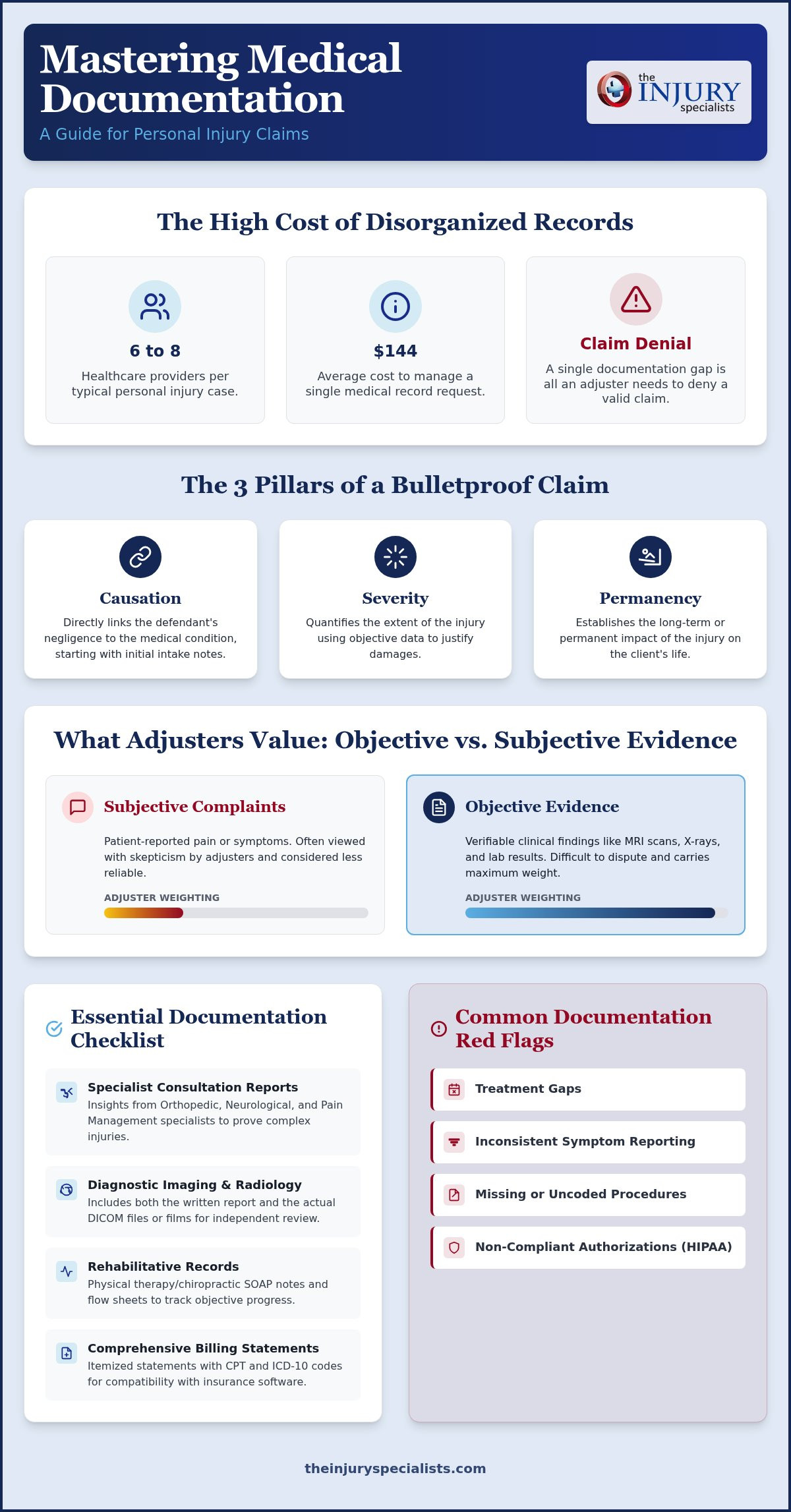
A typical personal injury case in 2026 requires records from six to eight different healthcare providers, which makes managing medical documentation for personal injury one of the top three cost categories for modern firms. For many practices, the average cost to manage a single record request has reached $144 in labor and fees. You already know that insurance adjusters look for any excuse to deny a claim, and a single documentation gap often provides that opportunity. It’s frustrating to see a valid case stall because of disorganized or incomplete files.
This guide ensures you master the essential medical records and strategies required to validate claims and maximize recovery. You’ll learn how to build a bulletproof paper trail that connects treatment to causation while avoiding common clinical red flags. We provide a comprehensive checklist of required documents, explain how to navigate the gap between billed and allowable amounts, and demonstrate a streamlined strategy for organizing records to ensure your firm remains efficient and growth oriented.
Key Takeaways
- Learn how insurance software evaluates medical documentation for personal injury to ensure every clinical code reflects the true value of the claim.
- Identify the critical records required from emergency departments and specialist consultations to build a comprehensive narrative of injury and recovery.
- Avoid common documentation pitfalls, such as treatment gaps and inconsistent symptom reporting, that insurance companies use to devalue settlements.
- Implement a structured approach to record management using master chronologies and HIPAA-compliant authorizations to streamline legal workflows.
- Leverage specialized referral networks and case management technology to secure “legal-ready” documentation and real-time record auditing.
The Foundation: Why Medical Documentation for Personal Injury is Non-Negotiable
Medical documentation for personal injury acts as the objective bridge between a traumatic incident and a successful legal recovery. In a professional legal environment, these records aren’t just clinical summaries; they’re the primary assets used to calculate damages. Insurance adjusters utilize sophisticated software, such as Colossus, to value claims based on specific documented codes. If a provider fails to record a symptom or treatment with the corresponding ICD-10 code, the software assigns it zero value. This makes precise record-keeping a logistical necessity for any firm aiming for maximum recovery.
Effective management of medical documentation for personal injury requires a strict adherence to the rule that if it isn’t written down, it didn’t happen. Without a chronological account, allegations of disability remain unsubstantiated hearsay. Understanding What is a Medical Record? in this context is vital. It’s the formal evidence used to establish the three pillars of a claim: causation, severity, and permanency. These pillars form the framework of the demand package and dictate the eventual settlement range.
Establishing the Link of Causation
Initial intake notes are the most critical records for establishing the mechanism of injury. These notes must accurately reflect how the incident occurred to prevent defense counsel from suggesting intervening causes. Causation is the direct link between a defendant’s negligence and the resulting medical condition. Any inconsistency between the statements made at the accident scene and those recorded in the emergency room creates a vulnerability. Professional documentation ensures the injury is tied directly to the incident from the very first encounter.
Objective Evidence vs. Subjective Complaints
While patient-reported pain is a relevant factor, it’s often viewed with skepticism by adjusters. Objective evidence carries significantly more weight because it’s verifiable through clinical testing. A patient’s claim of severe back pain is subjective, but an MRI showing a focal disc protrusion is an objective finding that’s difficult to dispute. Physicians must prioritize these findings in their narratives to build a dominant case. Utilizing specialized Personal Injury Diagnostic Imaging Referrals ensures that imaging reports are tailored for legal scrutiny. Shifting the focus from subjective complaints to objective data is the most efficient way to drive results.
The Essential Personal Injury Medical Documentation Checklist
Building a dominant case requires a systematic collection of clinical data. This process begins at the ground zero of the claim: the Emergency Department or Urgent Care facility. These initial records establish the baseline for all subsequent treatment. Without these foundational documents, the defense can easily argue that the injuries were pre-existing or unrelated to the incident. A complete file must move beyond simple summaries to include the granular details that prove a client’s losses.
To ensure your medical documentation for personal injury is comprehensive, your firm should secure the following items for every case:
- Specialist Consultation Reports: Detailed insights from Orthopedic, Neurological, and Pain Management specialists provide the high-level analysis needed to prove complex spinal or brain injuries.
- Diagnostic Imaging and Radiology: You must obtain both the written radiologist’s report and the actual DICOM files or films. These are essential for independent reviews and trial exhibits.
- Rehabilitative Records: Physical therapy and chiropractic SOAP notes must be accompanied by flow sheets. These documents track objective progress and functional improvements over time.
- Comprehensive Billing Statements: Every statement should be itemized with specific CPT and ICD-10 codes. This ensures the billing is compatible with insurance valuation software and accurately reflects the services rendered.
Clinical Records and Narrative Reports
Distinguishing between a standard medical chart and a formal medical-legal narrative report is essential for maximizing recovery. While progress notes track daily care, a narrative report synthesizes the entire case for the adjuster or jury. It emphasizes the History of Present Illness (HPI) to provide attorneys with a clear, documented timeline. Crucially, these reports must include Future Care Plans to project long-term economic damages and life-care costs. Identifying providers through a national referral network ensures you work with professionals who understand how to draft these critical narratives.
Ancillary Documentation and Out-of-Pocket Expenses
Supporting medical documentation for personal injury often includes records generated outside the physician’s office. Pharmacy logs and prescription records serve as objective proof of pain management efforts and medication compliance. Additionally, clients must maintain medical mileage logs and home health care invoices to capture every verifiable expense. A detailed Pain and Limitation Journal supplements clinical notes by providing a day-to-day account of how injuries impact daily living. This journal bridges the gap between clinical data and the human reality of the injury.
Common Red Flags and Documentation Pitfalls to Avoid
Insurance adjusters are trained to identify inconsistencies that justify lower settlement offers. When auditing medical documentation for personal injury, they prioritize specific “red flags” that suggest a lack of urgency or clinical credibility. A primary pitfall is mismatched billing, where the dates of service on an itemized statement don’t align with the physician’s clinical notes. This administrative error often leads to a total denial of those specific treatment costs during the valuation process.
Inconsistent symptom reporting creates similar risks for the recovery. If a patient describes radiating leg pain to a physical therapist but only mentions localized back pain to their orthopedic surgeon, the defense will use this discrepancy to challenge the severity of the injury. Maintaining a precise and uniform clinical narrative across all providers is a logistical necessity for a successful claim.
Managing Gaps in Medical Care
A 48-hour delay in seeking initial treatment or a two-week break during active care can drastically devalue a case. Adjusters interpret these gaps as evidence that the injury was either not severe or has already resolved. To mitigate this, providers must document valid reasons for any interruption, such as a localized illness or documented wait times for specialized imaging. Failure to follow medical advice can lead to allegations of comparative negligence, which shifts the financial burden back to the plaintiff. Consistent treatment schedules correlate with higher settlement multipliers because they demonstrate a disciplined commitment to medical recovery.
Transparency Regarding Prior Injuries
Non-disclosure of pre-existing conditions is often more damaging to a case than the conditions themselves. Defense counsel will eventually uncover prior medical history through discovery; finding this information during a deposition undermines the entire claim’s credibility. Instead, use the “Eggshell Skull” rule to your advantage. This legal principle holds that a defendant is liable for the full extent of the injuries they cause, even if the plaintiff’s prior condition made them more susceptible to harm.
Professional medical documentation for personal injury must clearly differentiate between old pain and new trauma. Clinical notes should explicitly state how the incident aggravated a dormant condition or worsened a stable one. This level of transparency builds professional credibility with adjusters. It transforms a potential weakness into a documented aggravation claim that is difficult to dispute.
Organizing and Managing Records for Legal Success
Effective management of medical documentation for personal injury requires a transition from passive collection to active organization. A disorganized file leads to missed billing opportunities and weakened arguments during settlement negotiations. Firms must implement a rigorous workflow to transform high volumes of clinical data into a streamlined, legal-ready format. This process ensures that every treatment date and diagnostic finding is accounted for before the demand package is finalized. Without a structured system, critical evidence can easily be lost in the administrative shuffle.
Following a sequential logic for record management minimizes administrative overhead and maximizes the value of the case. Use these four steps to optimize your firm’s internal processes:
- Step 1: Create a Master Medical Chronology. Track every provider, date of service, and specific injury complaint to maintain a clear narrative of the client’s recovery.
- Step 2: Secure HIPAA-compliant authorizations. Obtain signed releases for every facility visited, including imaging centers and pharmacies, to prevent delays in record retrieval.
- Step 3: Audit records for completeness. Verify that you have the full “Certified Medical Record” accompanied by a custodian of records affidavit. Missing pages or omitted provider notes can lead to “holes” in the evidence that adjusters will exploit.
- Step 4: Categorize records digitally. Use professional tools to segment files by provider type and date, ensuring rapid accessibility during depositions or trial preparation.
The Master Medical Chronology
A master medical chronology is the most effective tool for an attorney during settlement negotiations. It provides a high-level overview that allows you to identify treatment patterns and gaps instantly. Every chronology must include five key data points: Date, Provider, Complaint, Diagnosis, and Treatment. This level of detail identifies missing records before they become a problem at trial. It serves as a roadmap for the case, ensuring that the legal team can speak authoritatively about every aspect of the client’s medical history. When a chronology is well-maintained, it becomes the primary document used to draft persuasive demand letters.
Digital Record Management and Security
The industry has shifted from physical paper files to secure cloud-based storage to increase efficiency and security. Modern firms utilize Optical Character Recognition (OCR) technology to make thousands of pages of medical notes searchable in seconds. This allows staff to find specific keywords or “objective findings” without manual review. Utilizing a medical legal networking platform centralizes this data, ensuring that integrated case management remains seamless across multiple providers. This digital approach also ensures HIPAA compliance through encrypted storage and controlled access. To scale your firm’s operations and ensure documentation accuracy, leverage professional case management technology designed for the personal injury sector.
Leveraging Professional Networks for Seamless Documentation
The final step in mastering medical documentation for personal injury involves selecting the right professional partners. It’s not enough to simply collect records; you must ensure those records are generated by providers who understand the intersection of medicine and law. Most general practitioners focus solely on clinical outcomes and often overlook the specific coding and narrative requirements that insurance adjusters demand. Choosing providers within a specialized national network ensures that every note is “legal-ready” from the moment it’s created. This proactive approach minimizes the risk of claim denials and reduces the administrative friction that often slows down case resolution.
A well-oiled system relies on a national network to provide consistent care coordination across different regions. This level of scale allows for a standardized documentation process that independent providers simply can’t match. When every provider in the chain follows the same rigorous standards, the resulting medical documentation for personal injury becomes a cohesive and indisputable narrative of the client’s recovery. This reliability is what instills confidence in professional partners and drives the growth of a modern personal injury firm.
The Advantage of a Specialized Referral Network
Providers within The Injury Specialists network undergo a rigorous vetting process to ensure they possess a deep understanding of PI documentation nuances. They don’t just treat the patient; they document the mechanism of injury and clinical findings with the precision required for high-stakes litigation. There is a powerful synergy when chiropractic care, physical therapy, and imaging centers operate within a single, integrated network. This connectivity ensures that the clinical narrative remains consistent as the patient moves from ground-zero treatment to specialized care. For a more detailed analysis of these systems, review The Comprehensive Guide to Personal Injury Referral Networks in 2026.
Technology-Driven Case Management
Proprietary technology platforms have revolutionized how law firms interact with medical data. Our platform integrates medical case management directly into legal workflows, allowing for real-time auditing of medical documentation for personal injury as it’s generated. This prevents the “documentation gaps” and “red flags” discussed earlier by identifying missing notes or inconsistent reporting before the case moves to the demand phase. Automated record tracking removes the heavy administrative burden from your staff, allowing them to focus on high-level litigation strategy rather than chasing down missing bills. This level of logistical ease is essential for firms looking to scale their operations without sacrificing the quality of their evidence.
Optimizing Case Value Through Strategic Documentation
Success in 2026 requires a shift from passive record collection to proactive medical-legal management. Precision in record gathering and the use of specialized networks drive settlement success. Organizing these assets through master chronologies and digital tools prevents the administrative gaps that insurance adjusters exploit. Mastery of medical documentation for personal injury is no longer just a clinical requirement; it’s a logistical competitive advantage that protects your firm’s revenue and reputation.
You can eliminate the complexity of case management by partnering with a facilitator that bridges the gap between medical providers and legal teams. Streamline your case documentation with The Injury Specialists network today. We provide access to the nation’s largest PI referral network and proprietary medical case management technology. Our vetted providers understand PI legal requirements and deliver the “legal-ready” notes your cases demand. With these systems in place, your firm can scale efficiently while securing the maximum recovery for every client. Take the first step toward a more organized and profitable practice today.
Frequently Asked Questions
What is the most important medical document in a personal injury case?
The Emergency Department or Urgent Care intake report is the most critical document. It establishes the “ground zero” of the claim by documenting the mechanism of injury and initial symptoms immediately following the incident. This record serves as the baseline for all subsequent clinical findings and prevents the defense from claiming the injuries occurred elsewhere. It is the primary evidentiary link between the accident and the physical damage.
How long do I have to seek medical treatment after an accident for it to be documented?
Immediate treatment within 24 to 72 hours is the professional standard for documenting a claim. Insurance adjusters prioritize cases with a prompt medical timeline; delays exceeding 72 hours create a gap in treatment that devalues the case. These gaps suggest the injuries weren’t severe or resulted from a different event. Prompt medical documentation for personal injury ensures that symptoms are recorded before they potentially subside or evolve.
Can I use my own doctor, or do I need a personal injury specialist?
You can use your own doctor, but personal injury specialists are often more effective for legal recovery. General practitioners focus on primary health and may not use the specific ICD-10 coding or detailed narratives required by insurance valuation software. PI specialists understand the necessity of documenting causation and future care needs. Using a specialized network ensures the clinical notes are structured to withstand the scrutiny of defense counsel and adjusters.
What happens if there is a mistake in my medical records?
Mistakes must be corrected through a formal medical record amendment request. Inaccurate mechanism of injury descriptions or incorrect symptom locations can jeopardize the entire claim. You should contact the provider immediately to request an addendum rather than a deletion of the original note. Maintaining accurate medical documentation for personal injury requires auditing every record for clerical errors that could be used to challenge your credibility during settlement negotiations.
How do medical liens affect my documentation and settlement?
Medical liens allow providers to treat patients in exchange for a guaranteed payment from the final settlement. These liens must be documented clearly in the case file to ensure all treatment costs are included in the demand package. They facilitate access to high-quality care without upfront costs, which maintains a consistent treatment timeline. Proper lien management ensures that the total billed amount is accurately represented during negotiations with the insurance carrier.
Do I need to provide my entire medical history to the insurance company?
No, you only need to provide records relevant to the injuries sustained in the accident. While adjusters often request a blanket authorization for all past records, you should limit the scope to a reasonable timeframe and specific body parts. Providing an overbroad history allows the defense to search for unrelated pre-existing conditions to devalue the current claim. A strategic approach involves disclosing only what is legally required to prove the current trauma.
How does diagnostic imaging improve my medical documentation?
Diagnostic imaging provides objective evidence that carries significantly more weight than subjective complaints of pain. MRIs, CT scans, and X-rays offer verifiable proof of structural damage, such as disc herniations or fractures. This data is difficult for insurance companies to dispute because it relies on clinical findings rather than patient reporting. High-quality imaging reports provide the hard evidence needed to substantiate the severity and permanency of an injury.
What is a medical-legal narrative report, and why do I need one?
A medical-legal narrative report is a specialized document where a physician synthesizes clinical findings into a format tailored for legal use. Unlike standard progress notes, this report explicitly addresses causation, the necessity of past treatment, and the cost of future care. It bridges the gap between complex medical data and the legal requirements of a personal injury claim. This narrative is essential for justifying high-value settlements and explaining the long-term impact of injuries.
