

A physician referral can convert into a high-value legal client at a rate as high as 80 percent. While this August 2026 data underscores the massive potential for growth, many professionals still find themselves locked out of the most lucrative legal circles. You likely face the frustration of inconsistent case flow and the difficulty of proving your value to busy attorneys who rarely return your calls. Relying on casual networking is no longer a viable strategy for scale.
This guide provides the definitive blueprint on how to get personal injury referrals from attorneys through operational excellence and strategic synergy. You will learn to master a systematic approach that transforms your practice into a high-volume referral pipeline. We will detail the exact methods for building stronger professional relationships with top-tier firms, utilizing case management technology to ensure transparency, and securing better settlement outcomes for every client. It’s time to move from being a simple service provider to becoming a dominant market facilitator.
Key Takeaways
- Shift from outdated handshake agreements to a data-driven ecosystem that prioritizes professional synergy and measurable results.
- Discover how to get personal injury referrals from attorneys by optimizing internal documentation to provide the comprehensive medical evidence legal teams require for high-value settlements.
- Transition from low-ceiling social networking to systematic operational integration using world-class case management technology.
- Audit your current capabilities and target specific firms whose case profiles align with your medical expertise to ensure a high-conversion referral pipeline.
- Scale your practice immediately by leveraging national referral networks that provide instant infrastructure and “fruit of the tree” protection for every lead.
The Evolution of Personal Injury Referral Networks in 2026
The personal injury landscape in 2026 demands more than just a firm handshake. Successful professionals understand that the referral ecosystem is now a symbiotic relationship between legal, medical, and technology partners. Traditional, uncoordinated referrals are being replaced by data-driven networks that prioritize operational efficiency and measurable results. Understanding how to get personal injury referrals from attorneys now requires a focus on integrated medical case management. By aligning medical protocols with legal requirements, these networks create a streamlined path to maximum recovery for all stakeholders.
While a traditional Lawyer Referral Service might focus on connecting clients with counsel, modern B2B networks facilitate deeper operational integration. Top-tier firms now require partners with national reach to accommodate an increasingly mobile and remote-first legal environment. They seek a system that handles the logistics of care and documentation across multiple jurisdictions without increasing their internal overhead. This is why the industry has moved toward managed care models for trauma cases, where vetting and training members is the standard for entry.
Why Attorneys are Selective with Referral Partners
Attorneys face significant professional and financial risks when choosing referral partners. Poor documentation is the primary culprit behind reduced settlement values. If medical records don’t clearly establish causation and damages, the legal team loses its primary leverage during negotiations. Additionally, the administrative burden of managing multiple uncoordinated providers can drain a firm’s resources. Top firms seek partners who understand the medical-legal intersection. They need providers who recognize how clinical outcomes translate into legal evidence and who can communicate that data without constant prompting.
The Role of Technology in Modern Networking
Technology is the backbone of the 2026 referral model. Centralized platforms eliminate the friction typically found in manual case transfers. Law firm paralegals require real-time status updates to keep cases moving toward resolution. This is why learning how to get personal injury referrals from attorneys often starts with adopting HIPAA-compliant case management software. These platforms provide “fruit of the tree” protection for referring sources, ensuring that every lead is tracked and managed with total transparency. High-level facilitators now use world-class technology to bridge the gap between different professional sectors, ensuring that no case detail is overlooked.
What Attorneys Value Most in a Referral Partner
High-volume law firms prioritize operational efficiency over social connections. If you want to understand how to get personal injury referrals from attorneys, you must first recognize their internal metrics for success. Attorneys don’t need more friends; they need reliable partners who reduce their administrative burden and increase case values. Documentation excellence is the primary requirement. This involves providing comprehensive medical records that explicitly establish causation and quantify damages in a trial-ready format. When records are clear and concise, legal teams can demand higher settlements with less resistance from insurance adjusters.
Reliability and synergy are the next pillars of a successful partnership. Attorneys value several key operational traits:
- Communication Reliability: Providing fast response times and proactive updates on client status without being prompted.
- Operational Synergy: Aligning your internal workflows with the law firm’s distinct processes to ensure a seamless exchange of data.
- Client Satisfaction: Ensuring the injury victim feels supported during treatment, which prevents complaints to the referring attorney and protects the firm’s reputation.
The “Value-First” Approach to Attorney Outreach
Effective outreach identifies the attorney’s biggest pain point. For most firms, the primary struggle is chasing medical records and clarifying fragmented treatment plans. You should position your services as administrative relief rather than just a medical offering. By providing integrated medical case management, you act as a value-add for the firm. This model removes the friction from their daily operations and allows their paralegals to focus on legal strategy rather than logistical follow-ups. Firms that see you as a solution to their overhead are far more likely to provide a consistent stream of cases.
Navigating Medical Liens and Financial Alignment
Transparency in financial matters is non-negotiable for building long-term trust. Referral partners must have a deep understanding of medical liens and how they impact the final settlement. Building trust requires transparent billing and meticulous lien management to ensure there are no surprises at the conclusion of a case. Strategic partners often utilize pre-settlement funding to stabilize cases for all parties involved. This financial tool provides the necessary breathing room for the legal team to pursue maximum recovery without the pressure of immediate client financial needs. When you manage these financial complexities with precision, you solidify your position as an indispensable asset to the firm’s growth strategy.
Strategic Networking vs. Operational Integration
Traditional social networking has a low ceiling for practice growth. Relying on lunches, golf outings, or bar association mixers depends entirely on individual personality and constant availability. It’s not a scalable business system. If you want to master how to get personal injury referrals from attorneys, you must move toward operational integration. Systematic referrals utilize case management technology to create a predictable flow of cases. This shift ensures that your referral pipeline remains active regardless of your personal schedule. It replaces the “social favor” model with a performance-based partnership that values data and results.
The ROI of professional referral programs significantly outperforms traditional advertising like PPC or billboard campaigns. While advertising requires massive upfront costs with no guarantee of quality, a structured referral system leverages professional trust. Research from August 2026 indicates that physician-sourced referrals can convert into legal clients at rates as high as 80 percent. Joining an established network provides immediate credibility that years of social networking cannot replicate. It allows you to enter the market as a vetted leader, backed by a system that attorneys already trust.
Building a Scalable Referral Pipeline
Transitioning from one-off referrals to a consistent, high-volume stream requires a dedicated framework. You can’t manage a high-volume pipeline through spreadsheets and manual emails. Marketing and networking specialists are essential for bridging the professional gaps between medical providers and law firms. A law firm medical referral program is the gold standard for 2026. These programs implement automated workflows and integrated case management that allow your practice to scale without losing documentation quality. They provide a structured environment where every referral is tracked and every update is delivered in real time.
The Power-Connector Model
Becoming a “power-connector” means acting as a strategic hub in the medical-legal community. This model focuses on facilitating connections that benefit all parties involved. By leveraging pre-existing networks, you can bypass the traditional “gatekeeper” phase that often slows down practice expansion. The Injury Specialists serves as the primary facilitator for these high-level connections. As the largest personal injury referral network in the United States, the platform provides the necessary infrastructure to scale immediately. It uses world-class technology to provide “fruit of the tree” protection, ensuring that your practice stays connected to high-value firms through a reliable, transparent system.
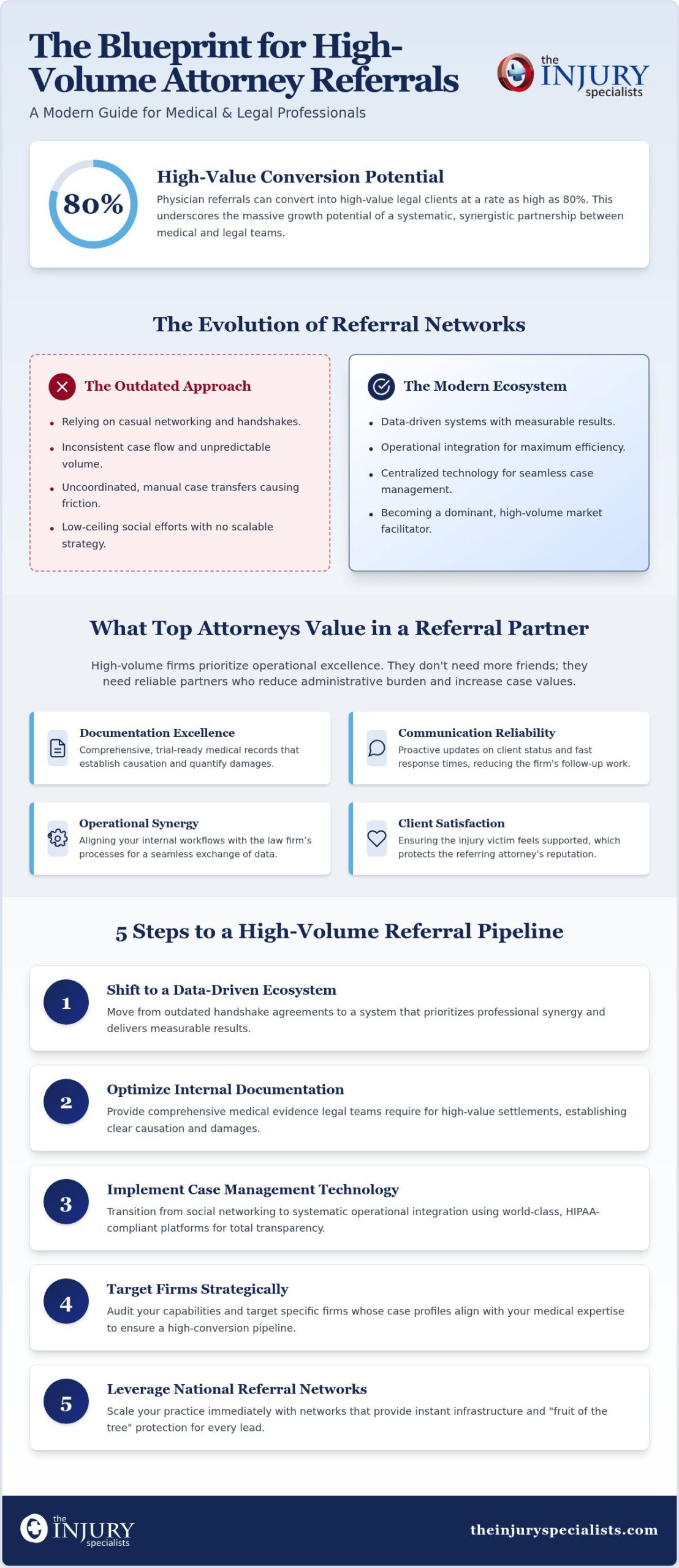
5 Steps to Securing High-Volume Attorney Referrals
Mastering how to get personal injury referrals from attorneys requires a transition from passive waiting to active operational scaling. Success isn’t accidental. It follows a methodical series of steps designed to align your practice with the needs of high-volume law firms. By focusing on systems rather than just social interactions, you create a professional environment that attorneys can trust with their most valuable cases.
Step 1: Operational Readiness Audit
Before reaching out to firms, you must ensure your internal systems can handle the specific demands of personal injury litigation. Staff must be trained on PI-specific intake protocols and the nuances of trial-ready documentation. Integrated medical case management is the backbone of personal injury success. Your audit should also verify total HIPAA compliance and rigorous data security standards to protect all parties involved. A firm’s reputation is on the line with every referral, so your operational foundation must be flawless.
Step 2: Strategic Firm Targeting
Identify firms that handle high-volume personal injury cases but lack a streamlined medical partner. Use personal injury case management technology to identify market gaps where firms struggle with uncoordinated care. Align your specific specialties, such as imaging, chiropractic, or physical therapy, with the case profiles of your target firms. This ensures you’re offering a solution that fits their existing caseload. Targeted outreach is far more effective than broad, unguided marketing efforts.
Step 3: The Pitch: Saving Time, Not Just Making Money
When you secure a meeting, focus the conversation on administrative ease and case value preservation. Demonstrate how your process integrates with their specific law firm workflow to eliminate redundant tasks. Use professional case studies to prove your results. High-volume attorneys care about efficiency. If you can show that your system saves their paralegals hours of work while maintaining documentation quality, the partnership becomes an easy decision.
Once you’ve made your pitch, offer a “pilot” case. This allows the firm to witness your operational excellence firsthand with no long-term commitment. After a successful pilot, formalize the relationship through a professional referral network. This provides the permanent infrastructure needed to manage a consistent stream of cases with total transparency and “fruit of the tree” protection for every lead.
To begin scaling your practice today, join The Injury Specialists referral network and gain access to the nation’s largest pool of vetted attorney partners.
Scaling with The Injury Specialists Referral Network
The Injury Specialists provides the “instant” referral infrastructure necessary for rapid practice expansion. For professionals focused on how to get personal injury referrals from attorneys, joining a national network is the most efficient path to growth in 2026. This “power-connector” model replaces the slow, manual process of individual outreach with a pre-vetted community of high-level partners. The platform serves as a central hub, allowing members to find doctors for personal injury cases across the United States. This national reach ensures that your referral pipeline remains active and scalable, regardless of local market shifts.
The network’s world-class technology platform is its primary differentiator. It automates the tracking of every referral, providing total transparency for both medical and legal partners. This system ensures “fruit of the tree” protection, meaning every lead is documented and managed within a secure, HIPAA-compliant environment. By removing the administrative guesswork, the platform allows you to focus on results rather than logistics. It’s a business-to-business solution designed for those who value efficiency and professional synergy.
Integrated Medical Case Management
Operational friction often occurs when medical providers and law firms use incompatible workflows. Our platform eliminates this issue by aligning with your firm’s distinct internal processes. Strategic coordination ensures cohesive care for the victim and effective representation for the attorney. This integrated approach reduces the friction traditionally associated with case transfers and record requests. When every stakeholder operates within the same managed care model, the entire case moves toward a faster, more favorable resolution. It’s about creating a well-oiled system that supports high-volume growth.
Accessing Pre-Settlement Funding and Imaging
Comprehensive evidence is the foundation of every successful personal injury claim. Members of the network can easily utilize personal injury diagnostic imaging referrals to bolster case evidence from the start. This ensures that causation and damages are established through high-quality medical data. Additionally, the network provides access to pre-settlement funding. This financial support helps victims stay on track with their treatment plans, preventing case drop-offs due to financial strain. Joining a community focused on logistical ease and streamlined success allows you to scale with confidence, knowing every case has the support it needs to succeed.
Dominating the 2026 Personal Injury Referral Market
The shift from social networking to operational integration is a permanent evolution in the legal-medical landscape. Attorneys in 2026 prioritize partners who reduce their administrative overhead while providing trial-ready documentation. Success depends on your ability to implement a systematic approach that ensures transparency and reliability. Mastering how to get personal injury referrals from attorneys requires moving beyond casual lunches and adopting a technology-first framework that protects every lead.
Scaling your practice no longer requires years of slow, manual outreach. By leveraging the largest personal injury referral network in the United States, you gain instant access to world-class case management technology and a national pool of professionals. Our platform provides specialized imaging and funding support to keep cases moving toward maximum recovery. It’s time to secure your position as a market leader and build a predictable, high-volume pipeline. Join the Largest Personal Injury Referral Network in the US and start your expansion today.
Frequently Asked Questions
How do I start a referral relationship with a personal injury attorney?
Start by identifying firms whose caseload aligns with your specific medical specialties. Focus on providing administrative relief by offering integrated documentation that explicitly establishes causation and damages. You don’t need a social connection; you need a value proposition that reduces their internal overhead. Joining a national network like The Injury Specialists provides instant access to these firms without the long gatekeeper phase.
What is the best way to track referrals from law firms?
Utilizing dedicated case management technology is the only scalable way to track referrals accurately. Manual spreadsheets often lead to lost data and missed follow-ups. A world-class platform allows both medical providers and legal teams to see real-time updates on patient status and record availability. This transparency ensures that every referred case is managed efficiently from intake through to the final settlement.
Do I need a special contract to receive attorney referrals?
While individual agreements vary, formalizing the relationship through a structured referral network is the most secure method. These networks utilize pre-vetted protocols that align with state-specific fee-sharing rules and ethical guidelines. Most professionals find that joining an established program provides the necessary legal and operational framework to manage high-volume pipelines safely. Always ensure that any arrangement includes clear written consent from the client.
How does medical case management help in getting more referrals?
Medical case management acts as the bridge between clinical care and legal requirements. It ensures that medical records are comprehensive, causation is clearly documented, and treatment plans are followed. Attorneys are more likely to send cases when they know the medical documentation will be trial-ready. This systematic approach reduces the firm’s administrative burden, making your practice a more attractive partner for long-term growth.
What are the ethical considerations for attorney referral programs?
Ethical compliance centers on transparency, client consent, and adherence to state bar rules. Attorneys must typically inform clients of any fee-sharing arrangements in writing. It’s also critical to distinguish between pure referral states and those requiring joint responsibility. Working within a professional network helps ensure that all interactions remain compliant with the American Bar Association’s Model Rule 1.5(e) and specific state regulations regarding professional conduct.
How can technology improve my referral rates in 2026?
Technology improves referral rates by removing friction from the case transfer process. In 2026, law firms prioritize partners who use integrated platforms for real-time communication and secure data sharing. Understanding how to get personal injury referrals from attorneys involves adopting software that automates status updates and record delivery. This level of efficiency proves your value as a sophisticated B2B partner and encourages firms to increase their referral volume.
Can a medical provider join a national personal injury network?
Yes, medical providers like physicians, chiropractors, and imaging centers can join national networks to scale their practices. The Injury Specialists operates the largest personal injury referral network in the United States, connecting healthcare professionals with top-tier law firms. Joining such a network provides immediate infrastructure, marketing support, and access to case management technology that’s otherwise difficult to build or maintain independently.
What is the “fruit of the tree” protection in attorney referrals?
“Fruit of the tree” protection refers to technology-driven tracking that ensures a referring source is credited for every lead they generate. It prevents cases from being lost or misattributed within a firm’s internal system. By using a centralized platform, the originating partner maintains visibility into the case’s progress. This transparency builds trust and ensures that the professional synergy between the medical provider and the attorney remains profitable.
