

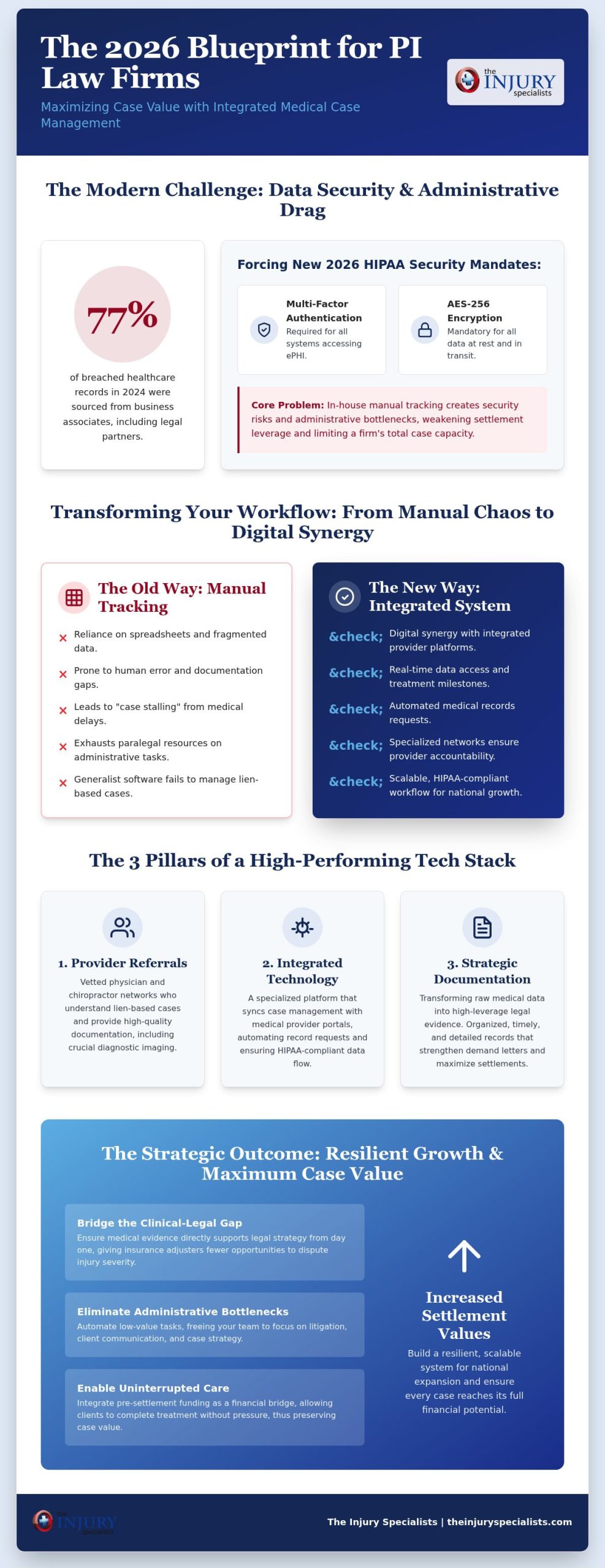
Business associates were the source of 77% of breached healthcare records in 2024, forcing the 2026 HIPAA Security Rule updates to mandate multi-factor authentication and AES-256 encryption for all legal partners. For a growing firm, the administrative weight of tracking medical documentation and vetting lien-based specialists often limits total case capacity. Integrating professional medical case management into your personal injury law firm technology stack is the most effective way to eliminate these bottlenecks while securing sensitive ePHI. You know that inconsistent documentation directly weakens settlement leverage and exhausts your paralegal resources.
This strategic guide explains how to transition from manual tracking to a streamlined, tech-enabled medical-legal workflow. You’ll discover how to utilize specialized referral networks and proprietary case management platforms to maximize documentation quality and settlement values. We provide a clear hierarchy of the tools and services required to scale your operations nationally. By the end of this article, you’ll have a blueprint for building a resilient system that bridges the gap between clinical care and legal evidence, ensuring every case reaches its full financial potential.
Key Takeaways
- Modern medical case management is a strategic necessity that bridges the gap between clinical care and legal evidence to maximize case value.
- Integrating an automated referral system into your personal injury law firm technology stack streamlines workflows and ensures HIPAA-compliant documentation at every stage.
- Specialized referral networks provide faster access to lien-based specialists, reducing the administrative burden on your internal staff and improving client outcomes.
- A five-step implementation plan helps you transition from manual medical tracking to a scalable, tech-enabled system designed for national expansion.
The Evolution of Attorney Medical Case Management in 2026
In 2026, medical case management is the strategic coordination of clinical care and legal documentation. It’s a proactive discipline that transforms raw medical data into high-leverage legal evidence. Firms that treat this process as a mere administrative chore often see lower settlement outcomes. To succeed, a modern personal injury law firm technology stack must integrate medical case management at its core. This shift from manual medical tracking to integrated professional networks allows firms to maintain a consistent flow of high-quality documentation.
A simple list of doctors isn’t enough to compete in the current legal market. Success requires a sophisticated system that vets providers for clinical excellence and administrative reliability. There is a direct link between comprehensive case management and increased settlement values. When medical records are organized, timely, and detailed, insurance adjusters have fewer opportunities to dispute the severity of an injury. This level of precision is only possible when technology and medical expertise work in tandem.
From Manual Tracking to Digital Synergy
Spreadsheets are the enemy of scale. Relying on manual entries for medical tracking leads to fragmented data and human error. Digital synergy occurs when your Legal Case Management system integrates directly with medical provider platforms. This real-time data access changes the attorney-client relationship. You don’t have to wait for a client to call with an update; you see treatment milestones as they occur. Technology now automates medical records requests, ensuring the evidence file remains current without constant paralegal intervention. This automation reduces the administrative burden and lets your team focus on high-value litigation tasks.
Why Generalist Software Fails the PI Attorney
Generic legal software often treats a personal injury case like a standard contract dispute. It lacks the specific architecture needed for lien-based tracking and specialized provider communication. PI attorneys require tools that manage the complexities of medical liens and letters of protection. Without these features, cases frequently stall. Medical delays are a primary cause of “case stalling,” where files sit idle because of missing records or unresponsive clinics. Specialized networks solve this problem by enforcing transparency. They provide a structured environment where providers understand legal requirements, preventing the documentation gaps that weaken demand letters. Using a specialized personal injury law firm technology stack ensures that medical care and legal strategy move at the same speed.
The Essential Pillars of a Modern PI Law Firm Technology Stack
A high-performing personal injury law firm technology stack rests on three structural pillars: Provider Referrals, Technology, and Documentation. Each pillar supports the others to create a scalable system for national growth. Without a reliable network of healthcare providers, even the best software cannot produce the evidence needed for a maximum settlement. Conversely, a vast medical network is useless if your team lacks the digital infrastructure to track treatment progress and lien status in real time. These components must work in unison to ensure no detail is overlooked during the demand phase.
Integrated Referral Networks and Provider Vetting
Vetted physician and chiropractor referrals are the foundation of any successful case. Quality care leads to quality documentation. In 2026, firms must prioritize providers who understand the legal nuances of personal injury, specifically those who operate on a lien basis. This ensures that clinical notes align with legal requirements from the first visit. Diagnostic imaging centers also play a critical role. Accurate MRIs and CT scans are non-negotiable for proving injury severity to insurance adjusters. For a deeper look at how software facilitates these connections, see the Personal Injury Case Management Technology: The 2026 Strategic Guide.
The Financial Bridge: Pre-Settlement Funding
Financial gaps often force victims to terminate treatment early, which severely devalues the case. Pre-settlement funding acts as a strategic stabilizer. It allows clients to cover essential living expenses while their legal team focuses on litigation. This ensures uninterrupted medical care and maintains case momentum. When clients aren’t pressured by immediate financial strain, firms have the breathing room to negotiate from a position of strength. This financial support is a critical component of a holistic medical-legal strategy.
Case Management Technology as a Growth Lever
A world-class technology platform offers real-time visibility into every aspect of a client’s medical journey. It identifies documentation gaps before they become liabilities. The best systems allow you to customize workflows to match your firm’s distinct processes. This level of control turns your medical-legal coordination into a predictable engine for growth. By centralizing data within your personal injury law firm technology stack, you eliminate the silos that typically slow down paralegals. You can access our national attorney referral program to integrate these technology pillars into a single, cohesive ecosystem. This synergy is what separates market leaders from firms that are merely getting by.
In-House Coordination vs. Specialized Referral Networks: A Comparative Analysis
Managing medical coordination internally often seems cost-effective until you audit the actual labor hours consumed. Many firms rely on a “DIY” approach, requiring paralegals to manually vet doctors, schedule appointments, and chase medical records. These tasks distract your legal team from their primary goal: litigating and winning cases. In contrast, a specialized referral network functions as a plug-and-play extension of your firm. It eliminates the administrative friction that typically slows down case progression and devalues the client experience.
The speed of care is a major differentiator between these two models. When a firm uses a manual referral method, they lack the institutional leverage to prioritize their clients in busy clinical schedules. Professional networks maintain established relationships with providers who understand the specific urgency of personal injury timelines. This ensures clients receive treatment immediately. Reliable medical liens are also easier to manage through a centralized network. Standardized lien agreements prevent the back-and-forth disputes that often occur during settlement negotiations, ensuring the final payout isn’t delayed by administrative errors.
Administrative Burden and Resource Allocation
Calculating the “hidden cost” of manual coordination reveals a significant drain on firm resources. If a paralegal spends several hours each week chasing records or verifying provider credentials, those are hours not spent on trial preparation. Outsourcing this management allows your staff to focus on high-value litigation. A robust personal injury law firm technology stack should facilitate this handoff seamlessly. Standardized reporting from a professional network ensures your demand letters are backed by consistent, high-quality clinical evidence every time. This consistency is vital for maintaining a reputation for excellence with insurance adjusters.
Scalability and National Reach
Growth-oriented firms face a steep challenge when entering new markets. Building a trusted provider network from scratch takes years of networking and vetting. Professional networks provide instant national infrastructure, allowing you to accept cases in new regions without delay. This “power-connector” model is essential for firms aiming for rapid expansion. Managing 100+ cases becomes a streamlined process when you have a partner handling the clinical logistics. You don’t need to hire more administrative staff to grow; you just need a more efficient system. This approach turns medical coordination into a scalable asset rather than a logistical bottleneck.
5 Steps to Implementing a Seamless Medical-Legal Workflow
Efficiency is a deliberate choice. Transitioning to a tech-enabled medical-legal workflow requires a structured approach that aligns your internal team with external clinical partners. By following a sequential implementation plan, you can transform your medical case management from a cost center into a settlement engine. This process ensures that every client receives immediate care while your staff maintains total visibility without the manual labor of traditional tracking.
Step 1 begins with a comprehensive audit of your current medical referral and tracking process. You must identify exactly where records requests stall and where communication breaks down. Step 2 involves partnering with a national personal injury referral network to gain immediate access to vetted specialists. In Step 3, you integrate proprietary technology with your firm’s existing CRM. A robust personal injury law firm technology stack is only effective if your systems communicate without manual data entry. Step 4 requires establishing clear communication triggers between the firm and case managers, ensuring your team is alerted the moment a treatment phase changes. Finally, Step 5 focuses on utilizing real-time data to drive settlement demand timing, allowing you to move cases toward resolution the moment maximum medical improvement is reached.
Audit and Process Alignment
Identifying bottlenecks in your current medical records workflow is the first priority. Many firms discover that their paralegals spend over 25% of their week on administrative follow-ups that could be automated. You must define your firm’s distinct process so that external case managers can mirror your internal standards. This alignment prevents confusion and ensures that documentation remains consistent across all cases. For a detailed roadmap on these procedures, consult The Comprehensive Guide to Law Firm Medical Referral Programs in 2026. This guide provides the technical specs needed to synchronize your operations with professional networks.
Leveraging Real-Time Data for Settlements
Treatment completion alerts are a powerful tool for reducing case cycle times. When these alerts are centralized within your personal injury law firm technology stack, they trigger the immediate drafting of demand letters. You must ensure all diagnostic imaging is included in the initial demand to prevent insurance adjusters from requesting extensions. Medical legal consulting plays a vital role here; experts can interpret complex case data to ensure your demand reflects the true clinical severity of the injury. This data-driven approach removes the guesswork from settlement timing and maximizes the final outcome. To begin this transition, you can streamline your firm’s medical-legal workflow through our specialized referral program.
Scaling Firm Growth Through The Injury Specialists’ Integrated Ecosystem
The Injury Specialists acts as the ultimate power-connector for law firms seeking to dominate the personal injury market. By centralizing medical coordination, we allow you to scale operations without adding significant administrative overhead. Our Attorney Referral Program isn’t just a service; it’s a strategic partnership that integrates directly into your personal injury law firm technology stack. This ecosystem transforms medical tracking from a manual burden into a high-speed engine for case resolution. Firms that leverage this integrated approach gain a decisive advantage by ensuring every client has immediate access to a national network of top-tier physicians and chiropractors.
Treating medical case management as a strategic partnership rather than a vendor relationship is the hallmark of a successful 2026 firm. When you align with a national network, you aren’t just getting a list of doctors; you’re gaining a logistical foundation that supports every stage of the litigation lifecycle. This connectivity ensures that diagnostic imaging and specialist reports are delivered in the specific formats your firm requires. It removes the friction from the referral process, allowing your team to focus on the legal strategy that wins cases.
A World-Class Technology Platform
Our proprietary platform ensures that data flows securely between legal and medical professionals. This dedicated medical-legal system eliminates communication silos that lead to case stalling. It provides real-time visibility into treatment milestones, allowing for immediate action on demand letters. This infrastructure streamlines marketing and networking for all partners, creating a synergy that general legal software cannot match. The platform is built for high-volume firms that demand reliability and security in their daily operations. It doesn’t just store data; it facilitates growth by making provider coordination effortless.
Getting Started: Joining the National Network
Integrating your firm into the largest personal injury referral network in the U.S. is a straightforward process. The onboarding for our specialized medical case management is designed to mirror your firm’s distinct workflow. We provide the national reach and physician access required for rapid growth in 2026. This system allows you to manage cases across different regions with the same level of precision as a local file. Optimize your firm’s medical-legal workflow today to secure your position as a market leader. Our team is ready to demonstrate how this integrated ecosystem can transform your firm’s efficiency and settlement outcomes.
Future-Proofing Your Firm’s Medical-Legal Infrastructure
A resilient personal injury law firm technology stack is the foundation of modern litigation success. You now have the blueprint to replace manual tracking with a streamlined system that bridges the gap between clinical care and legal evidence. By leveraging a specialized referral network, you reduce the administrative load on your paralegals and ensure every case is backed by superior documentation. This transition ensures your firm remains competitive in an increasingly tech-driven legal market.
The Injury Specialists provides the largest personal injury referral network in the U.S. and proprietary case management technology. Our national reach and specialized medical case management services offer the logistical scale needed for rapid expansion. This partnership ensures your firm maintains a dominant market position while maximizing every settlement outcome. You don’t have to build these networks from scratch when a proven ecosystem is already available for integration.
The tools for your firm’s next stage of growth are ready for deployment. Access the National Personal Injury Referral Network to integrate our ecosystem into your workflow. Your firm is prepared to lead the industry with efficiency and precision.
Frequently Asked Questions
What are attorney medical case management services?
Attorney medical case management services involve the professional coordination of a client’s healthcare journey specifically for legal purposes. These services act as a bridge between the clinical environment and the law firm, ensuring that treatment milestones are documented with legal precision. By managing specialist referrals and medical record requests, these services allow legal teams to focus on case strategy while maintaining a clear, evidence-backed narrative of the client’s injuries and recovery progress.
How does a medical referral network benefit personal injury lawyers?
A medical referral network provides lawyers with a pre-vetted roster of physicians, chiropractors, and imaging centers that specialize in personal injury. These providers understand the requirements of working on a lien basis and providing detailed clinical notes. This connectivity eliminates the time paralegals spend searching for reliable doctors. It ensures that clients receive immediate care from specialists who are prepared to support the legal demands of a personal injury case through consistent documentation.
Can medical case management software integrate with my existing legal CRM?
Modern medical case management software is built to integrate seamlessly with your existing legal CRM or case management system. This integration is a vital part of a high-performing personal injury law firm technology stack, as it allows for automated data exchange between platforms. Real-time updates on treatment status and record availability flow directly into your firm’s primary dashboard. This connectivity removes manual data entry and ensures your legal team always has the most current medical information.
Why is diagnostic imaging coordination important for settlement values?
Diagnostic imaging coordination is critical because MRIs, CT scans, and other objective tests provide the physical proof needed to validate injury severity. Without timely imaging, insurance adjusters often downplay the impact of an accident. Case managers ensure that imaging center referrals happen early in the process. This proactive approach secures the objective evidence required to justify higher settlement values and prevents delays that could otherwise stall the demand letter phase of a case.
How do medical case managers handle provider liens?
Medical case managers oversee the entire provider lien process by establishing standardized agreements between the law firm and the healthcare specialist. They track these liens in real time to ensure they are accurate and reflect the actual services rendered. This professional oversight prevents the administrative errors and last-minute disputes that often occur during the settlement phase. By maintaining clear lien records throughout the case, managers facilitate a smoother and faster final payout for all parties.
Is pre-settlement funding part of the medical case management process?
Pre-settlement funding is a core component of a comprehensive medical-legal strategy. It provides clients with the liquidity needed to cover essential living costs while their case is pending. Without this financial support, many victims are forced to settle early or stop treatment because of financial pressure. By integrating funding into the case management process, firms ensure that clients can complete their full course of care, which ultimately preserves the long-term value of the legal claim.
How does a national referral network help firms scale across states?
A national referral network provides the immediate infrastructure needed for a firm to accept cases in new states without local market expertise. Building a trusted provider network manually in a new region takes years of networking. A national partner offers instant access to a vetted ecosystem of physicians and diagnostic centers across the U.S. This model allows firms to scale their operations quickly while maintaining a consistent quality of care and documentation without the need for local staff expansion.
What is the cost of implementing professional medical case management?
Implementing professional medical case management is a strategic move designed to be an ROI-positive investment for growth-oriented law firms. While specific costs depend on the level of technology integration required, the focus is on the efficiency gains and increased settlement outcomes. By integrating these services into your personal injury law firm technology stack, you reduce the administrative burden on internal staff and improve the quality of clinical evidence, leading to higher overall leverage during insurance negotiations.
