

A single mismanaged MRI file can trigger a HIPAA violation that costs your law firm more than the value of the entire case settlement. Protecting client data isn’t just a regulatory checkbox. It’s a critical component of your firm’s professional reputation and financial stability. You understand that managing Protected Health Information (PHI) is often a logistical bottleneck. Waiting weeks for provider responses or struggling with massive diagnostic files stalls your momentum. Implementing a robust system for HIPAA compliant medical record sharing for law firms is the only way to safeguard your practice while maintaining a high-volume caseload.
This 2026 guide provides a foolproof blueprint to master these complexities and streamline your personal injury workflows. You’ll gain the tools to eliminate communication gaps and use proprietary case management technology to accelerate your settlements. We’ll examine the latest regulatory standards for 2026, secure protocols for large imaging data, and the strategic advantages of a centralized medical-legal hub. It’s time to move beyond basic encryption and establish a workflow that drives growth and total compliance.
Key Takeaways
- Identify the mandatory administrative, physical, and technical safeguards required to protect Protected Health Information (PHI) within a high-volume legal environment.
- Implement a standardized workflow for HIPAA compliant medical record sharing for law firms to eliminate communication delays and accelerate case settlements.
- Ensure all digital platforms and referral partners provide a signed Business Associate Agreement (BAA) to maintain strict regulatory liability protection.
- Leverage proprietary case management technology as a secure hub for exchanging sensitive diagnostic data and high-resolution imaging files.
- Integrate with a national medical referral network to bridge the gap between healthcare providers and legal teams through secure, automated data synchronization.
Why HIPAA Compliance is Non-Negotiable for Law Firms
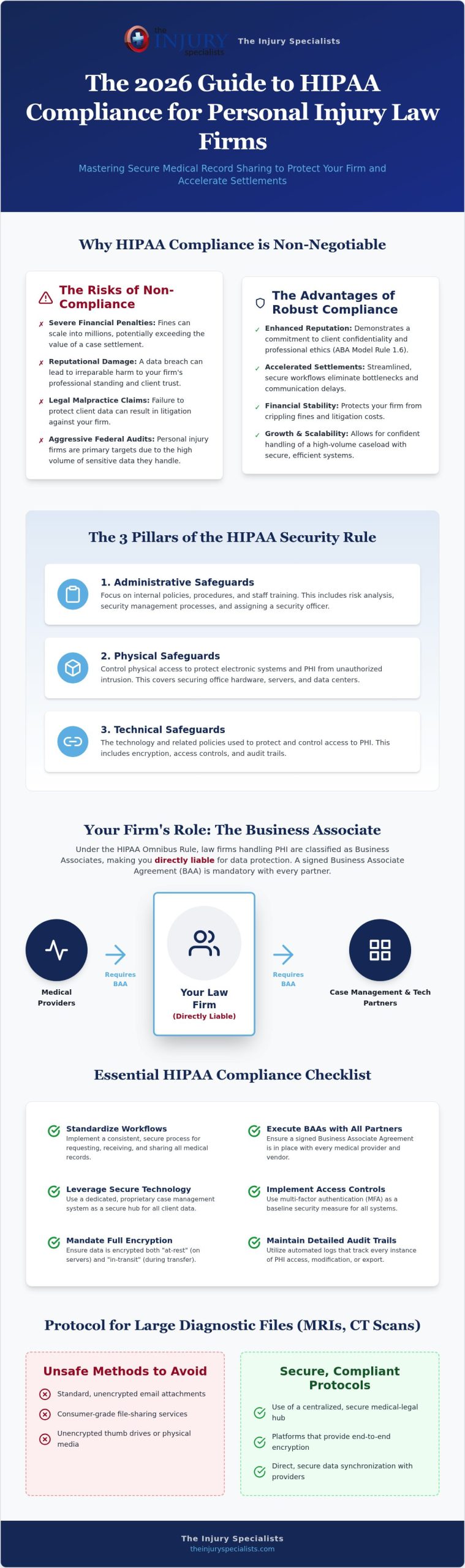
Law firms handling personal injury cases function as critical nodes in the healthcare data chain. The Health Insurance Portability and Accountability Act (HIPAA) sets the national standard for protecting sensitive patient data. For attorneys, Protected Health Information (PHI) includes any identifiable data related to a client’s past, present, or future physical or mental health. Failing to prioritize HIPAA compliant medical record sharing for law firms exposes your practice to aggressive federal audits and severe litigation risks. Personal injury firms are primary targets for data security audits because they aggregate high volumes of sensitive medical data, often without the enterprise-level security found in large hospital systems.
Compliance isn’t just about avoiding federal fines. It aligns directly with ABA Model Rule 1.6, which requires lawyers to make reasonable efforts to prevent the unauthorized disclosure of client information. While Rule 1.6 provides the ethical framework for confidentiality, HIPAA provides the technical enforcement mechanism. A breach doesn’t just result in an ethics committee hearing. It invites civil money penalties that can scale into millions of dollars. Beyond the financial impact, a data leak can lead to legal malpractice claims and irreparable damage to your firm’s professional reputation.
The Role of Law Firms as Business Associates
Under the HIPAA Omnibus Rule, law firms are officially classified as Business Associates when they handle PHI on behalf of a covered entity, such as a hospital or physician. This classification means your firm is directly liable for compliance. You must execute a formal Business Associate Agreement (BAA) with every medical provider and case management partner you work with. This document legally shifts the burden of data protection to your firm. Once you accept those records, you’re responsible for their security throughout the entire case lifecycle, from initial intake to final settlement.
Protected Health Information (PHI) in Personal Injury Cases
Personal injury litigation relies on granular, identifiable data. You handle everything from operative reports and pharmacy logs to specialized diagnostic imaging. Unlike medical research, legal cases cannot use de-identified data. You need specific names, dates of birth, and social security numbers to prove damages and establish liability. High-resolution files like MRIs and CT scans present unique challenges. Their massive file sizes often tempt staff to use non-secure transfer methods like standard email or unencrypted thumb drives. Maintaining HIPAA compliant medical record sharing for law firms requires a dedicated system that handles these large diagnostic files without compromising encryption or accessibility.
The HIPAA Security Rule: Technical Safeguards for Legal Teams
While the HIPAA Privacy Rule governs who has the right to access health information, the Security Rule dictates the specific technical standards you must use to protect that data in digital formats. For personal injury firms, this rule is divided into three essential pillars. Administrative safeguards focus on your internal policies and staff training protocols. Physical safeguards involve securing your office hardware and data centers. Technical safeguards are the most critical for 2026, as they define the infrastructure required for HIPAA compliant medical record sharing for law firms. You must implement a system that ensures data integrity and prevents unauthorized digital interception.
Modern standards for 2026 require more than just a strong password. Your firm’s legal portals and document repositories must utilize multi-factor authentication (MFA) as a baseline security measure. Additionally, the Security Rule mandates the use of detailed audit trails. These automated logs track every instance of PHI access, recording exactly who viewed, modified, or exported a file and at what time. If a data breach occurs, these audit trails are your first line of defense during a regulatory investigation, proving that your firm maintained strict oversight of sensitive client information.
Encryption Standards for Record Sharing
Data protection requires security in two distinct states. At-rest encryption secures files while they are stored on your servers or in cloud environments. In-transit encryption protects data as it moves between your firm and medical providers. Standard email is insufficient because it often travels across unsecured servers where it can be intercepted by third parties. AES-256 encryption is the recognized gold standard for securing legal data against modern decryption attempts. Ensuring your platform uses this level of protection is a mandatory step for maintaining compliance.
Access Controls and Identity Management
Effective data security relies on the principle of least privilege. This protocol ensures that staff members only have access to the specific medical files required for their current assignments. Shared logins are a high-risk liability because they destroy the accountability provided by audit trails. You must maintain unique user accounts for every employee to track individual activity accurately. When a staff member leaves the firm, your workflow must include a process for immediate access revocation to prevent unauthorized data exports. Utilizing a specialized case management technology ensures these technical safeguards are automatically integrated into your firm’s daily operations.
HIPAA Compliant File Sharing Checklist for Legal Professionals
Selecting a platform for HIPAA compliant medical record sharing for law firms requires a rigorous vetting process. You can’t rely on consumer-grade tools that lack the specific legal-medical architecture needed for 2026 standards. Your firm must audit every potential vendor to ensure they meet the technical and administrative requirements of the law. Use this checklist to standardize your selection process:
- Verified BAA: Confirm the provider offers a signed agreement for HIPAA Business Associates before any data enters the system.
- DICOM Compatibility: Ensure the platform natively supports high-resolution diagnostic imaging files common in personal injury litigation.
- Automated Reporting: Audit the platform for real-time logging and reporting capabilities to satisfy security audit requirements.
- Integrated Messaging: Replace unencrypted email with secure, portal-based messaging to prevent accidental data leaks.
- Granular Guest Access: Verify the solution allows for secure third-party access for expert witnesses without exposing your entire case database.
Evaluating Secure Document Portals
Generic cloud storage often lacks the necessary safeguards for legal workflows. You must contrast these basic tools with specialized personal injury case management technology that aligns with medical-legal synergy. Red flags in a vendor’s terms of service include clauses that allow the provider to scan files for metadata or those that omit clear data sovereignty statements. You need to know exactly where your medical records are physically stored and ensure they remain within compliant jurisdictions.
Managing Large Diagnostic Files Securely
Personal injury firms face unique challenges when sharing “heavy” files like MRIs and surgical videos. Physical media, such as CDs and USB drives, are high-risk security liabilities in 2026. They’re easily lost, stolen, or corrupted, and they provide no audit trail for PHI access. Secure portal-to-portal transfers are the only compliant method for handling diagnostic imaging. This approach ensures that massive files move directly from the imaging center to your firm’s secure hub without the risks associated with physical transport or unencrypted cloud links.
Streamlining the Medical-Legal Workflow for Personal Injury Firms
Personal injury firms operate in a high-velocity environment where the speed of medical record retrieval directly impacts case momentum. The typical lifecycle of a record, from initial physician intake to the final demand package, is often plagued by administrative friction. You can bypass these delays by collaborating with a personal injury referral network that prioritizes secure, automated data exchange. This strategic alignment ensures that HIPAA compliant medical record sharing for law firms is built into the referral process rather than treated as an afterthought. Standardized documentation also plays a crucial role in the financial health of your case. Organized, compliant records lead to faster approvals for pre-settlement funding, providing your clients with necessary liquidity while you litigate.
Coordinating with Medical Providers
Requesting records through traditional channels often leads to fragmented communication and security gaps. You should prioritize a unified law firm medical referral program to create a closed-loop environment. This system ensures that all PHI remains within an encrypted ecosystem from the moment of treatment. Working with HIPAA-native medical providers is essential because these partners understand legal deadlines. They provide documentation that is trial-ready, which reduces the need for constant follow-ups and clarifies the medical necessity of treatment immediately.
Integrating Medical Case Management
A dedicated medical case manager acts as a strategic bridge between the clinical and legal sectors. They organize and verify treatment notes, ensuring every piece of evidence is accounted for before it reaches your paralegals. Modern case management software automates the tracking of medical liens and billing records. This automation prevents accounting errors during the settlement phase and ensures no lien is overlooked. When your medical and legal teams operate on a shared, secure platform, you eliminate the risks associated with manual data entry and unencrypted file transfers. This level of integration allows your firm to scale its caseload without increasing its administrative overhead. To optimize your firm’s performance, you can leverage our proprietary case management technology to centralize your entire medical-legal workflow.
Leveraging Technology for Secure Case Management and Growth
The Injury Specialists provides a world-class technology platform that serves as the definitive solution for personal injury firms seeking to modernize their operations. This proprietary system offers a secure hub for HIPAA compliant medical record sharing for law firms, ensuring that every byte of data is encrypted at rest and in transit. It’s a comprehensive tool designed to align with specific legal workflows and documentation needs. By centralizing all data exchanges within a single environment, you eliminate the fragmentation that often leads to security vulnerabilities. Implementing this level of technical oversight allows your team to focus on litigation rather than administrative troubleshooting.
Modern technology enables your firm to scale case volume without a proportional increase in compliance risk. Manual processes are prone to human error, but an automated system enforces technical safeguards consistently across every case. This level of reliability is essential for maintaining the confident, authoritative stance required to lead in the personal injury sector. As you expand your reach, your infrastructure must remain robust enough to handle the increased load of Protected Health Information without compromise. High-volume growth is only sustainable when your case management system is built on a foundation of regulatory excellence.
The Injury Specialists’ Proprietary Ecosystem
Our platform facilitates seamless networking between medical and legal professionals, bridging the gap that often stalls case progress. It integrates diagnostic imaging referrals directly into the secure case management workflow. This ensures that high-resolution files move from the imaging center to your firm within a protected environment. Because this system was designed by personal injury experts for personal injury experts, it understands the unique pressures of legal deadlines. Accessing physician referral services through this ecosystem ensures that every partner you engage is already vetted for HIPAA awareness and secure data handling.
Next Steps: Securing Your Firm’s Future
Transitioning from legacy file sharing to a modern, integrated system requires a clear roadmap. You must first audit your current referral partners to ensure they provide signed BAAs and use encrypted transfer protocols. Once you identify gaps in your current workflow, you can begin migrating your active cases into a centralized platform. This transition eliminates the administrative friction discussed earlier and positions your firm for sustainable growth. Protecting your practice from HIPAA violations is a continuous process that demands the right technological partner. Partner with The Injury Specialists to streamline your medical-legal operations today.
Advancing Your Firm’s Medical-Legal Infrastructure
Mastering HIPAA compliant medical record sharing for law firms is a strategic necessity for high-volume personal injury practices in 2026. Security protocols like AES-256 encryption and multi-factor authentication are no longer just recommendations; they’re the baseline for professional liability protection. By implementing a standardized workflow that replaces unencrypted email with secure portals, you protect your firm’s reputation and accelerate the path to settlement. Integrating these technical safeguards into your daily operations ensures that sensitive client data remains a tool for litigation rather than a liability for your practice.
The Injury Specialists provides the proprietary world-class technology platform and national network of HIPAA-aware medical providers you need to succeed. Our system integrates expert medical case management directly into your firm’s distinct process, allowing you to scale case volume with confidence. You can eliminate administrative friction and ensure total regulatory compliance through our established medical-legal ecosystem. Join the largest personal injury referral network and secure your medical-legal workflows today. Building a resilient, secure practice is the most effective way to drive long-term growth and settlement success.
Frequently Asked Questions
Is standard email HIPAA compliant for sharing medical records?
Standard email is generally not HIPAA compliant because it lacks end-to-end encryption and secure access controls. Data sent via standard email travels across multiple servers in plain text, making it vulnerable to interception. For HIPAA compliant medical record sharing for law firms, you must use a secure portal or an encrypted messaging service. These platforms ensure that Protected Health Information (PHI) remains protected both in transit and at rest, satisfying federal security requirements.
What is a Business Associate Agreement (BAA) and why does my law firm need one?
A Business Associate Agreement is a legal contract that outlines the responsibilities of a third party handling PHI. Your law firm needs a BAA because the HIPAA Omnibus Rule classifies legal practices as Business Associates when they receive medical records from covered entities. This agreement establishes your firm’s liability for data protection. Without a signed BAA in place, both the healthcare provider and your firm are in direct violation of federal compliance standards.
Does HIPAA apply if we are representing the plaintiff rather than the healthcare provider?
Yes, HIPAA applies regardless of which party you represent if you handle Protected Health Information. As soon as your firm receives medical records to support a plaintiff’s personal injury claim, you become a Business Associate under the law. This status requires you to implement the same administrative, physical, and technical safeguards as the healthcare provider. Your role in the litigation doesn’t exempt you from federal data security and privacy mandates.
What are the penalties for a law firm that violates HIPAA rules in 2026?
HIPAA penalties in 2026 are categorized into four tiers based on the level of negligence. Fines can range from several hundred dollars per record to millions of dollars for willful neglect. Beyond financial penalties, firms face mandatory corrective action plans and federal oversight. A single data breach can also trigger legal malpractice suits and permanent damage to your firm’s reputation. Compliance is a fundamental requirement for maintaining operational stability and avoiding these severe consequences.
How can law firms securely share large diagnostic files like MRIs?
Law firms should use specialized case management portals designed to handle DICOM files and high-resolution imaging. Standard file-sharing methods often fail due to size limits or lack of encryption. Secure portal-to-portal transfers eliminate the need for physical media like CDs or USB drives, which are high-risk security liabilities. These modern platforms provide the necessary bandwidth and AES-256 encryption required for HIPAA compliant medical record sharing for law firms dealing with complex imaging data.
What is the difference between HIPAA compliance and ABA Rule 1.6?
ABA Rule 1.6 is an ethical requirement for attorneys to maintain client confidentiality, while HIPAA is a federal law with specific technical mandates. Rule 1.6 provides a broad framework for professional conduct, but HIPAA dictates the exact security standards for handling health data. While an ethical violation might lead to bar association discipline, a HIPAA violation involves federal audits and civil money penalties. Firms must satisfy both standards to ensure comprehensive data protection.
Can we use generic cloud storage like Dropbox or Google Drive for medical records?
Generic cloud storage is only compliant if you have a signed BAA with the provider and have correctly configured the security settings. Most standard consumer accounts don’t offer the necessary audit trails or encryption levels by default. You must verify that the specific service level you use supports HIPAA requirements. However, using specialized personal injury technology is often more efficient because it integrates these protections directly into your legal and medical workflows.
How does integrated medical case management improve HIPAA compliance?
Integrated medical case management improves compliance by centralizing PHI exchange within a single, secure environment. This approach eliminates the need for fragmented communication across unencrypted channels. Case management technology automates the creation of audit trails and manages user access controls, reducing the risk of human error. By aligning medical and legal teams on one platform, you ensure that every referral partner follows the same rigorous data protection standards throughout the case lifecycle.
