

A referral relationship that ends at scheduling isn’t a partnership. For injury practices and imaging centers, learning how to partner with imaging centers means building a process for appropriate referrals, smooth coordination, and clear communication, not simply pursuing higher volume. The aim is dependable handoffs and fewer workflow gaps, while keeping each organization’s role clear.
This article covers how to evaluate and establish an imaging center relationship. You’ll learn how to define referral criteria, set expectations for records and scheduling, and keep the right professionals informed. It also explains how case management and technology can support coordination across injury-focused medical and legal networks. The Injury Specialists connects imaging centers with injury victims and medical and legal professionals through its referral network, with imaging referrals, case management, marketing, and networking to support professional connections. The goal is a sustainable partnership with clear responsibilities and dependable processes from referral through follow-up.
Key Takeaways
- Learn how to partner with imaging centers by aligning referral processes, communication expectations, and support before launch.
- Assess a partnership based on workflow fit, technology, and coordination, not referral volume alone.
- Map each stage from referral and scheduling through imaging, documentation, and follow-up, while keeping clinical decisions with qualified providers.
- Launch in stages and track operational indicators such as referral completeness, scheduling progress, and communication responsiveness.
- Explore how The Injury Specialists connects imaging centers with injury-focused medical and legal professionals through referrals, case management, networking, and technology.
Why Imaging Centers Partner with Injury-Focused Referral Networks
An injury-focused referral partnership connects patients, referring clinicians, and imaging centers, while helping organize coordination around the referral. It doesn’t promise a particular number of cases or replace clinical judgment. Its value is in making professional connections and handoffs easier to manage, so each participant understands what information to share and who owns the next step.
For imaging centers, a network can create structured connections with clinicians and legal professionals involved in injury-related care. The treating clinician determines whether imaging is appropriate and makes the relevant clinical decisions. The center schedules and performs imaging within its role. A referral network can help coordinate the handoff and case-related communication without directing diagnosis or treatment.
What an injury-focused imaging partnership can involve
The relationship may bring together a referring clinician, a patient, an imaging center, and, where relevant, a legal professional. The clinician initiates a referral based on the patient’s care needs. The center follows its scheduling, imaging, and records processes. The patient participates in the care process, while legal professionals may need relevant case information through appropriate channels.
A network can facilitate these connections and support case-management coordination. Set expectations for who sends referral details, how scheduling status is communicated, and how records are routed. Electronic image exchange may also be part of the coordination plan. The overview of Medical Image Sharing provides context on exchanging images between healthcare organizations. Participation in a referral network doesn’t mean the network owns the center, acquires patients directly, or makes clinical decisions.
How this differs from a health-system radiology partnership
Referral coordination and facility development serve different purposes. A referral relationship connects existing providers and organizes the movement of referrals and case information. Health-system partnerships, by contrast, may involve developing or managing outpatient imaging facilities. OIA’s health-system partnership model is an example of that broader facility-oriented approach, rather than a direct equivalent to injury-focused referral coordination.
The right model depends on the organization’s goals and operating needs. A center seeking connections with injury-focused clinicians may prioritize referral pathways, communication practices, and case-management support. An organization seeking to build or manage imaging capacity may consider a health-system arrangement with a different scope. Keep the distinction clear: a referral network supports professional connectivity; it doesn’t itself create a joint venture or transfer ownership.
A well-defined referral partnership can support:
- Clear points of contact among the center and referring professionals.
- Organized communication about referral status and records.
- Case workflows that clarify handoffs without crossing clinical roles.
- Professional connections that fit the center’s injury-related services.
These fundamentals help make how to partner with imaging centers a practical question: define the purpose, preserve clinical boundaries, and build coordination around each participant’s responsibilities.
How to Evaluate an Imaging Center Partnership Before Joining
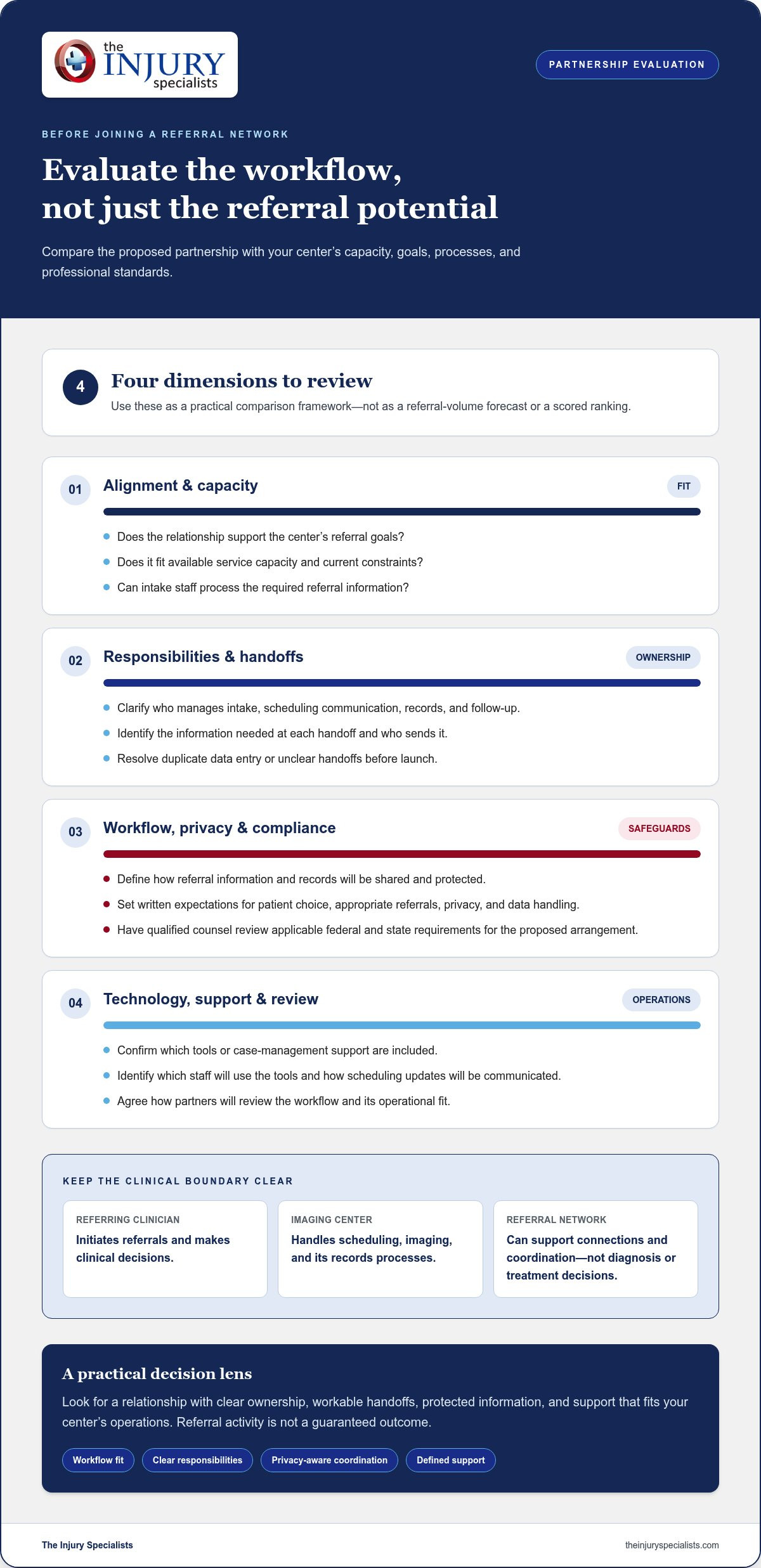
A strong fit depends on more than a network’s reach or a center’s interest in referrals. Before joining, compare the proposed relationship with your center’s capacity, goals, processes, and professional standards. Clarify what the network supports, who owns each handoff, and how partners will review the workflow. This gives you a practical basis for deciding how to partner with imaging centers without treating projected referral activity as a guaranteed outcome.
Assess fit, scope, and operating expectations
Start with your center’s service capacity, referral goals, and current constraints. Consider whether intake staff can process the required referral information, how scheduling updates will be communicated, and who handles documentation and follow-up. Map proposed responsibilities against existing workflows. If a new process creates duplicate data entry or unclear handoffs, resolve those issues before launch rather than leaving staff to troubleshoot them case by case.
Review compliance, privacy, and reputational considerations
Include compliance in the evaluation from the outset. Have qualified counsel review applicable federal and state requirements for the proposed arrangement. Put expectations for patient choice, appropriate referrals, privacy, and data handling into written workflows. Don’t assume a payment structure or referral practice is permissible based on a general description. The details and context matter, and this article doesn’t provide legal conclusions.
Use a comparison framework to weigh needs, responsibilities, workflows, and review measures:
- Alignment: Does the relationship support the center’s referral goals and fit its available capacity?
- Responsibilities: Who manages intake, scheduling communication, records, and follow-up?
- Workflow: What information is needed at each handoff, and how will it be shared and protected?
- Technology and support: What tools or case-management support are included, and which staff will use them?
- Review measures: Which operational indicators will partners review, and how often?
Distinguish stated capabilities from results that require evidence. A network may describe its connections, technology, or coordination support, but those claims don’t establish referral volume, case fit, or business growth. To assess outcomes, agree on a baseline and review method before launch. Measures such as referral completeness, scheduling progress, and responsiveness can show where the process works and where it needs attention without promising a particular volume of cases.
Document the comparison and any unresolved questions before deciding. A concise written record helps leaders, intake staff, and case-management teams work from the same expectations. Imaging centers exploring injury-focused connections can also review The Injury Specialists’ imaging referral network as part of evaluating how referral relationships and coordination support fit their goals.
Build Referral and Case-Management Workflows That Work
A referral pathway works best when every handoff has an owner, an agreed communication method, and a clear next step. Before referrals begin, define how the center, referring clinician, and case-management team will handle intake, scheduling updates, records, and follow-up. Establish an escalation path for missing information, delays, or requests outside the agreed process. These steps make coordination more consistent without placing administrative teams in clinical roles.
Set up a clear referral handoff
Document the information needed to route a referral and identify who receives it. Specify how the team handles relevant patient and referring-clinician details, what happens when information is incomplete, and who communicates the next action. Agree on a secure, approved channel for each exchange. Informal messages can leave staff unsure where the latest update belongs.
Use a staged workflow to identify gaps and assign responsibility at each point:
- Referral: The referring clinician initiates the request and supplies the information required by the center’s intake process. The clinician determines whether imaging is appropriate.
- Scheduling communication: The designated contact relays scheduling progress or relevant status changes through the agreed channel. If a request is incomplete or delayed, staff follow the documented escalation path.
- Imaging: The imaging center performs the scheduled service within its role. Qualified providers retain responsibility for clinical decisions and image interpretation.
- Documentation: Each organization records the actions and communications it is responsible for, following agreed procedures for authorized information exchange.
- Follow-up: Assigned contacts communicate administrative updates and outstanding coordination needs, while clinical questions go to the appropriate qualified provider.
Coordinate records and case updates responsibly
Set expectations for record requests before the first case moves through the workflow. Specify who can request or send information, which channels partners will use, and how staff should handle requests that need clarification. Align the process with applicable privacy requirements and each organization’s policies. A defined procedure helps prevent case coordination from becoming broad or unnecessary information sharing.
Keep administrative status updates separate from clinical interpretation. A case-management contact may track whether a referral was received or a records request is outstanding, but shouldn’t interpret images or advise on medical necessity. Clinical decisions and interpretation remain with qualified providers. This boundary clarifies roles and helps each partner route questions to the right professional.
Case-management technology can help organize referral information, communication, and professional connections. Define what the system supports, who enters updates, and how staff handle information that arrives outside the system. Technology provides structure, but it doesn’t replace agreed workflows, sound judgment, or responsible handling of records. For teams considering how to partner with imaging centers, a documented pathway gives staff a practical reference for each handoff and a consistent way to flag process gaps.
Launch the Partnership in Stages and Measure Its Performance
A staged launch gives each organization room to test the agreed process, identify operational friction, and adjust before the workflow becomes routine. Set a baseline for current processes, choose indicators to review, and assign owners to track them. This keeps the review grounded in observable coordination rather than assumptions about referral volume, revenue, or case outcomes.
Prepare the team and launch the workflow
Assign internal owners for intake, scheduling coordination, records, and partner relationship management. Train relevant staff on the agreed handoffs and escalation paths, then provide a concise written workflow they can reference. Before referrals begin, make sure each owner knows what they handle, where to record an issue, and whom to notify when a step stalls.
Move from planning to review in clear stages:
- Readiness review: Confirm that staffing, capacity, contact roles, and the proposed referral process are aligned.
- Workflow design: Document handoffs, communication channels, responsibilities, and steps for exceptions.
- Onboarding: Orient participating teams to the process and the tools they will use to coordinate.
- Limited rollout: Start with the defined workflow and record incomplete referrals, delays, or unclear ownership as they arise.
- Scheduled review: Bring partners together to assess the baseline, discuss feedback, and agree on process changes.
Track partnership health with practical measures
Choose operational measures that teams can observe consistently. Track whether referrals include the information required by the agreed process, whether scheduling advances through the expected communication steps, how promptly partner contacts respond, and whether workflow exceptions remain unresolved. Set a baseline before launch and review trends over time. Don’t treat an isolated change as proof of lasting improvement.
Invite feedback from authorized partner contacts and staff who manage intake, scheduling, records, and case coordination. A recurring problem, such as unclear responsibility for a status update, may point to a workflow issue rather than an individual failure. Record the friction, identify the process step involved, and assign an owner to propose a revision. Share the update with everyone affected so teams follow the same procedure.
Keep performance reviews focused on coordination and service processes. Measures can show whether information is arriving as expected or where handoffs need clarification. They don’t establish clinical quality, determine medical necessity, or guarantee business or legal results. Case-management technology can help organize coordination, but partners still need clear responsibilities and regular feedback to keep the workflow useful.
A disciplined launch turns how to partner with imaging centers into a practical operating plan: prepare, test, review, and refine. To build connections through injury-focused imaging referrals, explore imaging center referral partnerships with The Injury Specialists.
Partner with The Injury Specialists to Connect Within the PI Network
Imaging centers seeking injury-focused professional connections can work with The Injury Specialists through its national referral network. The network connects imaging centers with injury victims and medical and legal professionals. It facilitates connections and supports coordination; it doesn’t provide imaging, direct medical treatment, or legal representation. Participation supports relationship-building, but doesn’t promise referral volume, business growth, or case outcomes.
What imaging centers gain from a connected network
Network participation creates a connection point between an imaging center and professionals working with injury-related cases. Imaging referrals are supported by medical case management, marketing and networking, and case-management technology designed to support coordination and professional connections. The value depends on how these capabilities fit the center’s services, staff, and operating priorities.
- Professional connections: Build visibility among injury-focused medical and legal professionals through network participation.
- Coordination support: Use medical case management to support communication among participating professionals.
- Technology support: Apply case-management technology to help organize coordination and professional networking.
These capabilities support a more connected process, but don’t replace the center’s own workflows or guarantee a particular result. Clinical decisions remain with qualified providers, and legal professionals retain their own responsibilities. A useful partnership starts with clear expectations for roles, communication, and how participation aligns with the center’s goals.
Take the next step toward partnership
Prepare for a focused partnership discussion by summarizing your center’s current workflow and priorities. Identify the professional connections you want to develop, the services your team can support, and the coordination challenges you want to address. This gives both sides a practical starting point for discussing fit, responsibilities, and how a relationship could work within existing operations.
The Injury Specialists provides a national connection and coordination partner for imaging centers seeking relationships across injury-focused medical and legal communities. To explore whether network participation aligns with your objectives, explore partnership opportunities with The Injury Specialists.
Build Your Next Partnership Around Clear Priorities
A productive partnership starts with a defined purpose and grows through consistent professional coordination. As you decide how to partner with imaging centers, focus on what your organization wants the relationship to support and how you’ll keep its processes aligned as needs evolve. A measured, collaborative approach can strengthen connections without treating referral volume or outcomes as a promise.
The Injury Specialists offers imaging center referrals and connects medical and legal professionals nationally. Its case-management technology supports professional coordination, giving imaging centers a connection point within the personal injury network. These capabilities can help frame a conversation about partnership fit and shared priorities.
Identify your goals and the professional relationships you want to develop. Explore partnership opportunities with The Injury Specialists to discuss how network participation can fit your organization’s direction. A clear starting point helps your team build a purposeful partnership around connection and coordination.
Frequently Asked Questions
How do imaging centers partner with personal injury referral networks?
Imaging centers can join through a staged process: assess readiness and partner fit, agree on workflows, onboard staff, then evaluate how coordination is working. A practical approach to how to partner with imaging centers is to identify a point person for referral questions before the first case arrives. A network can facilitate professional connections and case coordination, while treating clinicians retain responsibility for care decisions. No referral volume or outcome is assured.
What should an imaging center look for in a referral partner?
Look for alignment between the partner’s approach and your center’s services, clear responsibilities and handoffs, secure information practices, reliable communication, and practical support. Staff should know who receives a referral and where to route a scheduling question. Assess whether the proposed process fits existing operations, and have qualified counsel review applicable requirements. No single partnership model suits every center or operating goal.
Can an imaging center join a personal injury referral network without changing its clinical decisions?
Yes. Referral coordination is administrative and doesn’t determine whether imaging is appropriate. Qualified treating professionals make care decisions, and imaging centers retain their own clinical responsibilities. An agreed workflow can clarify who communicates appointment status, routes records requests, or flags missing referral information. Those steps organize coordination; they don’t direct clinical judgment, interpret images, or guarantee a particular case result.
What information should an imaging center prepare before starting a partnership?
Prepare an overview of your imaging services, intake procedures, communication roles, documentation workflows, operational capacity, and partnership objectives. For example, note who currently receives referrals and how staff handle incomplete requests. This gives partners a basis for discussing a workable process and identifying operational gaps. Preparation isn’t a universal onboarding checklist, and it doesn’t replace appropriate legal, privacy, or clinical review.
How can an imaging center measure whether a referral partnership is working?
Track process measures such as referral completeness, scheduling progress, response times, and recurring workflow issues. Set a baseline before the partnership begins, then review trends with relevant operational stakeholders and authorized partner contacts. Repeated missing information, for example, may signal a need to clarify referral instructions. These indicators help teams assess coordination and improve procedures, but they don’t guarantee revenue, clinical outcomes, or case results.
Are referral partnerships between imaging centers and personal injury networks subject to compliance requirements?
They may be, depending on the arrangement and applicable federal and state requirements. Before implementation, have qualified healthcare and legal counsel review the proposed referral processes, privacy practices, and approach to patient choice. Keep written workflows aligned with that review and the organizations’ responsibilities. The details matter, so a general description cannot establish whether a particular structure or payment arrangement is compliant.

Leave A Comment
You must be logged in to post a comment.