

More technology won’t fix a handoff no one owns. Streamlining personal injury case management starts with clear responsibility and reliable information flow, not another layer of process. When case updates and documents sit across disconnected workflows, staff spend time chasing details instead of moving work forward.
That frustration is familiar to firms coordinating attorneys, clients, medical providers, and internal teams. Better coordination doesn’t require making every task more complicated. It requires deciding who owns recurring work, what information needs to move, and what the next person needs to take action.
This practical 2026 guide shows how to map key case stages, assign ownership, define handoffs among authorized participants, and keep information moving consistently. It also covers how to assess case-management tools against your firm’s workflow and build a focused improvement plan. The goal is a more coordinated operation, with technology and medical-legal connections supporting the process rather than adding complexity.
Key Takeaways
- Streamlining personal injury case management begins with clear task ownership, timely information flow, and consistent case progression.
- Trace representative cases to find delays, duplicate work, missing information, and tasks that lose visibility.
- Clarify roles and handoffs before selecting or adjusting software. Technology supports a defined process but can’t assign ownership on its own.
- Use a five-step improvement plan: map the workflow, prioritize a bottleneck, assign responsibility, pilot a change, and review the results.
- Build defined communication pathways with medical and legal professionals, supported by referral relationships and medical case management.
What streamlining personal injury case management actually means
Streamlining personal injury case management means making recurring work clear and dependable. Each task has an owner, relevant information reaches the right participant in time, and the case progresses through defined steps. The aim isn’t to eliminate every delay. A firm can improve its own process, but it can’t control every factor affecting treatment, documentation, negotiations, or resolution.
A practical definition: Streamlined case management is a repeatable workflow in which responsibilities, handoffs, and next steps are clear to the people authorized to carry them out. This reflects broader case management principles, adapted to the distinct needs of a personal injury matter.
Legal case management organizes the firm’s work, including intake, legal documents, deadlines, case decisions, and client communication. Medical case management focuses on coordinating aspects of care and related communication among appropriate participants. The workflows intersect when a development in treatment or documentation affects what the legal team needs to do next. They remain distinct functions, and coordination doesn’t mean every participant accesses the same records.
Which parts of a personal injury case create operational friction?
Trace recurring work from intake through treatment coordination, documentation, and case resolution. Follow a representative matter through the steps people actually take, not just the stages listed in a procedure manual. At each point, record who owns the task, what information they need, where work waits, and whether it gets repeated or becomes difficult to track.
- Duplicated entry: Staff re-enter the same basic information in separate records or forms.
- Unclear ownership: A request or follow-up task has no named person responsible for moving it forward.
- Repeated status requests: Team members ask for updates because the latest status or next action isn’t easy to identify.
- Delayed handoffs: Information reaches the next person late, or arrives without enough context to act.
Separate process delays from case-specific timing outside the firm’s control. An internal delay might occur when a received document sits without an assigned review task. Waiting for an external response is different. This distinction helps firms target changes they can make rather than treating every elapsed day as a workflow failure.
Why do medical-legal handoffs need clear ownership?
A handoff is a defined transfer of information or responsibility. Without clear expectations, an update may prompt extra calls, duplicate requests, or uncertainty about who should take the next step. For each recurring handoff, specify who initiates it, who receives it, who records the relevant status, and who acts on it. Share only information the recipient is authorized to receive and needs for their role.
For example, a firm can define how its team records a request for treatment-related documentation, tracks its status, and follows up through an appropriate communication pathway. Medical and legal participants can coordinate around information relevant to their respective work without assuming they use the same records or systems. Clear ownership makes the process more reliable while leaving case outcomes and external timing where they belong: outside the workflow’s control.
How to find bottlenecks in a personal injury case workflow
Before changing a procedure or investing in new technology, trace representative cases through the work your team already performs. Follow each matter from intake through treatment coordination, document collection, review, and resolution. Note the actual steps, who completes them, and what must happen before work can continue. This reveals where the workflow stalls instead of relying on assumptions about what software should fix.
A workflow bottleneck is a recurring point where work waits, repeats, or loses ownership; a software limitation is a tool constraint that prevents a defined process from being carried out. The distinction matters: replacing a tool won’t resolve a handoff that has no owner.
Which workflow signals should a firm examine?
Review recurring delays in obtaining, routing, reviewing, and organizing case materials. Track repeated outreach, especially when staff have to ask again because the next step or responsible person wasn’t clear. Compare findings by workflow stage, using only the information needed to understand the process and avoiding unnecessary personal details.
- Handoff completion: Did materials or updates reach the intended recipient with the next action clear?
- Outstanding requests: Which requests remain open, and where do they tend to stall?
- Task aging: How long do assigned tasks remain open at each stage?
- Rework frequency: How often do staff repeat entry, outreach, review, or routing?
Use the same definitions when reviewing cases so the baseline is useful. For example, count a handoff as complete when the intended recipient has received the required information and the next action is recorded, not merely when a message is sent.
How can teams identify the cause, not just the symptom?
A task that stays open is a symptom, not an explanation. Check whether the delay starts with unclear responsibility, missing information, or a process gap. Then compare written procedures with the steps staff actually follow. A procedure may assume one person checks incoming materials, while several people in practice expect someone else to do it.
Record exceptions separately. A case with unusual documentation needs may require a different path; treating it as typical can lead the firm to redesign a workflow around a rare circumstance. Look for repeat patterns across representative cases, then validate the suspected cause with the staff handling that stage.
For a focused review, select one workflow stage and establish its baseline before making a change. Recheck the same measures afterward to see whether handoffs are more complete, requests remain open for less time, or rework occurs less often. This gives streamlining personal injury case management a practical starting point without assuming every delay is preventable. Firms assessing technology alongside workflow can also consider workflow-aligned case management technology as part of the improvement process.
People, process, and software: what actually streamlines case management?
Operational friction rarely has a single cause. A process may be unclear, a task may lack an owner, or a tool may make an established step difficult. These are different problems and need different responses. For streamlining personal injury case management, treat role alignment, process design, and technology as complementary levers: clarify the work, assign responsibility, then use tools to support how the team needs to operate.
New software isn’t automatically the answer. A platform can make information easier to organize, but it can’t decide who should review a document, resolve conflicting procedures, or define when a handoff is complete. Use the comparison below to connect a recurring bottleneck to a practical response and a way to assess progress.
| Bottleneck | Process response | Technology support | Measure of progress |
|---|---|---|---|
| Two staff members complete the same review | Define one accountable role and when others are consulted | Use task assignment and shared status documentation, where available | Fewer duplicate reviews without missed required checks |
| Staff follow different steps for routine requests | Document a standard sequence and clear completion criteria | Use configurable workflow tools if they fit the sequence | More matters follow the agreed process |
| Information is hard to locate across records | Set conventions for where information is recorded and maintained | Assess whether the system supports access to useful information without duplicate records | Staff can locate the current information through the agreed process |
When should a firm change its process before its software?
Change the process first when staff encounter unclear steps, duplicate approvals, or inconsistent task ownership. If multiple people believe someone else is responsible for checking a routine request, define the owner and next action before configuring software around it. Standardize repeatable work, but preserve room for professional judgment when case circumstances call for a different approach.
A new platform can encode a workflow, but it can also make conflicting procedures harder to untangle. Write down the intended steps and test whether the team can follow them consistently before deciding that the tool needs to change.
What should firms assess in case-management technology?
Assess whether a tool fits the firm’s actual workflow, documentation needs, and authorized user roles. Consider how staff will find and maintain useful information without creating parallel records or unclear versions. In medical-legal coordination, access should reflect each participant’s role; a shared workflow doesn’t mean every person should see the same material.
Keep evaluation practical. Map a representative task from start to finish, then assess how the technology supports each step and handoff. Verify claims about integrations, automation, security, or specific features before relying on them. The Injury Specialists’ case-management technology is designed to align with professional workflows and documentation needs, making workflow fit a central consideration in a firm’s improvement plan.
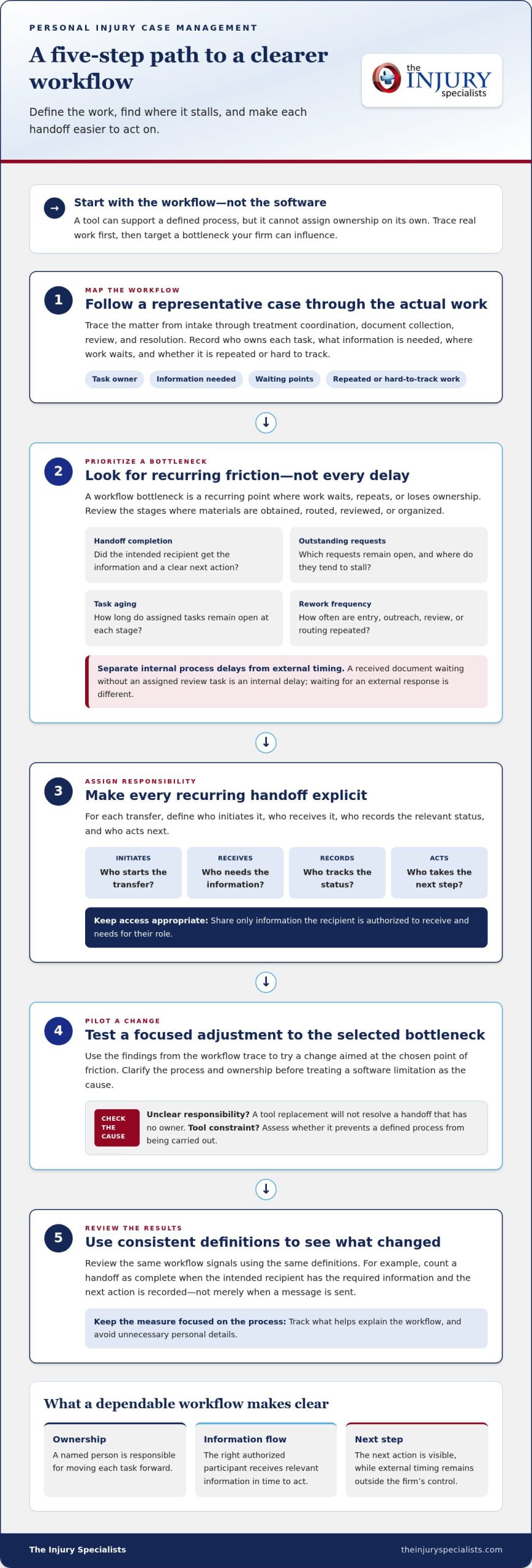
A five-step plan to streamline personal injury case management
Put improvement into a controlled sequence. Streamlining personal injury case management doesn’t require a firmwide redesign at the outset. Start with one repeatable workflow, establish how it works now, and make a focused change the team can assess before extending it further.
- Map the workflow. Choose a recurring process, such as routing a document request or moving an update to the next responsible person. Record the steps staff actually follow, the roles involved, common exceptions, and where work pauses or gets repeated.
- Prioritize one friction point. Use the workflow map and baseline measures to identify a problem the team can influence. Keep the scope manageable. A clear issue, such as repeated follow-up caused by an unclear next step, is easier to address than a broad goal to “improve communication.”
- Assign ownership. Name the role accountable for initiating the task, completing each handoff, and following up when the next step is still open. Define completion criteria so staff share the same understanding of when the work is done.
- Pilot the change. Test the revised steps with a defined team using the selected workflow. Give participants a shared description of the new process, clarify how to handle exceptions, and collect feedback as the pilot runs.
- Review and adjust. Compare pilot results with the baseline, identify what helped or created new friction, and revise the process. Extend it to other teams only when the workflow is clear and workable in practice.
A pilot works best when it’s narrow enough to observe closely but representative of recurring work. Before it starts, document the current steps and expected handoffs. During the test, invite staff to flag points where responsibility remains unclear, information arrives too late, or the revised process adds unnecessary effort. Early feedback helps refine the approach, but it isn’t proof by itself that the change has improved firmwide performance.
Measure every workflow change against a baseline, or the firm can’t tell whether the new process improved the work or simply changed it. Compare task aging, repeated follow-ups, handoff completion, and rework using consistent definitions. Pair those operational measures with staff feedback on clarity and usability. Set a regular review point, then adjust steps that create new delays or extra work.
Keep the review tied to the original problem. If the goal was to reduce repeat outreach, check whether staff now understand who follows up and what action closes the task. If the change shifts effort to another role or stage, account for that before expanding the pilot. A useful improvement makes the workflow more dependable, not just different.
Firms aligning workflow changes with case-management tools can explore case-management technology designed to support professional workflows and documentation needs.
Connect case workflows with medical-legal coordination and the right support
A firm’s internal process is only one part of a personal injury case workflow. Coordination with medical professionals can also affect how relevant updates and documentation move between authorized participants. Clear communication pathways help each professional understand what information is needed, who should send it, and what action follows. They also keep responsibilities distinct: the law firm makes legal decisions, while medical providers make treatment decisions.
For streamlining personal injury case management, external relationships should complement the firm’s process rather than create a parallel one. Define how each professional relationship fits into the firm’s workflow, including what information is relevant, how a handoff is initiated, and who records the next step. The firm can then incorporate appropriate updates into its procedures without assuming that all parties access the same records or systems.
How can external partners fit into a firm’s case workflow?
Start by setting practical expectations for each handoff. A firm might identify when its team sends a request, which role receives it, how the status is tracked internally, and who follows up if the next step remains open. Keep the process specific to the relationship and the authorized information involved. This gives partners a clearer path for coordination while preserving the boundaries of their professional roles.
Referral relationships work best when they connect to a defined internal process. Firms developing that structure can use this guidance on law firm medical referral programs to consider how referral pathways fit alongside case workflows. The goal is not to shift legal or treatment decisions to another participant. It’s to make coordination around those decisions easier to manage.
Where can a coordinated referral and case-management network help?
The Injury Specialists connects injury victims with medical and legal professionals through referral programs and medical case management integrated with those services. Its professional relationships include physicians, chiropractors, physical therapists, imaging centers, and law firms. These connections can complement a firm’s workflow by supporting coordination among professional participants, while the firm retains control of its internal case process.
The Injury Specialists’ technology platform supports case management, marketing, and networking between professionals. It is designed to align with professional workflows and documentation needs. Firms assessing how tools fit within their process can review this guide to personal injury case management technology. The guide to personal injury referral networks offers a wider view of how professional connections support coordination.
Strong coordination depends on clear expectations, appropriate communication, and support that aligns with the firm’s workflow. Professional partners can explore the personal injury referral network to learn more about connecting within this coordinated ecosystem.
Make your next workflow improvement a connected one
Treat workflow improvement as an ongoing operating practice, not a one-time project. As responsibilities, case needs, and team structures evolve, revisit whether your processes still make ownership and information flow clear. Ground adjustments in what staff encounter in daily work, and build on changes that prove practical for the people using them.
Streamlining personal injury case management also means considering how the firm’s internal process connects with professional relationships and supporting tools. The Injury Specialists brings injury victims, medical providers, and law firms into a connected professional network, with case-management technology designed to align with professional workflows and documentation needs. These resources can complement a firm’s own approach as it refines coordination.
Explore The Injury Specialists’ professional referral and case-management network to find support for your firm’s next workflow improvement. With clear priorities and the right connections, your team can keep building a more coordinated process.
Frequently Asked Questions
What does streamlining personal injury case management mean?
Streamlining personal injury case management means designing casework so people can identify the current status, next action, and person responsible without relying on memory or repeated internal messages. For example, a new document might trigger a defined review step and a recorded follow-up, rather than separate staff members checking whether someone else has handled it. The aim is dependable coordination, not a promised case timeline or result.
How can a personal injury law firm identify case-management bottlenecks?
Choose representative matters and reconstruct what happened at each important transition, using existing task records, correspondence logs, or staff walkthroughs. Look for moments when work stopped because someone was waiting for information, unsure who should act, or repeating an earlier request. Compare cases with similar workflow needs, and separate unusual circumstances from recurring patterns. This helps identify whether the obstacle is in intake, review, follow-up, or another step.
Can case-management software work with a firm’s existing workflow?
Software can support an existing workflow when the team first defines the steps the tool needs to accommodate. Document a typical matter, then assess whether the system’s functions can represent the firm’s tasks, records, and role assignments without forcing unnecessary workarounds. A mismatch may call for process adjustment, tool configuration, or further evaluation. Don’t assume every platform supports the same setup or capabilities.
What metrics can show whether a case-management process is improving?
Track measures tied to the change being tested. A firm working on document routing might compare how often items reach the intended reviewer on the first pass; a follow-up improvement could be assessed by counting repeated outreach. Define each measure consistently and review it alongside staff feedback. A single metric can hide tradeoffs, so check whether improvement in one step creates extra work elsewhere before deciding the change is effective.
How can small personal injury firms streamline casework without adding staff?
Small firms can reduce avoidable effort by focusing on recurring administrative steps before adding capacity. Use a shared checklist for routine intake details, define one owner for common follow-ups, and group similar review tasks when appropriate. Keep templates limited to repeatable communications and preserve individual review where judgment matters. Start with the task that causes the most interruption, then check whether the change frees time without shifting the burden to another team member.
How often should a law firm review its case-management workflow?
Review a workflow on a regular schedule that fits the firm’s workload, and revisit it when a meaningful change makes existing steps harder to follow. Triggers may include a new case-management tool, staffing changes, recurring missed handoffs, or a rise in duplicate work. Keep reviews focused: examine one process, gather input from the people who use it, and record any adjustment. This makes workflow maintenance manageable rather than a major redesign.

Leave A Comment
You must be logged in to post a comment.