

Effective chiropractic marketing to attorneys starts with a practice that communicates clearly, follows a dependable process, and respects the boundaries between patient care and legal strategy. Outreach may open a door, but reliable operations give attorneys a practical reason to continue a professional relationship.
A growing contact list is not the same as a strong referral network. Attorneys need confidence that communication will be handled appropriately, records will be organized, and clinical decisions will remain independent. Privacy and referral ethics matter as much as visibility: a relationship that appears to compromise either can weaken professional trust.
This guide explains how to build sustainable connections with personal injury law firms without promising referrals, settlements, or case outcomes. Learn what attorneys value in a chiropractic partner, how to create clear communication and case-coordination processes, and how to assess outreach by relationship quality rather than contact volume. It also covers how referral networking and medical case management can support more coordinated workflows between chiropractic practices and law firms.
Key Takeaways
- Strong chiropractic marketing to attorneys demonstrates dependable coordination, not just practice visibility.
- Turn law firms’ expectations into clear communication processes that protect privacy and support continuity.
- Keep outreach credible by separating professional education and networking from arrangements tied to referrals.
- Use a practical outreach sequence to identify relevant firms, share accurate information, follow up, and assess relationship quality.
- Referral networking and medical case management can help connect chiropractic practices with the personal injury legal community.
Why Chiropractic Marketing to Attorneys Depends on Trust, Not Just Visibility
Attorney-facing marketing has a different purpose from a patient acquisition campaign. It helps law firms understand how a chiropractic practice works, communicates, and coordinates care, rather than simply putting its name in front of more people. Visibility can start a conversation. Professional confidence grows when a practice explains its processes and follows through consistently.
A referral-ready practice combines reliable communication, well-defined processes, and independent clinical judgment. Those qualities give attorneys practical reasons to understand how coordination works without suggesting that a provider can influence a claim or predict its outcome.
What attorneys need from a chiropractic practice
Attorneys and their staff may need to know how to reach the practice, what information can be shared, and how coordination works when a patient has authorized communication. Explain the actual process: who handles inquiries, how records requests are routed, and how the practice tracks follow-up. Specific details are more useful than a broad claim that the office is “easy to work with.”
Care decisions must be based on the patient’s clinical needs, separate from a law firm’s legal strategy. A practice can explain its approach to care and coordination without implying that treatment is designed to strengthen a case. For foundational context on the profession, What is Chiropractic? offers an overview of chiropractic’s history and practices. Because firms have different workflows, learn their preferences through respectful professional dialogue instead of assuming one process fits every office.
- Clarify communication: Identify appropriate points of contact and explain how requests are handled.
- Make coordination visible: Describe the steps that support continuity while protecting patient information.
- Keep roles distinct: Maintain clinical independence and avoid claims about legal results.
Why visibility alone may not create lasting referrals
An advertisement, social post, or introduction can create awareness, but one impression does not show how a practice will function in a working relationship. Useful professional interactions build that understanding over time. A clear response to an inquiry, accurate practice information, or a thoughtful conversation about coordination can demonstrate reliability. Advertising can help, but it works best when it leads to credible engagement.
A strong online presence can reinforce that engagement. A law firm reviewing a practice may use its website to understand services, approach, and contact pathways. Keep those details accurate and consistent with what staff communicate directly. Then support that foundation with relevant conversations and dependable follow-through. This relationship-first approach makes chiropractic marketing to attorneys more than a campaign: it gives firms a practical basis for assessing whether coordination could fit their workflow.
How Chiropractors Earn Attorneys’ Confidence Through Reliable Case Coordination
After an introduction, day-to-day execution shows whether a practice is dependable. Replace broad claims such as “seamless service” with observable processes: who handles professional inquiries, how staff route records requests, and how the office tracks follow-up. These routines make coordination easier to understand without suggesting that a provider can shape legal strategy or guarantee a result.
Make communication predictable and professional
Assign a clear point of contact for law firm inquiries and establish an internal method for routing messages to the right team member. If that person is unavailable, staff should know where to direct the inquiry. Keep communication courteous, factual, and consistent. Explain what the practice can share and which appropriate channels it uses.
Before discussing patient-specific information, confirm that the necessary authorization is in place and follow applicable privacy safeguards. Keep professional updates neutral and limited to information the recipient is authorized to receive. For example, an update might confirm that an appointment was scheduled or that a records request is being processed. It should not offer a legal conclusion, speculate about a claim, or imply that care is being directed by the case.
Use documentation and workflow to support continuity
Accurate, timely clinical records help the practice maintain a clear account of care and respond to appropriate requests with organized information. Documentation should reflect clinical observations and decisions, not be tailored to support a preferred legal position. A consistent process also helps staff distinguish care coordination from legal analysis.
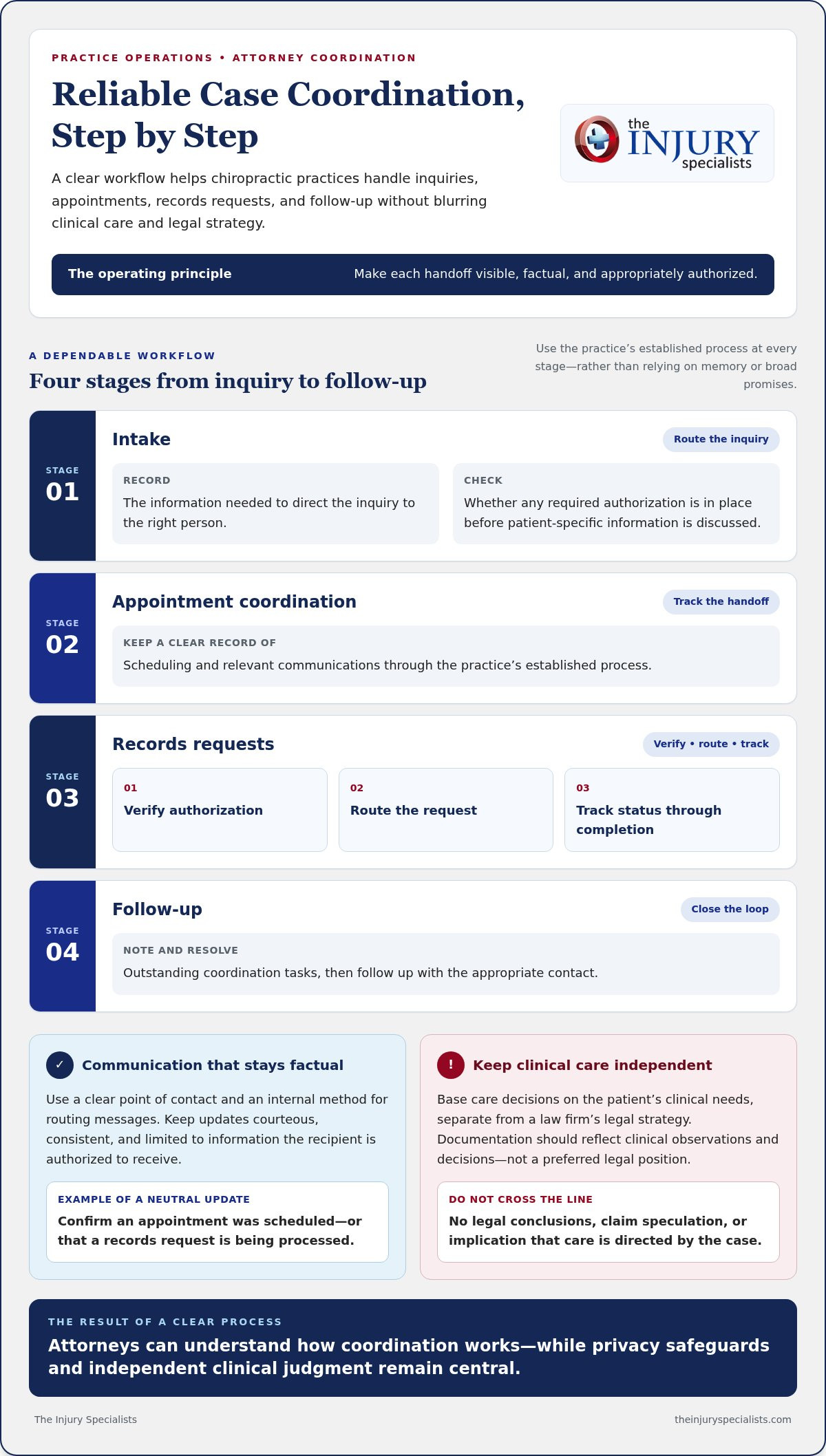
Map the work in stages so handoffs do not depend on memory:
- Intake: Record the information needed to route the inquiry and identify any required authorization.
- Appointment coordination: Track scheduling and relevant communications through the practice’s established process.
- Records requests: Verify authorization, route the request, and track its status through completion.
- Follow-up: Note outstanding coordination tasks and close the loop with the appropriate contact.
This operational approach complements broader medical case management for attorneys, where coordination is structured around a law firm’s process. The goal is not to promise a case outcome. It is to make communication and handoffs more orderly.
Attorney-facing trust checklist: “Clear contact. Appropriate authorization. Accurate records. Tracked requests. Neutral updates. Consistent follow-through.” Use these signals to review the process, identify missed handoffs, and improve the experience for professional partners.
The Injury Specialists’ referral and case management network connects chiropractic providers with the personal injury legal community. This can support a more organized workflow while leaving clinical decisions independent. Learn more at The Injury Specialists’ referral and case management network.
How to Keep Attorney-Focused Chiropractic Marketing Ethical and Credible
Ethical outreach makes the purpose of a professional relationship clear: share accurate information, build connections, and coordinate appropriately. It should never suggest that a payment, gift, or other benefit is offered in exchange for patient referrals. A relationship that could appear to influence patient choice or clinical judgment can undermine trust for both the practice and the law firm.
Set clear boundaries around referrals and compensation
Keep education, networking, and service coordination separate from any exchange tied to referrals. A clinical overview or discussion of office processes can inform a firm, but should not be framed as a reason to direct patients to a specific provider. Avoid gifts or benefits linked to referrals, and do not describe a marketing or networking arrangement in a way that implies referral volume is being purchased.
Before entering a formal arrangement, seek legal review of its structure under applicable federal and state requirements. Rules can differ by jurisdiction and by the parties involved, so general guidance is not a substitute for current advice on a specific arrangement. Document the legitimate purpose, scope, and terms of professional activities. Keep educational events transparent, focused on professional information, and free of promises about patient referrals or case outcomes.
Protect patient privacy in marketing and coordination
Patient information belongs in appropriate care and coordination processes, not casual outreach. Use it only with appropriate authorization and through privacy-compliant channels. Before sharing an update with a law firm, confirm that the communication is authorized and limited to information that can properly be disclosed. Staff should know where to route requests and how to avoid discussing patient details in public or informal settings.
Apply the same discipline to marketing materials. A testimonial or case story may seem useful, but it is not automatically suitable for publication just because it exists in a file or conversation. Do not publish identifiable details unless required permissions and appropriate professional reviews are in place. Even after removing a name, distinctive facts may still identify someone. Review the complete content, images, and surrounding context before use.
For integrated-care context, personal injury chiropractic and physical therapy referrals show how professional coordination can support connected care without blurring provider roles.
- Keep the purpose clear: Education and networking should not be linked to a promise of referrals.
- Review arrangements: Obtain legal guidance before formalizing financial or referral-related terms.
- Protect information: Confirm authorization and use appropriate communication processes.
- Check marketing materials: Review testimonials and case examples for permissions, privacy, and accuracy.
These safeguards make chiropractic marketing to attorneys more credible because they put professional judgment and patient privacy ahead of promotional pressure. The Injury Specialists connects chiropractors and other medical providers with legal and medical professionals through referral networking and case management, supporting more coordinated relationships within clear professional boundaries. Learn about attorney referral networking and case management built around organized workflows, not promised outcomes.
A Practical Attorney Outreach Plan for Chiropractic Practices
A focused outreach plan makes relationship-building easier to manage and evaluate. Set a clear purpose for each interaction, keep materials factual, and record professional follow-ups separately from patient information. Use this sequence to move from preparation to review without treating attorney outreach as a promise of referrals or case outcomes.
- Define practice capacity. Identify the services the practice provides, how appointments are handled, and which coordination tasks staff can manage. Outreach should reflect current capacity, not an idealized version of it.
- Identify relevant firms. Prioritize firms whose work and communication needs appear aligned with the practice. Note what you know about each firm and what you need to learn through conversation, rather than assuming every office follows the same workflow.
- Prepare concise materials. Create a short, accurate overview of services, contact routes, appointment processes, and coordination capabilities. Remove claims of guaranteed results, preferred case outcomes, or anything that could overstate the practice’s role.
- Make a professional introduction. Use an appropriate business contact method and state the purpose plainly. Invite a discussion about the firm’s process instead of pressing for referrals.
- Follow up with a useful next step. Refer to the prior conversation, share relevant information if requested, and record any agreed follow-up. Avoid repeated messages that add no value.
- Review and adjust. Assess which conversations are productive, what questions recur, and whether the practice’s capacity or materials need updating.
Prepare a useful first introduction
A strong introduction answers practical questions quickly: what the practice does, how appointments are coordinated, which contact route firms should use, and what kind of professional coordination the practice can support. Keep the language direct. If a firm describes a specific workflow, tailor the discussion to that process without implying that its needs represent every law firm’s.
Educational materials can explain how the practice handles coordination or what information is useful for a professional inquiry. Keep them informative, not framed as promises about medical care or legal results. This gives the conversation substance while preserving clear professional boundaries.
Measure relationship quality, not just lead volume
Track outreach at the firm level in a professional relationship log. Useful fields include the firm contacted, date and channel, conversation summary, questions raised, agreed next step, follow-up status, and relationship continuity. Keep this log separate from patient records, and do not include identifiable patient information. Record appropriate referrals only in systems and workflows designed to protect that information.
Review patterns in context. Referral counts alone do not show whether communication is useful, coordination is consistent, or the practice has capacity to respond. Periodic reviews can reveal where outreach should focus, what processes need refinement, and when to pause activity that exceeds available capacity. That discipline makes chiropractic marketing to attorneys more measurable and sustainable.
The Injury Specialists’ referral, marketing, networking, and case management support connects chiropractic practices with the personal injury legal community. Learn about attorney and provider networking.
How The Injury Specialists Connects Chiropractors and Attorneys
Building professional relationships takes consistent effort. The Injury Specialists provides a connection point for chiropractors, other medical providers, injury victims, and legal professionals through referral programs, marketing and networking support, medical case management, and technology. For practices, these services offer a structured way to expand professional connections across the personal injury community while leaving clinical care and legal representation with the appropriate professionals.
Connect practice needs with a broader professional network
A network can help practices meet professionals beyond their existing contacts and develop relationships through a more organized channel. The Injury Specialists offers referral programs for chiropractors and other medical providers, alongside marketing and networking support. These services can complement a practice’s own outreach by creating opportunities for connection without promising a particular number of referrals or a specific growth result.
The role is facilitation. The Injury Specialists connects participants in the personal injury ecosystem; it does not provide chiropractic treatment or direct legal representation. Chiropractors retain responsibility for independent clinical decisions, while attorneys manage legal matters. A referral connection can support communication between professionals, but it does not replace their separate roles or determine what is right for a patient or a case.
For a broader look at how referral relationships fit into the industry, explore personal injury referral networks. Understanding the wider ecosystem can help a practice assess how networking and coordination relate to its own capacity, processes, and professional goals.
Align medical and legal workflows through case management
Law firms can have distinct processes for working with medical providers. Medical case management can support more coordinated professional workflows by helping align communication and case coordination with those firm-specific processes. The Injury Specialists also provides technology designed to support workflow alignment. Its role is to facilitate coordination, not offer legal advice, practice medicine, or promise a case result.
For a chiropractic practice, the practical value is in connecting outreach with operational readiness. A network can help create professional introductions, while case management and technology can support coordination after a connection is made. Practices can consider how those resources fit alongside their own communication procedures and capacity. The aim is a more organized working relationship, not simply a larger contact list.
This infrastructure can complement a deliberate approach to chiropractic marketing to attorneys: build relevant connections, communicate professionally, and support clear coordination without tying relationships to promised referrals or outcomes. The Injury Specialists brings referral networking and case management together to connect providers and legal professionals across the personal injury community.
Explore how The Injury Specialists network connects providers and legal professionals through referral programs, networking support, and case management.
Turn Professional Intent Into a Stronger Next Step
The next stage of chiropractic marketing to attorneys is putting one improvement into practice. Choose a single part of your outreach to strengthen, such as clarifying practice information or assigning responsibility for professional follow-up. Then review whether conversations become more useful and coordination more consistent. Small, deliberate adjustments give your relationship strategy direction without tying success to referral counts or promised outcomes.
Keep the standard straightforward: build connections that respect patient privacy, preserve independent clinical judgment, and make professional communication easier to manage. A reliable process gives your team a foundation for developing relationships at a pace that fits its capacity.
The Injury Specialists supports connections between chiropractic practices and the personal injury legal community through referral networking and case management. Its network can complement your practice’s relationship-building efforts.
Explore The Injury Specialists network to build more coordinated professional connections.
Frequently Asked Questions
Can attorneys require an injured client to see a particular chiropractor?
Not automatically; the answer depends on the case, applicable rules, and the client’s circumstances. Do not assume a law firm can dictate a patient’s provider choice. A chiropractic practice can describe its services accurately and respect patient autonomy, privacy requirements, and professional obligations. Explain how a patient can learn about the practice without implying that choosing it is required. For a specific matter, rely on qualified legal guidance rather than general marketing advice.
How long does it take to build relationships with personal injury attorneys?
There is no universal timeline, and outreach cannot guarantee referrals. Relationships develop through useful communication and dependable follow-through over time. Set review points to assess concrete signals, such as whether a firm responds, whether conversations lead to agreed next steps, and whether your practice can support the coordination discussed. If commitments are repeatedly missed, adjust your process before expanding outreach. Measure relationship quality and operational readiness, not a promised referral result.
Do personal injury attorneys expect chiropractors to accept medical liens?
Expectations vary by firm, patient, and case arrangement, so there is no single nationwide answer. Before accepting a lien or similar payment arrangement, understand its financial and documentation implications for the practice. Put policies in clear language and explain them consistently, including what happens if a case resolves differently than expected. Do not assume payment is assured or linked to a particular legal outcome. Seek appropriate legal and financial guidance for the specific arrangement.
Can a chiropractic practice work with more than one personal injury law firm?
Yes, a practice can develop professional relationships with multiple firms, subject to relevant contracts, exclusivity terms, conflicts, and professional rules. Review proposed commitments before agreeing to them, especially if they could restrict other relationships or create competing obligations. Keep treatment decisions based on clinical judgment, not a firm’s preferences. A practice can use consistent communication procedures across firms while adapting coordination details to each relationship.
What should a chiropractor include in an introduction to a personal injury attorney?
Keep it concise and factual: identify the practice’s services, how scheduling works, the right contact route, and how professional coordination is handled. For example, briefly explain where a firm can direct a general process question without including patient details. Chiropractic marketing to attorneys should invite a conversation about workflow fit, not offer benefits for referrals. Avoid unsupported claims, guaranteed results, or language that suggests the practice can influence a legal case.
How much should a chiropractic practice spend on attorney-focused marketing?
There is no reliable universal budget because practices have different staffing, outreach methods, materials, and capacity. Start by deciding what time and resources the practice can sustain, then select activities that can be reviewed. Track meaningful conversations, kept follow-up commitments, and workflow readiness alongside financial considerations. If an activity consumes resources without advancing relevant professional relationships, revise the plan. Generic industry figures cannot replace a budget based on your practice’s own priorities.

Leave A Comment
You must be logged in to post a comment.