

Can financial support during a pending injury claim preserve a victim’s choices, or complicate them? The answer depends on more than whether funding is available. Ethical considerations in pre-settlement funding include clear repayment terms, the client’s control over legal decisions, and careful handling of confidential case information.
It’s reasonable to pause if an agreement is difficult to understand or the total obligation is unclear. A funding decision should be informed and voluntary. It shouldn’t replace independent legal advice or pressure someone to accept a settlement. Attorneys and funding facilitators also need clear boundaries around their roles and the information shared.
This guide explains the ethical questions and practical safeguards injury victims and their professional partners can assess before proceeding. It covers how to review repayment language, protect client autonomy and confidentiality, identify potential conflicts, and prepare focused questions for qualified legal counsel. The goal is a transparent process in which clients understand their options and make decisions without compromising independent legal judgment.
Key Takeaways
- Distinguish ethical questions about funding from legal conclusions that depend on the case and jurisdiction.
- Use the ethical considerations in pre-settlement funding to identify terms or processes that deserve closer review.
- Compare funding options by examining written disclosures, communication practices, and opportunities for independent review.
- Follow a practical review sequence, document unanswered questions, and seek qualified advice before deciding.
- Understand how clear roles and coordinated communication can support an informed process without guaranteeing a legal or financial outcome.
What ethical considerations in pre-settlement funding actually involve
Pre-settlement funding is an arrangement in which an injured person receives funds while a legal claim is unresolved. Repayment terms are set by the agreement and may be tied to the case outcome. The structure and obligations can vary. A legal financing overview describes common litigation-finance practices, but a general description can’t establish the terms of a particular agreement.
Ethical considerations focus on whether the person can make a voluntary, informed decision and whether everyone involved handles the process transparently. Ethical funding means clear terms presented in a way that supports voluntary, informed choice. That is an ethical standard, not a legal conclusion. The law and any professional obligations may depend on the jurisdiction, the agreement’s details, and the facts of the case.
Timing matters. An injured person may be managing lost income, medical needs, or other expenses while waiting for a claim to resolve. At the same time, the case’s duration and outcome may be uncertain. Those pressures make it especially important to understand the full repayment obligation and not mistake an estimate or verbal explanation for a binding term. A sound decision process leaves room for review, questions, and independent advice.
How pre-settlement funding differs from an ordinary loan
Some arrangements are described as advances or legal financing rather than traditional loans. Labels alone don’t tell a client what they may owe, when payment is due, or what happens if the case doesn’t resolve as expected. Review the written agreement for the repayment calculation, any added charges, and the events that trigger payment. Ask qualified counsel to explain unclear language before signing.
Who has an ethical role in the decision?
The injured person decides whether to pursue funding. An attorney can help the client understand how an agreement may interact with the case, but should act as an independent adviser, not a funding provider’s sales representative. The provider and any facilitator should clearly explain their own roles, what information they request, and which party can answer the client’s questions.
For attorneys, the practical task is to support understanding without steering a client toward a particular financial choice. For providers and facilitators, clear communication helps the client distinguish funding information from legal advice. No participant should imply that funding is necessary, that a case will settle by a particular date, or that accepting an advance determines the legal strategy. Clear boundaries help preserve client autonomy and make each participant’s responsibilities visible.
Where ethical risks can arise in pre-settlement funding
Ethical risks aren’t automatic features of every funding arrangement. They can arise when a client can’t confidently explain the agreement, feels pushed to act quickly, or believes funding terms should influence legal decisions. A useful test is whether the client has enough clear information and independence to evaluate the choice.
Transparency, fees, and repayment expectations
Review the complete written agreement, not just a summary or verbal explanation. Look for how the amount owed is calculated, what fees or other charges may apply, and how the potential total repayment could change over time. Ask the provider to explain when payment is due and how different case outcomes or settlement scenarios could affect what is owed. If a term is unresolved or unclear, request a written explanation before proceeding.
Legal classification matters, too. Whether a charge or repayment obligation is treated as interest, a fee, or something else may depend on the agreement, the facts, and applicable law. Don’t treat an industry label as a legal conclusion. Have qualified counsel review uncertain terms under the relevant jurisdiction’s rules. The Consumer Financial Protection Bureau offers consumer finance information, but its general resources don’t replace advice about a specific funding agreement.
Client autonomy, conflicts, and confidentiality
A client’s need for funds can create tension around case decisions, especially if someone suggests that accepting or rejecting a settlement will resolve a funding concern. Funding should not dictate litigation strategy or the client’s decision about settlement. The attorney’s role is to provide independent legal advice, not promote a provider or allow a funding relationship to displace the client’s informed choice.
Potential conflicts deserve direct review. For example, a professional who receives a benefit connected to a funding referral may have interests that differ from the client’s. The client can ask whether any financial or business relationship exists and seek independent legal guidance about its significance. A referral or relationship doesn’t by itself establish wrongdoing, but unclear incentives should be addressed openly.
Confidentiality also requires care. Before case materials are shared, clarify what information is requested, why it’s needed, who will receive it, and how the client’s attorney will assess any applicable duties or restrictions. Share only information appropriate for the stated purpose, following the client’s direction and the attorney’s guidance.
Transparent disclosure can clarify a decision, but it can’t guarantee a favorable legal or financial outcome. A facilitator can help connect parties and support organized communication, while leaving legal advice to the client’s attorney. For an overview of the facilitator role, review pre-settlement funding information.
How to compare funding options without overlooking ethical safeguards
Compare the documents and review process, not just a provider’s description of its service. Ethical considerations in pre-settlement funding include whether each option gives the client enough clear information to make an independent decision. Use the same checklist for each option to identify differences, without treating any single feature as proof that an arrangement is suitable.
| Review area | What to check | Follow-up |
|---|---|---|
| Written disclosures | Are the agreement, fees, conditions, and repayment calculation provided in writing? | Request any missing terms or explanations in writing. |
| Clarity of terms | Can the client trace how the potential amount owed may change under different resolution scenarios? | Ask for an explanation of each unfamiliar term and calculation. |
| Communication | Are the provider’s role, contact points, and requested case information clearly explained? | Confirm who receives information and how it may be used. |
| Independent review | Can the client take time to read the agreement and consult independent counsel? | Pause if there is pressure to sign before review. |
Keep two questions separate. First, what does the agreement say about charges, timing, conditions, and repayment calculations? Second, what legal effect do those terms have? The second question is for qualified counsel familiar with the relevant facts and jurisdiction. A provider’s explanation can help clarify the document, but it doesn’t replace independent legal advice.
Questions to ask before signing an agreement
Ask what may be owed under different settlement or case-resolution scenarios, and request a written explanation of any fees, conditions, or repayment outcomes that aren’t clear. Confirm who will receive case materials, what information is needed, and how it may be used. If the response differs from the agreement, ask which written provision controls and have counsel review the discrepancy.
What a credible review process should make clear
A careful process identifies the provider’s role and presents material terms in plain language. It also gives the client a reasonable opportunity to review the documents and seek independent advice. Urgency alone doesn’t establish that an arrangement is improper, but pressure to sign quickly is a reason to pause, document unanswered questions, and avoid relying only on verbal assurances.
For broader context on how the process may work, see this pre-settlement funding guide. Use it as background, then assess the actual agreement and obtain qualified advice for questions that depend on its terms or applicable law.
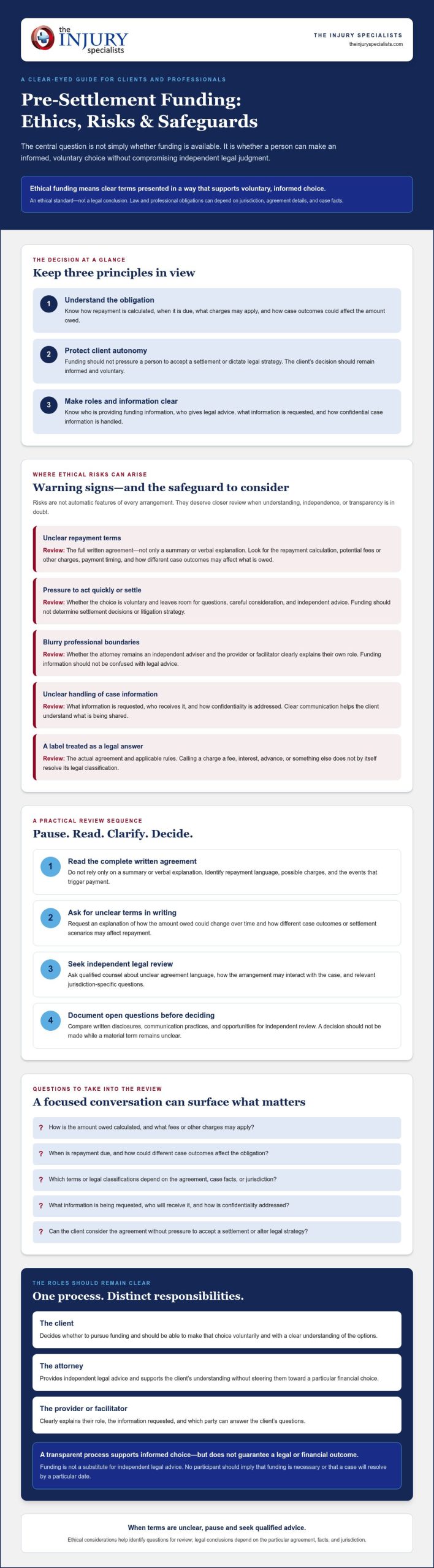
A practical ethical review checklist for clients and professionals
A repeatable review process helps clients and professionals identify gaps before a funding decision is made. The ethical considerations in pre-settlement funding are practical: clarify who is involved, understand the written terms, record questions, and get independent advice where needed. Keep the funding decision separate from choices about medical care and legal strategy.
A step-by-step review before accepting funding
- Start with the written agreement. Identify each party and distinguish the funding provider from any facilitator connecting the parties. Confirm what arrangement is being proposed and which entity is responsible for each part of the process.
- Review the financial terms. Locate disclosures about fees, repayment calculations, timing, and contingencies. Ask how the amount owed could differ under relevant case-resolution scenarios. Don’t rely on a verbal summary if the written terms are incomplete or appear to say something different.
- Document unanswered questions. Keep a written list of unclear terms, requested explanations, and any responses received. This creates a record the client and attorney can review together and makes it easier to identify unresolved issues.
- Consult independent counsel before signing. Ask the client’s attorney to assess how the agreement relates to the case and whether jurisdiction-specific law or professional duties affect the decision. The client should decide whether to proceed without pressure from a provider, facilitator, or other professional.
Funding should not determine which medical care a person pursues or whether a settlement offer is accepted. Those decisions involve separate considerations and should remain with the client, supported by appropriate medical and independent legal advice. A funding provider or facilitator can describe its process, but neither replaces the client’s attorney.
When to pause and seek additional guidance
Pause if pages or terms are missing, repayment language is unclear, or a verbal explanation conflicts with the agreement. Request clarification in writing. Seek qualified legal advice when the answer may depend on state law, the specific contract, or an attorney’s professional responsibilities. Don’t sign simply because someone presents a deadline without explaining why it applies.
For professionals, clear records and defined communication steps can help keep review organized. Personal injury case management technology can provide broader context on documentation and coordinated workflows. Organized records support process clarity, but they don’t determine whether an agreement is appropriate or guarantee a legal or financial result.
To learn about the company’s role in facilitating funding, review pre-settlement funding support. Keep the client’s independent advice and informed decision at the center of any next step.
How coordinated support can keep funding discussions informed and transparent
Funding discussions can involve an injured person, an attorney, a funding provider, and a facilitator. Clear communication helps each participant understand their responsibilities and where questions should go. For example, a client may ask the provider to explain a term in the agreement, then consult their attorney about how that term could affect the case. Keeping those roles distinct supports informed choice without shifting legal decisions to a funding or referral process.
The facilitator’s role in a broader injury-support network
The Injury Specialists facilitates pre-settlement funding services within a wider personal injury network connecting injury victims with medical and legal professionals. A facilitator can help connect parties, but it isn’t a law firm or medical provider. It doesn’t provide direct legal representation or medical treatment, and it shouldn’t be presented as directly issuing funding or controlling an attorney’s decisions.
That distinction matters in practice. A facilitator may help make the pathway between participants clearer, while the funding provider explains its agreement and the client’s attorney addresses legal questions. The client remains the decision-maker. Clear role descriptions can reduce confusion about who can explain a term, who gives legal advice, and who decides whether to proceed.
Coordinated communication can also support an organized record. Participants can identify which agreement version is under review, note who is responsible for answering outstanding questions, and document when a clarification is provided. Any exchange of case information should follow the client’s direction and the attorney’s guidance on applicable confidentiality duties. Coordination supports process clarity, but it doesn’t guarantee a legal or financial outcome.
Next steps for an informed, independent decision
Before moving forward, gather the agreement and any written explanations or disclosures. List unanswered questions, including who the parties are, how the arrangement works, what information may be shared, and which terms need clarification. Bring that list to qualified independent counsel for advice specific to the client’s agreement, case, and jurisdiction. General educational material and a funding provider’s explanation can help frame the discussion, but neither replaces legal counsel.
The ethical considerations in pre-settlement funding are best addressed through clear roles, transparent communication, and the client’s independent decision-making. For information about the company’s role and broader network, explore The Injury Specialists’ personal injury network.
Make the Next Step an Informed One
The ethical considerations in pre-settlement funding come down to transparency, voluntary choice, and independent legal judgment. Review the complete agreement, clarify the potential repayment obligation, and document unanswered questions before deciding. Keep funding decisions separate from legal strategy and medical care, and seek qualified counsel when terms or jurisdiction-specific issues need review.
Clear coordination can help everyone understand their role without promising a particular case result. The Injury Specialists facilitates connections among injury victims, medical providers, and legal professionals, and provides pre-settlement funding facilitation and medical case management services. It doesn’t replace independent legal advice or make the client’s decision.
For information about The Injury Specialists’ network and services, explore the company’s professional network. With clear documents, open questions, and independent guidance, you can move forward with greater confidence in your decision.
Frequently Asked Questions
Is pre-settlement funding ethical?
Pre-settlement funding isn’t automatically ethical or unethical in every situation. The ethical considerations in pre-settlement funding include whether the agreement clearly explains its terms, whether the injured person can choose freely with adequate information, and whether legal judgment remains independent. Laws and professional obligations can vary by jurisdiction. Review the specific agreement with qualified independent counsel before deciding, rather than relying on a general explanation.
Can pre-settlement funding affect a personal injury case?
Funding doesn’t determine the merits of a claim, but its financial obligations may affect a person’s decisions about settlement or case timing. The agreement and case circumstances matter. Funding shouldn’t dictate legal strategy, and attorneys should maintain independent judgment. Before accepting or rejecting an offer, clients should ask the attorney handling the case to explain how the funding agreement may interact with settlement proceeds and the client’s options.
What should I review in a pre-settlement funding agreement?
Read the entire written agreement and identify the parties, the facilitator’s role, the amount provided, all disclosed charges, and how repayment may work under different outcomes. Ask for plain-language explanations of unfamiliar terms or verbal statements that aren’t reflected in the document. Keep a record of unanswered questions. A general article can’t interpret a specific contract, so have independent counsel review concerns before signing.
Does an attorney have to approve pre-settlement funding?
Whether attorney involvement is required, and what professional obligations apply, can depend on the jurisdiction and arrangement. An attorney’s involvement doesn’t replace the client’s informed decision. Ask the attorney what role they’ll play, what information they may need to share, and whether professional or jurisdiction-specific concerns arise. Attorney approval doesn’t guarantee a particular outcome or establish that every agreement term suits the client’s circumstances.
Can a funding provider influence my settlement decision?
The agreement and applicable law determine a provider’s rights, so don’t assume every arrangement works the same way. Funding information isn’t legal advice, and an advance shouldn’t be treated as a reason to accept an offer without understanding its consequences. Ask your attorney to explain how the agreement may interact with settlement proceeds and your choices. The settlement decision should remain an independent legal decision made with qualified counsel.
Are pre-settlement funding rules the same in every state?
No. A general explanation can’t fully describe rules across the United States. Legal definitions, regulation, and professional responsibilities may depend on jurisdiction and the details of the arrangement. Check current primary legal sources and consult qualified counsel familiar with the applicable law. This article provides general education, not legal advice, and shouldn’t be used to decide whether a particular agreement is enforceable.
What should I do if funding terms are unclear or I feel pressured?
Pause and don’t sign until you understand the written terms and have had a reasonable chance to ask questions. Request clarification in writing, compare it with the agreement, and consult independent legal counsel about your situation. Pressure to sign, incomplete disclosures, or a difference between verbal assurances and written terms are reasons to stop and review. Keep copies of the agreement and related communications for your records.
