

A referral list alone won’t solve inconsistent case flow, paperwork delays, or uncertainty around medical liens. A lawyer referral service for physicians should connect your practice with personal injury law firms and support the case-management process that follows.
Physicians need dependable legal partners, clear communication, and organized documentation without adding unnecessary administrative work. The right network can help bring those pieces together while keeping patient needs and professional standards in view.
This article explains how specialized referral networks work, what to look for when evaluating personal injury law firms, and how case-management technology can help organize documentation and track case progress. You’ll also learn how The Injury Specialists connects medical and legal professionals through physician referral services, integrated case management, and technology designed to streamline coordination. The goal is a more consistent referral process and a more manageable workflow for your practice.
Key Takeaways
- A lawyer referral service for physicians can offer more than directory listings by connecting medical practices with personal injury law firms through a professional network.
- Assess a referral network across three areas: referral connections, case-management technology, and coordination that fits participating firms’ processes.
- When evaluating law firm partners, ask about their experience with medical liens and letters of protection, and how they manage case documentation and updates.
- Bar referral services and specialized PI networks serve different purposes. Understanding their models can help you choose a partner that fits your practice’s needs.
- The Injury Specialists connects physicians, chiropractors, imaging centers, and law firms through referral programs, medical case management, and technology.
Lawyer Referral Service for Physicians: Beyond the Directory
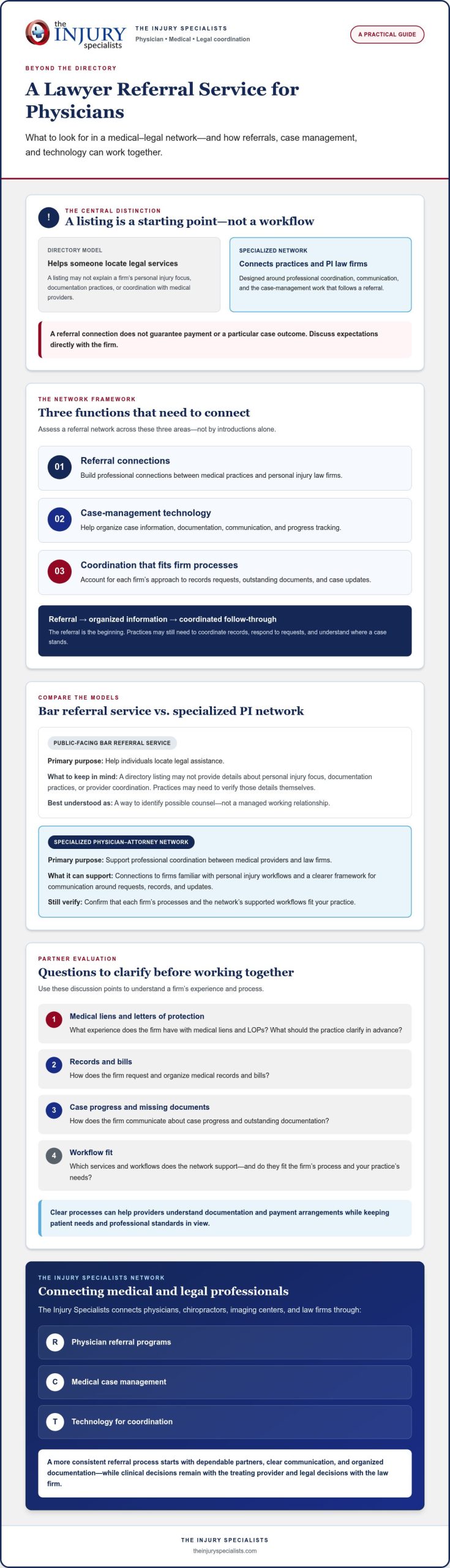
A public directory can help someone locate legal services. A medical practice, however, needs more than a name and phone number. A lawyer referral service for physicians should connect practices with personal injury law firms and support the communication and case-management work that follows. The distinction matters when treatment records, billing details, medical liens, and letters of protection (LOPs) need to be coordinated during a case.
A lawyer referral service can take different forms, from public-facing programs that help consumers find counsel to professional networks built around ongoing relationships between medical and legal organizations. The right model depends on what your practice needs. Look beyond general eligibility and ask whether a firm understands injury-related documentation, has clear communication processes, and can explain how it handles liens and LOPs. A referral connection does not guarantee payment or a particular case outcome, so discuss expectations directly with the firm.
The Limitations of General State Bar Referrals
Public-facing bar referral services are generally structured to help individuals locate legal assistance, not to manage the working relationship between a medical practice and a law firm. They can be a useful starting point, but a directory listing may not tell you about a firm’s personal injury focus, documentation practices, or approach to coordinating with medical providers. Practices may need to verify those details themselves.
These programs also aren’t typically designed as practice-growth networks. A listing alone doesn’t create a coordinated process for case updates, records requests, or ongoing professional networking. Treat a directory as a way to identify possible counsel, then evaluate the firm before establishing a working relationship.
The Benefits of a Specialized Physician-Attorney Network
A specialized network is organized around professional coordination. It can connect physicians with firms familiar with personal injury workflows and support a clearer framework for communication. That structure can reduce administrative friction when practices are tracking requests, sending documentation, and seeking updates across multiple cases.
Ask prospective partners to explain their procedures, including:
- How the firm requests and organizes medical records and bills.
- How it communicates about case progress and missing documentation.
- How it approaches liens and LOPs, including what the practice should clarify in advance.
Clear processes support both sides: patients can pursue appropriate care while providers understand the documentation and payment arrangements connected to a case. The Injury Specialists connects medical and legal professionals through physician referral services, case management, and technology. A specialized lawyer referral service for physicians can make those connections easier to manage, but practices should still confirm that each firm’s processes fit their needs.
The Architecture of a Professional Medical-Legal Referral Network
A professional network works best when it connects three functions: referrals, technology, and case management. Referrals build relationships between physicians and personal injury law firms. Technology helps organize communication and case information. Case management supports coordination around each firm’s process. Together, these elements can connect medical and legal teams that otherwise work in separate systems.
A referral is only the beginning. A practice may need to coordinate records, respond to documentation requests, and understand where a case stands. A lawyer referral service for physicians should therefore offer more than introductions. It should help create a workable communication structure while leaving clinical decisions with the treating provider and legal decisions with the law firm.
Integrated Medical Case Management for Physicians
Medical case management can help coordinate case-related information from the initial referral through later case milestones. The process should account for each firm’s distinct requirements, such as how it requests records, tracks outstanding documents, or communicates about case progress. Confirm which services and workflows a network supports before relying on them.
Consistent coordination can also make it easier to identify missed appointments, incomplete records, or other documentation gaps. It doesn’t determine a settlement value or guarantee an outcome. It can help the practice maintain a clearer record of care and give the legal team information it may need to evaluate and present the case.
Technology as a Strategic Advantage
Without a central system, referral details and document requests can become scattered across emails, calls, and practice workflows. Case-management technology can provide a more organized way to track referrals and documentation. Ask whether a platform supports the updates your team needs, who can access case information, and how information is shared. Don’t assume every system provides real-time updates or the same functions.
Technology can also support professional networking by helping practices connect with a broader legal network. For physicians, chiropractors, physical therapists, and imaging centers, these connections can help build relationships with firms seeking coordinated medical resources.
Imaging referrals are another part of a medical-legal network. When clinically appropriate, diagnostic imaging can provide findings that treating professionals document and explain. Those records may add context to a law firm’s case file, but imaging should be guided by clinical judgment, not by a desired legal outcome.
The Injury Specialists combines physician referral services, medical case management, and proprietary technology to connect medical and legal professionals. Learn more about The Injury Specialists’ medical-legal network and consider how its services may fit your practice’s coordination and referral goals.
Comparing State Bar Services to Specialized PI Networks
State bar referral services and specialized personal injury (PI) networks serve different needs. A bar service generally helps an individual find a lawyer, often through a public-facing directory or matching process. A specialized network focuses on professional connections between medical practices and law firms, with attention to case coordination and practice needs. Neither model replaces a physician’s responsibility to assess whether a prospective partner is a good fit.
For a physician, the difference is practical. A consumer referral may provide a starting point for finding counsel, but it may not address how a firm requests medical records, communicates about case status, or handles provider liens. A specialized lawyer referral service for physicians is designed around those working relationships. Ask what support the network provides, then confirm directly with each firm how it handles documentation and lien-related questions.
Vetting Standards: Beyond the Law License
Bar standing is a basic credential to verify, not proof of personal injury specialization or a firm’s fit for your practice. Ask about the types of injury matters the firm handles, its processes for working with medical providers, and how it manages records and bills. Request a clear explanation of how the firm approaches medical liens and letters of protection (LOPs). These discussions help establish expectations, but they don’t guarantee payment or a case result.
Consultation arrangements also differ by service and firm. A public referral program may offer a consultation under its own terms, while a professional network may emphasize ongoing coordination rather than a one-time introduction. Compare the actual services and terms instead of assuming one model includes lien management or other support.
Operational Efficiency and Scalability
A referral connects two parties. A strategic partnership supports repeatable communication as cases move forward. If your practice handles personal injury matters, ask:
- Can the firm explain its intake and documentation workflow?
- How will staff receive and respond to case-related requests?
- What system, if any, supports tracking referrals and outstanding documentation?
- Can the network connect the practice with relevant firms beyond its existing professional circle?
Public services may be organized around particular jurisdictions or consumer access, while specialized networks can offer broader professional connectivity. The Injury Specialists operates a national medical-legal networking platform with referral services, case management, and technology. For more on network models and operational considerations, read The Comprehensive Guide to Personal Injury Referral Networks in 2026. A lawyer referral service for physicians is most useful when its connections align with your practice’s needs and its processes are clear enough to evaluate.
Evaluating a Referral Partner: A Physician’s Strategic Framework
Strong referral relationships depend on clear processes, not promises of case volume or payment. Use these five checks to assess whether a law firm can coordinate effectively with your practice and manage personal injury cases with appropriate attention to medical documentation.
- Assess lien and LOP experience. Ask how the firm documents medical liens and letters of protection, communicates about them, and addresses outstanding balances as a case progresses. Clarify what the practice should expect, since no referral relationship can guarantee that a lien will be paid in full.
- Verify case-management capabilities. Find out who tracks records requests, bills, and other case documents. Ask how the firm identifies missing information and follows up with the provider’s office.
- Review communication protocols. Confirm how staff can submit medical updates, who handles questions, and what relevant case-status information the firm can share. Agree on a practical process for routine requests and documentation deadlines.
- Clarify professional networking expectations. Ask whether the relationship includes ongoing introductions or networking opportunities. Referrals should remain based on the patient’s needs and professional judgment, not an expectation of guaranteed or paid reciprocal referrals. Review any proposed arrangement for applicable ethical requirements.
- Examine the technology. Ask what tools support referral tracking, document exchange, and status updates. Confirm who can access shared information and whether the system fits your practice’s workflow.
Red Flags to Watch For
Take care if a firm repeatedly misses agreed documentation timelines, cannot explain how it tracks case status, or gives vague answers about lien handling. If pre-settlement funding comes up, ask how the firm explains its role and terms to clients. Don’t assume funding is part of a medical referral program. Unclear communication at the outset can create avoidable administrative work later.
Questions for Prospective Law Firm Partners
Use direct questions to compare firms: How do you coordinate medical case management for clients? What technology do you use to communicate with providers? How do you track medical records and bills? What is your process for addressing liens as a case moves toward resolution, and what updates can a provider expect? Specific answers should help your team understand the firm’s workflow.
A structured evaluation can turn a basic introduction into a more informed professional relationship. For additional context on network models and coordination, read the guide to physician referral services for personal injury. The Injury Specialists provides physician referral services, medical case management, and technology for medical-legal coordination. Details about its physician referral services can help you assess how the network fits your practice.
Scaling Your Practice with The Injury Specialists Network
Building a dependable personal injury referral channel takes more than meeting firms one at a time. The Injury Specialists operates a national medical-legal networking platform and identifies itself as the largest personal injury referral network in the United States. It connects medical providers and law firms through referral services, case management, and technology. Network participation can create opportunities for professional connection, but it doesn’t guarantee a specific number of referrals or revenue.
The platform connects physicians, chiropractors, physical therapists, imaging centers, and law firms. For a medical practice, these connections can support visibility among legal professionals seeking medical providers. For firms, coordinated relationships can make it easier to connect with providers whose services fit a case. Patient care and clinical decisions remain with the treating provider, while legal decisions remain with the attorney.
A Growth-Oriented Partnership
Marketing and networking can help practices expand their referral-partner base. Integrated medical case management and proprietary technology are designed to streamline coordination. Because law firms may have distinct processes, ask how case management works with their requirements and what information your team will need to provide.
A well-organized workflow can help your practice present its capabilities clearly to legal partners. It doesn’t establish “preferred provider” status or promise referrals. Instead, it creates a structure for building professional relationships and managing case-related communication. Physicians evaluating a lawyer referral service for physicians should weigh the quality of its connections alongside the practical support available after an introduction.
Joining the Professional Ecosystem
Before joining, clarify how provider onboarding works, what information the network needs, and which services apply to your practice. Ask how referrals are coordinated, how the technology supports documentation or case tracking, and how medical case management aligns with participating firms’ workflows. Confirm the terms and scope of any service before relying on it.
The Injury Specialists also offers imaging center referrals and pre-settlement funding. These are distinct offerings, so ask about their eligibility, process, and relevance to your organization rather than assuming they are part of every physician referral relationship. A thoughtful review can help you decide whether the network’s services fit your operational and professional goals.
For practices assessing a national medical-legal network, The Injury Specialists’ provider and referral services provide information about participation, case management, and technology. A lawyer referral service for physicians is most useful when its connections and workflows match the needs of your practice.
Build a More Connected PI Referral Network
A strong lawyer referral service for physicians offers more than introductions. The right network supports professional connections, clear communication, and case management that fits the needs of medical providers and law firms. Evaluate potential partners by their approach to documentation, lien communication, technology, and ongoing coordination.
The Injury Specialists connects medical and legal professionals through a national network it describes as the largest personal injury referral network in the United States. Its proprietary case-management technology is designed to streamline coordination, while the network supports connections between practices and law firms. These resources can support a more organized referral workflow, though outcomes depend on each provider’s and firm’s processes.
To explore physician referral services, case management, and technology for medical-legal coordination, contact The Injury Specialists about joining its network.
Frequently Asked Questions
How do lawyer referral services for physicians differ from public bar directories?
Public bar directories help individuals find legal counsel, while a specialized network connects medical providers and law firms for professional coordination. A lawyer referral service for physicians may include medical case management, networking, and technology to support referrals and case-related communication. Ask what the service actually provides. A directory listing or network connection alone doesn’t verify a firm’s personal injury experience or guarantee referrals, payment, or a particular case outcome.
Can a physician join a referral network to increase personal injury patient volume?
Physicians can join professional networks designed to build connections with law firms and expand referral partners. The Injury Specialists offers physician referral services, marketing, and networking for medical providers. These services may help increase a practice’s visibility among legal professionals, but they don’t guarantee patient volume or a specific number of referrals. Evaluate the network’s reach, provider requirements, and support process, while ensuring every referral remains appropriate for the patient’s needs.
What is the role of medical case management in a lawyer referral service?
Medical case management helps organize coordination between providers and law firms during a personal injury case. Depending on the service, this can include aligning documentation and communication with a firm’s distinct process. For example, a practice may need to provide records or respond to requests as a case progresses. Confirm which tasks the network handles and which remain with your staff. Case management supports workflow; it doesn’t determine clinical care or legal outcomes.
Are there national lawyer referral services that specialize in personal injury?
Yes. The Injury Specialists operates a national personal injury referral network that connects injury victims, medical providers, and law firms. Its services include specialized referral programs for physicians, chiropractors, and imaging centers, along with medical case management and case-management technology. National scope can broaden professional connectivity, but practices should still review participation terms and assess whether the network’s workflows and connections fit their needs.
How does a referral network help protect medical liens for physicians?
A referral network can support clearer communication and documentation around medical liens, but it can’t guarantee that a lien will be paid or fully satisfied. Ask how the firm records provider balances, shares relevant case updates, and addresses liens as a case moves toward resolution. Clarify the practice’s own documentation responsibilities and confirm any lien terms directly with the firm. A consistent process helps providers understand status and outstanding questions.
What technology should a professional medical-legal network provide?
Look for technology that supports practical coordination, such as organizing referrals, case-related documentation, and communication between medical and legal professionals. Ask whether the platform fits your staff’s workflow, what information it tracks, and who can access shared records. The Injury Specialists offers proprietary case-management technology for the personal injury ecosystem, including marketing and networking capabilities. Confirm the platform’s specific functions rather than assuming it provides real-time updates or a particular integration.
How do I evaluate a law firm as a potential referral partner?
Verify the firm’s standing and personal injury experience, then ask how it handles medical records, bills, liens, and letters of protection. Clarify who manages provider communication, how the firm tracks requests, and what case updates it can share. Ask about its technology and workflows, too. Specific, transparent answers help you assess operational fit. Don’t treat a referral connection as a guarantee of payment, reciprocal referrals, or a case result.
