

Informal lunch meetings and sporadic peer check-ins can no longer sustain an ambitious personal injury practice. With legal paid search campaigns frequently exceeding $442 per lead, relying on casual goodwill drains capital while failing to deliver predictable caseloads. Sustainable firm expansion requires systematic attorney referral marketing strategies that replace ad hoc networking with institutional, technology-driven infrastructure.
You already know that bidding wars on search engines bleed margins, while unvetted peer handoffs often arrive without proper case qualification or organized medical documentation. Treating providers often work in operational silos, creating communication gaps that drag out liens and slow case resolution. Real operational scale demands vetted professional alliances. In this 2026 playbook, you’ll discover how modern attorney referral marketing strategies establish reliable inbound case flow from healthcare partners, streamline medical coordination, and drastically lower client acquisition costs. We examine the exact operational blueprints, ethical fee frameworks, and integrated systems required to transform professional relationships into an automated growth engine.
Key Takeaways
- Replace volatile digital ad spending with institutional attorney referral marketing strategies that secure consistent, high-value personal injury cases.
- Partner directly with multidisciplinary medical providers, including physicians, chiropractors, and diagnostic imaging centers, to establish high-converting referral pipelines.
- Implement dedicated case management technology to streamline communication, eliminate record retrieval delays, and accelerate settlement velocity.
- Execute a structured five-step operational framework to audit existing contacts, segment top-tier partners, and institutionalize referral tracking.
- Utilize centralized personal injury referral networks to eliminate administrative friction and scale your firm’s national reach without increasing overhead.
The Evolution of Attorney Referral Marketing: Why Traditional Tactics Fail in 2026
Broad commercial growth requires treating professional partnerships as a systematic business development asset rather than a casual social activity. At its core, referral marketing leverages established third-party trust to guide qualified claimants directly into a firm’s operational pipeline. In personal injury law, modern attorney referral marketing strategies replace sporadic lunches and handshake agreements with disciplined, scalable infrastructure. Traditional networking creates volatile caseload fluctuations that strain administrative staff and stall revenue. Enterprise-level practices now view referral generation as a predictable, high-velocity intake channel.
The Escalating Costs and Diminishing Returns of Saturated Legal Ads
Paid digital advertising has become a capital-intensive trap for personal injury practices. Pay-per-click rates continue to surge nationwide, requiring massive cash reserves just to generate raw inquiries. Consumer ad skepticism and banner fatigue further depress conversion rates, forcing intake teams to waste billable hours screening low-value leads. Firms relying exclusively on transactional digital ads remain financially vulnerable to sudden platform policy shifts and well-funded competitors. Developing structured referral sources provides an impenetrable moat, securing pre-qualified cases with documented liability at a fraction of paid digital acquisition costs.
From Transactional Rolodexes to Institutional Referral Ecosystems
The traditional Rolodex approach fails because ad hoc favor-trading cannot support enterprise growth. Exchanging cases informally creates clear operational bottlenecks:
- Zero Pipeline Predictability: Unstructured peer handoffs fluctuate wildly in volume and case quality.
- Siloed Case Information: Tracking referrals across manual spreadsheets delays clinical updates and lien resolutions.
- One-Way Value Flows: Practices that fail to return reciprocal value quickly lose their best referral sources.
Implementing sophisticated attorney referral marketing strategies solves these systemic flaws. By shifting from transactional contacts to institutionalized medical-legal networks, firms establish automated communication, maintain full file transparency, and create sustainable mutual value across every matter.
Core Pillars of High-Performing Legal Referral Networks
Modern legal practices cannot rely on goodwill alone. High-velocity attorney referral marketing strategies require systematic alignment, strict compliance boundaries, and verifiable mutual benefit across all stakeholders. As outlined in the comprehensive guide to personal injury referral networks in 2026, successful alliances thrive on clear protocols that govern how cases transfer, how records move, and how partners communicate.
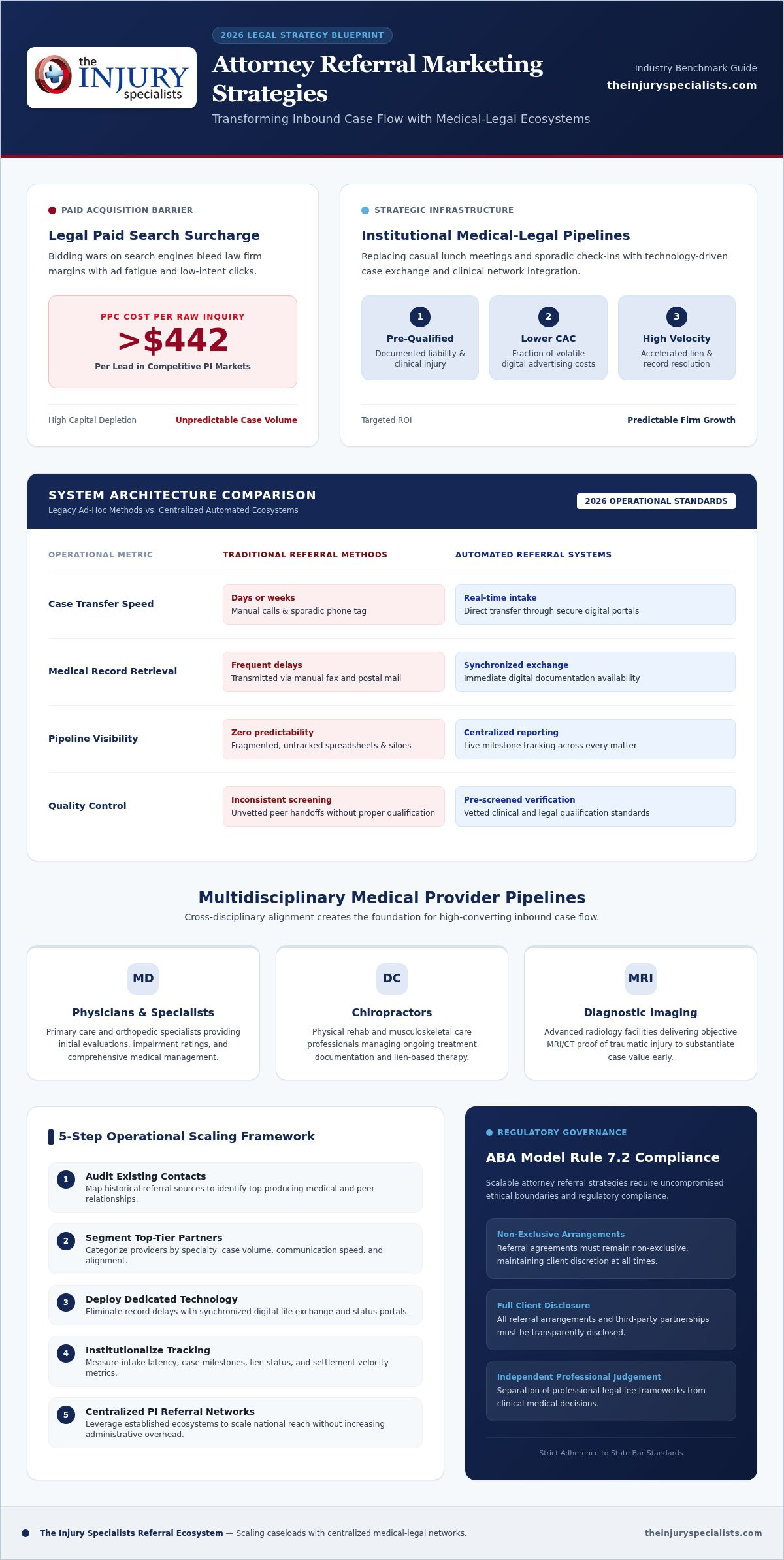
The contrast between legacy methods and automated networks highlights why traditional firms struggle with growth:
| Operational Metric | Traditional Referral Methods | Automated Referral Systems |
|---|---|---|
| Case Transfer Speed | Days or weeks via manual calls | Real-time intake through secure portals |
| Medical Record Retrieval | Frequent delays via fax and mail | Synchronized digital exchange |
| Pipeline Visibility | Fragmented, untracked spreadsheets | Centralized milestone reporting |
| Quality Control | Inconsistent peer screening | Vetted clinical and legal qualification |
Ethical Compliance and State Bar Rule Governance
Executing scalable referral networks requires uncompromised ethical standards. ABA Model Rule 7.2 permits lawyers to participate in qualified referral services and establish reciprocal referral relationships, provided those arrangements are non-exclusive and fully disclosed to the client. Law firms must maintain absolute independence, keeping professional fee agreements separate from clinical relationships. Non-lawyer fee-splitting remains prohibited under standard bar rules, meaning cross-disciplinary networks must focus purely on logistical coordination, client care continuity, and operational efficiency rather than split proceeds.
Mutual Value Creation: Aligning Attorney and Partner Incentives
Referral pipelines collapse when communication flows one way. Medical providers refer injured patients because they want prompt treatment authorization, consistent documentation, and professional coordination. Legal teams benefit from timely, objective clinical notes that substantiate damages. Tracking core relationship metrics such as intake-to-treatment speed, record completeness, and client satisfaction ensures that both sides protect case integrity from day one.
Integrated Case Management Technology as a Retention Engine
A major blind spot for expanding firms is failing to coordinate medical case management with referring entities. When treatment records scatter across multiple clinics, case values drop and settlement timelines drag out. Integrating personal injury case management technology eliminates these administrative barriers by providing shared dashboards, secure file sharing, and automated stage notifications. Connecting your firm with The Injury Specialists gives your practice direct access to an established medical-legal ecosystem designed to streamline client care and accelerate case resolution.
Cross-Disciplinary Medical Provider Partnerships: The Untapped Referral Pipeline
Healthcare professionals represent the actual front line of personal injury recovery. Before an accident victim ever contacts a law firm, they present to emergency rooms, urgent care clinics, or private practices with acute physical distress. Most law firms overlook this early clinical window, leaving massive inbound potential on the table. Expanding beyond peer-to-peer exchanges and integrating physician referral services for personal injury into modern attorney referral marketing strategies connects firms with claimants when treatment pathways are actively taking shape.
A resilient medical referral network requires alignment across diverse clinical disciplines:
- Primary Care and Urgent Care Physicians: Identify accident-related trauma immediately and initiate initial injury charting.
- Chiropractors and Physical Therapists: Provide extended rehabilitation, documenting functional limitations, range-of-motion metrics, and daily pain progressions.
- Diagnostic Imaging Centers: Secure critical early objective findings through MRIs, CT scans, and X-rays that definitively establish trauma severity.
- Interventional Pain Specialists and Orthopedic Surgeons: Provide specialist evaluations, injections, and surgical interventions that clarify the catastrophic nature of complex claims.
Establishing Strategic Alliances with Specialized Treatment Facilities
Clinical practice administrators prioritize patient compliance and predictable reimbursement. When reaching out to clinics, firms must demonstrate administrative efficiency rather than pitching legal services. Healthcare providers avoid legal cases when they anticipate protracted lien negotiations and non-responsive legal teams. Outlining transparent communication protocols and demonstrating how your firm protects medical liens builds immediate credibility with facility administrators across orthopedic, neurologic, and physical rehabilitation groups.
The Role of Professional Medical Case Management in Partner Trust
Medical case management functions as the operational bridge connecting clinical treatment with courtroom advocacy. Dedicated case coordinators ensure clients attend scheduled therapy sessions, follow discharge instructions, and maintain regular care intervals. This rigorous oversight prevents defense counsel from citing gaps in treatment to diminish settlement values. For healthcare providers, meticulous case management guarantees clean billing records and reliable lien preservation. Implementing structured collaboration frameworks, as detailed in the comprehensive guide to law firm medical referral programs in 2026, elevates standard attorney referral marketing strategies into an integrated, multi-specialty care ecosystem that protects client recovery and partner trust simultaneously.
Implementing Modern Referral Operations: From Intake to Settlement
Successful personal injury practices run their partnership channels with the same operational rigor as courtroom litigation. High-yield attorney referral marketing strategies require deliberate workflows that eliminate intake bottlenecks, automate data collection, and preserve partner confidence across the entire litigation lifecycle. Managing these interactions through fragmented emails guarantees lost cases and broken relationships.
Executing an enterprise-level referral framework requires five systematic steps:
- Audit and Segment Existing Networks: Categorize historical partners by case volume, matter value, and communication reliability to focus resources on top-tier contributors.
- Deploy Dedicated Tracking Infrastructure: Implement software that attributes inbound leads precisely, logs conversion rates, and monitors case status in real time.
- Standardize Rapid Intake Protocols: Engage referred claimants within minutes using structured multi-channel response sequences.
- Maintain Proactive Milestone Reporting: Provide referring partners with scheduled, automated litigation updates without requiring manual staff outreach.
- Optimize Operational Velocity: Expedite medical lien resolutions and record audits to conclude matters quickly and return clear settlement data to partners.
Rapid Client Intake and White-Glove Onboarding Protocols
Speed to lead dictates referral conversion. When an injured individual gets referred by a physician or another attorney, delays of even an hour dramatically decrease retention rates. Injured claimants seek immediate reassurance and clear direction. Modern intake operations deploy dedicated response teams who execute electronic retainer agreements immediately. They quickly gather insurance details and schedule prompt clinical evaluations, ensuring patient recovery begins without administrative delay.
Automating Partner Communication Without Draining Legal Staff
Referring partners disengage when their referrals enter an information vacuum. Constant phone calls and status requests drain your paralegals and legal assistants. Automated communication workflows solve this friction entirely. Secure platforms distribute milestone alerts when critical events occur: intake completion, primary diagnostic imaging, demand package submission, and settlement distribution. These notifications maintain partner trust while protecting HIPAA-governed health records and client-attorney confidentiality. To replace manual follow-ups with centralized operational tracking, streamline your partner network with The Injury Specialists and secure a seamless intake-to-settlement pipeline.
Scaling Law Firm Caseloads with The Injury Specialists Referral Ecosystem
Executing scalable attorney referral marketing strategies requires an institutional partner capable of bridging legal operations with medical networks. The Injury Specialists operates the largest personal injury referral network in the United States, connecting law firms, medical providers, and injured individuals through purpose-built infrastructure. Rather than forcing firms to build professional relationships from scratch, this ecosystem delivers immediate access to vetted healthcare partners backed by centralized logistics.
The network integrates every operational layer required to scale a personal injury practice:
- Vetted Healthcare Connectivity: Immediate access to medical professionals, chiropractors, physical therapists, and diagnostic imaging centers experienced in personal injury documentation.
- Proprietary Case Management Technology: Centralized software engineered specifically for personal injury workflows, document exchanges, and automated milestone tracking.
- Tailored Medical Case Management: End-to-end clinical coordination customized to match each law firm’s specific operational requirements and litigation preferences.
- Pre-Settlement Funding Support: Non-recourse financial assistance that preserves client stability and ensures uninterrupted medical treatment while negotiations proceed.
National Reach with Tailored Firm-Specific Integration
National scale does not require one-size-fits-all operations. The Injury Specialists tailors medical case management to reflect your firm’s distinct intake, treatment monitoring, and trial-readiness workflows. This operational alignment ensures that referring medical providers adhere strictly to the documentation timelines and reporting structures your attorneys require. Personal injury firms expand their operational reach across the country, securing qualified cases without taking on additional in-house administrative or paralegal overhead.
Comprehensive Support: Case Management, Technology, and Funding
Sustained legal growth depends on removing administrative friction at every stage of the matter. Proprietary case management technology powers seamless, real-time collaboration between attorneys and medical facilities, eliminating the delays common to manual record requests. Specialized case managers track client treatment compliance, protecting medical liens and ensuring damages are thoroughly documented. By integrating dedicated technology, active clinical coordination, and pre-settlement funding options, firms establish an automated, highly profitable growth pipeline. Position your practice for scalable expansion by applying for the Attorney Referral Program today.
Transform Your Law Firm’s Growth Pipeline for 2026 and Beyond
Relying on volatile digital ad spending or unorganized word-of-mouth creates unnecessary risk for expanding personal injury practices. Sustainable firm expansion requires modernized attorney referral marketing strategies anchored by structured operational workflows, direct alignment with multidisciplinary healthcare providers, and integrated case tracking. When medical treatment, clinical documentation, and legal milestones synchronize seamlessly, case progression accelerates while administrative friction disappears.
Scaling your firm nationwide no longer requires endless manual outreach. As the largest personal injury referral network in the United States, The Injury Specialists bridges the divide between legal teams and healthcare providers. With proprietary case management technology connecting legal and medical professionals, alongside end-to-end medical case management tailored to individual law firm workflows, your practice can secure high-value cases while lowering acquisition costs. Take command of your inbound pipeline today and partner with The Injury Specialists Attorney Referral Program to build a dependable, scalable competitive advantage.
Frequently Asked Questions
How do attorney referral marketing strategies differ from traditional legal advertising?
Attorney referral marketing strategies focus on building institutional, B2B relationships with healthcare providers and legal peers rather than buying transactional public ad space. Traditional legal advertising relies on volatile pay-per-click auctions and billboard impressions that yield unvetted inquiries. Systematic referral strategies secure qualified, high-intent claimants who have already initiated medical care. This lowers client acquisition costs and establishes a predictable inbound caseload protected from ad auction inflation.
Are medical provider referral networks compliant with state bar ethics and anti-kickback laws?
Structured networks comply with state bar rules and anti-kickback statutes when they operate without non-lawyer fee splitting or paid patient steerage. Ethical platforms maintain complete independence between legal counsel and clinical judgment. ABA Model Rule 7.2 permits reciprocal referral relationships provided they remain non-exclusive and fully transparent to the client. Modern platforms facilitate administrative data exchange, case coordination, and communication protocols without violating professional conduct standards.
What types of medical specialists should personal injury law firms partner with?
Personal injury practices should establish alliances across diagnostic, acute care, and long-term rehabilitation fields. Key clinical partners include diagnostic imaging centers for rapid MRIs, chiropractors and physical therapists for daily treatment notes, and orthopedic surgeons or interventional pain specialists for complex trauma. Securing connections across this multidisciplinary spectrum ensures claimants receive thorough treatment while your legal team gathers the objective documentation needed to prove full damages.
How does integrated medical case management improve personal injury case outcomes?
Integrated medical case management bridges clinical care and legal documentation to eliminate administrative delays and preserve case value. Dedicated case managers monitor client treatment attendance, track functional recovery milestones, and retrieve medical billing records immediately upon discharge. This oversight prevents defense insurers from exploiting gaps in care, ensures medical liens remain fully protected, and provides trial attorneys with organized clinical evidence to accelerate settlement timelines.
How quickly should a law firm contact a referred personal injury client?
Law firms should contact referred clients within minutes of receiving the referral. Data shows conversion rates plummet rapidly when inbound claimants wait hours for an initial consultation. Prompt contact reassures injured claimants during acute distress, establishes representation before competing adjusters intervene, and immediately coordinates necessary medical appointments. Deploying dedicated intake response systems ensures high-value partner referrals convert into retained matters consistently.
Can modern referral marketing strategies scale nationally without opening regional offices?
Law firms can expand their caseloads nationally without opening physical satellite offices by leveraging centralized partner platforms. Modern attorney referral marketing strategies use proprietary case management technology and nationwide medical provider networks to manage matters across multiple jurisdictions. These systems streamline medical coordination, digital document retrieval, and remote client intake, allowing ambitious firms to scale case volume efficiently without inflating brick-and-mortar overhead.
What role does pre-settlement funding play in sustaining attorney referral networks?
Non-recourse pre-settlement funding stabilizes injured claimants financially while legal proceedings unfold. When accident victims face mounting living expenses, financial pressure often forces them into premature, discounted settlements or causes them to abandon necessary medical treatment. By providing liquidity for essential costs, pre-settlement funding enables continuous clinical care, protects medical liens for treating providers, and gives legal teams the runway needed to pursue maximum compensation.
