

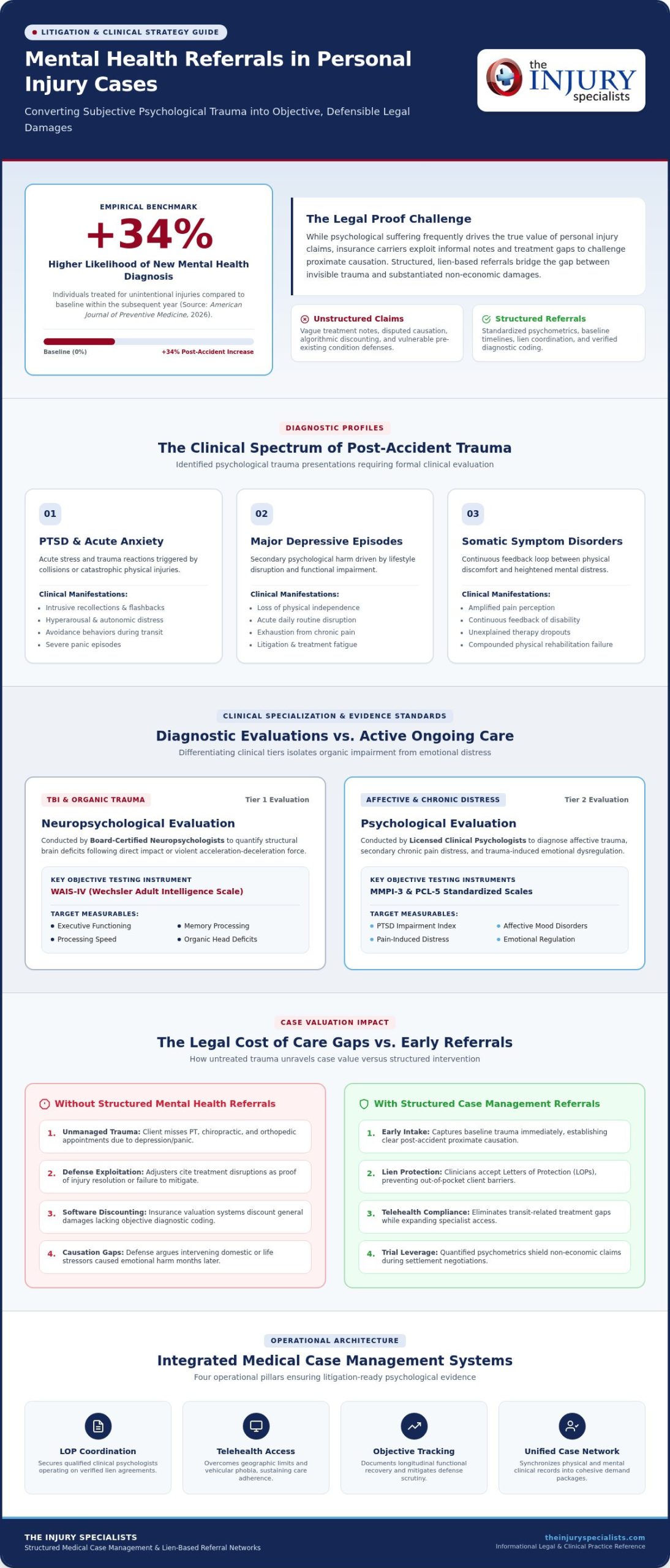
According to a 2026 study published in the American Journal of Preventive Medicine, individuals treated for unintentional injuries are 34% more likely to receive a new mental health diagnosis within the following year. Despite this reality, securing credible, lien-based mental health referrals for personal injury cases remains a major operational bottleneck for litigation teams. When outside clinicians reject letters of protection or generate vague treatment notes, legitimate non-economic damages quickly evaporate under defense scrutiny.
You already know that psychological suffering often dictates the true value of a claim, but insurance carriers relentlessly exploit care gaps and informal counseling records to contest proximate causation. Discover how structured mental health referrals establish direct causation, document verifiable psychological damages, and optimize personal injury case value. This comprehensive 2026 guide breaks down the objective diagnostic standards, lien coordination strategies, and medical case management systems required to turn subjective emotional distress into defensible trial and settlement leverage.
Key Takeaways
- Structured mental health referrals for personal injury cases establish undeniable proximate causation, converting subjective suffering into objective, compensable legal damages.
- Differentiating between diagnostic evaluations and active therapeutic care protects claims from pre-existing condition defenses and establishes clear baselines.
- Navigating letters of protection and telehealth compliance expands provider access while eliminating standard defense arguments regarding treatment gaps.
- Integrating psychological care into a unified medical case management ecosystem streamlines lien reconciliation and ensures seamless clinical record transmission.
Understanding Mental Health Referrals for Personal Injury Cases
Personal injury litigation historically prioritized visible trauma: broken bones, spinal misalignments, and surgical interventions. Modern tort strategy demands a broader scope. Coordinating timely mental health referrals for personal injury cases connects victims directly to licensed clinical psychologists, neuropsychologists, and psychiatrists capable of diagnosing trauma-induced sequelae. Tort law treats verified psychological harm with the same evidentiary weight as physical impairment, transforming how firms substantiate non-economic damages under the established legal concept of damages.
Left unaddressed, psychological trauma degrades client rehabilitation, destabilizes medical compliance, and depresses settlement values. Establishing early clinical intake captures immediate baseline trauma before opposing counsel can claim that symptoms stem from unrelated life stressors.
The Clinical Spectrum of Post-Accident Psychological Trauma
Trauma manifests across diverse clinical presentations following a severe collision or acute injury:
- Post-Traumatic Stress Disorder (PTSD) and Acute Anxiety: Marked by intrusive recollections, hyperarousal, avoidance behaviors, and severe panic during transit.
- Major Depressive Episodes: Driven by acute disruption of routine, loss of physical independence, and ongoing chronic pain.
- Somatic Symptom Disorders: Complex clinical conditions where physical discomfort amplifies underlying psychological distress, creating a continuous feedback loop of chronic disability.
Legal teams must watch for subtle behavioral markers: unexplained missed physical therapy sessions, unreturned phone calls, irritability, or severe litigation fatigue. These behaviors signal immediate psychological needs that require formal clinical evaluation rather than simple administrative follow-up.
The Legal Cost of Ignoring Invisible Injuries
Unmanaged psychological trauma directly damages a legal file. When clients suffer from untreated depression or trauma-related panic, they stop attending chiropractic, orthopedic, or imaging appointments. Defense adjusters track these care disruptions aggressively, arguing that non-compliance proves the injury resolved or that the plaintiff failed to mitigate damages.
Insurance software systems systematically discount general damages that lack concurrent, objective diagnostic coding. Waiting months to initiate mental health referrals for personal injury cases creates wide, indefensible causation gaps. Defense attorneys routinely exploit these delays, alleging that intervening personal, domestic, or financial stressors caused the mental suffering. Structured, early referrals establish immediate proximate causation, securing clinical documentation that shields your case against valuation reductions.
Clinical Specialties in Personal Injury: Evaluations vs. Ongoing Care
Precision matters when coordinating mental health referrals for personal injury cases. High-value litigation requires clear operational distinctions between diagnostic evaluations and active therapeutic treatment. Diagnostic evaluations establish an objective evidentiary baseline, whereas ongoing therapy documents longitudinal recovery and functional mitigation. Conflating these two clinical tiers leads to wasted disbursements, misaligned specialist notes, and compromised demand packages.
Neuropsychological vs. Psychological Evaluations
Defense adjusters routinely exploit diagnostic ambiguity between traumatic brain injuries (TBI) and secondary psychological trauma. A direct blow or violent acceleration-deceleration force frequently causes organic brain dysfunction that coexists with emotional distress. However, their legal proof requirements differ completely:
- Neuropsychological Evaluations: Administered by board-certified neuropsychologists to quantify objective deficits in executive functioning, memory processing, and processing speed caused by concussive or structural head trauma. Testing instruments like the WAIS-IV isolate organic neurological impairment from pre-existing conditions.
- Psychological Evaluations: Conducted by licensed clinical psychologists to diagnose affective disorders, chronic pain distress, and trauma-induced dysregulation. Standardized psychometrics, including the MMPI-3 and PCL-5, produce validated impairment scores for conditions like Post-Traumatic Stress Disorder.
Separating organic brain dysfunction from post-accident psychiatric responses prevents defense counsel from arguing that a client’s cognitive deficits are merely temporary stress reactions.
Therapeutic Modalities for Documented Trauma Recovery
While forensic assessments establish liability baselines, active therapeutic interventions demonstrate persistent damages and proactive mitigation. Litigation workflows require clinicians who track measurable recovery metrics through evidence-based modalities:
- Cognitive Behavioral Therapy (CBT): Generates quantifiable benchmarks showing functional improvements in sleep hygiene, emotional regulation, and daily tasks.
- Eye Movement Desensitization and Reprocessing (EMDR): Deconstructs acute vehicular phobias and somatic trauma triggers, allowing clients to resume normal commuting and employment activities.
- Psychiatric Care: Oversees targeted psychotropic medication management when severe depressive episodes or acute panic impede everyday routines.
Managing these specialized care tracks requires strong administrative coordination. Utilizing a dedicated network for physician referral services ensures your firm connects clients with vetted specialists whose notes align directly with personal injury documentation standards.
Establishing Causation and Maximizing Case Valuation
Subjective complaints don’t move insurance adjusters. Concrete medical evidence does. Deploying prompt mental health referrals for personal injury cases transforms an injured victim’s self-reported anguish into compensable clinical proof. Insurance carriers routinely categorize general damages as inflated unless objective diagnostic metrics establish proximate cause. Integrating psychological evaluations directly into demand packages anchors non-economic harm within established frameworks governing compensatory and punitive damages.
Clinical testimony and objective records bridge the gap between collision dynamics and functional impairment. They turn amorphous emotional distress into measurable economic and non-economic recovery.
Defeating the Pre-Existing Condition Defense
Defense adjusters immediately comb through prior medical histories to locate pre-existing depression, family trauma, or situational anxiety. A forensic mental health specialist systematically defeats this tactic using the eggshell plaintiff doctrine:
- Differential Diagnostic Interviews: Evaluators isolate historical baseline functioning from acute post-incident mental decompensation.
- Functional Analysis: Clinical records prove the plaintiff managed prior mild stressors successfully until the actionable crash triggered acute psychological collapse.
- Validity Testing: Standardized symptom validity metrics dismantle defense accusations of symptom exaggeration or secondary financial gain.
Documenting these clinical distinctions early prevents the defense from attributing ongoing psychological suffering to pre-existing conditions or unrelated life events.
Translating Clinical Records into Non-Economic Settlement Leverage
Maximizing settlement value requires translating clinical progress notes into clear legal leverage. Adjuster evaluation software assigns low values to vague notes like “client feels stressed.” In contrast, structured mental health reports quantify specific functional deficits:
- Loss of Enjoyment of Life: Clinicians document an inability to engage in social events, drive on highways, or maintain marital intimacy.
- Vocational Reductions: Reports measure cognitive exhaustion and executive disruption that reduce billable hours, workplace endurance, and promotional prospects.
- Life Care Plan Valuations: Treating clinicians establish defensible projections for future psychiatric care, trauma therapies, and pharmacotherapy costs.
Aligning clinical psychological records with structured medical case management ensures your demand packages present a unified evidentiary front that commands maximum settlement respect.
Overcoming Operational Barriers: Liens, Telehealth, and Logistics
Securing specialized behavioral clinicians represents one of the most frustrating friction points in personal injury litigation. Most private psychiatric and psychological practices operate on immediate cash or commercial insurance models. They routinely refuse letters of protection (LOPs) due to prolonged court calendars and uncertain settlement timeframes. Coordinating effective mental health referrals for personal injury cases requires overcoming these billing roadblocks while eliminating patient transportation hurdles through structured virtual care.
Navigating Medical Liens and Financial Protections
Solo behavioral practitioners rarely possess the administrative bandwidth to monitor litigation accounts receivable. When law firms attempt ad-hoc outreach to local therapists, they encounter delayed billing cycles, inconsistent chart updates, and sudden balance-billing demands directed at vulnerable clients.
Specialized referral ecosystems resolve this impasse by establishing standardized lien workflows. Partnering with dedicated physician referral services for personal injury guarantees that treating clinicians understand letter-of-protection protocols. This operational alignment secures continuous therapeutic treatment while ensuring all medical records, billing statements, and lien documents arrive synchronized for demand packaging.
Telehealth Integration in Modern Injury Care
Severe physical injuries, totaled vehicles, and accident-induced driving phobias frequently prevent victims from traveling to physical clinics. Telehealth eliminates these logistical roadblocks:
- Consistent Treatment Adherence: Virtual sessions prevent treatment gaps that defense adjusters weaponize to challenge injury severity.
- Rapid Diagnostic Triage: Early remote neuropsychological screenings detect subtle cognitive declines, expediting timely referrals for comprehensive diagnostic workups.
- Expanded Specialist Access: Telehealth broadens access to subspecialists who understand the forensic demands of personal injury claims without geographic limitations.
Virtual clinicians must adhere to rigorous forensic standards. Treatment platforms must maintain secure, HIPAA-compliant audit trails, while clinical records must document that remote assessments meet evidentiary standards for courtroom cross-examination.
Fragmented billing and disjointed records waste valuable staff hours and weaken settlement negotiations. You can streamline this entire pipeline. Work with The Injury Specialists to coordinate credentialed personal injury referrals across your active caseload.
Integrating Mental Health into a Unified Case Management Network
Isolated medical care fractures legal strategy. When orthopedic surgeons, chiropractors, imaging centers, and therapists operate in separate silos, litigation teams waste dozens of billable hours chasing scattered medical records. Coordinating mental health referrals for personal injury cases within an integrated ecosystem eliminates administrative bottlenecks, prevents conflicting clinical statements, and synthesizes physical and emotional damages into a single, cohesive narrative.
Unified case management ensures psychological care functions as a core evidentiary pillar rather than an uncoordinated afterthought. This synchronized approach accelerates case resolution and protects client retention.
The Power of Multidisciplinary Provider Synergy
Cross-specialty collaboration directly strengthens liability and damages presentations. When physical medicine and behavioral healthcare coordinate directly, clinical findings validate one another:
- Corroborating Pain Reports: Physical therapy logs recording cervical mobility loss directly support a clinical psychologist’s findings on accident-induced panic during physical exertion.
- Diagnostic Consistency: Dedicated medical case managers review incoming clinical notes, preventing contradictory statements regarding work capacity or treatment milestones.
- Holistic Damage Presentation: Synchronized reporting demonstrates how physical trauma triggers psychological decompensation, substantiating complex general damages.
Deploying a nationwide personal injury referral network gives litigation teams immediate access to credentialed providers who understand how their documentation impacts settlement negotiations.
Harnessing Case Management Technology for Legal Efficiency
Modern personal injury practice demands automated logistics. Relying on phone calls, manual faxes, and paper mail to track psychological therapy attendance creates severe administrative drag. Centralized digital portals provide real-time transparency across your entire active caseload:
- Automated Record Aggregation: Treatment notes, diagnostic scoring sheets, and billing statements update automatically within a centralized system.
- Attendance Monitoring: Real-time compliance tracking identifies missed therapy appointments immediately, giving case managers the opportunity to re-engage clients before the defense can allege gaps in care.
- Lien Status Visibility: Cloud-based dashboards track lien balances in real time, expediting final settlement reconciliation.
Adopting specialized personal injury case management technology eliminates operational friction, protects non-economic damage value, and frees legal teams to focus on case strategy and aggressive advocacy.
Scale Case Outcomes with Systematic Mental Health Coordination
Psychological trauma often determines whether a personal injury claim settles for baseline medical specials or reaches its true value. Structuring timely mental health referrals for personal injury cases provides the objective diagnostic testing and continuous treatment notes needed to survive defense challenges. This proactive approach eliminates care gaps, counters pre-existing condition arguments, and converts subjective client distress into defensible non-economic damages.
Operating as the largest nationwide network connecting personal injury attorneys with specialized healthcare providers, The Injury Specialists delivers integrated medical case management designed specifically for high-stakes litigation workflows. Our comprehensive technology platform tracks medical documentation, lien compliance, and treatment continuity in real time, eliminating administrative burnout and accelerating settlement negotiations. Transform your firm’s operational velocity. Connect with vetted mental health specialists through The Injury Specialists network today to build stronger, fully documented cases with total confidence.
Frequently Asked Questions
Why are mental health referrals essential in personal injury cases?
Mental health referrals are essential because they convert subjective complaints into verifiable, objective clinical evidence. Unaddressed psychological trauma often leads to missed therapy appointments, treatment non-compliance, and compromised rehabilitation. Establishing timely mental health referrals for personal injury cases creates an immediate paper trail that counters insurance defense arguments regarding intervening life stressors, protecting both general damages and the client’s long-term physical recovery.
What types of mental health specialists accept personal injury medical liens?
Licensed clinical psychologists, board-certified neuropsychologists, psychiatrists, and licensed clinical social workers routinely accept medical liens or letters of protection when connected through specialized provider networks. Independent private practitioners often decline personal injury liens due to lengthy billing cycles and court appearances. Working through an established national referral ecosystem ensures attorneys access credentialed clinicians who understand legal billing protocols, litigation hold requirements, and court-admissible forensic reporting.
How does an attorney prove that psychological conditions were caused by an accident?
Attorneys establish proximate causation by presenting forensic diagnostic evaluations that compare the plaintiff’s pre-incident functional history against post-accident psychological impairment. Clinicians utilize standardized psychometric testing, differential diagnosis interviews, and symptom validity measures to rule out malingering. Contemporaneous treatment notes demonstrate that symptoms like panic, sleep disruption, and depression began immediately after the collision rather than arising from unrelated pre-existing life events or secondary gain motives.
Can telehealth psychological evaluations be used as evidence in personal injury trials?
Yes, telehealth psychological evaluations are admissible in personal injury trials provided the testing protocols satisfy standard evidentiary rules and state-specific licensing requirements. Virtual consultations maintain consistent treatment timelines when severe physical injuries or transportation barriers prevent in-person visits. Clinicians must conduct these assessments through secure, HIPAA-compliant platforms, ensuring that all remote psychometric testing meets established forensic standards for cross-examination and deposition defense.
What is the difference between a clinical psychologist and a neuropsychologist in PI litigation?
The core difference lies in their diagnostic focus and clinical testing methodologies. Clinical psychologists diagnose affective and emotional conditions such as post-traumatic stress disorder, severe anxiety, and adjustment disorders using psychometric inventories. Neuropsychologists specialize in evaluating organic brain pathology, concussions, and traumatic brain injuries through extensive cognitive testing. Coordinating precise mental health referrals for personal injury cases ensures claimants undergo evaluations suited to their specific head trauma or emotional symptoms.
How do mental health records impact pain and suffering damage calculations?
Mental health records provide the objective documentation required to substantiate high-value pain and suffering claims during negotiations. Insurance evaluation software routinely minimizes general damages that lack formal diagnostic codes and continuous clinical treatment notes. Detailed psychological records quantify specific functional disruptions, including loss of consortium, career disruption, and diminished enjoyment of life. Clinician treatment plans also establish defensible economic projections for future counseling and psychiatric medication expenses.
