

Broad personal injury keywords regularly command digital ad costs exceeding $300 to $500 per click, making the traditional billboard generalist model obsolete. You already feel the pressure; fighting for generic, low-margin auto claims against soaring client acquisition costs drains cash flow and burns out trial teams. Successfully developing a niche personal injury practice provides the most reliable path out of this margin compression. However, hyper-specialization without an integrated clinical infrastructure inevitably leads to operational collapse and stalled cases.
Transitioning into complex, catastrophic injury litigation requires aligning law, medicine, and technology. In this blueprint, you will learn how to build, scale, and dominate a high-margin niche practice through specialized operational frameworks, clinical partnerships, and streamlined medical-legal workflows that reduce attorney workload. We examine the exact systems top firms use to secure higher settlement multiples, build dependable professional referral ecosystems, and scale case capacity without adding administrative overhead.
Key Takeaways
- Transitioning to high-value injury categories protects firm profitability from aggressive ad bidding wars and expands firm valuation multiples.
- Auditing historical case performance and underwriting trends validates the highest-margin practice areas before committing firm resources.
- Successfully developing a niche personal injury practice depends on rapid alignment with specialized physicians, chiropractors, and imaging centers.
- Automating clinical chronologies and records workflows through dedicated case management technology eliminates operational bottlenecks.
- Establishing structured, bi-directional professional referral networks produces sustainable high-value case volume without consumer advertising spend.
Why Developing a Niche Personal Injury Practice Drives Superior Firm Valuation
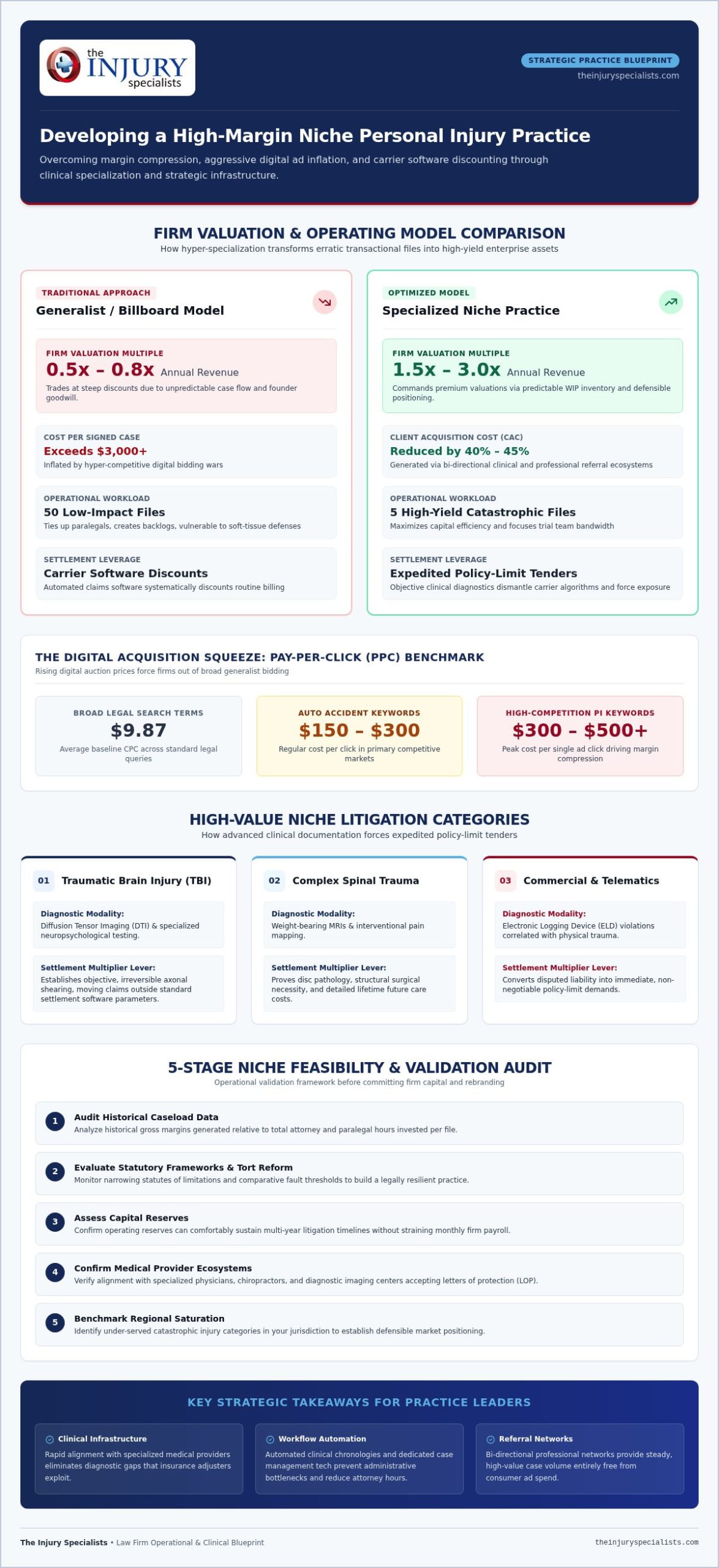
General litigation firms face unprecedented margin compression. For law firm leaders evaluating long-term equity, personal injury practice models that rely on broad volume are no longer sustainable. Industry valuation benchmarks show generalist contingency firms frequently trade at steep discounts below 0.5x to 0.8x annual revenue because their revenues depend on unpredictable case flow and founder goodwill. Conversely, developing a niche personal injury practice centered on high-barrier litigation commands premium valuations between 1.5x and 3.0x revenue. Institutional buyers and lenders reward predictable work-in-progress inventories, specialized clinical documentation, and defensible market positioning that generalist shops cannot replicate.
The Mathematical Trap of Generalist Personal Injury Practice
Running a high-volume practice handling generic motor vehicle collisions creates severe operational friction. While broad legal search terms average $9.87 per click, competitive auto accident keywords regularly exceed $150 to $300 per click in primary markets. This dynamic inflates cost-per-signed-case figures above $3,000 for standard claims.
Carrying fifty low-impact, soft-tissue files ties up paralegal resources, generates administrative backlog, and leaves firms vulnerable to minor property damage defenses. In contrast, managing five catastrophic injury files concentrates capital efficiency. Firms targeting distinct clinical niches reduce client acquisition costs by 40% to 45% while transforming erratic transactional files into high-yield enterprise assets.
Settlement Multipliers in Sub-Specialized Litigation Fields
Insurance carriers utilize automated claims evaluation software to commoditize general injury demands. These algorithmic systems systematically discount unverified pain complaints and routine physical therapy billing. Developing a niche personal injury practice dismantles this carrier defense playbook through objective clinical evidence.
Focusing on high-value injury profiles unlocks immediate settlement leverage:
- Traumatic Brain Injury (TBI): Utilizing diffusion tensor imaging (DTI) and specialized neuropsychological testing establishes irreversible axonal shearing, taking claims outside standard settlement software parameters.
- Complex Spinal Trauma: Documenting disc pathology through weight-bearing MRIs and interventional pain mapping proves surgical necessity and future care costs.
- Commercial Liability and Telematics: Correlating electronic logging device (ELD) violations with severe physical trauma converts disputed liability into immediate policy-limit demands.
Specialized litigation teams command respect from defense counsel and claims adjusters. When demand packages integrate comprehensive diagnostic imaging, objective physician assessments, and detailed future care projections, insurance carriers face genuine trial exposure. That shift eliminates arbitrary settlement discounts and forces expedited policy-limit tenders.
How to Select and Validate Your Personal Injury Practice Focus
Precision selection prevents catastrophic misallocation of capital. Law firm principals cannot simply rebrand their websites overnight; selecting a niche requires rigorous operational validation. According to U.S. Bureau of Labor Statistics projections for legal practitioners, specialized legal services continue to outpace general legal roles in long-term earnings potential. Developing a niche personal injury practice successfully demands a five-stage feasibility audit before taking on complex litigation:
- Audit historical caseload data: Identify which injury profiles have yielded your highest gross margins relative to attorney hours invested.
- Evaluate statutory frameworks and tort reform: Monitor shortening statutes of limitations and comparative fault thresholds nationwide to select resilient practice areas.
- Assess capital reserves: Ensure operating capital can support multi-year litigation timelines without straining monthly payroll.
- Confirm medical provider ecosystems: Verify access to trusted diagnostic networks that accept letters of protection and provide verifiable medical documentation.
- Benchmark regional saturation: Identify under-served injury categories where generalist firms lack the trial acumen to compete.
High-Yield Specialty Areas in Modern Personal Injury Law
Focusing on high-complexity matters elevates your litigation profile. Commercial motor carrier litigation governed by federal safety compliance regulations offers clear liability leverage through telematics and driver qualification files. Severe spinal trauma and catastrophic orthopedic fractures require multi-stage surgical care, creating high-value damages profiles. Premises liability cases involving traumatic brain injuries demand rigorous neuro-cognitive assessments, providing clear clinical barriers that keep generalist mills from competing effectively.
Assessing Resource Demands and Capitalized Runways
Complex litigation alters a firm’s cash conversion cycle. Preparing catastrophic claims for trial involves significant disbursements for biomechanical reconstructionists, vocational evaluators, and certified life-care planners. Because niche cases often require 12 to 36 months to reach settlement or verdict, firms must manage extended liquidity gaps.
Sustainable expansion relies on balancing operational runway with disciplined financing. Partnering with dedicated specialty networks like The Injury Specialists referral network helps firms access robust clinical coordination and non-recourse pre-settlement funding, protecting internal cash reserves while developing a niche personal injury practice at scale.
Building the Clinical Foundation: Medical Case Management and Provider Alignment
Litigation strategy collapses quickly without rigorous medical substantiation. While general personal injury claims often rely on ad-hoc primary care records, developing a niche personal injury practice requires an institutional medical infrastructure. High-stakes defense adjusters routinely retain biomechanical engineers to dispute injury causation. To dismantle these challenges, plaintiffs need prompt access to specialist physicians, chiropractors, physical therapists, and advanced imaging centers capable of delivering objective, trial-ready clinical narratives.
Coordinated medical case management bridges the gap between active healthcare delivery and evidentiary demands. Utilizing an established law firm medical referral program ensures that injured clients receive comprehensive evaluations without treatment interruptions, giving litigators the defensible paper trail needed to substantiate severe pain, impairment ratings, and long-term functional loss.
Integrating Advanced Diagnostic Imaging into Case Strategy
Objective diagnostics eliminate carrier skepticism. Standard X-rays and low-field MRIs regularly fail to reveal subtle micro-trauma, allowing defense examiners to argue that complaints stem from age-related degeneration rather than acute trauma.
Securing prompt personal injury diagnostic imaging referrals allows litigators to establish indisputable structural pathology early:
- High-Field 3T MRI: Delivers exceptional spatial resolution to isolate acute annular tears, labral damage, and ligamentous disruption.
- Diffusion Tensor Imaging (DTI): Visualizes white-matter tract disruptions to prove traumatic brain injury when standard neuroimaging reads normal.
- Weight-Bearing Motion Imaging: Captures kinetic cervical instability and facet joint displacement under load, nullifying degenerative pre-existing condition defenses.
Navigating Medical Liens and Letter of Protection Protocols
Unstructured lien agreements introduce substantial risk during resolution. Unvetted medical liens create friction during final disbursal negotiations, while arbitrary provider billing triggers post-settlement holdbacks that erode client trust and delay revenue realization.
Developing a niche personal injury practice means establishing standardized letter of protection protocols with orthopedic surgeons, neurologists, and physical therapists from the start. Transparent lien underwriting ensures compliant billing schedules, prevents procedural disputes, and eliminates treatment gaps that insurance adjusters exploit to devalue claims. A unified clinical network keeps medical documentation aligned with trial milestones, ensuring legal teams spend their energy litigating liability rather than untangling fragmented medical records.
Operationalizing Niche Workflows: Legal Technology and Capital Management
Specialization increases case complexity, which quickly overwhelms generic office workflows. Developing a niche personal injury practice requires purpose-built operational infrastructure that links litigation deadlines directly to medical recovery milestones. Without dedicated systems, paralegals spend countless hours chasing missing medical bills and unindexed clinical records. Deploying integrated personal injury case management technology allows litigation teams to standardize evidence assembly, maintain compliance, and eliminate administrative drag across every active matter.
Automating Medical Records Tracking and Evidence Assembly
Delays in obtaining clinical records stall demand generation and compromise trial preparation. Modern catastrophic caseloads require dynamic tracking that captures treatment events in real time rather than waiting months for discharge summaries.
Automated clinical workflows transform this evidentiary pipeline through three essential steps:
- Milestone-triggered record retrieval: Automated requests trigger the moment a client completes an imaging protocol or surgical evaluation, reducing settlement delays.
- Standardized chronology generation: Dynamic indexing organizes dense electronic health records into chronological, cited exhibits suitable for immediate exhibit filing.
- HIPAA-compliant coordination: Secure portals facilitate bi-directional data exchange between clinical partners and litigation support teams without administrative phone tags.
Capital Preservation and Case Cost Financing Frameworks
Catastrophic cases tie up operating cash. Self-funding substantial discovery costs, accident reconstructions, and expert retainers directly from operating accounts restricts marketing investments and limits intake capacity. Developing a niche personal injury practice demands structured balance sheet management to insulate operating capital from litigation volatility.
Firm liquidity is only half the equation; client financial stability also protects case value. Severe injuries often leave plaintiffs unable to work, tempting them to accept early, discounted insurer offers out of desperation. Aligning clients with non-recourse pre-settlement funding for injury victims removes immediate financial distress, allowing trial teams to hold out for maximum settlement values while maintaining strict accounting separation for case-specific disbursements.
Ready to modernize your firm’s medical-legal operations? Integrate your firm with The Injury Specialists platform to centralize medical case coordination, technology workflows, and strategic funding solutions.
Accelerating Acquisition: Strategic Networking and Sustainable Case Flow
Relying exclusively on pay-per-click ads to generate catastrophic injury files is a losing economic strategy. With cost-per-lead numbers for specialized matters like medical negligence climbing past $500 and signed-case costs routinely exceeding several thousand dollars, firms need disciplined customer acquisition. Developing a niche personal injury practice successfully means pivoting away from volatile consumer ad auctions toward institutional, business-to-business referral channels that yield predictable, qualified case flow.
Sustainable growth comes from professional credibility rather than highway advertising. Establishing bi-directional relationships with non-competing attorneys, speaking at specialized CLE symposiums, and embedding your firm within an established national personal injury referral network provides an ongoing pipeline of high-damages litigation without inflating client acquisition costs.
Building an Attorney-to-Attorney Co-Counsel Network
General practitioners, real estate lawyers, and high-turnover settlement mills regularly turn away or under-value complex files. They lack the capital reserves and trial readiness required to litigate severe commercial carrier claims or multi-level spine fusions against tier-one defense firms.
You can capture these high-value opportunities by establishing structured co-counsel pipelines:
- Target resource-constrained firms: Position your team as the elite trial vehicle for complex matters that general practitioners are unequipped to litigate.
- Ensure strict ethical fee-sharing: Draft transparent fee divisions under professional responsibility rules, ensuring client consent in writing while assuming joint responsibility.
- Provide transparent case tracking: Furnish referring counsel with automated litigation updates to secure their ongoing loyalty and future deal flow.
Leveraging Dedicated Medical-Legal Ecosystems for Practice Expansion
Specialized case acquisition extends beyond legal circles. Participating in nationwide medical-legal ecosystems creates strong operational advantages. These structured networks connect plaintiff firms with qualified medical diagnostic facilities, chiropractors, physical therapists, and surgical practices operating under compliant lien frameworks.
Developing a niche personal injury practice requires scaling intake without adding internal payroll. Centralizing clinical referrals, diagnostic scheduling, and medical tracking through dedicated partner platforms eliminates intake friction. Your litigation attorneys can focus strictly on trial strategy, liability discovery, and maximum financial recovery, allowing the firm to scale catastrophic caseload capacity while keeping overhead lean.
Transform Your Practice into a High-Yield Litigation Leader
Transitioning beyond commoditized auto claims into complex litigation unlocks superior settlement leverage, premium firm valuations, and predictable revenue. Successfully developing a niche personal injury practice requires more than exceptional courtroom acumen. It demands an integrated operational engine that connects rapid clinical evidence, disciplined capital preservation, and sustainable professional referral pipelines.
You don’t need to build this complex infrastructure alone. Access to the largest nationwide personal injury network provides integrated medical case management customized to law firm workflows, along with seamless connections to specialized physicians, chiropractors, and advanced imaging facilities. This unified ecosystem removes administrative bottlenecks so your trial team can focus entirely on high-stakes advocacy.
Scale your firm’s specialized caseload with The Injury Specialists network to capture higher case values, protect operating capital, and secure lasting market leadership.
Frequently Asked Questions
How do I choose the most profitable niche for my personal injury law firm?
Choose a niche by auditing past firm files to identify which injury categories yielded the highest recovery relative to attorney hours. Look closely at traumatic brain injuries, commercial vehicle collisions, or complex spinal trauma. Confirm that your target practice area has accessible medical specialists willing to treat on liens. Finally, verify that statutory frameworks and local underwriting climates support substantial non-economic and economic recoveries.
Can a smaller personal injury practice successfully transition away from general auto-accident cases?
Yes, boutique firms can successfully transition without expanding internal headcount. Rather than self-funding high consumer marketing overhead, smaller practices build strategic co-counsel pipelines with high-volume generalists. Combining attorney referrals with external medical case management and imaging networks allows a lean trial team to litigate catastrophic claims efficiently. Developing a niche personal injury practice this way replaces high volume with superior case multiples.
How do specialized medical referral networks improve settlement values in niche cases?
Specialized networks connect injured plaintiffs directly with qualified neurologists, orthopedic surgeons, and advanced imaging centers. Immediate access to objective diagnostics, like 3T MRIs and diffusion tensor imaging, provides indisputable physical proof of trauma. Clear, continuous medical documentation prevents insurance adjusters from applying standard algorithmic discounts, forcing carriers to evaluate claims based on true catastrophic exposure and policy limits.
What are the common risks of developing a niche personal injury practice?
Extended case duration and front-loaded trial disbursements represent the primary risks. Developing a niche personal injury practice involves litigating files that take 12 to 36 months to resolve, demanding significant capital reserves for expert witnesses and accident reconstruction. Failing to partner with an established network of lien-treating physicians and imaging centers can also stall clinical evidence assembly and compromise liquidity.
How do medical liens impact law firm revenue and client recovery in complex cases?
Medical liens grant victims access to high-level surgical and rehabilitative care without immediate out-of-pocket expenses. However, uncoordinated provider liens can trigger intense dispute during final disbursements. Standardized lien agreements and integrated medical case management eliminate arbitrary billing. This transparency protects firm contingency fees, satisfies medical providers promptly, and maximizes the net recovery delivered directly to the client.
What role does case management technology play in managing specialized personal injury dockets?
Dedicated case management technology automates evidence assembly, records requests, and treatment tracking across active files. Niche litigation requires precise synchronization between medical milestones and legal deadlines. Purpose-built platforms coordinate communication between law firms and medical networks, creating cited chronological summaries from complex electronic records. This automation eliminates administrative bottlenecks, freeing litigation teams to concentrate on discovery and trial preparation.
How can law firms maintain cash flow when litigating complex, multi-year niche claims?
Law firms maintain stability by combining staged capital planning with external financing tools. Protecting firm operating accounts requires shifting case disbursements toward specialized litigation capital lines. Additionally, offering clients non-recourse pre-settlement funding removes immediate personal financial pressure. This safeguard keeps injured plaintiffs from accepting premature settlement offers, allowing your firm to carry files through trial or maximum policy tenders.

Leave A Comment
You must be logged in to post a comment.