

In an era where digital lead costs for personal injury firms often exceed $442 per lead, relying on unpredictable auctions is a high-risk strategy. You’re likely aware that inconsistent case flow and the administrative burden of managing disjointed provider relationships can stall your firm’s growth. It’s frustrating when you receive medical documentation that lacks the clinical detail needed to maximize case value. Creating a PI referral program for your firm shouldn’t be a manual struggle or a game of chance. You need a repeatable system that secures high-quality cases while automating medical-legal coordination.
This strategic guide provides the blueprint to build, automate, and scale a professional referral ecosystem. You’ll learn how to move beyond informal contact lists toward a structured network of specialized medical providers who understand the demands of litigation. We’ll explore the technology required to streamline case management, the regulatory landscape of professional collaborations, and the methods for maintaining documentation standards that protect your clients’ settlements. By the end of this guide, you’ll have the framework to transform your referral operations into a dominant, results-oriented profit center.
Key Takeaways
- Establish a structured B2B system by creating a PI referral program for your firm that replaces passive networking with proactive partner management.
- Implement a rigorous vetting process to secure medical providers who are experts in PI documentation and specialized treatment protocols.
- Scale your operations by replacing manual tracking with integrated case management technology that automates partner updates and document retrieval.
- Develop a high-level value proposition to recruit specialized physicians and imaging centers into your firm’s professional ecosystem.
- Leverage established national networks to gain immediate access to a turnkey referral infrastructure and integrated medical case management.
The Strategic Value of Creating a PI Referral Program for Your Firm
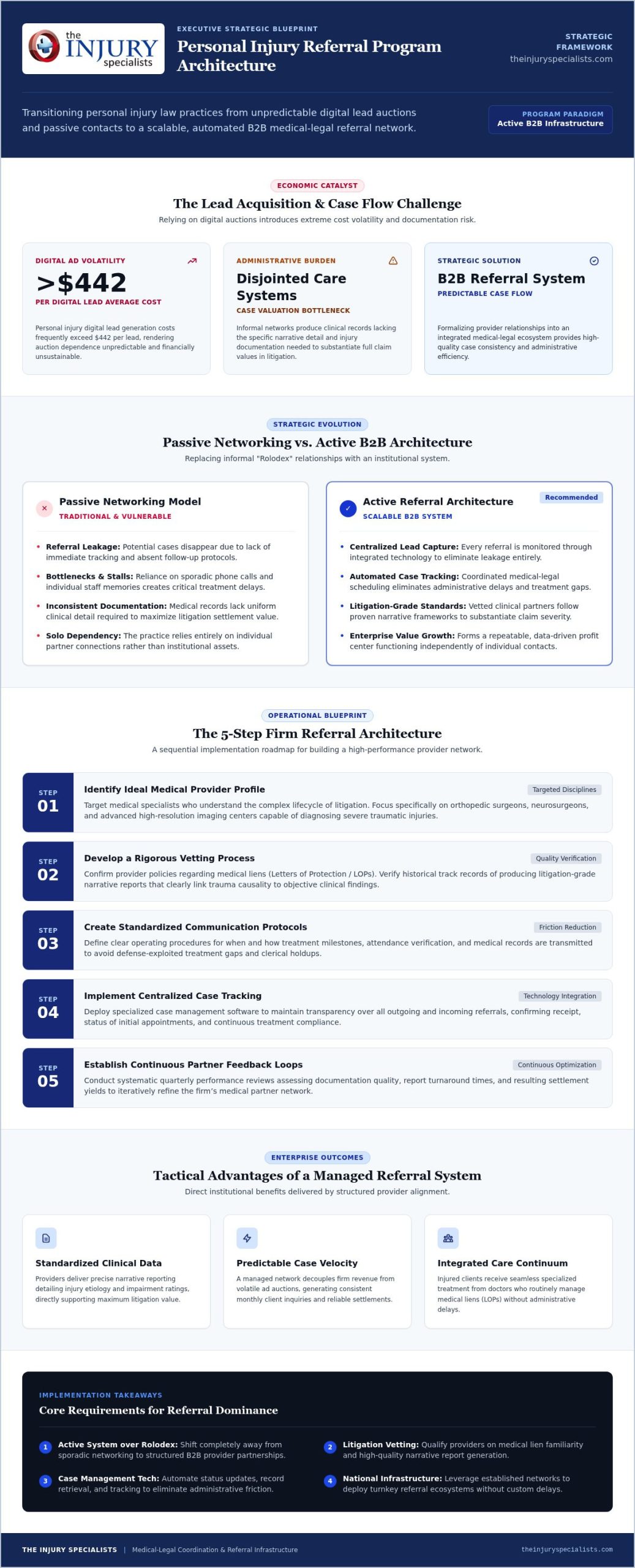
Creating a PI referral program for your firm transforms your practice from a reactive operation into a sophisticated, high-scale business. This isn’t merely a casual list of medical contacts or a collection of business cards. It is a structured B2B system designed to synchronize legal strategy with professional medical care. By formalizing these relationships, you establish a pipeline of high-quality cases and standardized documentation that serves as the foundation for successful litigation. A well-oiled program ensures that you aren’t just practicing law; you’re managing a growth-oriented medical-legal ecosystem.
Shifting from Passive Networking to Active Referral Systems
Relying on traditional word-of-mouth networking creates a dangerous bottleneck for long-term growth. In a competitive personal injury market, waiting for a physician to remember your firm’s name is a liability. Passive networking often leads to significant referral leakage, where potential cases disappear due to a lack of centralized tracking or immediate follow-up. You can’t scale a firm on “hope” and sporadic phone calls.
Transitioning to an active system allows you to function as a strategic facilitator. You aren’t just taking calls; you’re applying established referral marketing frameworks to manage partner relationships with clinical precision. This proactive approach ensures every lead is captured and every medical partner feels integrated into your firm’s success. It replaces the “Rolodex” model with a repeatable, data-driven architecture that functions independently of any single individual’s personal connections.
Key Benefits: Scalability and Predictable Case Flow
A formal program is the primary engine of firm scalability. It allows your team to handle significantly higher case volumes without a proportional increase in administrative overhead. When protocols are clear, the friction of medical-legal coordination vanishes. Creating a PI referral program for your firm provides several tactical advantages:
- Standardized Documentation: Providers understand exactly what clinical data and narrative reports you need to maximize settlement value.
- Predictable Revenue: A managed network provides a stable alternative to the volatility and high costs of digital advertising auctions.
- Cohesive Care Ecosystem: The injury victim receives continuous, specialized care from providers who understand the nuances of personal injury liens.
This structure also increases the enterprise value of your practice. Investors and partners value firms with repeatable acquisition systems. Medical providers prefer this structure as well; they want to work with firms that offer logistical ease, clear communication, and professional synergy. To maintain this level of efficiency at scale, many firms leverage personal injury case management technology to automate partner updates and ensure no case stalls due to administrative gaps. By building a professional system, you position your firm as a market leader that values results over effort.
How to Design Your Firm’s Referral Architecture
A robust architecture is the difference between a disorganized contact list and a professional profit center. Creating a PI referral program for your firm requires a sequential blueprint that prioritizes high-performance partnerships over casual acquaintances. To build a system that scales, you must implement a rigorous five-step framework:
- Step 1: Identify Your Ideal Medical Provider Profile. Focus on specialists who understand the personal injury lifecycle, including orthopedic surgeons, neurosurgeons, and high-resolution imaging centers.
- Step 2: Develop a Vetting Process. Verify that providers accept medical liens (LOPs) and have a proven history of producing litigation-grade narrative reports.
- Step 3: Create Standardized Communication Protocols. Define exactly how and when you expect status updates and medical record deliveries to prevent treatment gaps.
- Step 4: Implement a Tracking Mechanism. Use a centralized platform to monitor every referral sent and received, ensuring no case falls through administrative cracks.
- Step 5: Establish a Feedback Loop. Conduct quarterly reviews of partner performance, focusing on documentation quality and settlement outcomes to optimize your network.
Identifying and Vetting High-Quality Medical Partners
Vetting is the most critical phase of program development. A “PI-ready” provider must demonstrate more than clinical expertise; they need to understand the financial and legal mechanics of personal injury. This includes a willingness to work on medical liens and an understanding of how pre-settlement funding supports patient care. Providers who lack this experience often create administrative friction that devalues your claims. This is why specialized physician referral services for personal injury are the backbone of high-stakes cases. They provide a pre-filtered layer of clinicians who are already integrated into the medical-legal ecosystem and understand the necessity of objective proof of damages.
Establishing Clear Communication Protocols and Liens
Documentation standards must be non-negotiable. To support a high-value settlement, medical records must be comprehensive, timely, and strictly adhere to HIPAA Privacy Rule compliance standards. You should align provider workflows with your firm’s distinct internal processes to ensure seamless data exchange. When a provider understands your specific requirements for initial evaluations and final discharge summaries, the burden on your paralegals decreases significantly. Creating a PI referral program for your firm succeeds only when medical partners operate as an extension of your legal team. If you want to accelerate this setup, leveraging a managed national network can eliminate the trial-and-error of individual provider vetting and protocol design.
Integrating Medical Case Management Technology
Manual spreadsheets are the primary obstacle to scalability in a modern law practice. They create data silos, invite human error, and require constant manual oversight that drains your firm’s resources. Creating a PI referral program for your firm without a digital foundation is a strategy destined for stagnation. You need a system that bridges the gap between legal case files and medical treatment records in real time. This connectivity ensures that your strategy remains agile and your documentation remains complete.
Integrating personal injury case management technology provides the necessary infrastructure to handle high case volumes. This technology ensures that HIPAA-compliant data sharing is built into every interaction, protecting both the patient’s privacy and the firm’s liability. By centralizing communication, you eliminate the friction that typically occurs when law firms and medical providers operate in separate information vacuums. A well-integrated system transforms medical records from static documents into dynamic assets that drive case value.
Automating Document Collection and Status Updates
Efficiency depends on the elimination of “phone tag” between paralegals and medical billing departments. A unified portal allows both legal and medical professionals to access the same records simultaneously, creating a single source of truth. Key milestones in a personal injury case, such as the completion of an initial evaluation or the issuance of a final discharge summary, should trigger automated notifications to your team. This automation ensures that your legal team has the medical evidence they need the moment it’s available. It reduces administrative drag and allows your staff to focus on high-value litigation tasks rather than chasing missing paperwork.
Using Data to Audit Referral Partner Performance
A successful network requires constant optimization based on performance data. You shouldn’t guess which providers are your best partners; you should know. Creating a PI referral program for your firm gives you the opportunity to track specific KPIs that directly impact your bottom line. These metrics include document delivery speed, treatment consistency, and the clinical depth of medical narratives.
Real-time visibility into your personal injury referral network allows you to audit partner performance objectively. If a provider consistently fails to deliver records within a standard window, the data will highlight that bottleneck immediately. This insight allows you to prioritize high-performance partners for your most significant cases, ensuring that your firm’s reputation for excellence is supported by every provider in your ecosystem.
Marketing and Expanding Your Referral Network
Creating a PI referral program for your firm requires a transition from traditional consumer-facing advertising to sophisticated B2B marketing. You must articulate a value proposition that resonates with top-tier medical specialists. Surgeons and imaging centers aren’t influenced by retail branding; they prioritize clinical continuity, administrative efficiency, and financial reliability. Your outreach should position your firm as a strategic asset that simplifies the medical-legal bridge rather than adding to a provider’s administrative workload. This focus on professional synergy is what attracts high-caliber partners to your ecosystem.
B2B Outreach Strategies for Physicians and Chiropractors
Successful outreach targets the operational friction points medical providers face daily. Most clinicians struggle with inconsistent billing, incomplete documentation, and the logistical burden of litigation. Your messaging should focus on how your firm’s internal protocols solve these issues. Multi-channel engagement is essential to maintain visibility in the medical-legal community. Use LinkedIn for professional positioning, host seminars to demonstrate your legal expertise, and maintain a consistent presence in specialized networking groups. Face-to-face interactions remain the gold standard for building the trust required for high-stakes referrals.
Implementing a structured law firm medical referral program acts as a powerful competitive differentiator. It signals to providers that you have the infrastructure to manage their patients’ cases with professional precision. Educational marketing is a cornerstone of this strategy. By teaching providers how to refine their PI documentation and narrative reports, you improve their clinical defensibility while simultaneously increasing the value of your firm’s cases. This creates a mutually beneficial relationship where the provider’s professional standards and your firm’s settlement outcomes grow in tandem.
Maintaining Long-Term Partner Loyalty
Loyalty is built on transparency and consistent execution. A Partner Success model ensures that medical providers feel supported throughout the lifecycle of a case. This involves providing proactive status updates and ensuring that the provider’s staff is never left in the dark regarding case progress. When providers see that your firm respects their time and clinical expertise, they become long-term advocates for your practice. Managing these relationships requires the same level of attention you give to your clients.
Pre-settlement funding plays a vital role in maintaining these connections. It ensures that medical care remains uninterrupted and that providers receive payment without waiting years for a case to resolve. This financial stability is a significant incentive for high-quality specialists to remain in your network. The success of creating a PI referral program for your firm also depends on your ability to handle difficult cases with lower settlement potential without damaging the referral relationship. If you want to scale your outreach immediately without the overhead of individual provider recruitment, partner with a managed national network to access an established ecosystem of vetted medical professionals.
Accelerating Growth with The Injury Specialists Network
Creating a PI referral program for your firm from the ground up is a viable long-term strategy, but the time-to-market and administrative costs are substantial. Building a proprietary network requires years of vetting, relationship management, and technical development. Leveraging an established national network provides an immediate shortcut to professional scale. Instead of dedicating internal resources to individual provider recruitment, you can plug into a pre-existing, world-class architecture designed for high-volume litigation.
The Injury Specialists operates the largest personal injury referral network in the United States, offering a turnkey solution that eliminates the trial-and-error phase of program development. This system integrates medical case management with proprietary technology, ensuring that your legal strategy is always supported by high-quality clinical data. By choosing a managed ecosystem, you bypass the technical barriers that often stall firm growth and move directly into a phase of repeatable case acquisition.
Accessing a Pre-Built National Ecosystem
Joining a national network offers an unparalleled advantage in a competitive legal market. You gain instant access to a pre-vetted roster of specialized imaging centers, chiropractors, and surgical partners who already understand the nuances of personal injury liens. This “power-connector” status allows your firm to compete with much larger practices by offering a level of medical-legal coordination that usually requires a massive internal department.
This approach allows you to scale your firm’s reach without adding internal marketing overhead or business development staff. You aren’t just gaining a list of contacts; you’re gaining a strategic partner that facilitates the bridge between different professional sectors. This connectivity ensures that your firm remains at the center of a high-performance ecosystem, securing a consistent flow of high-quality cases while maintaining professional synergy with medical providers.
Leveraging Integrated Funding and Technology Solutions
The technical infrastructure of The Injury Specialists removes the administrative burden of managing multiple provider relationships. The proprietary technology platform centralizes scheduling and document retrieval, providing a single source of truth for both legal and medical professionals. This transparency ensures that medical documentation is consistent and treatment gaps are eliminated. Integrated medical case management based on your firm’s distinct processes ensures that the care care ecosystem remains cohesive for every injury victim.
Integrated pre-settlement funding further strengthens this system. It ensures that victims receive the care they need while the case progresses, regardless of their financial status. This continuity of care protects the integrity of the medical evidence and the ultimate settlement value. Creating a PI referral program for your firm doesn’t have to be a manual struggle. You can implement a professional, automated system today. Join the network and start scaling your PI practice today.
Future-Proof Your Practice with a Professional Referral Architecture
Creating a PI referral program for your firm is no longer an optional growth strategy; it’s a fundamental requirement for maintaining a competitive edge. You’ve seen how a structured architecture replaces inconsistent word-of-mouth with a repeatable, technology-driven ecosystem. By prioritizing specialized medical partners and automating documentation through proprietary case management technology, you protect your firm’s valuation and ensure a cohesive care experience for every client.
The transition from manual processes to integrated medical case management is the key to scaling without increasing administrative overhead. While building this infrastructure from scratch is possible, joining a pre-established national network offers a significant shortcut to professional success. As the largest personal injury referral network in the United States, The Injury Specialists provides the turnkey solutions you need to dominate your market. You can eliminate the trial-and-error of individual provider vetting and focus on high-value litigation immediately. Scale your firm with the nation’s largest PI referral network and transform your practice into a streamlined, results-oriented operation. Your firm’s expansion starts with the right professional connectivity.
Frequently Asked Questions
What are the first steps in creating a PI referral program for your firm?
Identify ideal provider profiles and establish a vetting protocol as your primary action. You must define the clinical specialties your firm requires, such as neurosurgery or imaging, and verify their willingness to work on Letters of Protection. Creating a PI referral program for your firm starts with setting clear expectations for communication and documentation standards before onboarding any partners. This proactive approach ensures that every new relationship is built on a foundation of professional synergy.
How do I ensure medical providers in my referral program provide high-quality documentation?
Implement standardized reporting protocols and conduct regular clinical audits to maintain high standards. You should provide medical partners with a clear checklist of the clinical data and narrative elements required to support high-value settlements. Consistent feedback loops allow your team to address documentation gaps immediately. By treating medical providers as an extension of your legal team, you ensure that the evidence produced is objective, thorough, and ready for trial or settlement negotiations.
Is it better to build a custom referral system or join an existing network?
Joining an existing network like The Injury Specialists is significantly faster and more cost-effective than building a custom system. Creating a PI referral program for your firm from scratch requires years of vetting, technical development, and relationship management. An established national network provides immediate access to pre-vetted specialists and proprietary technology. This turnkey approach allows your firm to scale case volume without the high overhead of internal marketing or business development departments.
What role does medical case management play in a law firm’s referral program?
Medical case management ensures a cohesive care ecosystem and prevents treatment gaps that devalue claims. It acts as a bridge between the clinical treatment plan and the legal case strategy. Professional case management tracks patient compliance, coordinates follow-up care, and ensures that all medical records are retrieved promptly. This integrated approach protects the integrity of the medical evidence and ensures that the injury victim receives consistent, specialized care throughout the recovery process.
How can technology help manage relationships with multiple medical providers?
Centralized case management technology eliminates the administrative friction of managing disjointed relationships. A world-class platform provides a single source of truth where both law firms and medical providers can share HIPAA-compliant data in real time. This technology automates status updates and document retrieval, reducing the need for manual follow-up by paralegals. It allows your firm to maintain a high level of connectivity with a vast ecosystem of providers without increasing internal staff counts.
How do I track the ROI of my personal injury referral program?
ROI is tracked by monitoring specific performance data that directly impacts firm revenue. You should compare the acquisition cost of referral leads against traditional digital PPC leads, which often exceed $442 per lead. Key metrics to analyze include:
- Lead-to-case conversion rates
- Average settlement multipliers
- Medical record delivery speed
- Clinical depth of narrative reports
Analyzing these data points allows you to prioritize high-performance partners who contribute most effectively to your firm’s long-term growth.
Can a referral program help with pre-settlement funding for my clients?
Yes, integrated pre-settlement funding ensures that injury victims receive uninterrupted medical care while the legal process unfolds. This financial support bridges the gap between the accident and the final settlement, allowing providers to be paid for their services. It removes the financial pressure on the client and the provider, ensuring that the clinical treatment plan remains on track. This stability is essential for maintaining high documentation standards and protecting the ultimate case value.
What are the ethical considerations when building a medical-legal referral network?
Ethical referral programs must strictly adhere to state bar rules regarding fee-splitting and anti-kickback statutes. You must ensure that relationships with medical providers are based on professional collaboration rather than financial incentives for patient referrals. Transparency is paramount; always obtain written client consent for any professional coordination. By focusing on a model that prioritizes patient care and documentation quality, your firm maintains a dominant and ethically sound position in the personal injury market.
