

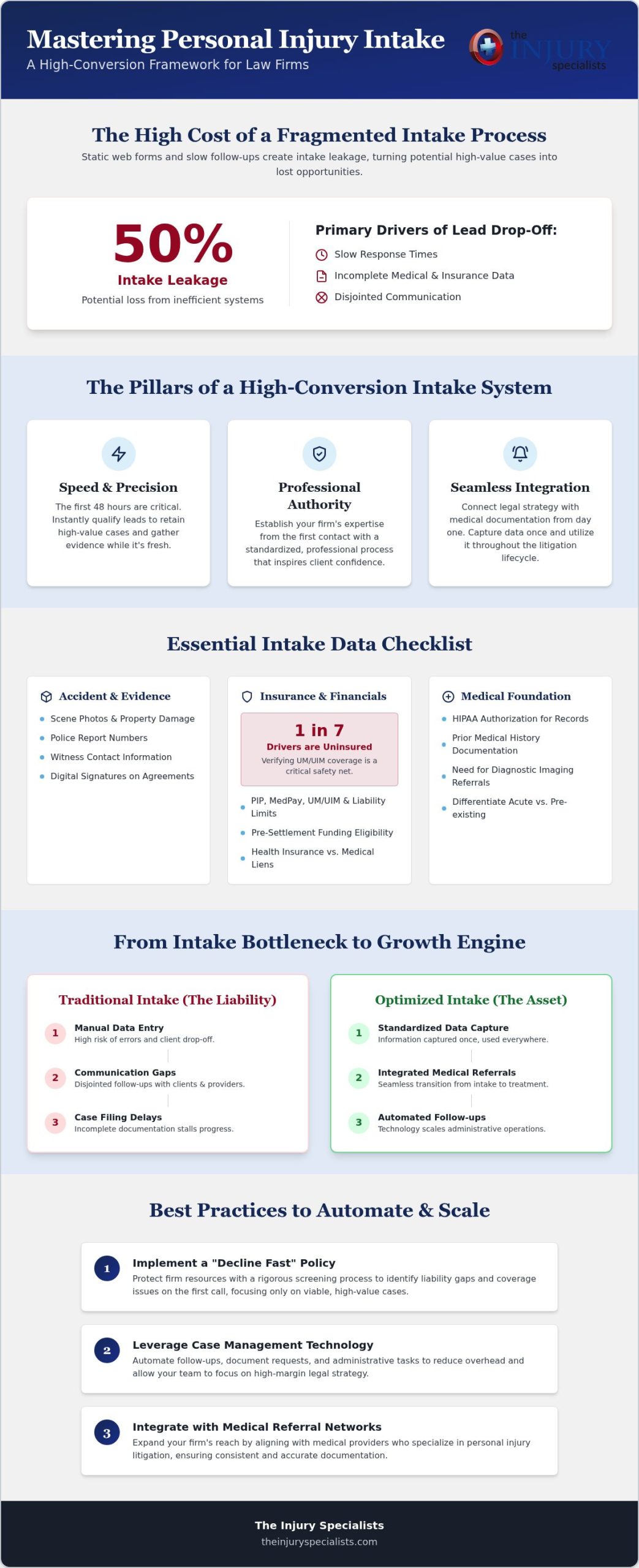
Firms relying on static web forms for lead generation often suffer from intake leakage as high as 50%. In a market where 1 in 7 drivers is uninsured and statute of limitations windows are tightening across the country, a slow or fragmented intake process is a liability. Implementing the best practices for personal injury intake is no longer just a clerical requirement. It’s a strategic necessity for firms that intend to scale in 2026.
You recognize that slow response times and incomplete medical data are the primary drivers of lead drop-off. When communication between legal teams and medical providers is disjointed, case filing delays become inevitable. This guide promises to help you master the frameworks and technologies required to transform your intake from a data-entry task into a high-conversion engine. We’ll examine how to qualify leads instantly, integrate seamlessly with medical referral networks, and reduce administrative overhead to maximize your firm’s growth.
Key Takeaways
- Standardize the intake process to prioritize speed and professional authority while eliminating the redundant data entry points that cause lead leakage.
- Capture essential accident details and insurance landscape data to establish case value and liability limits from the first contact.
- Integrate medical case management into your workflow to ensure consistent documentation and bridge the gap between clinical care and legal strategy.
- Master the best practices for personal injury intake by leveraging case management technology to automate follow-ups and scale administrative operations.
- Access a national referral network to expand your firm’s reach and align with medical providers who specialize in the needs of personal injury litigation.
The Strategic Value of a Standardized Personal Injury Intake Process
Intake is the engine room of a successful personal injury firm. It isn’t a clerical formality; it’s a strategic operation that dictates the trajectory of every case. When you standardize this process, you establish professional authority and ensure that potential clients recognize your firm’s expertise immediately. High-growth practices prioritize speed and precision to prevent administrative leakage. By eliminating redundant data entry points, you ensure that information flows seamlessly from the first call into your case management system. This early alignment between legal strategy and medical documentation is one of the best practices for personal injury intake that separates market leaders from stagnant firms. It’s about building a system where data is captured once and utilized throughout the entire litigation lifecycle.
Defining the Intake-to-Settlement Pipeline
The journey from initial contact to case filing must be a frictionless path. The first 48 hours of client onboarding are critical for retaining high-value leads. Bottlenecks at this stage often result in lost opportunities and incomplete evidence gathering. To maintain momentum, you must map the journey and identify exactly where communication breaks down. Set clear KPIs for your intake staff, focusing on response time, conversion rate, and data completeness. A successful pipeline relies on the foundational principles of personal injury law to ensure all necessary liability and insurance data is captured at the outset. This allows your team to move a client from a prospect to a medical referral without the friction of manual follow-ups.
Risk Mitigation and Case Selection Criteria
Protecting your firm’s resources starts with aggressive case qualification. You cannot afford to waste billable hours on non-viable matters. Implement a rigorous screening process that identifies liability gaps and coverage issues during the first call. Adopting a “decline fast” policy for cases that don’t meet your firm’s specific value thresholds is essential for maintaining operational efficiency. Your intake personnel must be trained to recognize high-value indicators such as significant property damage or immediate medical intervention. This proactive approach keeps your docket focused on high-margin files and ensures that your medical partners receive actionable cases. Reliable intake protocols transform your firm into a high-conversion engine built for long-term scale and professional synergy.
Essential Data Points and Documentation for High-Value Cases
High-value cases require extreme precision from the very first interaction. Collecting essential data points for personal injury claims ensures that the legal team has a clear path toward recovery. This includes securing scene photos, police report numbers, and witness contact information immediately. You must also obtain digital signatures for HIPAA authorizations and representation agreements to prevent administrative delays. One of the best practices for personal injury intake is documenting prior medical history to differentiate between new acute injuries and pre-existing conditions. This distinction is vital for defeating defense arguments regarding causation. Precise documentation at the start prevents the defense from claiming that a client’s pain is merely a continuation of a past issue.
The Insurance and Financial Landscape
Identifying every potential layer of coverage is a non-negotiable step. Intake teams should verify PIP, MedPay, UM/UIM, and liability limits during the initial call. Given that 1 in 7 drivers on the road is uninsured, verifying UM/UIM coverage is a critical safety net for your firm’s recovery potential. Understanding the financial pressure on the client is equally important for retention. Determining eligibility for pre-settlement funding for injury victims can provide the stability needed to see a case through to its maximum value. Additionally, you should document whether the client prefers using health insurance or medical liens for their treatment billing to avoid future lien-resolution bottlenecks.
Medical Documentation Accuracy
The quality of medical evidence starts at intake. Identifying the immediate need for personal injury diagnostic imaging referrals ensures that objective evidence is captured before it fades or is attributed to other causes. Intake staff must capture subjective complaints in the client’s own words; don’t settle for paraphrased summaries. These raw descriptions are often more persuasive in future demand letters than summarized clinical notes. Establishing a clear timeline of symptoms, starting from the moment of impact, creates a cohesive narrative for the case. Implementing these best practices for personal injury intake ensures that no critical detail is overlooked. Firms that prioritize these data points often see higher settlement values and faster resolutions. You can streamline this data collection by partnering with a national referral network that understands these specific documentation requirements.
Integrating Medical Case Management into the Intake Workflow
Effective intake doesn’t end with a signed retainer. To truly master the best practices for personal injury intake, firms must integrate medical case management directly into their onboarding workflow. This integration ensures that the client’s path to recovery is overseen by professionals who understand the intersection of clinical care and litigation requirements. Gaps in treatment are the primary reason for reduced case values; a cohesive care ecosystem prevents these lapses by facilitating immediate referrals to specialists, chiropractors, and imaging centers. By managing these variables from the start, you protect the integrity of the medical evidence before the defense has an opportunity to challenge it.
The Role of a Physician Referral Network
Speed is the most critical factor in establishing a credible medical narrative. Utilizing physician referral services for personal injury allows your firm to connect clients with vetted providers within hours of the initial call. It’s essential to work with a network of providers who are experienced in treating patients on a lien basis and who maintain meticulous documentation. This professional synergy allows you to scale case volume effectively. Leveraging a law firm medical referral program ensures that your intake team has immediate access to a nationwide grid of medical experts, removing the burden of manual provider outreach and vetting.
Coordinating Care and Legal Documentation
Standardizing medical record retrieval during the intake phase is a prerequisite for high-speed litigation. When you align physician findings with the legal theory of the case early on, you create a more compelling demand package. This coordination ensures that the documentation produced by medical providers directly supports the specific damages you intend to claim. Medical case management acts as the structural bridge that converts clinical recovery data into actionable settlement evidence. This systematic approach ensures that every diagnostic finding and treatment milestone is captured and categorized, providing your legal team with the objective proof needed to maximize recovery. Efficiently bridging this gap allows your staff to focus on strategy rather than chasing down missing records or clarifying ambiguous medical notes.
Leveraging Technology to Automate and Scale Intake Operations
Manual data entry is a significant bottleneck that limits your firm’s ability to scale. In an environment where speed-to-lead is measured in seconds, relying on paper forms or static spreadsheets is no longer viable. High-growth firms adopt a personal injury case management technology platform to enable real-time tracking and eliminate administrative friction. This infrastructure allows you to implement best practices for personal injury intake by automating the repetitive tasks that typically drain staff resources. Automated SMS and email follow-ups ensure that unreturned intake forms are completed without manual intervention, while digital portals facilitate secure document uploads and instant e-signatures. These tools don’t just save time; they create a professional, tech-forward experience that increases client confidence and retention.
Automating the Information Gathering Phase
The information gathering phase should be dynamic and responsive. Deploying smart forms that adjust questions based on the accident type ensures that your team captures relevant data without overwhelming the prospect. This data should sync directly into your core case management system, removing the need for manual transcription and reducing the risk of human error. You can also automate the generation of medical authorization forms, allowing clients to sign documents on their mobile devices immediately after the initial consultation. This level of automation ensures that your legal team has the necessary permissions to begin evidence collection within minutes of onboarding a new case.
Real-Time Networking and Communication
Technology serves as the connective tissue between your firm and your medical partners. Using integrated software allows you to alert medical providers of new referrals instantly, ensuring that the client receives care without delay. Centralizing this communication ensures that every team member has access to the current case status, regardless of their department. Beyond day-to-day operations, you should analyze intake data to identify which referral sources provide the highest-value cases. This data-driven approach allows you to optimize your marketing spend and focus on the partnerships that drive the most significant growth. To implement these advanced systems and streamline your firm’s growth, you can access our proprietary case management technology and start scaling your operations today.
Optimizing Referral Networks for Seamless Client Onboarding
Scaling a personal injury firm beyond local constraints requires a shift toward national connectivity and operational standardization. Joining a personal injury referral network provides the infrastructure needed to handle cases across diverse jurisdictions with the same level of precision. This is a core component of the best practices for personal injury intake. It ensures that once a lead is qualified, the hand-off to a medical provider is immediate and professional. Strategic networking increases both the volume and the quality of incoming leads by aligning your firm with partners who prioritize clinical excellence and litigation-ready documentation. When you remove the friction of manual provider vetting, your intake team can focus on client conversion and case valuation.
Strategic Medical-Legal Partnerships
Selecting medical partners based on documentation accuracy and reliability is essential for long-term success. You must foster relationships with specialists who accept personal injury liens nationally to maintain flexibility in your case management strategy. A robust referral network acts as a force multiplier for firm growth by providing instant access to specialized medical expertise without the overhead of internal coordination. These partnerships should be built on a foundation of mutual accountability. Providers must understand the specific needs of PI litigation, such as the importance of the 72-hour treatment window and the necessity of objective diagnostic findings. By aligning with medical professionals who are accustomed to the rigors of legal scrutiny, you ensure that every case file is built for maximum recovery from day one.
Finalizing the Intake: Next Steps for the Client
The intake process isn’t complete until the client has a clear roadmap of the journey ahead. Confirming the first medical appointment before the intake call concludes is one of the most effective best practices for personal injury intake to prevent lead drop-off. This immediate action reinforces the firm’s commitment to the client’s recovery and establishes professional momentum. You must also ensure the client understands the role of the medical case manager. This professional acts as a strategic facilitator, ensuring that the care plan remains consistent with the legal theory of the case. Providing this level of clarity reduces client anxiety and increases the likelihood of a successful, long-term relationship. Clear protocols for the transition from intake to active treatment prevent the communication gaps that often lead to client dissatisfaction and case leakage.
Scaling Your Firm Through Operational Excellence
Mastering the intake process is about more than just gathering data; it’s about building a high-conversion engine that bridges the gap between legal strategy and medical recovery. By standardizing your protocols and leveraging advanced automation, you eliminate the administrative leakage that stalls case growth. This guide has outlined the frameworks necessary to qualify leads instantly and integrate medical case management from the first interaction. Implementing these best practices for personal injury intake ensures your firm remains competitive in a market where speed and precision are non-negotiable requirements for success.
Strategic growth requires a partner that provides both the technology and the professional network to scale. You can gain immediate access to our world-class technology platform, integrated medical case management for every case, and a nationwide network of physicians and imaging centers. These resources allow your team to focus on high-level litigation while we handle the logistical complexities of medical-legal coordination. Join the largest personal injury referral network in the United States today. You now have the strategic framework to transform your intake process into a scalable asset for long-term success.
Frequently Asked Questions
What is the most important information to gather during a personal injury intake?
Identifying clear liability and every layer of insurance coverage is the most critical step. This includes verifying PIP, MedPay, and UM/UIM limits immediately to protect the case’s financial viability. You must also document the client’s symptoms starting from the moment of impact and secure digital signatures for HIPAA authorizations. Capturing these details early ensures the case is legally viable and establishes a foundation for medical evidence before the defense can challenge it.
How long should a standard personal injury intake call take?
A standard intake call typically requires 15 to 30 minutes to complete. This duration allows for a thorough screening of liability, insurance coverage, and medical history without overwhelming the potential client. Using dynamic smart forms can shorten this window by only presenting relevant questions based on the accident type. Efficiency is key; however, rushing the process often leads to missing documentation that causes significant delays during the later litigation phases.
How can I increase my law firm’s intake conversion rate?
Speed-to-lead is the primary driver of conversion in the personal injury sector. You should contact leads within five minutes of an inquiry to prevent them from seeking other representation. Implementing the best practices for personal injury intake involves using automated SMS and email follow-ups for unreturned forms. Providing a clear roadmap of the legal and medical journey during the initial call also increases trust and helps secure a signed retainer immediately.
Why is medical case management important during the intake phase?
It bridges the gap between clinical care and legal strategy from day one. Integrating medical case management ensures that a client’s recovery is documented in a way that supports the specific damages claimed in the lawsuit. This proactive oversight prevents treatment gaps that the defense often uses to devalue cases. By coordinating referrals to specialists and imaging centers immediately, you ensure that objective evidence is captured while the injuries are still acute.
Should I use an automated intake system or a live intake team?
A hybrid approach is the most effective strategy for modern firms. Use automated systems for initial data gathering, secure document uploads, and follow-ups to maintain efficiency and 24/7 availability. However, high-value cases often require a live intake team to establish professional authority and address complex liability questions. Technology should handle the repetitive administrative tasks, while your staff focuses on high-level case qualification and building a direct relationship with the client.
How do I qualify a personal injury lead for pre-settlement funding?
Qualification depends on strong liability and sufficient insurance coverage. During intake, you must confirm that a defendant is clearly at fault and that there are adequate policy limits to cover the potential damages. Additionally, the lead must have established medical treatment or a clear path to receiving it. Documenting these factors early allows you to determine if the case is a viable candidate for pre-settlement funding to support the client’s financial stability.
What are the risks of a poor personal injury intake process?
Poor intake leads to high lead drop-off rates and administrative leakage. When data collection is incomplete, firms waste billable hours chasing missing records or discovering coverage issues months into the litigation process. This inefficiency increases overhead per case and can result in missed statutes of limitations. Disjointed communication during the intake phase often causes clients to feel neglected, leading to lower retention rates and damaged professional reputations over time.
How does a referral network improve the intake process for attorneys?
A national referral network provides an immediate hand-off for medical care. Instead of your intake staff manually searching for providers who accept liens, they can use a centralized platform to schedule appointments instantly. This is a core part of best practices for personal injury intake because it ensures the client starts treatment without delay. Access to a nationwide grid of vetted physicians and imaging centers allows your firm to scale operations across different regions seamlessly.

Leave A Comment
You must be logged in to post a comment.