

A high-volume referral network is your firm’s greatest asset, but it’s also your most significant liability if your compliance protocols are outdated. Most personal injury attorneys and medical providers recognize that sustainable growth depends on strong professional partnerships. However, the persistent fear of professional discipline or uncertainty regarding the legality of referral fees often stalls expansion. You need a reliable way to grow without constantly questioning the integrity of your partners or the ethics of your fee arrangements.
Avoiding referral conflicts of interest requires more than just good intentions; it demands a structured system of clinical and legal independence. This 2026 guide shows you how to scale your practice through ethical networking while maintaining strict compliance with the latest ABA Model Rules and federal anti-kickback statutes. We’ll provide clear criteria for vetting ethical partners and explain how integrated medical case management acts as a critical buffer. You’ll learn to build a compliant, scalable system that ensures your network remains both professional and highly profitable.
Key Takeaways
- Identify and neutralize common red flags such as “quid pro quo” arrangements and volume-based incentives that threaten your professional standing.
- Implement a rigorous due diligence process to vet new partners based on board certifications and verified disciplinary histories.
- Master the essential protocols for avoiding referral conflicts of interest, including the necessity of full written disclosure to every client and patient.
- Transition from risky informal agreements to a centralized, technology-driven referral network that ensures all communications are transparent and auditable.
- Utilize medical case management as a strategic buffer to maintain strict clinical independence between legal and medical professionals.
The Strategic Risk of Referral Conflicts in Personal Injury
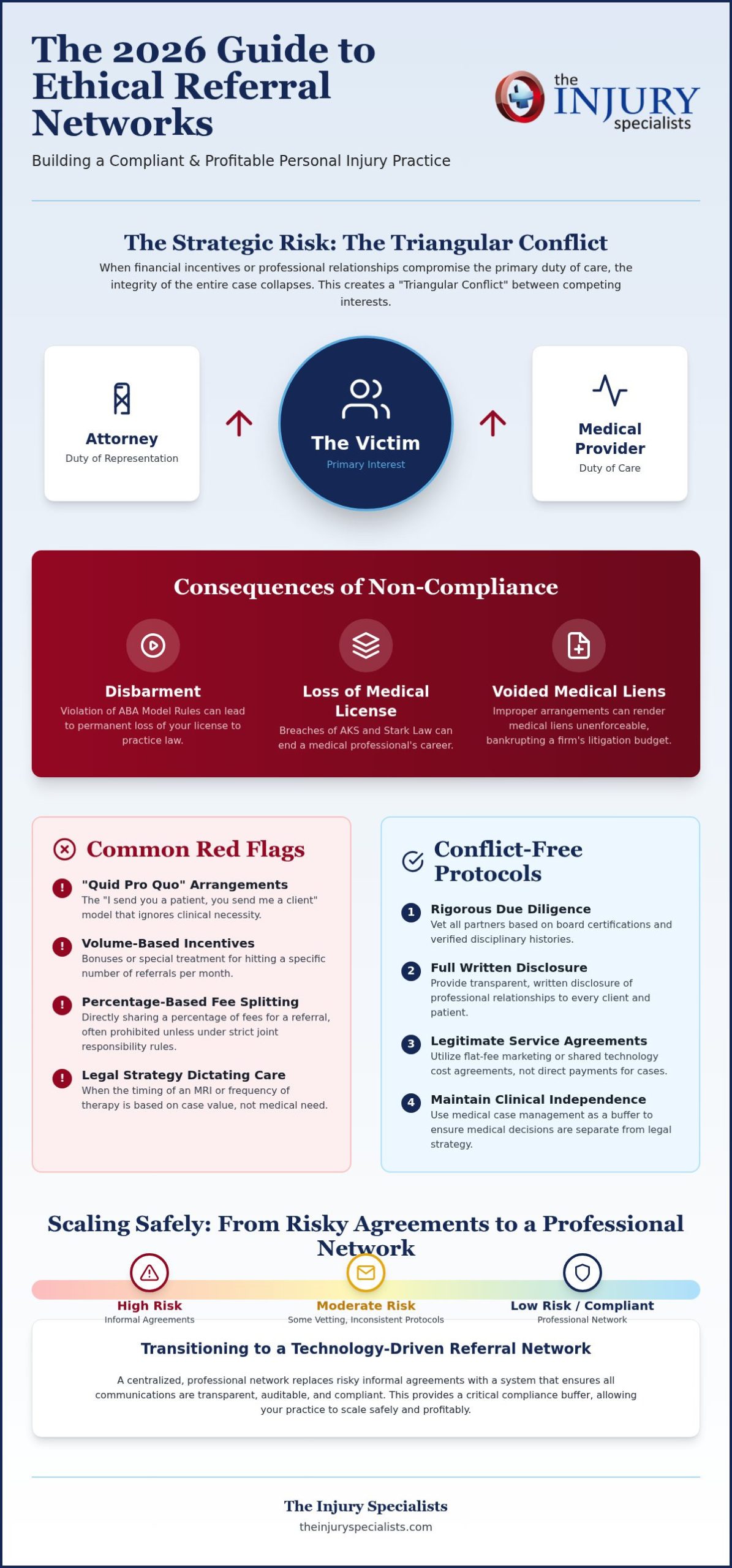
A conflict of interest in personal injury occurs when financial incentives or professional relationships compromise the primary duty of care or representation. In a referral hub, this often manifests as a “Triangular Conflict” where the competing interests of the attorney, the medical provider, and the victim create friction. If a lawyer prioritizes a high-volume provider over the client’s actual clinical needs, the integrity of the entire case collapses. This isn’t just an ethical lapse; it’s a strategic failure that undermines the credibility of the evidence and the final settlement.
Regulatory scrutiny in 2026 has reached an all-time high. The American Bar Association’s 2026 edition of the Model Rules of Professional Conduct includes updated guidance that demands stricter oversight of professional networks. Non-compliance isn’t just a minor administrative hurdle. It leads to disbarment, the loss of medical licenses, and the voiding of medical liens, which can bankrupt a firm’s litigation budget. Successfully avoiding referral conflicts of interest requires a proactive, systemized approach to partnership management that prioritizes transparency over convenience.
Legal Ethics and the ABA Model Rules
ABA Model Rule 7.2 prohibits paying for referrals, yet many firms struggle to distinguish between illegal kickbacks and legitimate marketing or networking costs. In 2026, understanding jurisdictional variations is critical. Some legal frameworks permit pure referral fees with written client consent, while others require joint responsibility or proportional work to be established. Professional referral networks act as a compliance buffer by ensuring that all financial interactions remain within these diverse legal bounds. They focus on shared technology and case management rather than direct payment for patients, which is essential for avoiding referral conflicts of interest.
Medical Ethics and Clinical Autonomy
For healthcare providers, the federal Anti-Kickback Statute (AKS) and Stark Law present significant risks. Any exchange of value intended to influence referrals for services covered by federal programs is strictly prohibited. Medical necessity must remain independent of legal case strategy. Physicians must avoid “quid pro quo” arrangements where patient care is traded for legal leads. A structured referral system protects the physician-patient relationship by ensuring that clinical decisions are based on the patient’s health, not the potential settlement value. This independence ensures that medical testimony remains credible during litigation and preserves the provider’s professional standing.
Identifying Common Conflict Scenarios and Red Flags
Conflicts of interest in personal injury aren’t always as obvious as a cash kickback. They often exist in the subtle, systemic pressures that influence how a case moves from an accident scene to a settlement check. One primary red flag is any arrangement involving direct financial incentives for case volume. If a medical provider or an attorney receives a “bonus” for hitting a specific number of referrals per month, professional judgment is immediately compromised. This creates a scenario where the referral is made to satisfy a quota rather than to serve the client’s recovery needs.
Quid pro quo arrangements are equally dangerous. The “I send you a patient, you send me a client” model creates a closed loop that ignores the necessity of clinical fit. This practice often leads to over-treatment or unnecessary diagnostic imaging. When legal strategy, rather than medical necessity, dictates the frequency of physical therapy or the timing of an MRI, the case becomes vulnerable during discovery. Insurance adjusters and defense counsel look for these patterns. If a medical report mirrors a legal complaint too closely, it loses its evidentiary value. Maintaining ethical referral protocols requires a clear separation between legal goals and medical care.
Fee-Splitting vs. Legitimate Service Agreements
Structuring networking agreements requires precision to avoid the fee-sharing trap. Percentage-based referral incentives are strictly regulated and often prohibited unless specific joint responsibility criteria are met. Professional firms instead utilize flat-fee marketing or networking agreements. A referral fee is a direct payment for the transfer of a specific case, while a marketing expense is a fixed cost for professional visibility and infrastructure within a network. This distinction is the foundation of avoiding referral conflicts of interest. Utilizing a managed physician referral service helps ensure that all financial interactions remain within these safe harbor boundaries.
Clinical Red Flags in Medical Documentation
Attorneys must be vigilant for “canned” medical reports. If every patient referred to a specific clinic receives the exact same diagnosis and treatment duration, it suggests that the provider is prioritizing legal demand over individual care. Attorneys should never direct specific medical treatments or dictate the duration of care. Independent diagnostic standards are essential for the credibility of the case. Imaging centers and specialists must maintain their own protocols to ensure that their findings withstand the scrutiny of expert depositions and trial testimony.
Vetting Referral Partners for Ethical Integrity
Scaling a personal injury practice requires a network built on more than just volume. While the largest personal injury referral network in the US offers significant reach, safety comes from the quality of the individual partners. Establishing a rigorous due diligence process is the only reliable method for avoiding referral conflicts of interest. You must move beyond superficial introductions and conduct a deep audit of a partner’s professional standing and internal operational standards. Relying on unvetted “handshake” deals in a large-scale operation invites regulatory scrutiny that can jeopardize your entire firm.
Vetting begins with verifying board certifications and reviewing disciplinary histories through state licensing boards. A partner’s internal documentation protocols are equally revealing. If a provider lacks a structured system for tracking patient progress or fails to maintain transparent billing, they become a liability during litigation. High-integrity partners welcome oversight and demonstrate a commitment to clinical and legal independence. Quality over quantity is the only sustainable strategy in the 2026 regulatory environment.
The Attorney Due Diligence Checklist
Attorneys must audit a medical provider’s history with personal injury liens to ensure they aren’t inflated or predatory. Assess the provider’s willingness to participate in integrated medical case management. This participation is a key indicator of a provider who values clinical oversight over unchecked volume. Review their billing practices for “reasonableness” according to 2026 standards; unreasonable fees can lead to voided liens and reduced settlement values. A partner who utilizes case management technology is often better equipped to provide the transparent, auditable records required in modern PI litigation. Don’t hesitate to ask for redacted samples of their medical reports to check for canned language.
The Medical Provider’s Vetting Framework
Healthcare providers should evaluate a law firm’s reputation for ethical case handling before accepting referrals. It’s essential to identify firms that prioritize full patient recovery over quick, low-value settlements. Ensure the firm respects clinical boundaries and strictly adheres to patient privacy regulations like HIPAA. A law firm that attempts to influence treatment plans or diagnostic timing is a significant risk. Ethical firms understand that avoiding referral conflicts of interest protects the doctor-patient relationship and ensures that medical testimony remains credible. Look for firms that value long-term professional synergy and have a clear, written protocol for how they handle referred cases.
Implementing a Conflict-Free Referral Protocol
Ad-hoc referral systems are the primary source of ethical breaches in personal injury practice. To scale safely, your firm must transition from informal handshake agreements to a formalized, written referral policy. This document should define the criteria for both incoming and outgoing referrals, ensuring that every professional connection serves a specific clinical or legal purpose. A standardized protocol eliminates the ambiguity that often leads to regulatory scrutiny and professional discipline.
Implementing a formalized protocol is the most effective method for avoiding referral conflicts of interest. Regular auditing of these referral patterns is essential to ensure a diverse network. If a firm finds that a vast majority of its cases are flowing to a single provider without a clear clinical justification, it creates a pattern of bias that is easily exploited by defense counsel. Maintaining a balanced, multi-provider network demonstrates that your referrals are based on patient needs rather than financial convenience.
The Role of Independent Medical Case Management
Utilizing medical case management for attorneys acts as an ethical firewall between your legal strategy and the patient’s clinical care. This system ensures that care coordination is handled by licensed medical professionals rather than legal staff. When clinicians manage the “cohesive care ecosystem,” the risk of an attorney inadvertently directing medical treatment is eliminated. This separation preserves the integrity of the medical evidence and protects the firm from allegations of over-treatment or diagnostic interference.
Transparency and Client Informed Consent
Full disclosure is a non-negotiable component of a compliant referral system. Firms must draft clear disclosure forms that explain the nature of their professional network to the client. These documents must explicitly state that the client has the absolute right to choose any provider or attorney, regardless of the firm’s recommendations. Prioritizing the client’s best interest over the network’s growth is not just an ethical requirement; it’s a strategic necessity for long-term practice stability. To see how a structured network can streamline your compliance, explore our attorney referral program today.
Scaling Safely with a Professional PI Referral Network
Relying on informal “handshake” deals is an obsolete strategy that invites unnecessary legal and ethical risks. In the high-stakes personal injury environment of 2026, professional facilitation is the only way to ensure growth without compromising integrity. A centralized personal injury specialist network provides the infrastructure needed to maintain professional boundaries while maximizing case volume. This systemic approach replaces vague verbal agreements with documented, transparent processes that protect all parties involved.
Professional networks act as a strategic facilitator between the medical and legal sectors. By standardizing how partners are vetted and how cases are transferred, these hubs remove the pressure of direct financial solicitation. This is the most effective way of avoiding referral conflicts of interest while scaling a practice. Moving toward a facilitated model ensures that your firm remains a leader in both compliance and results, positioning you as a reliable partner in a crowded market.
Leveraging Case Management Technology
The core of a compliant network is its technical infrastructure. Utilizing proprietary personal injury case management technology allows firms to track every interaction within an auditable environment. These HIPAA-compliant platforms ensure that sensitive patient data is protected while providing a clear trail of communication. Technology streamlines workflows by automating documentation and status updates, which prevents the need for constant, informal check-ins that can blur professional boundaries. This transparency is a critical component for avoiding referral conflicts of interest, as it provides objective proof of clinical and legal independence.
Strategic Networking for Long-Term Success
Transitioning from tactical, one-off referrals to a strategic growth ecosystem changes the trajectory of your practice. Being an ethical “power-connector” attracts higher-quality medical providers and legal partners who prioritize professional synergy. A well-managed network creates a self-sustaining cycle of high-value cases and reliable documentation. This shift allows you to focus on high-level strategy rather than the logistical complexities of individual referrals. By building a reputation for strict ethical adherence and logistical ease, your firm secures its position as a dominant operator in the 2026 personal injury sector.
Future-Proof Your Referral Strategy
Scaling a personal injury practice in 2026 requires a shift from informal networking to a structured, technology-driven ecosystem. Success depends on your ability to maintain professional boundaries while increasing case volume. By implementing rigorous vetting processes and utilizing third-party facilitation, you ensure that clinical decisions remain independent of legal strategy. This approach is the most reliable method for avoiding referral conflicts of interest and protecting your firm from the rising tide of regulatory scrutiny. A well-oiled system doesn’t just mitigate risk; it creates a predictable path for sustainable expansion.
The Injury Specialists provides the infrastructure you need to lead your market with confidence. Our proprietary case management technology ensures compliant workflows, while integrated medical case management guarantees clinical independence across our nationwide network of vetted professionals. It’s time to move beyond tactical handshake deals and embrace a strategic, growth-oriented ecosystem. Join the largest ethical personal injury referral network in the US today. Build your practice on a foundation of professional excellence and streamlined success.
Frequently Asked Questions
Is it legal for an attorney to receive a referral fee from a doctor?
No. ABA Model Rules and state ethics boards strictly prohibit attorneys from receiving anything of value in exchange for referring a client to a medical provider. This prohibition is a primary pillar of avoiding referral conflicts of interest. While lawyers can share fees with other attorneys under specific conditions, receiving payments or kickbacks from non-lawyers for referrals is a violation of professional conduct that can lead to disbarment.
What is the difference between a referral network and a kickback scheme?
A legitimate referral network focuses on professional facilitation, transparency, and clinical independence. It utilizes structured protocols and technology to connect professionals without direct financial incentives per case. Conversely, a kickback scheme involves undisclosed payments or volume-based bonuses. In 2026, the distinction lies in the presence of auditable documentation and the absence of direct financial links between a specific referral and a payment.
How do I disclose a referral relationship to my client without losing their trust?
Use a standard written disclosure form that emphasizes client autonomy and the network’s purpose. Explain that the network exists to ensure they receive high-quality, coordinated care from vetted professionals who understand personal injury. Explicitly state that the client has the right to choose any provider. Transparency builds trust by demonstrating that you have a professional ecosystem designed to support their recovery and case outcome.
Can medical case management help prevent conflicts of interest?
Yes, medical case management acts as an essential compliance buffer between legal and medical professionals. By allowing licensed clinicians to handle care coordination, the attorney is removed from treatment decisions. This ensures that medical necessity, rather than legal strategy, drives the patient’s care. Integrated case management provides the clinical oversight necessary for avoiding referral conflicts of interest while maintaining a cohesive care ecosystem for the victim.
What should I do if I suspect a referral partner is acting unethically?
Immediately cease all referral activity with that partner and conduct an internal audit of existing cases. Document your findings and consult with your firm’s ethics counsel. If the behavior involves illegal kickbacks or fraud, you may have a reporting obligation under state bar rules. Protecting your firm’s reputation and license requires a zero-tolerance policy for unethical conduct. Professional networks help mitigate this risk by vetting partners before they enter your ecosystem.
Are tiered referral networks ethical under ABA Model Rules?
Tiered networks are ethical if they are based on objective quality metrics and don’t involve “pay-to-play” structures. Under 2026 ABA guidance, ranking partners based on board certifications, disciplinary history, and responsiveness is a legitimate due diligence practice. However, if “top-tier” status is purchased or linked to referral volume, it likely violates Rule 7.2 regarding recommendations of services for value. Ethical networks prioritize performance and compliance over financial contributions.
How does the Anti-Kickback Statute apply to personal injury medical liens?
The Anti-Kickback Statute (AKS) prohibits exchanging anything of value to induce referrals for services covered by federal healthcare programs. In personal injury, if a provider offers a lawyer a discount on a lien in exchange for future referrals, it may trigger AKS scrutiny. This is especially critical if the patient is a Medicare or Medicaid beneficiary. Compliance requires that all lien negotiations remain independent of referral agreements and reflect fair market value.
What are the red flags of a “sham” referral network?
Red flags include a lack of transparent documentation, “pay-to-play” membership fees, and a “closed loop” where referrals are only traded between a few specific partners. A sham network often lacks proprietary technology for tracking compliance or clinical oversight. If the network’s primary value proposition is “guaranteed volume” rather than professional facilitation and case management, it should be avoided. Legitimate networks focus on streamlining growth through ethical, auditable communication and clinical independence.

Leave A Comment
You must be logged in to post a comment.