

Your staff likely spends more time acting as couriers for medical records than they do building legal strategies. This administrative friction isn’t just a nuisance. It’s a direct drain on your firm’s profitability and case velocity. Realizing the full potential of a case requires streamlining imaging referrals for personal injury firms to ensure medical data moves as fast as the litigation process demands. When your team is forced to manually track down diagnostic reports, the entire firm’s growth slows down.
You understand that every day a client waits for an MRI or a paralegal spends hours chasing a missing bill is a day your settlement remains stagnant. Gaps in care and a lack of transparency in the referral pipeline often lead to lower settlement values and frustrated clients. This guide shows you how to eliminate these bottlenecks and maximize case value by shifting to a high-efficiency diagnostic imaging workflow. We’ll explore how paperless record retrieval and integrated referral technology can accelerate scan turnarounds and drive higher settlement potential for every file in your cabinet.
Key Takeaways
- Identify and eliminate the hidden administrative costs of manual referral tracking that drain your paralegals’ time.
- Discover the specific digital triggers required for streamlining imaging referrals for personal injury firms to accelerate client care.
- Understand how connecting your case management system to a dedicated referral platform eliminates the need for manual record retrieval.
- Evaluate the strategic advantages of national referral networks over single-facility vendors to ensure consistent care across all cases.
- See how a centralized “Business to Business” referral model provides the transparency needed to maximize case value and settlement potential.
The Administrative Bottleneck: Why Traditional Imaging Referrals Drain Firm Resources
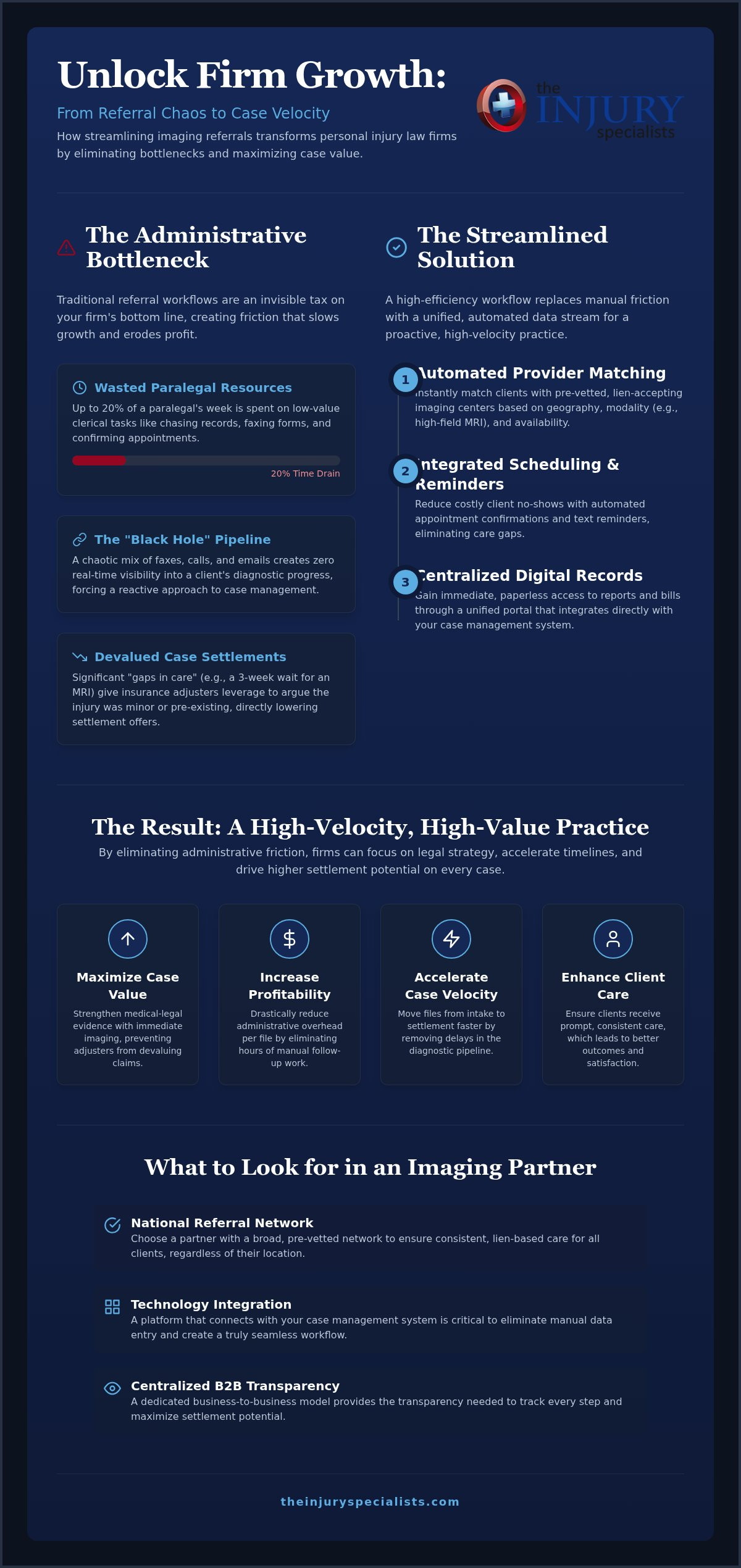
Manual referral tracking is an invisible tax on your firm’s bottom line. While most attorneys focus on the final settlement, the labor required to reach that point often erodes the net profit of the case. Traditional workflows rely on a chaotic mix of faxes, phone calls, and unencrypted emails. This lack of a centralized system creates a massive administrative bottleneck that affects every department. When your firm lacks a unified pipeline, you lose visibility into the status of your clients’ diagnostic progress.
The friction caused by disparate communication channels is more than a minor annoyance. It creates a “black hole” in the referral pipeline. Without a unified portal, your firm has no real-time visibility into whether a client actually attended their scan. You’re left waiting for a bill or a report to trigger the next step in the case. This reactive approach is the antithesis of a growth-oriented practice. Streamlining imaging referrals for personal injury firms is the only way to move from a defensive, reactive posture to a proactive, high-velocity model.
The True Cost of ‘Chasing’ Records
Paralegals and case managers frequently spend up to 20% of their workweek performing clerical follow-ups. They call imaging centers to confirm appointments, fax HIPAA authorizations, and wait weeks for CDs to arrive in the mail. This “chasing” of records is a poor use of specialized talent. It pulls high-value staff away from substantive legal work and building client relationships. When documentation is fragmented across multiple platforms, the risk of missing a critical radiology report increases. Administrative bloat doesn’t just slow down your team; it directly reduces firm profitability by increasing the overhead cost per file.
Gaps in Care and Case Value
In the context of a personal injury claim, time is a metric of credibility. A “gap in care” describes any significant delay between the date of the accident and the start of specific medical treatments or diagnostics. Insurance adjusters are trained to identify these delays. They use them as leverage to argue that the injury was either pre-existing or not severe enough to warrant immediate attention. If a client waits three weeks for an MRI, the adjuster sees a reason to lower the settlement offer.
Streamlining imaging referrals for personal injury firms eliminates these tactical disadvantages. By automating the referral-to-imaging pipeline, you ensure that clients receive MRI or CT scans within days rather than weeks. Immediate imaging creates a contemporaneous record of the injury. This strengthens the medical-legal evidence and prevents adjusters from devaluing the claim based on perceived delays. Faster diagnostics lead to faster treatment plans, which ultimately increases case velocity and settlement potential across your entire docket.
The Anatomy of a Streamlined Imaging Referral Workflow
A digital-first approach replaces the fragmented paper trail with a unified, automated data stream. This transition eliminates the manual triggers that often stall a case for weeks. By moving to a centralized system, firms significantly reduce the accounting friction associated with disparate billing formats and manual ledger entries. It is a fundamental shift toward operational scalability. Streamlining imaging referrals for personal injury firms requires a workflow where data flows as easily as the legal strategy itself.
Step 1: Automated Provider Matching
Finding the right diagnostic facility shouldn’t require an afternoon of phone calls. A sophisticated network portal allows case managers to match clients with imaging centers instantly. The criteria for these matches include geographic proximity, specific imaging modalities like high-field MRI, and, most importantly, lien-acceptance. Utilizing a pre-vetted national network provides peace of mind that the facility understands the unique requirements of personal injury litigation. This automation removes the guesswork and ensures clients are sent to providers who are already aligned with your firm’s operational needs.
Step 2: Integrated Scheduling and Reminders
Patient no-shows are a silent killer of case velocity. When a client misses a scan, it creates a new gap in care that adjusters will exploit. Integrated scheduling platforms reduce these rates through automated patient communication and text reminders. This digital bridge eliminates the constant back-and-forth between the law firm and the imaging facility. Securing a prompt appointment is critical to meeting discovery deadlines and maintaining the momentum of the claim. Efficient scheduling ensures the diagnostic phase of the case is completed without unnecessary administrative delays.
Step 3: Real-Time Status Tracking
Dashboards replace the outdated “calling for updates” culture. When a paralegal can see a live status update on an active referral, they can provide immediate answers to clients and attorneys. This visibility is essential for managing the legal and ethical issues inherent in health informatics and data management. You no longer have to wait for a mailed CD or a faxed report to know if a scan was performed. Having instant access to the referral-to-imaging pipeline allows your firm to operate with a level of transparency that maximizes efficiency. You can experience this level of control by utilizing a national referral network designed for high-volume firms.
Leveraging Technology to Eliminate Administrative Friction
Technology acts as the catalyst for firm-wide efficiency. A medical-legal networking platform serves as a centralized hub where law firms and diagnostic centers interact within a secure, high-speed ecosystem. This infrastructure eliminates the need for manual data entry and repetitive phone follow-ups. API-led integrations further enhance this by connecting the referral portal directly to your firm’s existing Case Management System (CMS). When these systems communicate, data flows automatically between platforms, ensuring that streamlining imaging referrals for personal injury firms becomes a seamless extension of your current operations rather than a separate administrative task.
Paperless Communication and Record Retrieval
The move to a paperless environment is essential for maintaining HIPAA compliance and data security. Digital document exchange effectively retires the fax machine, replacing it with encrypted, instant transfers that protect sensitive patient information. This shift is particularly beneficial during the time-sensitive preparation of demand packages. On-demand record retrieval allows your staff to pull diagnostic reports and bills the moment they are finalized by the imaging facility. You don’t have to wait for mail delivery or physical CDs to arrive. Every report is delivered in a high-resolution, court-ready format, ensuring your medical evidence is accessible and perfectly organized from the moment it’s generated.
The 24/7 Referral Portal
Litigation doesn’t happen only during standard business hours. Attorneys and case managers require “anytime” access to their case data to stay ahead of discovery deadlines and court dates. A 24/7 referral portal provides this flexibility, offering a comprehensive, real-time view of every active imaging referral regardless of the time or location. Mobile-responsive platforms are especially valuable for off-site case managers who need to verify scan statuses or authorize new referrals while traveling or attending depositions. These self-service tools empower your legal staff to move cases forward independently. By utilizing technology as a “power-connector,” your firm maintains a constant, high-velocity workflow. This level of digital integration is the standard for streamlining imaging referrals for personal injury firms that aim to scale without increasing their administrative headcount.
Strategic Selection: What to Look for in an Imaging Referral Partner
Selecting a referral partner is a strategic business decision that directly impacts your firm’s scalability. Many firms make the mistake of partnering with local, single-facility vendors based solely on proximity. While local options may seem convenient, they often lack the administrative infrastructure required for high-volume litigation. A true partner provides more than just a scan; they provide a comprehensive system for streamlining imaging referrals for personal injury firms. This selection process should focus on network reach, integrated support services, and the quality of the final medical-legal work product.
National Reach vs. Local Limitations
National referral networks offer a level of scalability that local vendors cannot match. As your firm expands or handles cases across state lines, you need a partner with a consistent footprint. A national network ensures that documentation standards, billing formats, and communication protocols remain uniform regardless of where the client is located. This consistency is vital for maintaining an organized case file. Larger networks also provide easier access to specialized imaging modalities such as Diffusion Tensor Imaging (DTI) or upright MRI. These advanced tools are often necessary for documenting complex traumatic brain injuries or spinal issues, and a national partner ensures these resources are available on demand.
The Value of Integrated Case Management
Integrated medical case management is the missing link in many referral workflows. A partner that provides dedicated case managers acts as a high-level liaison between your law firm and the imaging center. These professionals ensure the cohesive care ecosystem is maintained throughout the life of the case. They handle the logistical heavy lifting, from verifying insurance or lien status to ensuring that radiology reports are delivered on time. This support significantly reduces the attorney’s role as a “medical coordinator.” When your legal team is no longer bogged down by medical logistics, they can focus entirely on the legal strategy and trial preparation.
Streamlining imaging referrals for personal injury firms through integrated case management ensures that no client falls through the cracks and no evidence is delayed. Beyond logistics, look for partners that offer value-added services such as pre-settlement funding and “expert-read” radiology reports. High-quality documentation is essential for building a persuasive demand package. Reports should be detailed, court-ready, and generated by board-certified radiologists who understand the nuances of personal injury litigation. To gain access to a network that combines these strategic advantages with a proprietary technology platform, you can partner with The Injury Specialists today.
The Injury Specialists: Scaling Firm Efficiency Through Integrated Imaging
The Injury Specialists functions as the premier facilitator for high-growth law firms. We move beyond simple vendor lists to provide a robust, B2B infrastructure that manages the entire medical-legal relationship. Our model is built on the premise that efficiency is the primary driver of case value. By streamlining imaging referrals for personal injury firms, we remove the logistical barriers that prevent attorneys from focusing on their core legal practice. This revolutionary approach treats medical coordination as a professional service, ensuring that your firm operates with the scale and reliability of a market leader.
A World-Class Technology Platform
Our proprietary technology platform is the only digital ecosystem specifically engineered for the personal injury sector. It provides immediate connectivity to a national network of over 1,100 professionals. This platform automates the referral process and provides on-demand access to medical records through a paperless interface. The system aligns with your existing legal workflows, allowing for 24/7 portal access to all referral data. For a deeper look at how digital tools are reshaping the industry, consult our Personal Injury Case Management Technology: The 2026 Strategic Guide. This level of integration ensures that your firm remains competitive in a market that increasingly demands speed and transparency.
Connecting the Medical-Legal Ecosystem
True efficiency is found in synergy. The Injury Specialists creates a cohesive environment where imaging, chiropractic, and physician referrals are managed under a single, integrated medical case management umbrella. This holistic approach ensures that every diagnostic finding is captured and every treatment plan is documented without administrative gaps. We act as your strategic partner, bridging the gap between medical providers and legal professionals to maximize case velocity. Our system is designed to scale with your firm, providing the logistical ease required to handle high-volume caseloads with precision. The result is a well-oiled system that increases settlement potential by eliminating delays in care. To see the platform in action, you can request a demo and discover the power of the largest injury referral network today.
Your firm’s growth shouldn’t be limited by administrative friction. By adopting a tech-enabled referral model, you position your practice as a sophisticated operator that values professional synergy and results. Streamlining imaging referrals for personal injury firms through our platform ensures that your team focuses on litigation while we handle the logistics. The transition from manual “chasing” to an integrated ecosystem is the most effective way to protect your firm’s profitability and ensure your clients receive the highest standard of diagnostic care. It’s time to move your practice into the future of medical-legal logistics.
Maximize Case Value with High-Efficiency Referral Systems
Operational friction is no longer an acceptable cost of doing business. Shifting away from manual record chasing and fragmented communication allows your team to focus on high-level legal strategy. Streamlining imaging referrals for personal injury firms is the most direct path to increasing case velocity and ensuring that medical evidence is both contemporaneous and court-ready. By integrating advanced technology with a national network, you eliminate the administrative bottlenecks that once stalled your settlements.
The Injury Specialists provides the infrastructure you need to scale. With a presence in 40+ states and a network of 1,100+ professional partners, we offer the industry’s most innovative paperless technology platform. You don’t have to manage these logistics alone. It is time to leverage a system designed for professional synergy and logistical ease. Request a Demo of the Largest Injury Referral Network to see how we can transform your diagnostic workflow. Your firm is ready to reach its full growth potential.
Frequently Asked Questions
How do streamlined imaging referrals impact case settlement values?
Streamlined referrals reduce gaps in care, which prevents insurance adjusters from devaluing claims. Faster diagnostics lead to earlier treatment plans and stronger medical evidence. This contemporaneous documentation makes it harder for defense teams to argue that injuries weren’t related to the accident. Efficiently streamlining imaging referrals for personal injury firms ensures that the full scope of an injury is documented immediately; this maximizes the objective value of the demand package.
Can a national referral network handle imaging for clients in rural areas?
A national referral network uses a vast ecosystem of over 1,100 professional partners to ensure coverage across the country. This scale allows firms to locate vetted imaging centers even when clients reside outside major metropolitan hubs. The network’s reach is designed to maintain consistency in care and documentation standards regardless of the client’s location. By utilizing a nationwide infrastructure, firms provide their rural clients with the same high-quality diagnostic access as those in urban centers.
What is the difference between an imaging referral service and a medical funding company?
An imaging referral service like The Injury Specialists focuses on the logistical and clinical coordination of the diagnostic process. It connects firms with providers and manages the case workflow. In contrast, a medical funding company strictly provides capital to cover the cost of care or pre-settlement expenses. While we integrate pre-settlement funding into our ecosystem, our primary value lies in the technology and case management that automates the medical-legal relationship from referral to record retrieval.
How does on-demand medical record retrieval work within a referral portal?
On-demand retrieval operates through a secure, paperless technology platform that connects the imaging facility directly to the law firm’s portal. Once a radiologist finalizes a report, the document is uploaded and becomes immediately accessible for download. This eliminates the need for manual follow-up calls or waiting for physical mail. The system ensures that all diagnostic reports and bills are court-ready and available 24/7; this significantly accelerates the preparation of demand packages.
Is the technology platform compatible with our existing law firm case management software?
The proprietary technology platform is designed for seamless integration with modern law firm case management software. Through API-led connectivity, the referral portal can sync data directly with your existing system to eliminate double data entry. This alignment ensures that streamlining imaging referrals for personal injury firms doesn’t create a new administrative silo. Instead, it enhances your current workflow by providing a dedicated layer for medical-legal logistics that feeds directly into your primary case files.
What are the benefits of using lien-based imaging centers for personal injury cases?
Lien-based imaging centers allow clients to receive necessary diagnostic scans without upfront out-of-pocket costs. The facility agrees to defer payment until the case reaches a settlement or verdict. This arrangement is vital for ensuring that uninsured or underinsured clients don’t suffer from gaps in care due to financial constraints. For the law firm, these centers provide reliable medical evidence and predictable billing practices that are specifically tailored to the personal injury litigation process.
How does medical case management assist in coordinating diagnostic imaging?
Medical case managers act as the primary liaison between the law firm, the client, and the imaging facility. They handle the complex logistics of scheduling, verifying authorizations, and ensuring that the specific imaging modalities required for the legal strategy are performed. This professional oversight maintains a cohesive care ecosystem and ensures that no diagnostic steps are missed. By managing these clinical details, case managers allow attorneys to focus on the legal merits of the case.
