

Waiting years for a personal injury settlement to conclude is a business liability your practice can no longer afford to carry. In a 2026 market where the pre-settlement funding sector has surged to over $21 billion, holding stagnant accounts receivable is a strategic error. Understanding exactly how pre-settlement funding affects medical liens is the first step toward reclaiming your practice’s liquidity and eliminating the financial risk of a lost case. You already know the administrative burden of tracking Letters of Protection. It is time to move toward a more predictable financial model.
This strategic guide details how to transform those long-tail receivables into immediate, non-recourse cash flow. We provide the blueprint to eliminate the risk of non-payment while protecting the essential provider-attorney relationship. This guide delivers the strategies to leverage funding and create a system that supports high-volume patient care without the traditional wait times.
We will examine the latest 2026 regulatory shifts, the mechanics of lien purchasing, and the proprietary technology used to streamline medical-legal documentation. This is your roadmap to a more efficient, well-oiled financial system.
Key Takeaways
- Bridge the 18-36 month liquidity gap by converting stagnant accounts receivable into immediate, non-recourse cash flow.
- Discover how pre-settlement funding affects medical liens to eliminate the financial risk of zero recovery and protect essential provider-attorney relationships.
- Master the documentation and underwriting workflows necessary to secure favorable funding terms and accelerate practice scaling.
- Evaluate potential partners based on speed to fund, transparency of terms, and their ability to support a national B2B growth strategy.
- Leverage funding as a core pillar within a cohesive care ecosystem to facilitate high-volume physician referrals and streamlined case management.
Understanding the Liquidity Gap in Personal Injury Care
Medical lien funding is a professional, non-recourse transaction that allows healthcare providers to receive payment for services rendered before a legal case concludes. Unlike traditional bank lines of credit, which are recourse-based and require repayment regardless of the case outcome, this specialized funding shifts the financial risk from the provider to the funder. By reviewing Understanding Legal Financing, it’s clear that this mechanism is a purchase of a portion of the potential settlement proceeds rather than a debt obligation. This distinction is vital for practices that need to maintain a healthy balance sheet while treating personal injury patients.
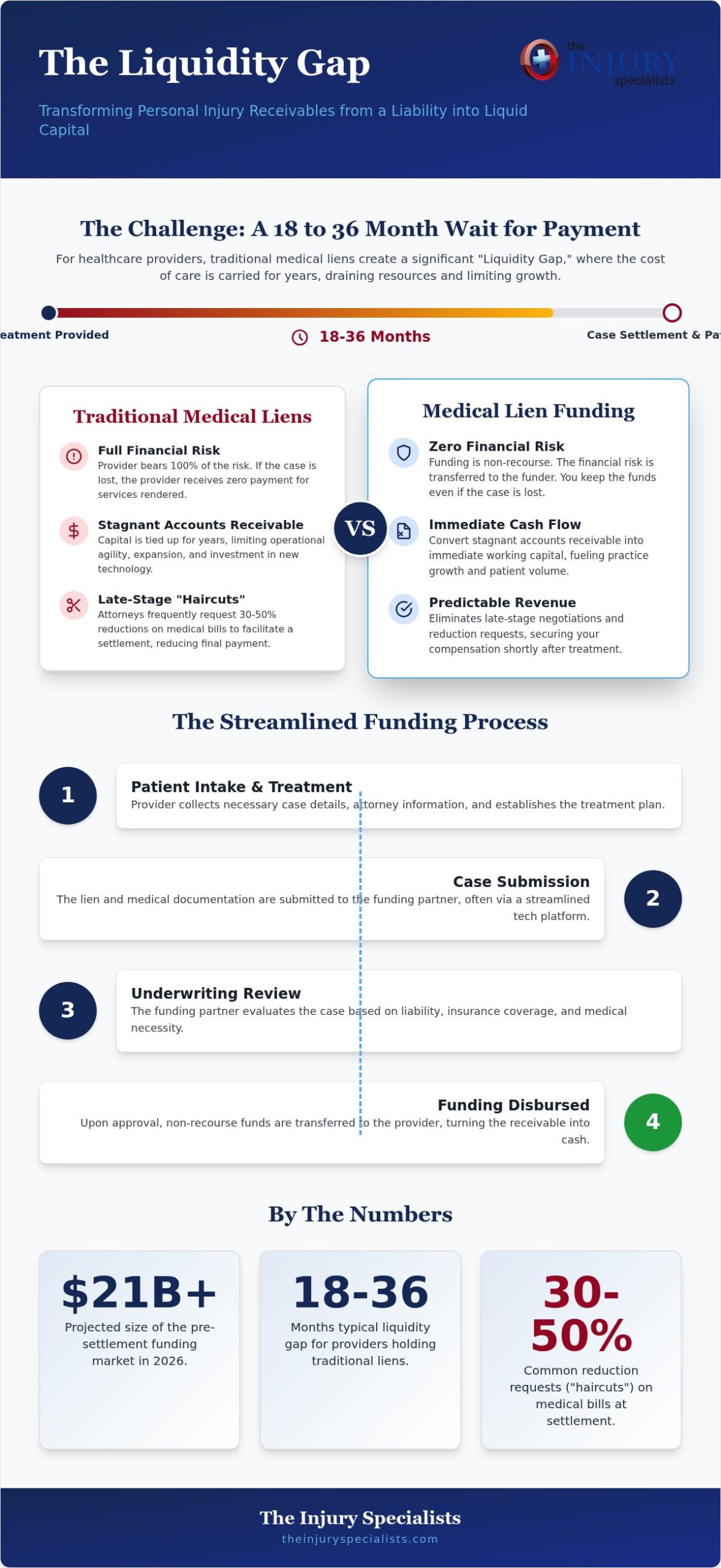
Most personal injury cases involve a “Liquidity Gap,” a period typically lasting 18 to 36 months where a provider carries the cost of care without compensation. This delay creates a significant bottleneck for practices aiming to increase their case volume. Without immediate liquidity, providers are forced to limit their exposure to personal injury work to avoid overextending their finances. Analyzing how pre-settlement funding affects medical liens reveals a clear path to bypass these delays and maintain operational momentum.
The Financial Burden of Traditional Liens
Stagnant accounts receivable (AR) drain practice resources and limit operational agility. When a provider holds a traditional lien, they’re essentially acting as a lender to the patient and attorney for years. This burden is compounded by “reduction requests” at the end of a case. Attorneys often ask providers to take a 30% to 50% haircut on their bills to facilitate a settlement. When you factor in the administrative costs of tracking Letters of Protection (LOPs) and following up on case statuses over several years, the true cost of holding a lien is often higher than the value of the payment received. Understanding how pre-settlement funding affects medical liens involves recognizing that it eliminates these late-stage negotiations and heavy administrative overhead.
Bridging the Gap Between Care and Compensation
Funding creates a professional synergy where clinical decisions remain independent of the legal timeline. Medical lien funding is a strategic tool for 2026 practice growth that converts future settlement expectations into immediate working capital. This infusion of cash allows for uninterrupted patient care and the ability to scale operations without waiting for the slow-moving wheels of the civil justice system. By removing the financial barriers to entry, providers can accept a higher volume of complex cases, knowing their compensation is secured shortly after treatment is completed.
The Mechanics of Medical Lien Funding and Underwriting
The transition from treating a patient on a lien to receiving immediate capital involves a structured underwriting sequence designed for speed and accuracy. This workflow begins at patient intake, where the provider collects the necessary case details and attorney information. Once the treatment plan is established, the case is submitted to a funding partner for review. Advanced technology platforms now automate much of this data transfer, reducing the approval cycle from weeks to days. A core benefit of this process is the non-recourse guarantee. Unlike traditional debt, the provider retains the disbursed funds even if the underlying legal case is lost or results in a zero recovery.
This financial safety net is why understanding how pre-settlement funding affects medical liens is critical for modern practice management. It shifts the burden of case outcome risk away from the medical facility. To ensure a smooth transition, many providers choose to integrate case management technology that aligns with national funding standards.
The Underwriting and Case Evaluation Process
Funding companies analyze three primary pillars: liability, insurance coverage, and medical necessity. Underwriters look for clear evidence that the defendant is at fault and that sufficient policy limits exist to cover the medical costs. The quality of clinical documentation is the most influential factor in securing favorable terms. In particular, clear personal injury diagnostic imaging referrals provide the objective evidence required to validate the severity of an injury. In 2026, most professional funding partners complete the initial case review within 24 to 48 hours, with wire transfers typically disbursed within one business day of agreement execution.
Compliance and Documentation Standards
To maintain a high approval rate, providers must supply a standard set of records, including police reports, the Letter of Protection (LOP), and initial evaluation notes. Maintaining HIPAA compliance is mandatory during the digital transmission of these medical-legal records. As noted in the U.S. GAO report on third-party litigation financing, the industry is increasingly focused on transparency and ethical standards. Ensuring that all funding agreements align with both state regulations and national best practices protects the provider’s reputation and ensures the long-term viability of the referral network. High-level facilitators use proprietary platforms to manage these documents securely, creating a seamless bridge between the clinical and financial aspects of the case.
Strategic Comparison: Traditional Medical Liens vs. Funding Solutions
Choosing between holding a traditional lien and utilizing a funding partner is a choice between passive waiting and active growth. Traditional medical liens represent a significant financial gamble. The provider assumes total risk for the case outcome, legal expenses, and the patient’s eventual settlement amount. In contrast, medical lien funding transfers this volatility to a third-party specialist. By reviewing a legal analysis of the litigation financing industry, practitioners can see that this shift is not just a cash-flow fix but a fundamental risk management strategy. This comparison is central to understanding how pre-settlement funding affects medical liens and the practice’s overall stability.
The 2026 economy makes the “cost of waiting” more expensive than ever. High inflation erodes the value of stagnant accounts receivable. A payment received three years from now is worth significantly less in real terms than capital deployed today into marketing or facility expansion. Professional funding management also preserves professional capital. It removes the friction of end-of-case negotiations, allowing providers and attorneys to focus on their respective expertise rather than arguing over bill reductions.
Risk Mitigation for the Medical Practice
Traditional liens are subject to the “zero-recovery” reality. If a case is lost at trial or dismissed, the provider often faces a total loss on the services provided. Funding solutions utilize non-recourse financial structures that guarantee the provider keeps the advanced funds regardless of the court’s decision. This structure eliminates the pressure of reduction requests from law firms that typically occur during settlement distribution. Funding protects the provider’s bottom line from legal volatility by locking in revenue at the time of service.
Operational Efficiency and Scalability
Immediate liquidity transforms how a practice interacts with the legal community. With secured cash flow, providers can aggressively grow personal injury law firm referrals by demonstrating a capacity for high-volume care. Internal collections departments are often an expensive overhead burden. Outsourcing the financial risk to a funding partner reduces this administrative weight and allows staff to focus on clinical excellence. This model enables practices to accept high-value cases that require expensive, upfront diagnostic procedures like advanced imaging or surgical consultations, which might otherwise be too risky to carry on a traditional lien.
Evaluating a Medical Lien Funding Partner for National Scaling
Scaling a medical practice within the personal injury sector requires more than just capital; it requires a strategic partner that functions as a high-level facilitator. While many local firms offer quick cash, national scaling demands a B2B focus that prioritizes professional synergy over transactional speed. A partner should be deeply embedded in the personal injury referral network ecosystem. This ensures they understand the specific needs of both medical providers and law firms. When analyzing how pre-settlement funding affects medical liens, the quality of the partner determines whether the funding becomes a catalyst for growth or a source of administrative friction.
Transparency and Ethical Funding Structures
Longevity in the medical-legal community is built on trust and clear communication. Providers must identify and avoid funders who utilize predatory compounding interest models or obscure hidden fees. These practices often lead to friction during the final settlement phase, damaging your reputation with law firm partners. A professional partner maintains tripartite communication between the funder, the attorney, and the provider. This transparency ensures everyone understands the repayment structure from the outset. Selecting a partner with a proven national reputation protects your practice from the volatility of unethical funding practices.
Technological Integration in 2026
Manual lien tracking is an obsolete practice that drains staff resources and increases the risk of error. In a modern personal injury case management technology environment, real-time data access is the industry standard. Effective partners provide digital dashboards that allow medical staff to track funded amounts, case statuses, and documentation requirements in real time. Understanding how pre-settlement funding affects medical liens through these technological lenses allows for more informed decision-making and faster internal processing.
Integrated platforms eliminate the data gaps that plague traditional lien management. Centralized systems ensure every funded case has the documentation required for underwriting. This visibility reduces the administrative burden on your billing department and ensures that law firm partners have immediate access to the records they need for settlement. To ensure your practice is equipped for high-volume growth, partner with a national referral network that prioritizes technological efficiency.
The Injury Specialists: Integrating Funding into Cohesive Care
The Injury Specialists operates as a strategic partner that bridges the gap between clinical excellence and financial viability. By positioning funding as a central pillar of the largest national personal injury referral network in the United States, we enable a cohesive care model that benefits every stakeholder. This integrated approach solves the primary problem of stagnant accounts receivable. When you analyze how pre-settlement funding affects medical liens within our network, it’s clear that liquidity is the engine of practice growth. We don’t just provide capital; we provide a system that supports high-volume patient care.
Providing both high-quality referrals and immediate financial liquidity creates a unique competitive advantage for medical practices. This synergy facilitates physician referral services personal injury by removing the financial hesitation that often limits a provider’s capacity. Instead of worrying about the 18 to 36-month wait for payment, practitioners can focus on patient outcomes and volume. Our proprietary technology platform serves as the single source of truth, providing seamless documentation that satisfies both underwriters and legal teams.
A Holistic Approach to Case Management
Our cohesive care ecosystem ensures that victims receive uninterrupted treatment from top-tier specialists. Integrated funding means care doesn’t stop because of a slow-moving legal system. Professional medical case management is a standard feature for every funded case, ensuring that clinical documentation meets the rigorous standards required by the courts. This level of organization acts as a catalyst for growth. Strategic networking through our platform connects you with the right partners, allowing you to scale a high-volume personal injury practice with confidence. We maintain a focus on logistical ease, ensuring the system works for you rather than against you.
Streamlining the Attorney-Provider Synergy
We reduce administrative friction for law firms by offering pre-vetted, funded medical options. Attorneys don’t have to spend hours searching for specialists willing to work on a lien or negotiating complex payment terms. By utilizing our network, law firms gain access to the objective medical evidence needed to maximize settlement values. Understanding how pre-settlement funding affects medical liens within this framework allows attorneys to move cases forward without financial bottlenecks. The result is a well-oiled system where providers get paid, attorneys settle cases efficiently, and patients receive the care they deserve.
Partner with The Injury Specialists for comprehensive referral and funding solutions to transform your practice’s financial and operational trajectory.
Strategic Liquidity and Practice Expansion in 2026
Practices that embrace this strategic shift move beyond the limitations of traditional accounts receivable. You have discovered that professional funding is not just about cash; it’s about building a predictable, scalable business model. Integrating these solutions ensures that clinical decisions remain independent of legal delays, while your bottom line remains protected from market volatility. Understanding how pre-settlement funding affects medical liens is the first step toward reclaiming your operational agility and focusing on patient care.
The Injury Specialists provides the infrastructure needed to succeed in this high-volume environment. By utilizing our proprietary world-class technology platform and a national network of pre-vetted professionals, you can streamline documentation and accelerate growth. Every funded case includes integrated medical case management to ensure compliance and maximize recovery. It’s time to transform your stagnant receivables into active working capital. Join the largest national personal injury referral and funding network today to begin your practice’s transformation.
Frequently Asked Questions
What is the primary difference between medical lien funding and a lawsuit loan?
Medical lien funding is a professional B2B transaction where a funding company purchases a healthcare provider’s accounts receivable at a discount. In contrast, a lawsuit loan is typically a consumer advance provided directly to a plaintiff for personal living expenses. While both are non-recourse, lien funding focuses specifically on securing payment for clinical services. This distinction is vital for understanding how pre-settlement funding affects medical liens and practice liquidity.
Is medical lien funding non-recourse for the healthcare provider?
Yes, medical lien funding is strictly non-recourse. This means the funding company assumes the entire risk of the legal case outcome. If the underlying personal injury case does not result in a recovery, the healthcare provider is not required to return the disbursed funds. This structure eliminates the financial risk associated with treating patients on a Letter of Protection and ensures the practice maintains consistent cash flow regardless of legal volatility.
How quickly can a medical practice receive funds after submitting a personal injury case?
Under 2026 standards, most professional funding partners complete the underwriting process within 24 to 48 hours of receiving the required documentation. Once the agreement is executed, funds are typically disbursed via wire transfer within one business day. This rapid turnaround allows practices to reinvest capital immediately into operations or marketing rather than waiting years for a traditional settlement to conclude and clear the stagnant accounts receivable.
Does medical lien funding require a credit check for the patient or the physician?
No, medical lien funding does not rely on the personal credit scores of the patient or the medical provider. The approval process is based entirely on the merits of the legal case, including liability, insurance coverage, and medical necessity. Because the transaction is a purchase of a case asset rather than a traditional loan, credit history is irrelevant to the underwriting decision. This allows providers to focus on clinical care.
What types of medical providers are eligible for medical lien funding?
Eligibility extends to a wide range of healthcare professionals within the personal injury ecosystem. This includes:
- Orthopedic surgeons and neurosurgeons
- Chiropractors and physical therapists
- Pain management specialists
- Diagnostic imaging centers
- Ambulatory surgery centers
Any provider treating patients under a Letter of Protection can utilize these services to stabilize their practice’s cash flow and mitigate the risk of non-payment from long-tail settlements.
How does utilizing a funding partner affect the final settlement negotiations for the attorney?
Funding simplifies the final distribution process by removing the need for late-stage bill negotiations. Since the provider has already been paid, the attorney doesn’t have to request reductions on medical liens to facilitate a settlement. This preserves the attorney-provider relationship and ensures the law firm can close cases faster. It creates a more efficient synergy where clinical and legal goals are financially aligned from the very beginning.
Can funding be used for expensive diagnostic imaging like MRIs and CT scans?
Yes, funding is frequently used to cover high-cost diagnostic procedures. Immediate payment for MRIs, CT scans, and other advanced imaging is essential for establishing the objective medical evidence needed for a personal injury case. By securing funding for these services, imaging centers can maintain their equipment and staff without carrying the burden of unpaid liens for years. This ensures patients receive necessary diagnostics without any clinical delay.
What happens to the funded amount if the personal injury case results in a zero recovery?
If a case results in zero recovery, the healthcare provider keeps the full amount of the funded payment. Because the transaction is non-recourse, the funder assumes the total loss. This is a primary factor in how pre-settlement funding affects medical liens, as it removes the risk inherent in traditional personal injury work. Providers can treat complex cases with the confidence that their compensation is guaranteed upon funding approval.

Leave A Comment
You must be logged in to post a comment.