

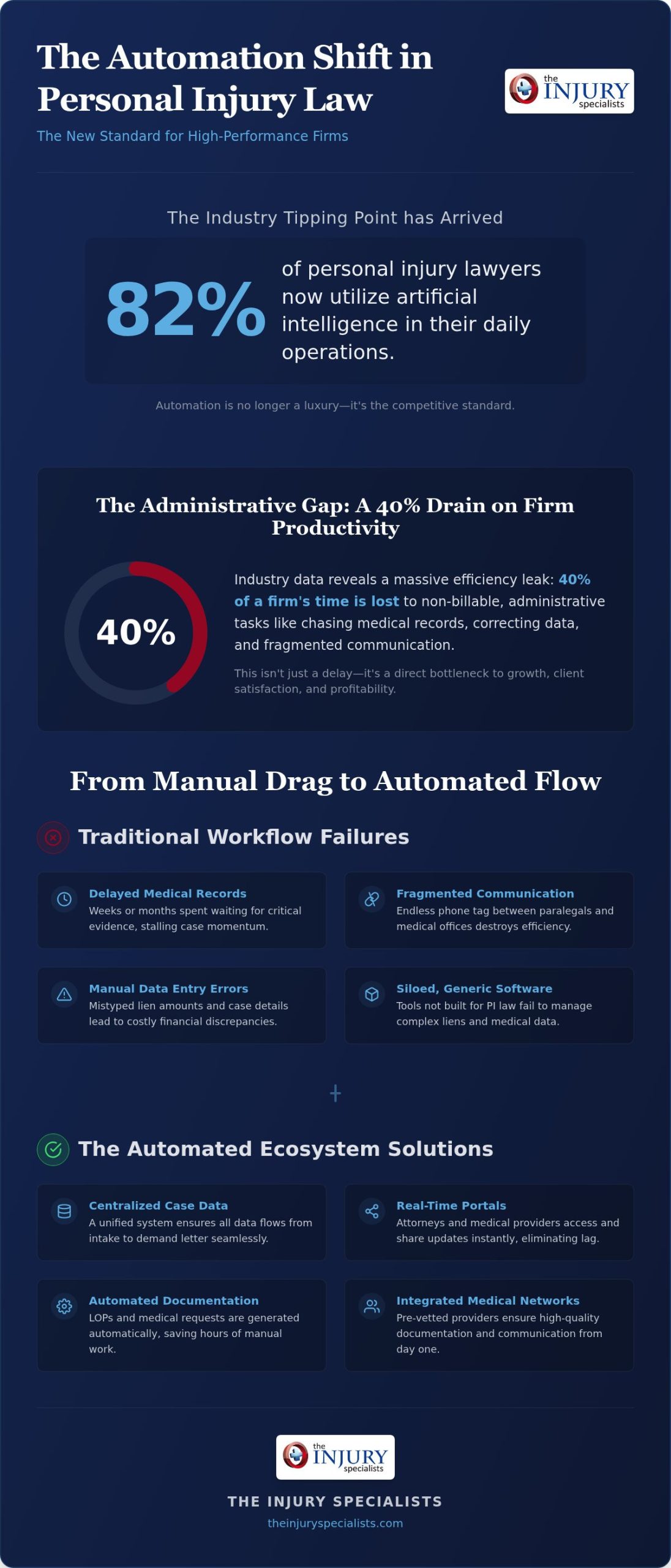
Eighty-two percent of personal injury lawyers now utilize artificial intelligence in their daily operations, marking a definitive shift in how the industry handles case volume. This surge proves that personal injury law firm automation is no longer a luxury; it is the standard for firms aiming to maintain a competitive edge in 2026. You likely recognize the logistical drag caused by administrative bottlenecks, particularly the slow pace of medical record retrieval and fragmented communication with outside physicians. These inefficiencies don’t just delay justice. They extend settlement cycles and increase the overhead required to manage disorganized case data.
We agree that managing these complexities shouldn’t come at the expense of your firm’s growth or professional focus. You can accelerate your settlement turnarounds and maximize operational efficiency by mastering the integration of medical networking and case management technology. This strategy moves your practice beyond manual oversight and into a model of streamlined, logistical success.
This 2026 strategic guide provides the framework for building a high-performance workflow. We’ll preview how a unified medical-legal ecosystem produces higher quality documentation and ensures your firm operates as a sophisticated, result-oriented leader in the field.
Key Takeaways
- Reclaim the 40% of firm time currently lost to non-billable administrative tasks by identifying and closing the gap in your medical-legal workflow.
- Discover how personal injury law firm automation centralizes case data through real-time portals that connect attorneys directly with medical providers.
- Master the equilibrium between AI speed and strategic management to ensure your firm prioritizes case value alongside settlement frequency.
- Reduce settlement cycles by integrating pre-vetted medical networks and automated lien tracking to prevent documentation bottlenecks.
- Scale your operations using a unified ecosystem that bridges the divide between world-class technology and the largest US referral network.
The Bottleneck: Why Traditional PI Workflows Fail in a Modern Landscape
Traditional personal injury workflows often collapse under the weight of their own administrative requirements. In a professional setting, workflow streamlining is defined as the strategic reduction of friction between medical treatment and legal demand. When these two phases don’t align, firms experience a massive Administrative Gap. Industry data suggests that 40% of firm time is lost to non-billable tasks, such as chasing medical records or correcting data entry errors. Implementing personal injury law firm automation is the most direct way to reclaim this lost capacity and refocus resources on high-value litigation.
This administrative friction isn’t just a nuisance; it’s a structural failure. Fragmented communication between law firms and medical providers creates a lag that extends settlement timelines by months. Without a centralized system, case managers spend their days acting as glorified couriers rather than legal professionals. This logistical drag prevents firms from scaling their case volume without exponentially increasing their overhead costs. It’s a system built for a slower era that can’t keep pace with 2026 demands.
The Cost of Fragmented Communication
Delayed medical records represent the primary cause of settlement stagnation. When firms rely on manual requests, they often wait weeks or months for critical evidence. This delay is frequently compounded by inconsistent documentation quality. Non-specialized medical providers may not understand the specific evidentiary requirements of a personal injury claim, leading to gaps in the case file. The resulting cycle of phone tag between paralegals and medical offices destroys case momentum and lowers client satisfaction. Utilizing a pre-integrated personal injury referral network solves this by establishing standardized communication protocols from the start. It ensures that medical data is captured correctly the first time, eliminating the need for constant follow-up.
Administrative Bloat in Case Intake
High-volume intake phases are particularly vulnerable to manual data entry errors. A single mistyped digit in a medical lien amount can lead to significant financial discrepancies at the time of settlement. Many firms still rely on generic practice management software that lacks the specific functionality to handle complex personal injury liens or imaging center coordination. This is a common failure in the broader field of legal technology; tools built for general law don’t account for the unique medical-legal intersection. In 2026, leading firms are moving away from these siloed operations. They’re adopting personal injury law firm automation to ensure that every piece of data, from the initial referral to the final demand letter, flows through a unified system that reduces human error and accelerates the path to recovery.
Leveraging Case Management Technology to Bridge the Medical-Legal Divide
Bridging the medical-legal divide requires more than just standard software. It demands specialized personal injury case management technology that centralizes every data point from intake to settlement. By moving away from reactive methods, firms can implement proactive workflows that anticipate case needs rather than merely responding to crises. This transition is essential for scaling operations while maintaining rigorous case quality standards. When your technology acts as a central nervous system, you gain total visibility into the treatment status of every client.
Real-time portal access for both attorneys and medical providers eliminates traditional information silos. When a physician uploads a treatment update or an imaging report, the legal team sees it instantly. This level of connectivity facilitates the automated generation of Letters of Protection (LOPs) and medical requests, stripping hours of manual labor from the workday. Industry analysis of legal process automation confirms that these tools significantly increase accuracy by removing repetitive human tasks from the equation. This shift allows your staff to focus on strategy rather than clerical follow-up.
Centralized Medical Record Management
Digital hubs act as the single source of truth for all case documentation. These hubs allow for instant retrieval and sharing, which is critical when preparing demand packages. By standardizing medical narratives, firms can produce higher-value demands that clearly reflect the true extent of a client’s injuries. Automated follow-up systems ensure that no documentation is lost in transit. These systems track every request and alert your team if a provider hasn’t responded within a specific timeframe, preventing case stagnation.
Aligning Firm-Specific Workflows
Every firm has distinct processes that generic tools fail to accommodate. Advanced personal injury law firm automation allows for deep customization to match your firm’s specific legal timeline. Integrating medical case management directly into this timeline ensures that treatment milestones trigger legal actions automatically. Secure, HIPAA-compliant communication channels protect sensitive data while maintaining the speed of digital exchange. This professional synergy defines a modern, high-growth practice. Firms looking to optimize these connections often benefit from a world-class technology platform that scales with their specific case volume.
AI Integration vs. Strategic Case Management: Finding the Efficiency Equilibrium
The current surge in personal injury law firm automation has introduced proactive AI assistants like Archie AI into the pre-litigation lifecycle. These tools represent a significant leap in operational velocity. However, a critical distinction exists between tools that provide speed and those that provide value. AI serves as a high-speed engine for data processing, but strategic case management remains the steering wheel for case outcomes. Finding the efficiency equilibrium means using technology to eliminate clerical friction while retaining human experts for high-level medical-legal consulting. This approach protects the integrity of your settlements while maximizing the throughput of your firm.
The Role of AI in Demand Drafting
AI’s primary strength lies in its ability to process vast quantities of unstructured medical data. By automating the extraction of medical codes and treatment dates, AI tools can reduce the time spent drafting demand letters by up to 75%. This automation creates a standardized baseline for every file. Using AI-driven playbooks ensures that high-volume litigation remains consistent, preventing critical treatment details from slipping through the cracks. Your staff can then pivot from manual data entry to reviewing the AI-generated output for strategic accuracy. This workflow allows for a higher volume of demand packages without a corresponding increase in headcount.
Why Human Case Management Remains Essential
While AI can identify a treatment date, it can’t fully navigate the nuance of pre-existing conditions or the complexities of causation. Human case management remains essential for interpreting how a specific injury interacts with a client’s unique medical history. This strategic advocacy is what ultimately drives higher settlement values in high-stakes negotiations. The human element is also vital for building and maintaining relationships with specialized physician referral services. These professional networks rely on trust and mutual expertise that software can’t replicate. By integrating personal injury law firm automation as a support system, your case managers are empowered to focus on the advocacy that AI can’t yet master. This combination of technological speed and human expertise creates a dominant market position for your firm.
5 Actionable Strategies to Accelerate Case Lifecycles
Accelerating case lifecycles in 2026 requires a transition from manual oversight to systemic integration. Implementing personal injury law firm automation across these five pillars ensures that cases move through the pipeline with minimal friction. By standardizing intake protocols, firms capture critical insurance and medical data immediately, preventing the downstream delays that occur when information is missing. This proactive approach establishes a foundation for high-speed litigation. A unified case management platform then connects all referral partners, ensuring that every stakeholder operates from a single source of truth.
- Standardize intake protocols to eliminate data gaps at the start of the case.
- Automate medical lien tracking to prevent financial surprises during the settlement phase.
- Implement a pre-vetted medical provider network to guarantee high-quality documentation.
- Utilize pre-settlement funding to stabilize clients and preserve case value.
- Integrate a unified case management platform across all referral partners for real-time visibility.
Automating the medical lien tracking process is particularly vital for maintaining case momentum. This reduces the administrative burden of managing unpaid medical bills and ensures that settlement negotiations aren’t stalled by unexpected claims. When these strategies are executed in tandem, the firm operates as a well-oiled machine rather than a collection of siloed departments.
Optimizing the Provider Connection
Selecting providers who understand personal injury documentation requirements is the first step in ensuring a cohesive care ecosystem. Using law firm medical referral programs allows your firm to automate scheduling and record retrieval directly within your existing workflow. This connectivity ensures that medical treatment remains aligned with the legal timeline from day one. When providers are pre-integrated into your system, they provide the consistent narratives required to build a strong demand package without constant manual follow-up from your paralegals.
Financial Liquidity as a Workflow Tool
Financial friction is a frequent workflow killer that forces firms into quick, low-value settlements. Integrating pre-settlement funding for injury victims removes this pressure, allowing the legal process to reach its full potential. This liquidity bridges the gap between medical treatment and final settlement for both the victim and the medical providers. It effectively reduces the administrative friction caused by unpaid liens and ensures that clients can afford the necessary care without compromising the case’s strategic direction. To implement these strategies and scale your firm’s efficiency, partner with The Injury Specialists to access a world-class technology platform and the nation’s largest referral network.
The Injury Specialists Ecosystem: A Unified Approach to Workflow Optimization
The Injury Specialists operates as the ultimate strategic partner by bridging the critical gap between medical providers and legal professionals. While software alone provides a digital framework, our ecosystem integrates the largest personal injury referral network in the United States with a world-class technology platform. This combination ensures that personal injury law firm automation is supported by real-world logistical expertise. We act as a power-connector, facilitating seamless interactions between victims, doctors, and lawyers to accelerate case cycles. Our integrated medical case management is specifically designed to align with your firm’s distinct processes. This ensures that our technology enhances rather than disrupts your existing workflow, creating a system of streamlined success.
A Technology Platform Built for PI
The TIS platform provides a comprehensive environment for the management of referrals, marketing, and networking. It’s engineered to meet the demands of the 2026 medical-legal landscape, where data security and immediate accessibility are mandatory. Whether you operate as a solo practitioner or manage a large-scale firm, our solutions scale to meet your specific case volume. This specialized focus allows your team to move beyond the limitations of generic practice management tools. You gain a system that understands the nuances of imaging center coordination and physician communication. By centralizing these functions, you reduce the manual labor required to maintain case momentum and improve the overall quality of your demand packages.
The Strategic Advantage of Our Network
Access to our extensive network provides immediate connectivity to specialized physicians, chiropractors, and imaging centers across the nation. This isn’t just a list of providers; it’s a cohesive care coordination system that leads to better medical and legal outcomes. By utilizing a pre-vetted network, you ensure that every client receives high-quality care documented according to the rigorous standards of personal injury litigation. This synergy between medical treatment and legal strategy is the foundation of a high-growth practice. It removes the guesswork from provider selection and ensures that your case managers have the data they need when they need it. We encourage you to join the network today to streamline your firm’s workflow and experience the benefits of a truly unified medical-legal ecosystem.
Modernize Your Firm for the 2026 Legal Landscape
The transition to a high-efficiency practice depends on your ability to bridge the divide between medical treatment and legal demand. You’ve seen how identifying administrative bottlenecks and balancing AI speed with human strategy can transform case lifecycles. By adopting personal injury law firm automation, you move your practice away from manual record chasing and toward a model of logistical ease. These systems don’t just save time; they protect the integrity of your settlements. This evolution ensures that your staff focuses on high-value advocacy rather than clerical follow-up.
Success in this competitive environment requires more than just software; it demands a unified ecosystem. Access to the largest PI referral network in the US, combined with integrated medical case management technology, provides the infrastructure necessary for scalable growth. We facilitate the strategic networking required for top-tier law firms to maintain their market leadership and ensure professional synergy across every case file.
Take the next step in optimizing your firm’s performance. Streamline your firm’s medical-legal workflows with The Injury Specialists and secure your position as a dominant leader in your field. We look forward to facilitating your firm’s continued expansion and operational success.
Frequently Asked Questions
How does streamlining workflows impact the actual settlement value of a case?
Streamlined workflows ensure comprehensive documentation and faster demand delivery. This prevents gaps in medical evidence that insurers use to devalue claims. By using personal injury law firm automation, firms can track treatment milestones in real-time; it’s the best way to ensure the final demand package reflects the total scope of the injury. Higher quality documentation typically leads to more accurate and robust settlement offers from insurance adjusters.
Can case management technology integrate with my existing legal software?
Modern case management technology is designed to integrate seamlessly with your existing legal software stack. These platforms often use APIs to sync data between your practice management tools and medical case management systems. This connectivity eliminates the need for manual data entry across multiple applications, reducing human error. It ensures that your referral records, treatment updates, and legal filings remain consistent and accessible from a single, unified digital environment.
What is the biggest bottleneck in personal injury case management today?
The most significant bottleneck in personal injury case management is the delayed retrieval and organization of medical records and bills. Administrative friction often occurs when firms must manually follow up with multiple providers to obtain necessary evidence for a demand package. This lag can extend settlement cycles by several months. Automating these requests and using a centralized portal for record sharing removes this hurdle; it’s the fastest way to move cases toward resolution.
How do medical referral networks improve firm efficiency?
Medical referral networks improve efficiency by providing access to a pre-vetted ecosystem of providers who understand PI documentation needs. These networks, such as the one operated by The Injury Specialists, automate scheduling and communication. This reduces the time staff spends on phone tag; it’s a system that ensures medical narratives are captured correctly the first time, preventing costly delays in the legal timeline.
Is AI-driven demand drafting reliable for high-stakes litigation?
AI-driven demand drafting is highly reliable for extracting data, but it requires human oversight for high-stakes litigation. AI excels at organizing medical codes with high precision. However, software can’t fully capture complex nuances like causation or pre-existing conditions. Using personal injury law firm automation for drafting saves significant time while preserving the value of expert legal advocacy.
How does pre-settlement funding assist in firm workflow optimization?
Pre-settlement funding assists workflow optimization by removing the financial pressure that often forces clients into premature, low-value settlements. When clients have the liquidity to manage their daily expenses, the legal team can focus on building the strongest possible case without constant interruptions regarding quick payouts. This funding also bridges the gap for medical providers, ensuring that victims receive uninterrupted care, which maintains the momentum of both the treatment and the legal case.
What should I look for in a personal injury case management platform?
Look for a platform that offers integrated medical case management and real-time portal access for all stakeholders. A world-class system should align with your firm’s distinct processes rather than forcing you into a generic workflow. Key features include automated document generation for Letters of Protection, secure HIPAA-compliant communication channels, and the ability to manage a national network of referral partners. The platform must be scalable to handle your current volume and future growth.
