

Over 70% of attorneys identify referrals as their primary source of new business, yet many firms still manage these high-value relationships through fragmented emails and manual spreadsheets. This reliance on outdated systems creates dangerous data silos between medical providers and law firms. When you’re integrating case management with referral networks, you stop reacting to administrative friction and start driving a deliberate growth strategy.
You’ve likely experienced the frustration of manual entry errors leading to lost referral revenue or slow communication cycles that frustrate your networking partners. It’s clear that a handshake isn’t enough to sustain a competitive practice in 2026. We’ll show you how to unify medical-legal logistics and professional networking into a single high-velocity growth engine for your personal injury practice.
This strategic guide outlines the path to a streamlined pipeline from medical referral to settlement. You’ll discover how automated documentation sharing and real-time connectivity allow you to scale your referral partner base without increasing manual overhead. We’ll examine the technical and operational shift required to turn your network into a predictable revenue asset.
Key Takeaways
- Eliminate settlement friction by synchronizing lead acquisition with case logistics to prevent delayed care and lost documentation.
- Discover how integrating case management with referral networks creates a seamless data flow from the initial physician referral to final legal intake.
- Transition from manual “handshake” networking to a scalable, tech-enabled ecosystem that supports national growth without increasing administrative overhead.
- Implement a strategic roadmap for 2026 that aligns your firm’s unique workflows with a national network of medical and imaging partners.
- Access a high-velocity growth engine by leveraging professional case management technology and the largest personal injury referral network in the US.
The Fragmentation Problem in Personal Injury Case Logistics
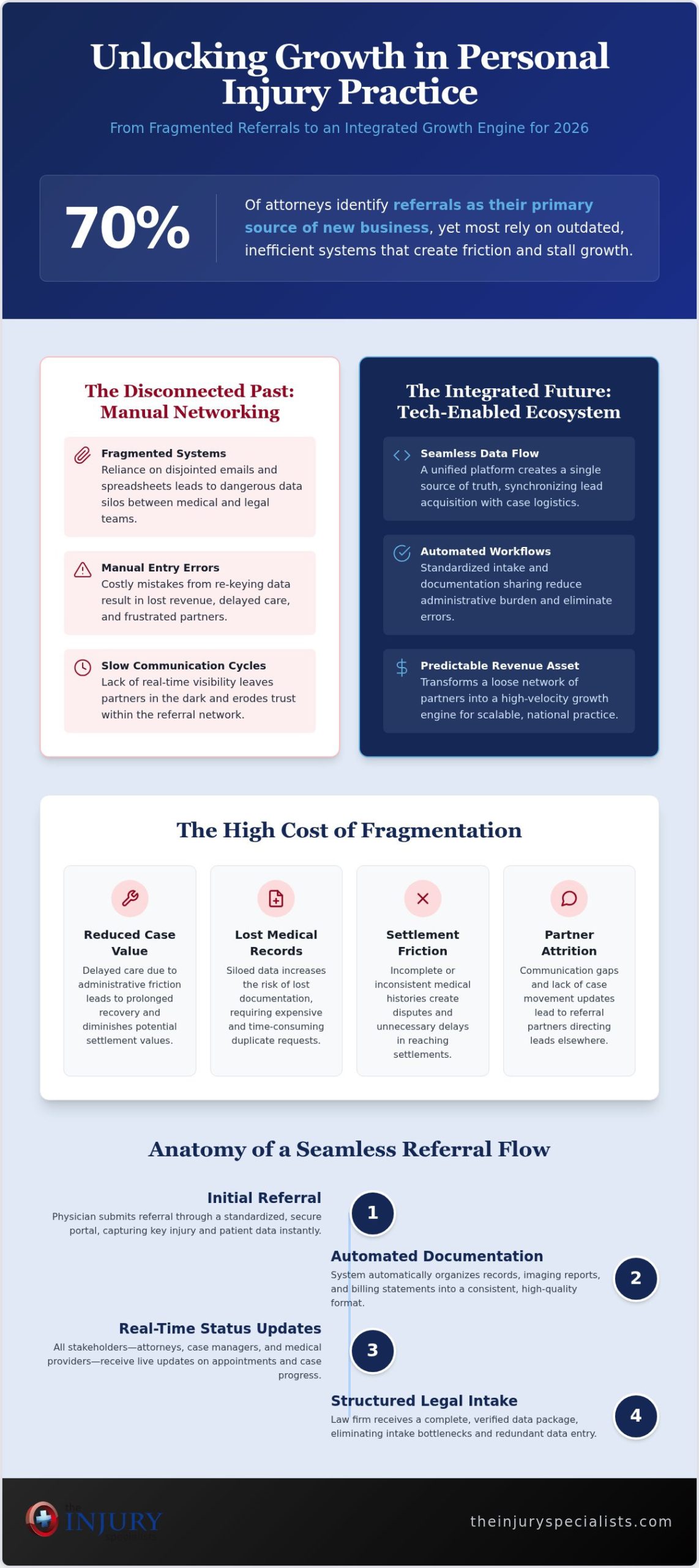
Fragmentation in case logistics is the single greatest barrier to scaling a personal injury practice. Integrated referral management is the synchronization of lead acquisition and case logistics. When these two functions operate in silos, the result is administrative friction that delays clinical care and increases settlement friction. Success in 2026 requires integrating case management with referral networks to ensure that every stakeholder, from the intake specialist to the treating physician, operates from a single source of truth. Fragmented systems carry a high cost that impacts the bottom line through several specific channels:
- Delayed care leading to prolonged recovery times and reduced case value.
- Lost medical records requiring expensive and time-consuming duplicate requests.
- Settlement friction caused by incomplete or inconsistent medical histories.
- Communication gaps that leave referral partners in the dark about case status.
Manual referral tracking fails as a practice scales nationally. Spreadsheets and email chains are inherently local and person-dependent. They cannot provide the real-time visibility required to manage hundreds of cases across multiple jurisdictions. A unified ecosystem solves this by connecting medical providers and attorneys through a shared platform. This connectivity transforms a loose collection of partners into a high-velocity growth engine where data moves as fast as the cases themselves.
Why Siloed Referral Data Stalls Firm Growth
Manual data entry creates immediate bottlenecks in the intake process. Every hour spent chasing a missing medical record or re-keying patient demographics is an hour lost to higher-value litigation. Beyond internal efficiency, siloed data causes referral attrition. If medical partners don’t see immediate case movement or receive timely updates, they direct their leads elsewhere. Poor communication within a personal injury referral network erodes trust. It limits the firm’s ability to handle high volumes because the staff is too busy managing the “noise” of fragmented data to focus on growth.
The Shift Toward Professional Medical Case Management
The complexity of modern litigation demands more than a basic intake form. Case management in a medical context involves a collaborative process of assessment, planning, and advocacy. A professional medical case manager bridges the gap between clinical treatment and legal documentation. By integrating case management with referral networks, firms ensure injury victims receive cohesive care from the start. This professional oversight is a necessity in high-stakes personal injury cases. It guarantees that medical records are comprehensive, timelines are accurate, and the treatment plan aligns with the legal strategy. Professional management ensures that no critical piece of evidence is lost in the transition between providers.
Mechanics of Seamless Data Flow Between Medical and Legal Partners
The lifecycle of an integrated referral is a continuous loop of data exchange rather than a series of disconnected hand-offs. It begins with the initial physician referral, moves through diagnostic imaging, and culminates in a structured legal intake. For this chain to hold, real-time status updates are mandatory for every stakeholder. Integrating case management with referral networks ensures that attorneys don’t have to call clinics to ask if a client showed up for their appointment. By utilizing law firm medical referral programs, practices can standardize data collection from the first point of contact. This standardization improves the quality of evidence for settlements, as every medical report and billing statement follows a predictable, high-quality format.
Standardizing the Referral Intake Workflow
Successful medical-legal referrals require specific data points to be captured immediately. These include accurate injury descriptions, verified insurance information, and clear treatment timelines. Automation reduces the administrative burden on medical providers, allowing them to report to law firms without increasing their staff’s workload. When clinics use automated systems, manual entry errors drop, and referral revenue stays protected. When integrating case management with referral networks, firms eliminate the “black hole” where leads often disappear between the doctor’s office and the attorney’s desk. Implementing a “firm-distinct process” for medical records ensures that documentation matches your specific litigation needs. This level of organization is a hallmark of an authentically connected referral network, where the focus remains on logistical accuracy and clinical excellence.
Interoperability: Connecting Physicians and Attorneys
Interoperability is the ability of different software systems to communicate and exchange data accurately. In the context of personal injury case management technology, this means your case management platform “speaks” the same language as the medical provider’s internal systems. Cloud-based platforms facilitate secure document sharing that meets the 2026 HIPAA Security Rule, which mandates encryption of data at rest and in transit. Instant access to diagnostic imaging and chiropractic reports significantly increases case velocity. When your legal team sees a report the moment it’s uploaded, you can move toward a settlement demand weeks faster than traditional methods allow. To see how these systems integrate in practice, you can explore our national network solutions for medical and legal professionals.
Manual Networking vs. Integrated Technology Platforms
Traditional networking relies on personal relationships and verbal agreements. While these connections are valuable, they lack the structural integrity needed for national scale. Handshake agreements often lead to the “black hole” effect, where referrals are sent but never tracked. Without a digital trail, you can’t measure the return on investment for your marketing efforts. Modern ecosystems replace these vague interactions with data-driven connectivity. Integrating case management with referral networks allows firms to move from social networking to logistical networking. This shift ensures that every referral is accounted for and every partner is held to a high standard of performance.
Proprietary technology platforms provide the efficiency gains that manual systems simply cannot match. When you use a centralized system, you eliminate the need for constant status-check phone calls. Technology ensures accountability by creating a transparent record of every interaction. If a medical provider fails to upload a report or a law firm misses a referral notification, the system flags the delay immediately. This level of oversight is essential for national providers who manage hundreds of partners across various time zones. It turns a loose collection of contacts into a disciplined, high-velocity growth engine.
The Limitations of Traditional Physician Referrals
Manual referral management is inherently limited by human bandwidth. When a firm relies on staff to manually track leads via spreadsheets, information inevitably slips through the cracks. This lack of transparency makes it impossible to identify which partners are providing high-quality cases and which are causing delays. A case management implementation analysis highlights that integrated care systems succeed only when communication is standardized and documented. In a traditional model, you don’t know if a patient missed an appointment until weeks later. In an integrated platform, you receive an automated alert the same day, allowing for immediate intervention.
Key Features of a World-Class PI Technology Platform
A world-class platform acts as the central nervous system for your practice. It provides essential features that manual systems cannot replicate. Real-time tracking and secure messaging facilitate immediate communication between legal and medical staff. Automated reporting summarizes network health and partner performance, giving you the data needed to make strategic decisions. These tools don’t just manage existing business; they drive new growth. By integrating case management with referral networks, you create a centralized hub that facilitates strategic networking across the United States. Marketing tools within the platform help providers expand their own referral bases by demonstrating high efficiency and reliable documentation. This technical sophistication turns your network into a predictable asset rather than a variable expense.
Building a Scalable Framework for Referral Integration
The 2026 roadmap for integrating case management with referral networks centers on a shift from reactive lead handling to proactive pipeline management. Scalability is achieved by selecting partners who align with your specific firm workflows and documentation needs. This alignment ensures that medical records and legal updates flow without manual intervention. Staff training is a critical component of this framework. Without high adoption rates, even the most sophisticated platform becomes a bottleneck. Firms must incentivize usage and demonstrate how the integrated system reduces daily administrative noise. Successfully integrating case management with referral networks requires a commitment to data integrity from every user in the chain.
Optimization is a continuous process. By analyzing data-driven insights from your referral pipeline, you can identify which provider types or geographic areas yield the highest settlement values. This allows you to reallocate marketing resources to the most profitable segments of your network. Ongoing review helps you spot friction points, such as delayed imaging reports or slow intake responses, allowing for immediate course correction.
Selecting High-Quality Medical and Legal Partners
Criteria for choosing physicians, chiropractors, and imaging centers must go beyond clinical reputation. In a PI network, you need specialists who understand the medical-legal ecosystem. They must be willing to provide detailed reports that meet legal evidentiary standards and adhere to strict documentation timelines. Vetting partners for their willingness to use integrated case management tools is essential. A partner who refuses to engage with your technology platform creates a data silo that threatens the efficiency of the entire network. Prioritize partners who value transparency and demonstrate a track record of logistical reliability.
Integrating Pre-Settlement Funding into the Workflow
Continuous care is often interrupted by a victim’s financial instability. Integrating pre-settlement funding for injury victims directly into the case management workflow ensures care continuity. This financial support bridges the gap between medical providers and attorneys, allowing the patient to focus on recovery while the legal team builds the case. When funding requests are integrated into the platform, the approval process accelerates. This prevents treatment gaps that could diminish case value or lead to patient drop-off. You can join our referral network to access these integrated funding and management tools today.
Driving Firm Growth with The Injury Specialists’ Integrated Ecosystem
The Injury Specialists acts as the ultimate power-connector for the medical-legal community. By combining the largest personal injury referral network in the United States with world-class technology, the platform removes the traditional barriers to firm expansion. Integrating case management with referral networks through this ecosystem allows firms to expand their national footprint without the burden of manual oversight. It’s a system designed for logistical ease and professional synergy, ensuring that every partner operates at peak efficiency. This centralized hub provides the infrastructure needed to manage complex medical-legal logistics at scale.
Attorneys and medical providers gain a clear path to growth by joining a network that prioritizes data integrity and speed. The ecosystem isn’t just a directory; it’s an active facilitator of professional relationships. Our marketing and networking tools allow providers to demonstrate their reliability to potential partners through transparent performance metrics. This transparency builds trust and encourages long-term collaboration, turning a loose collection of contacts into a disciplined revenue engine. Scaling your practice becomes a matter of leveraging existing infrastructure rather than building new systems from scratch.
A Strategic Partnership for Professional Growth
Our Attorney Referral Program is a cornerstone of this integrated ecosystem. It streamlines medical case management by adapting to the distinct processes of each participating firm. This flexibility ensures that documentation and reporting meet specific legal requirements every time, reducing the risk of administrative rejection. For medical providers, such as physicians, imaging centers, and chiropractors, the network offers an immediate path to scaling their practice. They gain access to a steady stream of referrals while utilizing a platform that simplifies their reporting tasks. The reliability of our world-class technology platform means that data is secure and always accessible to authorized partners. This connectivity turns individual practices into integrated components of a national growth engine.
The Result: Faster Settlements and Better Patient Outcomes
The final outcome of this integration is a more efficient case resolution process and significantly higher client satisfaction. When data flows seamlessly from a physician referral to legal intake, settlements happen faster because the evidence is complete and organized from day one. Integrating case management with referral networks eliminates the delays associated with fragmented care and missing records. Reaching this level of operational excellence provides a decisive competitive advantage in 2026. A unified medical-legal system is now a requirement for firms that value scale and reliability. You can join the largest personal injury referral network in the United States today to begin streamlining your practice and accelerating your firm’s growth.
Scaling Your Practice Through Integrated Connectivity
The transition from manual “handshake” networking to a tech-enabled ecosystem is no longer optional for firms seeking national scale. By eliminating data silos and administrative friction, you ensure that medical-legal logistics move as fast as your litigation strategy. Integrating case management with referral networks provides the structural integrity needed to handle high case volumes while maintaining clinical and legal accuracy. You now have the roadmap to move beyond fragmented tracking and into a high-velocity revenue engine.
The Injury Specialists offers the infrastructure to make this transition immediate. You gain access to the largest US network of medical and legal professionals through a proprietary technology platform designed for seamless B2B integration. Join the Largest Personal Injury Referral Network in the United States to leverage integrated medical case management that aligns perfectly with your firm’s distinct workflow. Success in the 2026 market belongs to the firms that prioritize connectivity and logistical ease today.
Frequently Asked Questions
What are the primary benefits of integrating case management with a referral network?
The primary benefits include the synchronization of lead acquisition with case logistics, which eliminates data silos and administrative friction. By integrating case management with referral networks, firms can automate documentation sharing and reduce manual entry errors that often lead to lost revenue. This unified approach ensures that every stakeholder has real-time visibility into the case status. It results in faster settlements, improved documentation quality, and the ability to scale a practice nationally without increasing overhead.
How does integrated technology improve communication between attorneys and medical providers?
Integrated technology improves communication by providing a centralized, cloud-based platform where attorneys and medical providers share a single source of truth. Instead of relying on fragmented email chains or phone calls, partners use secure messaging and real-time tracking to monitor patient progress. This instant connectivity allows for immediate updates on diagnostic imaging or chiropractic reports. It ensures that legal teams can move toward settlement demands much faster by accessing critical medical records the moment they’re uploaded.
Can medical case management be customized to a specific law firm’s process?
Yes, medical case management can be fully customized to align with a law firm’s distinct internal processes. The Injury Specialists provides an Attorney Referral Program that integrates case management based on the specific workflow and documentation needs of the firm. This ensures that all medical reports, billing statements, and treatment timelines are formatted according to the firm’s evidentiary standards. Such customization reduces the need for manual record review and ensures a seamless transition from clinical care to legal intake.
How does a referral network help a medical practice grow its patient base?
A referral network helps medical practices grow by connecting physicians, chiropractors, and imaging centers with a vast ecosystem of personal injury attorneys. The Injury Specialists provides marketing and networking tools that allow providers to demonstrate their efficiency and reliability to potential legal partners. By integrating case management with referral networks, medical practices can prove their value through transparent reporting and timely documentation. This increased visibility leads to a steady stream of high-quality referrals and a more predictable patient volume.
What role does diagnostic imaging play in an integrated case management system?
Diagnostic imaging serves as a critical milestone in the integrated case management lifecycle. Specialized imaging center referrals ensure that injury victims receive high-quality diagnostics early in their treatment plan. When these centers are part of an integrated system, reports and images are uploaded directly to the technology platform. This provides attorneys with instant access to objective evidence of injury. Having these reports available immediately accelerates the demand process and strengthens the medical-legal foundation of the personal injury claim.
Is pre-settlement funding included in integrated referral programs?
Pre-settlement funding is a core component of the integrated referral programs offered by The Injury Specialists. It provides essential financial support to injury victims during the legal and recovery process, ensuring they don’t have to choose between treatment and financial stability. By facilitating these services, the program bridges the gap between medical providers and attorneys. This financial bridge ensures care continuity and prevents treatment gaps that could otherwise diminish the overall value of a personal injury settlement.
How do integrated platforms ensure HIPAA compliance during document sharing?
Integrated platforms ensure HIPAA compliance by adhering to the 2026 Security Rule, which mandates strict encryption for data at rest and in transit. The Injury Specialists’ world-class technology platform utilizes advanced security protocols, including multi-factor authentication and secure, cloud-based storage. These safeguards protect electronic protected health information (ePHI) during every exchange between medical and legal professionals. This level of security is mandatory for law firms acting as business associates, protecting them from the high costs associated with data breaches.
What is the first step for a law firm looking to join a national referral network?
The first step is to connect with a national facilitator like The Injury Specialists to evaluate your firm’s specific workflow needs. Legal professionals can join the Attorney Referral Program to access a vast network of medical providers and imaging centers. Once onboarded, the firm can begin utilizing the proprietary technology platform to streamline its case management and marketing efforts. This initial consultation helps align the network’s resources with the firm’s growth objectives, allowing for immediate integration into the national ecosystem.
